Austria-Hungary · The Central Powers
Karl Pflanzer-Baltin
Commander of an army group (1914–1915) and the Seventh Army (1915–1916) on the Eastern Front, commander of the forces in Albania (1918), colonel general
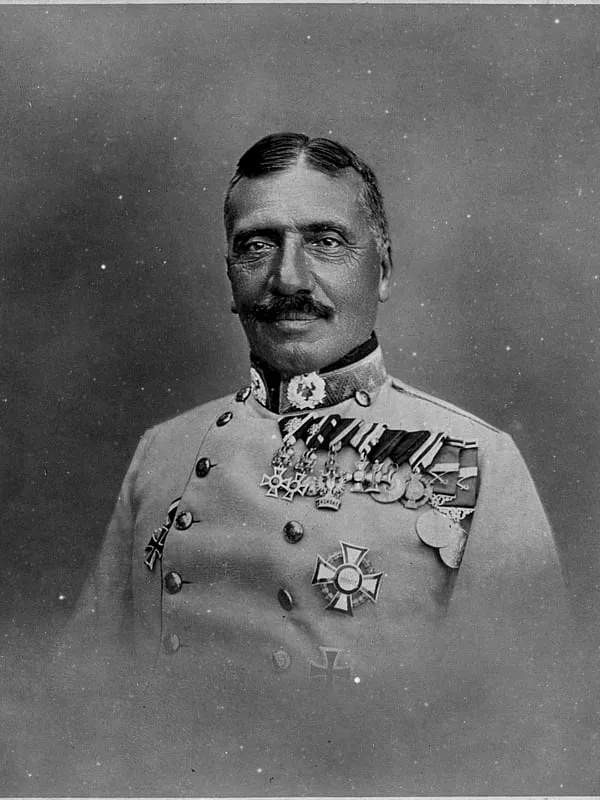
- Born:
- 1 June 1855, Pécs (Hungary)
- Died:
- 8 April 1925, Vienna
- Author:
- Łukasz Skowroń
- Photo:
- K.u.k. Kriegspressequartier, Lichtbildstelle - Wien, domena publiczna, Wikimedia Commons

In June 1914 Karl Pflanzer-Baltin asked to be retired. He was 59, in poor health, and his career seemed to be over. The war made him one of the best-known generals of the monarchy. In autumn 1914 he formed a group out of hastily assembled units that defended the Eastern Carpathians against the Russians, and in winter 1915 it retook Bukovina with Czernowitz. As commander of the Seventh Army he held the southernmost sector of the Eastern Front for a year and a half, until in June 1916 his army collapsed under the blows of the Brusilov Offensive. Removed under German pressure, he returned in 1918 to lead the last victorious attack of the Austro-Hungarian army in Albania.
Before the war
He was born on 1 June 1855 in Pécs in Hungary as Karl Pflanzer, the son of a military judge advocate who was ennobled in 1893. He took the second part of his surname and the title of baron in 1898 from his childless uncle, a retired captain, Josef von Baltin. From 1867 to 1871 he studied at the Theresian Military Academy in Wiener Neustadt, where his classmates included the future generals Karl Kirchbach and Arthur Giesl. He served in the cavalry and, after the war school in Vienna, on staffs and in regiments, among them an uhlan regiment in Tarnów, where he married in 1889. For several years he lectured at the war school, and from 1897 he was chief of staff of XI Corps in Lviv. Later he commanded brigades in Transylvania and the 4th Infantry Division in Brünn.
He was regarded as an outstanding teacher of officers. Senior generals criticised him for teaching tactics to junior officers too, and not only to staff officers, but he pushed his methods through and in 1911 became inspector general of the corps officers’ schools. In 1912 he received the rank of general of cavalry. That seemed the end of his career, and in June 1914 he asked to retire.
1914–1915: the Carpathians and Bukovina
When war broke out his retirement was halted. At the end of September 1914, as the Russians were crossing the passes of the Eastern Carpathians into Hungary and Romania seemed close to turning against the monarchy, Pflanzer-Baltin was given command of the defence of that sector. Out of Hungarian Honvéd units, older classes of the Landsturm, gendarmes and rear-area troops he built a group that shielded Máramaros and the passes against the Russians, and in October the Austrians even recaptured Czernowitz. His group also included the II Brigade of the Polish Legions, which fought heavy battles in the Eastern Carpathians in winter, among them at Rafajłowa. A British encyclopaedia of 1922 wrote that he conducted the defence as a series of bold attacks, with a division organised “almost out of nothing”. The Russians took Czernowitz again in November, while Pflanzer-Baltin’s group held on in the mountains.
In January 1915, during the Winter Battle in the Carpathians, his troops, reinforced by divisions from other sectors and by German units, struck in Bukovina and Pokuttia. The Hungarian prime minister István Tisza pressed for this attack because he wanted to push the Russians away from the borders of Transylvania and discourage Romania from entering the war. From the beginning of February the group advanced through snow and frost, took Kolomyia on 16 February, entered Czernowitz on 17 February and Stanisławów on 20 February. This was the greatest achievement of the whole winter offensive, and for Austria-Hungary one of the few reasons for joy that winter. The Russians, however, quickly brought fresh forces to this sector, from which General Platon Lechitsky’s Ninth Army was formed, and on 4 March they retook Stanisławów. Pflanzer-Baltin withdrew to north of Obertyn and Kolomyia, but held Bukovina with Czernowitz.
On 8 May 1915 his group was renamed the Seventh Army. As the Russians fell back from western Galicia after the breakthrough at Gorlice, heavy fighting went on along the Prut and the Dniester, in which neither the Seventh Army nor the Russians won a decisive success. In June the Russians abandoned Stanisławów, and Pflanzer-Baltin’s army reached the Dniester. In the autumn, during the failed offensive of the Central Powers in Volhynia and on the Seret, its left wing had to withdraw from near Tarnopol, which Pflanzer-Baltin carried out efficiently and without major losses.
Defence and defeat in 1916
From autumn 1915 the Seventh Army built positions on the Dniester and in Bukovina consisting of three belts of fortifications, with deep dugouts, concrete machine-gun emplacements and several rows of barbed wire. At the turn of 1915 and 1916 the Russians attacked them for several weeks, especially on the border of Bessarabia. Pflanzer-Baltin’s army repulsed every attack, and according to Austrian calculations the Russians lost almost 70,000 men and the defenders over 30,000. In May 1916 Pflanzer-Baltin became a colonel general. He was at the height of his popularity, also among the soldiers, who valued him for his energy and his care for the troops.
On 4 June the Brusilov Offensive began. Lechitsky’s Russian Ninth Army no longer attacked across the whole width of the front but concentrated its blow on a few weaker sectors. On 10 June it broke through the Seventh Army’s front near the village of Okna and, according to Russian communiqués, took over 18,000 prisoners that day. Pflanzer-Baltin, confined to bed with fever at his headquarters in Kolomyia, at first did not grasp the scale of the defeat. His army split into two parts. The larger fell back west towards Kolomyia, the smaller south. By the middle of June, according to the Austrian official history, the Seventh Army had lost 133,600 men, more than half its strength. On 18 June the Austrians abandoned Czernowitz, and by 24 June the Russians had occupied almost all of Bukovina. At the end of June the Ninth Army broke through the front at Kuty and on the Prut, and on 29 June Pflanzer-Baltin gave up Kolomyia.
Throughout June the high command reminded him that Russian progress in Bukovina might induce Romania to enter the war. German divisions were sent to Eastern Galicia, and the Seventh Army was subordinated to the army group of the heir to the throne, Archduke Charles, whose chief of staff was the German general Hans von Seeckt. The Germans accused Pflanzer-Baltin of letting German units under his command suffer heavier losses than Austro-Hungarian ones, and the dispute between the two commands quickly grew sharper. The commander-in-chief, Archduke Friedrich, finally sacrificed the popular general. In September 1916 Pflanzer-Baltin handed over command of the Seventh Army, officially for health reasons, and in November he was retired. The army was taken over by his academy classmate Karl Kirchbach, and in October by Hermann Kövess.
Albania 1918
After the death of Franz Joseph the new emperor, Charles I, brought him back into service. From March 1917 Pflanzer-Baltin was inspector general of infantry and dealt with the training of replacements. In summer 1918 the Italians from around Vlorë and the French from the Devoll began an offensive in Albania, routed the Austro-Hungarian XIX Corps and took Berat and Fier. Because the corps commander was seriously ill, the emperor appointed Pflanzer-Baltin commander of all the forces in Albania, and he arrived in Tirana on 13 July. He forbade stretching the troops into a thin cordon and ordered a defence in depth, with strong reserves. The enemy advance came to a halt around 22 July, partly because of the heat and malaria, and on 24 July his troops counter-attacked at Kuçi on the Seman.
Pflanzer-Baltin prepared the main blow in secret, explaining the plan to his commanders orally. On 22 August the reinforced Eastern Corps broke through the Italian front between Fier and Berat, and by the end of the month the Austrians had recovered both towns. As early as 25 August Pflanzer-Baltin decided that the operation ended there and forbade any further advance. His troops had no supplies, and malaria was thinning their ranks faster than the fighting. It was the last victorious attack of the Austro-Hungarian army in this war.
The success proved short-lived. After the collapse of the Salonika front and the capitulation of Bulgaria at the end of September, the eastern wing of his forces was left completely exposed. Pflanzer-Baltin had to leave Albania. On 3 October the Italians re-entered Berat, and in the middle of the month Durrës. Army Group Albania fell back along the coast and through Montenegro towards Kotor, covering itself only with rearguards. When it reached the old border of the monarchy, the monarchy no longer existed. Pflanzer-Baltin was one of the last Austro-Hungarian commanders to lay down his command. On 1 December 1918 he was retired.
After the war
After the war he lived in Vienna. The writer Robert Musil, who met him in a sanatorium near Vienna, described him in his diary as one of the most hot-tempered generals of flesh and blood. He died in Vienna on 8 April 1925 and was buried with military honours in the Hietzing cemetery. One of his two sons, a cavalry officer, was killed in the war.
Assessment
Pflanzer-Baltin is regarded as one of the most talented and at the same time most controversial commanders of the Austro-Hungarian army. Auffenberg, the author of his biographical entry in the British encyclopaedia of 1922, stressed his “brilliant organising talent” and his liking for a defence conducted through constant counter-attacks. Austrian and Hungarian authors point out that his operations in Bukovina were the only lasting success of the winter campaign in the Carpathians and that in 1918 his mere presence raised the morale of the demoralised troops in Albania. He received the Commander’s Cross of the Order of Maria Theresa in October 1918 precisely for the Carpathians and Bukovina.
Critics, among them historians of the Brusilov Offensive, point out that in 1916 Pflanzer-Baltin manned the front line too densely, trusting in its fortifications, and that after the breakthrough he ordered the retreat too late and could not rally his shattered army. His defeat in Bukovina hastened Romania’s entry into the war and deepened the monarchy’s dependence on Germany. Some historians note, however, that the fate of the Seventh Army was no different from that of the Fourth Army at Lutsk, and that his dismissal was as much a sacrifice offered to the Germans as a punishment for mistakes. In 1918 his victory in Albania could no longer change the course of a war that the monarchy was losing on every front.
Sources
Spotted a mistake?Report an error
Commanded in battles
(05)Mentioned in battles
(02)Often appears with
People who appear in the same events.