Austria-Hungary · The Central Powers
Hermann Kövess
Commander of XII Corps (1911–1915), 3rd Army (1915–1916) and 7th Army (1916–1918), last commander-in-chief of the Austro-Hungarian Army (1918), field marshal
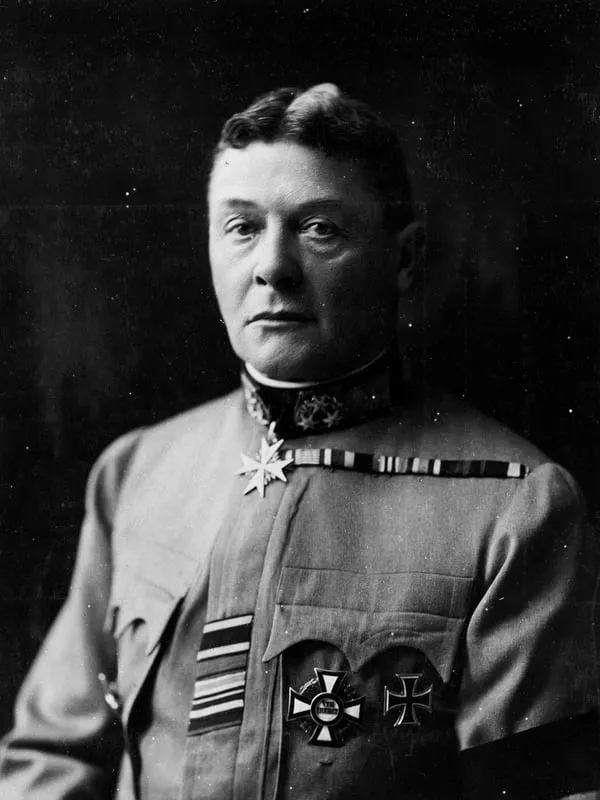
- Born:
- 30 March 1854, Temesvár (now Timișoara, Romania)
- Died:
- 22 September 1924, Vienna
- Author:
- Natalia
- Photo:
- K.u.k. Kriegspressequartier, Lichtbildstelle - Wien, domena publiczna, Wikimedia Commons

Hermann Kövess von Kövessháza, a baron from 1917, was among the most successful commanders of the Austro-Hungarian Army, although he began the war as one of the oldest and most overlooked generals of the monarchy. In 1914, while colleagues younger than him were taking over armies, he commanded a corps. Only in 1915 was he given independent tasks: his troops occupied the left-bank part of the fortress of Ivangorod, and in the autumn, as commander of the 3rd Army, he took Belgrade. In the winter of 1915/1916 he conquered Montenegro and northern Albania within a few weeks, and in the summer of 1917 he retook Bukovina with Czernowitz. He was one of the few generals of the monarchy whom the Germans also respected. Finally, in November 1918, Emperor Charles made him commander-in-chief of an army that was just ceasing to exist.
Before the war
He was born on 30 March 1854 in Temesvár in the Banat. His father was an officer who in 1873 was ennobled with the predicate “von Kövessháza”; his mother came from a family of Transylvanian Saxons. His mother tongue was German. He graduated from the Technical Military Academy in Vienna, became a second lieutenant of engineers in 1872 and, after the War School, served on staffs. In 1882 he took part in suppressing the uprising in the Krivošije in southern Dalmatia.
He twice failed the examination required of General Staff officers, however, and had to transfer to the infantry. Even so, he was promoted quickly, in several cases out of turn, and around 1900 he was one of the youngest colonels in the army. He commanded a regiment in Vienna, then a brigade and a division in Innsbruck. He also stood out in the army as a Protestant, a rarity in an officer corps dominated by Catholics. He was later to become the monarchy’s only Protestant field marshal.
In June 1911 he took over XII Corps in Hermannstadt, that is, command of the troops in Transylvania, and in November he became a General of the Infantry. In 1912, when several hundred Catholics in Hermannstadt converted to Protestantism, his opponents at court accused him of passivity and nearly brought about his dismissal.
1914: Galicia and Poland
In the summer of 1914 Kövess was the oldest corps commander in the army, both by age and by seniority, and yet he was not given an army. The armies went to Viktor Dankl and Eduard von Böhm-Ermolli, both younger than him. His corps, made up of Transylvanian divisions, went to eastern Galicia as the vanguard of the 2nd Army, which was still fighting the Serbs. Until that army arrived, Kövess commanded an army group covering Lviv and the Dniester alongside the 3rd Army of General Rudolf von Brudermann. In the Battle of the Złota Lipa and the subsequent fighting on the Gniła Lipa his troops suffered heavy losses and had to fall back, and on 3 September the Russians took Lviv. In those same days his eldest son Adalbert was killed near Uhnów.
After the Battle of Galicia XII Corps fought as part of the 2nd Army in the Carpathians and near Stary Sambor, and in November it was moved by rail to Silesia and into the Kingdom of Poland. There, on the Warta and the Pilica, it covered the southern flank of the Germans during the Battle of Łódź and in the winter positional fighting. When the 2nd Army returned to the Carpathians in the spring of 1915, Kövess stayed in Poland. His corps, expanded into an army group, became part of the army of the Prussian General Remus von Woyrsch.
1915: Ivangorod and Belgrade
After the breakthrough at Gorlice the Russians began to abandon the Kingdom of Poland, and Kövess’s group advanced to the Vistula. In July his Transylvanian divisions fought near Radom and Kozienice, and from 22 July they closed off the fortress of Ivangorod from the west. On 1 August, after a bombardment lasting several hours, an assault group of the 35th Division broke through the Russian advanced positions. During the night of 3/4 August the Russians blew up the fortifications and withdrew across the Vistula, and on 4 August Kövess’s troops entered the forts on the left bank. Viennese communiqués and some later biographies speak of the fortress being taken by storm, although the Russians gave up its main part of their own accord. For Ivangorod Kövess later received the Commander’s Cross of the Military Order of Maria Theresa.
At the end of September 1915 he took over the re-formed 3rd Army, intended for the campaign against Serbia. The whole operation was directed by the German Field Marshal August von Mackensen, and alongside Kövess the German 11th Army of Max von Gallwitz attacked. On 6 October the 3rd Army’s artillery opened fire, and during the night of 6/7 October its infantry forced the Sava and the Danube at the foot of Belgrade. After two days of fierce Serbian resistance the capital fell on 9 October. According to a formula popular in the monarchy at the time, Kövess was the second Austrian commander after Prince Eugene of Savoy to take Belgrade. The pursuit through the Šumadija and the mountains of the Sanjak was slow, however. Kövess’s army occupied Kragujevac, in November Novi Pazar and Mitrovica, and at the end of the year Peć, although the supply of the troops in the winter mountains almost broke down. In the conquest of Serbia Kövess commanded the main Austro-Hungarian force, but the decisive decisions were taken by the Germans.
Montenegro and Albania
In December 1915 the Chief of the General Staff, Franz Conrad von Hötzendorf, against the wishes of the Germans, removed the 3rd Army from Mackensen’s command and placed it under himself. Kövess was given a task that Conrad regarded as the monarchy’s own business: the conquest of Montenegro. At the beginning of January 1916 his troops struck from three directions: from the Bay of Kotor against the Lovćen massif, from Herzegovina and from the Sanjak. After three days of fighting the Austrians took Lovćen, and on 13 January they entered Cetinje. King Nicholas I asked for an armistice, but Conrad ordered Kövess by telegram to press on until Montenegro capitulated unconditionally. The country laid down its arms in the second half of January, and the troops of the 3rd Army occupied Scutari, Tirana and, at the end of February, Durrës. The conquest of Montenegro was one of the very few victorious campaigns that the Austro-Hungarian Army carried out without German participation. On 26 February 1916 Kövess became a colonel general.
1916: Tyrol and Galicia
In the spring of 1916 the 3rd Army was moved to the Tyrol. In the offensive that Conrad had prepared against Italy, it was to advance in the second echelon behind Dankl’s 11th Army and, after the breakthrough, descend onto the Venetian plain. In the Battle of Asiago, which began on 15 May, the troops of both armies took the plateaus of Folgaria and Vezzena, Arsiero and Asiago, but on the last ridges before the plain the attack stalled. When the Brusilov offensive began in the east, the 3rd Army’s headquarters was hastily moved to eastern Galicia. There, in the Stanislau area, between the Dniester and the Carpathians, Kövess took over part of the front of the shattered 7th Army. At the end of July and in the first days of August the Russian 9th Army broke through his front at Ottynia and Tłumacz, and on 11 August it entered Stanislau. Kövess no longer had anything with which to stop the enemy, and only German reinforcements saved him.
In mid-October 1916, at the request of Archduke Charles, the army group commander, Kövess took over the 7th Army at Máramarossziget, defending the Wooded Carpathians on the Hungarian border. Its previous commander, Karl Pflanzer-Baltin, had lost his post after the defeat in Bukovina. By the winter Kövess’s army had repelled Russian attacks on the passes which, after Romania’s entry into the war, were to open the way into Hungary for the Russians.
1917: Bukovina
In July 1917 the Kerensky offensive did not involve the 7th Army, but when the Germans and Austrians broke through the front at Złoczów, the whole Russian front from the Sereth to the Carpathians went into retreat. Kövess came down from the mountains. Together with the 3rd Army and German divisions he pursued the Russian 8th Army across Bukovina. On 3 August the Russians finally gave up Czernowitz, and soon afterwards Kövess’s army also occupied Radautz and almost the whole of Bukovina, up to the border of Bessarabia. The recovery of the capital of Bukovina was one of the monarchy’s few successes that year. Emperor Charles visited the recovered city and appointed Kövess field marshal, with effect from 5 August. In August Kövess received the Commander’s Cross of the Military Order of Maria Theresa and the title of Hungarian baron, and later a life seat in the Hungarian House of Magnates.
From mid-January to the beginning of April 1918 he commanded a front made up of the 1st and 7th Armies, from the Dniester to the south-eastern corner of Transylvania. After the peace with Russia and the armistice with Romania the front was dissolved, and Kövess was left without a posting for several months.
1918: the Balkans and the end of the monarchy
After the collapse of the Salonika front and the capitulation of Bulgaria at the turn of September and October 1918, Kövess was given the most thankless task of the war: the defence of the Balkans. He arrived in Belgrade at the beginning of October, and on 10 October he took command of all Central Powers forces in Serbia, Montenegro and Albania. The promised divisions from the Tyrol, from Ukraine and from Germany were still on the railways. When the Serbs retook Niš, Kövess decided to withdraw his troops behind the Danube, the Sava and the Drina and to form a new line of defence there. At the end of October the crossing was under way, and on 1 November the Serbs entered Belgrade. Defending the river line had lost its point, however, because the monarchy was falling apart.
On 3 November 1918, the day the Armistice of Villa Giusti was signed, Emperor Charles laid down the supreme command and named Kövess as his successor. Until his arrival the duties were carried out by the Chief of the General Staff, Arthur Arz von Straußenburg. Kövess, who was then on his way from the Balkans, travelled up the Danube and reached Vienna on 9 November, when Austria and Hungary were already separate states and the regiments were dispersing to their new homelands. As commander-in-chief of an army that no longer existed, he directed its demobilisation and the winding-up of the supreme command until the second half of December.
After the war
After the war he lived in Vienna and Budapest, devoting himself to history and art. In 1919 he turned down Hungarian officers who wanted to put him at the head of a counter-revolutionary organisation. He presided over the chapter of the Military Order of Maria Theresa and attended veterans’ reunions. He died in Vienna on 22 September 1924. He was buried with state honours in the Kerepesi Cemetery in Budapest.
Assessment
Kövess is among the most favourably judged generals of the monarchy, although little research has been devoted to him. A British encyclopaedia of 1922 called him one of the most popular commanders of the old monarchy, and Hungarian historians such as Tibor Balla count him among the most successful commanders of the Austro-Hungarian Army. The Austrian author Georg Reichlin-Meldegg titled his biography with the question of whether he was an “imperial Prince Eugene”. He was regarded as a calm commander who worked well with the Germans, which was rare in that army.
More cautious historians point out that his greatest successes were limited in character. In Serbia he operated under Mackensen’s orders and with German support, Montenegro was a very weak opponent, and in Bukovina in 1917 he followed a retreating army that was beginning to disintegrate. When he faced superior forces, as on the Gniła Lipa in 1914 or at Stanislau in 1916, he was beaten just like the others. His appointment as commander-in-chief in November 1918 was a gesture without military significance. All, however, credit him with composure and loyalty, and for many veterans he remained a symbol of the old multinational army with which he identified to the very end.
Sources
Spotted a mistake?Report an error
Commanded in battles
(08)- 23 August – 11 September 1914Battle of GaliciaEastern Front
- 26–30 August 1914Battle of the Złota LipaEastern Front
- 6–9 October 1915Defence of BelgradeBalkan Front
- 6 October – 4 December 1915Conquest of SerbiaBalkan Front
- 5–25 January 1916Conquest of MontenegroBalkan Front
- 6–7 January 1916Battle of MojkovacBalkan Front
- 8–11 January 1916Battle of LovćenBalkan Front
- 15 May – 25 June 1916Battle of AsiagoItalian Front
Often appears with
People who appear in the same events.
On the timeline
(22)1914
1915
July
- 21
- Central Powers encircle IvangorodOn 21 July 1915 Woyrsch's troops reached Ivangorod. Kövess's Austro-Hungarians closed it off from the west; the Germans prepared to cross the Vistula.
- End of the second battle of IvangorodOn 21 July 1915 the Silesian Landwehr broke the front at Zwoleń. The Russians left Ivangorod's forefield for the Kozienice–Gniewoszów line on the Vistula.