Germany · The Central Powers
Remus von Woyrsch
Commander of the Landwehr Corps (1914–1916), Army Detachment Woyrsch (1914–1917) and Army Group Woyrsch (1916–1917), colonel-general, from 1917 field marshal
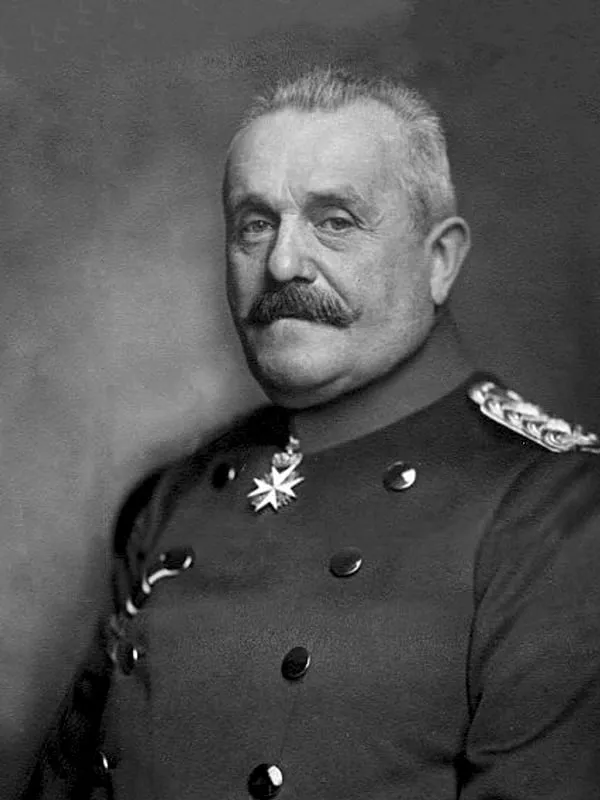
- Born:
- 4 February 1847, Pilczyce near Breslau (Prussia)
- Died:
- 6 August 1920, Pilczyce near Breslau
- Author:
- Łukasz Skowroń
- Photo:
- Nicola Perscheid, domena publiczna, Wikimedia Commons

In 1914 Remus von Woyrsch was a retired general in his sixties whom the war called back to service. He was given a corps of older reservists from Silesia and Greater Poland, and for more than three years he fought on Polish and Belarusian soil, always on a secondary but important sector: between the German and the Austro-Hungarian armies. In September 1914 his Landwehr covered the Austrian retreat from Tarnawka, in July 1915 it broke through the Russian front at Sienno and advanced to the fortress of Ivangorod, and in the summer of 1916 his army withstood at Baranovichi the attack of far more numerous Russians. He ended the war as a field marshal and one of the most popular commanders in Silesia.
Before the war
He was born on 4 February 1847 on the Pilczyce (Pilsnitz) estate near Breslau (Wrocław), today a neighbourhood within the city. He came from a noble family that had settled in Troppau (Opava) around 1500 and later in Prussian Silesia. His father, Karl Wilhelm Remus von Woyrsch, was a landowner, a privy councillor and a member of the Prussian House of Lords (PL). Remus was the eldest son.
On 5 April 1866 he joined the 1st Foot Guards Regiment in Potsdam as a cadet, and a few months later he was at war. At the Battle of Königgrätz he tried to rescue the badly wounded Prince Anton of Hohenzollern-Sigmaringen and was taken prisoner by the Austrians together with him. In the Franco-Prussian War he was wounded at the Battle of Gravelotte and received the Iron Cross.
For the next forty years he followed the ordinary career of a Guards and General Staff officer. He was a regimental and brigade adjutant, and from 1879 a company commander in his old regiment, where he trained in field service the young Prince Wilhelm, later Emperor Wilhelm II. In 1896 he took over the Guards Fusilier Regiment, in 1897 he became a major-general, in 1901 commander of the 12th Division at Neisse (Nysa), and in 1903 commander of VI Corps at Breslau. In 1905 he was promoted to general of infantry. In February 1911, after 45 years of service, he retired. From 1908 he sat, as his father had before him, in the House of Lords.
1914: the Landwehr Corps
At the beginning of August 1914 Woyrsch was recalled and given command of the Landwehr Corps. It consisted of two divisions of older reservists from Greater Poland and Silesia, 34 battalions with little artillery. The corps was to cover Silesia and keep contact with the Austrians. While the main German forces fought in East Prussia, the Landwehr men marched from the border through the western part of the Kingdom of Poland, and on 3 September they crossed the Vistula at Józefów and took their place beside the Austro-Hungarian 1st Army of General Victor Dankl.
They arrived at a bad moment. In the Battle of Galicia the Russians were gaining the upper hand, and on 7 September they attacked Dankl at Tarnawka, south of Lublin. The 4th Landwehr Division suffered heavy losses there, and some regiments shrank to one or two battalions. When Dankl began to fall back towards the San, the Landwehr covered the Austrian retreat and then crossed back to the left bank of the Vistula. German biographers quote an article from a St Petersburg newspaper according to which only the small Prussian Landwehr units had saved the Austrian army from complete destruction.
At the end of September the corps joined the German 9th Army, and in October it took part in the march on the Vistula that ended in the failed Battle of Warsaw and Dęblin. During the retreat Army Detachment Woyrsch (Armeeabteilung Woyrsch) was formed from the troops grouped around the corps, according to different sources on 14 October or 3 November. Woyrsch also received the Pour le Mérite. When the 9th Army left for the north to strike at Łódź, his troops stayed in Silesia, between the Austrians and the Germans, and in November fought on the northern wing of the Battle of Kraków. On 3 December 1914 Woyrsch became a colonel-general, and day-to-day command of the Landwehr Corps passed to his deputy, General Götz von König.
1915: Sienno and Ivangorod
Woyrsch’s group spent the winter and spring in the trenches in the western part of the Kingdom, next to the Austro-Hungarian 2nd Army of General Eduard von Böhm-Ermolli. When after the breakthrough at Gorlice the Russians fell back from the Nida in May, his troops followed them, and in the summer they stood between the Pilica and the Vistula, on the left wing of the Central Powers’ forces in the Kingdom. As in 1914, Woyrsch was then subordinate to the Austro-Hungarian high command.
In July 1915 his army was given an important task in the great offensive of the Central Powers. It was to pin the Russians down on the west bank of the Vistula, so that they could not shift troops against Mackensen. On 17 July the Silesian Landwehr broke through the Russian positions at Sienno, and Woyrsch ordered a relentless pursuit. In a few days his troops cleared the area from the Iłżanka to the Pilica, on 20 July attacked the last Russian field position before the fortress of Ivangorod (Dęblin), and broke through it the next day. The army also included the Austro-Hungarian group of General Hermann Kövess, which closed off the fortress from the west. On 23 July Woyrsch received the Oak Leaves to the Pour le Mérite, and the day before the university of Breslau had given him an honorary doctorate.
Where to cross the Vistula was settled only by the chiefs of the two general staffs. Franz Conrad von Hötzendorf wanted a crossing above the fortress, the Germans below it. In the end, on the night of 28–29 July, Woyrsch’s German divisions forced the river at Ryczywół, below Ivangorod, and for several days repulsed Russian counter-attacks on the east bank. The threat of encirclement hastened the Russian retreat from the Vistula. On 4 August the Austrians entered the abandoned forts of Ivangorod, and a day later the Germans took Warsaw.
Then Woyrsch’s army marched east in pursuit of the Russians, through Podlasie and Polesie, as far as the upper Shchara. According to German biographers it covered about 400 kilometres in a few months. In the autumn of 1915 the front came to a halt near Baranovichi, and Woyrsch went over to trench warfare. His army became part of the army group of Field Marshal Prince Leopold of Bavaria.
1916–1917: Baranovichi and the army group
Woyrsch faced his hardest test in the summer of 1916. During the Brusilov offensive the commander of the Russian Western Front, General Aleksei Evert, after weeks of delay, finally attacked at Baranovichi. On 2 July the Russian 4th Army began shelling Woyrsch’s positions, which were held by 82 German and Austro-Hungarian battalions. Leopold of Bavaria and Woyrsch gathered every available reserve behind the threatened sector. For a week the Russians failed to break through the front and lost, according to various estimates, about 80,000 men, and Woyrsch’s army a few thousand.
On 29 August 1916, when Leopold of Bavaria succeeded Paul von Hindenburg as commander-in-chief in the east, Woyrsch took over his former army group, henceforth called Army Group Woyrsch. In September he handed the Landwehr Corps, with which he had begun the war, to General Günther von Kirchbach.
After the revolution the Russian army was falling apart, and on 15 December 1917 the armistice of Brest-Litovsk was concluded. Army Group Woyrsch was dissolved in December, according to different sources on the 15th or the 31st. The seventy-year-old general asked to be retired, and as a parting gesture the Emperor made him a field marshal.
After the war
Woyrsch returned to his estate at Pilczyce. After the armistice of November 1918 he was called to service once more: he briefly commanded the southern sector of the Grenzschutz Ost, the German formations guarding the eastern border. In 1919 Breslau made him an honorary citizen, as Neisse had done earlier. He died at Pilczyce on 6 August 1920. His nephew Udo von Woyrsch (PL) became one of the senior SS commanders in the 1930s.
Assessment
Woyrsch was not one of the commanders historians argue about. His biographers present him rather as a solid commander who throughout the war did what was expected of him: he held a flank, kept contact with the ally and covered Silesia. His troops were seldom given the main tasks, and they consisted of older men, worse armed than the line divisions. Even so, Woyrsch’s Landwehr saved the Austrians from a worse defeat in September 1914, in July 1915 it delivered the breakthrough at Sienno and the crossing of the Vistula, and in 1916 at Baranovichi it stopped one of the bloodiest Russian offensives. The autumn campaigns of 1914, at Warsaw and Łódź, did not achieve the Germans’ aim, however, and the order and the promotion came all the same.
Woyrsch was also among the German generals who worked longest with the Austrians. Several times he was subordinate to Austro-Hungarian command, and Austro-Hungarian corps fought under his orders. In Silesia he became a hero during the war. In 1915 a wooden figure of the “Iron Woyrsch”, showing him as a knight with a sword, was set up in the town hall of Leobschütz (Głubczyce) (PL).
Sources
Spotted a mistake?Report an error
Commanded in battles
(04)Often appears with
People who appear in the same events.
On the timeline
(14)1914
1915
July
- 21
- Central Powers encircle IvangorodOn 21 July 1915 Woyrsch's troops reached Ivangorod. Kövess's Austro-Hungarians closed it off from the west; the Germans prepared to cross the Vistula.
- End of the second battle of IvangorodOn 21 July 1915 the Silesian Landwehr broke the front at Zwoleń. The Russians left Ivangorod's forefield for the Kozienice–Gniewoszów line on the Vistula.
August
- 05
- Key eventGermans occupy WarsawOn 5 August 1915 troops of the German Ninth Army entered Warsaw, abandoned by the Russians overnight. Russian rule, in place since 1815, came to an end.
- Central Powers take IvangorodOn 5 August 1915 Vienna announced the capture of Ivangorod. A day earlier the Austro-Hungarians had entered forts the Russians left on the Vistula's left bank.