1916: The Eastern Front
Battle of Baranovichi
- Dates:
- 2–9 July 1916
- Front:
- Eastern Front
- Location:
- The area around Baranovichi and Gorodishche, on the Servech and Shchara rivers, from Tsyryn in the north to Darevo and Labuzy in the south (Minsk Governorate, Russian Empire; now Brest Region, Belarus)On the battle map →
- Sides:
- Russian EmpireAlexei Evert, Alexander Ragoza, Abram DragomirovGerman Empire and Austria-HungaryPrince Leopold of Bavaria, Remus von Woyrsch, Johann von Henriquez
- Result:
- Russian defeat. The Fourth Army took only scraps of the first line of defence, and the main blow of the Western Front, which was to decide the outcome of the summer of 1916, collapsed after a week.
- Author:
- Łukasz Skowroń
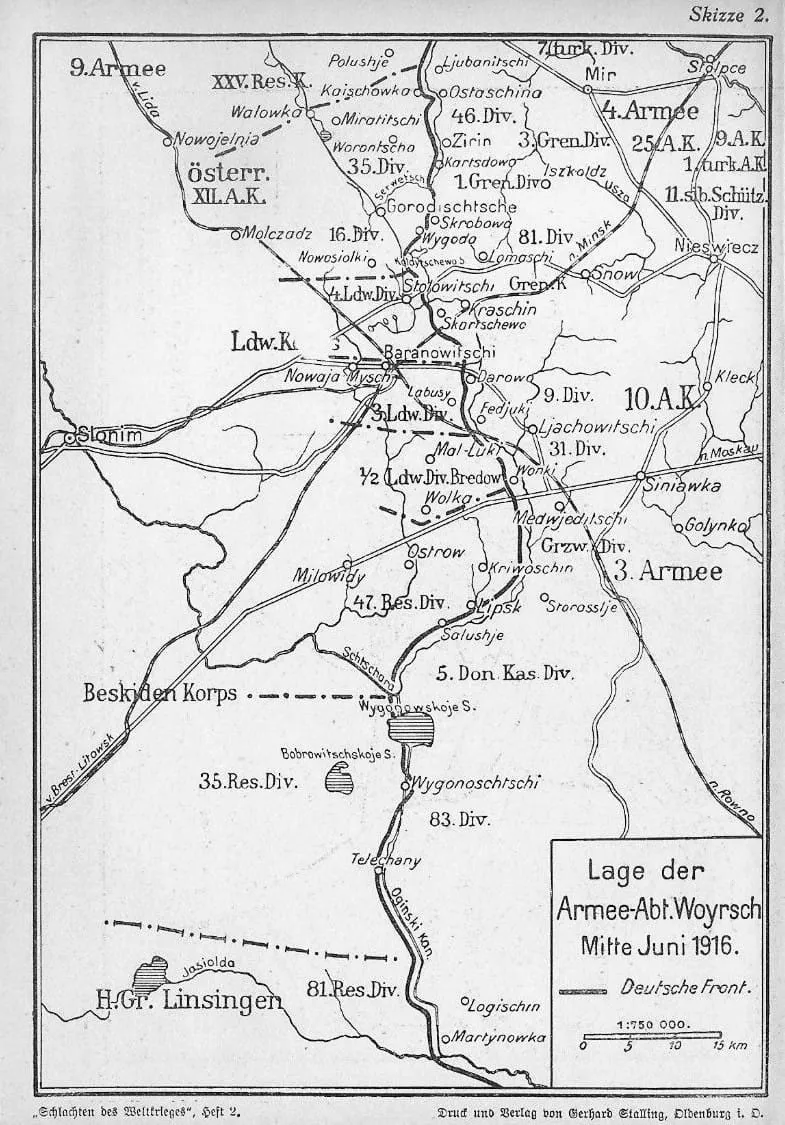
The Battle of Baranovichi was meant to be the main blow of the Russian army in the summer of 1916. The Western Front of General Alexei Evert, the strongest of all the Russian fronts, had spent the whole spring preparing an offensive on Vilna, and when in June the Brusilov Offensive broke through the Austro-Hungarian front in Volhynia, it still delayed. In the end it struck in a different place: on 2 July 1916 its new Fourth Army began a bombardment of the German and Austro-Hungarian positions at Baranovichi, and on 3 July it went over to the assault. Despite a several-fold superiority in infantry it took only parts of the first line of defence. After a week, on 9 July, the offensive petered out. The Russians lost about 80,000 men, and the command concluded that a breakthrough of the German front north of Polesia was impossible.
Name and dates
German and Austrian literature speaks of the Battle of Baranovichi (Schlacht bei Baranowitschi), Russian literature of the Baranovichi operation. Russia then used the Julian calendar, 13 days behind. In Russian documents the assault therefore began on 20 June, not 3 July. On this page all dates are given according to the Gregorian calendar.
The British chronology of the war, on which our timeline is based, and the Austrian official history date the battle to 2–9 July 1916: from the start of the Russian bombardment to the day on which the Western Front halted the offensive. Russian studies usually count the operation from the first infantry assault on 3 July to 25 July, and sometimes to 29 July, because they include the German counter-attack of 14 July and the last, equally unsuccessful attempt at an offensive on 25–29 July. The Russian historian Aleksei Oleinikov even distinguishes three offensives at Baranovichi: the attack of the Grenadier Corps at Stolovichi in mid-June, the main battle at the beginning of July and the renewal of the attacks at the end of July. On this page we adopt the dates 2–9 July and describe the later fighting as an epilogue.
Background
At a conference at Stavka in April 1916 the Chief of Staff of the Supreme Commander, General Mikhail Alekseyev, entrusted the main blow of the summer campaign to the Western Front. Evert received most of the reserves and heavy artillery, and his objective was Vilna. After the defeat at Lake Naroch in March, however, the front commander did not believe in the success of a new offensive. He postponed the date, first set for 10–11 June, several times, and on 15 June he convinced Stavka that the Germans were too strong at Vilna and that it would be better to strike at Baranovichi, closer to the South-Western Front. For this, however, he needed two or three weeks of preparation. Brusilov asked Alekseyev in vain to compel Evert to attack at the prepared place. He wrote that a blow delayed by several weeks would be of no help at all to his armies.
Baranovichi was an important railway junction at the crossing of the Brest – Minsk – Moscow and Vilna – Rovno lines. Until August 1915 the Russian Stavka was located here, and in September 1915, at the end of the Great Retreat, the front came to a halt east of the town. Over ten months the Germans fortified themselves here very thoroughly. According to Russian studies their first position consisted of three lines of trenches on the western banks of the marshy valleys of the Servech (PL) and Shchara rivers, with concrete machine-gun nests, deep dugouts and in places a dozen or more rows of barbed wire. Russian intelligence did not reconnoitre the second and third positions at all before the offensive.
At the end of June Evert formed a new Fourth Army from the troops standing at Baranovichi and reinforcements from the whole front and entrusted it to General Alexander Ragoza, who had led the offensive at Lake Naroch in March. It also included the Polish Rifle Brigade, a Polish formation of the Russian army, which held the front on the Shchara. According to Russian data Ragoza assembled 19 infantry divisions and 2 Cossack divisions, in all about 340,000 men, 331 battalions and about 1,000 guns, including 258 heavy ones. Facing them, according to the same data, stood 82 battalions of the army of General Remus von Woyrsch, part of the army group of Field Marshal Prince Leopold of Bavaria. The sector of the offensive was held by the Austro-Hungarian XII Corps of General Johann von Henriquez (16th and 35th Infantry Divisions, largely made up of Transylvanian regiments) and the German Silesian Landwehr Corps of General von König.
The main blow was to fall on the Austro-Hungarian XII Corps, between the bend of the Servech and the lake near Koldychevo (PL). The shock wedge, which was to break through towards Gorodishche, was commanded by General Abram Dragomirov, commander of IX Corps, to whom XXXV Corps was also subordinated. In the north the attack was covered by the 46th Infantry Division of XXV Corps, and in the south the Grenadier Corps and X Corps were to attack the German Landwehr at Darevo and Labuzy. In reserve stood III Siberian Corps, III Caucasian Corps and cavalry. The preparations were hard to conceal. The Russians dug a network of assault trenches in front of the line, the artillery spent a long time registering, and just before the attack many deserters went over to the Germans. The Austrian official history writes that from the last week of June the commands of the Central Powers knew exactly where and when the blow would fall and had gathered all available reserves behind the front.
Course
2 July. According to the Austrian official history, the Russian batteries opened fire at 4 a.m. and pounded the positions of XII Corps and the Landwehr all day. In the evening the assault trenches filled with infantry, and the first, reconnaissance attacks were repulsed. On the same day the Russian Tenth Army detonated a large mine under the German trenches at Smorgon to divert the Germans’ attention from Baranovichi. The Germans retook the captured craters by 4 July.
3 July. Before dawn, after a short hurricane bombardment, IX and XXXV Corps and the 46th Division fell on XII Corps’ sector, 7.5 kilometres wide. After an hour the Russians had broken into the centre of the 16th Division and were advancing west along the Servech valley. The Austro-Hungarian 35th Division, with the help of German Landwehr regiments and a brigade made up of German reserve battalions, retook its first line by noon, but in the afternoon a new blow came through Skrobovo. By evening the Austro-Hungarian 31st Infantry Brigade had been pushed back to the second position, and a planned counter-attack had to be called off because all forces were needed for defence. The brigade reported the loss of about 5,000 men. According to Russian studies, assault platoons made up of grenadiers operated effectively in IX Corps, but the divisions of XXXV Corps, fed into the battle regiment by regiment, did not exploit the success, and the infantry got stuck in front of undamaged machine-gun nests on the reverse slopes of the hills. In the south the attack of the Grenadiers and X Corps on the Silesian Landwehr collapsed under fire, with very heavy losses.
4–6 July. The Russian artillery repeated the preparation, and III Caucasian Corps entered the line. The Central Powers meanwhile brought up reinforcements. By 4 July most of the German 5th Reserve Division had arrived, and its commander, General Wilhelm von Woyna, took command of the most threatened sector. On the evening of 4 July several Russian divisions renewed the attack, and the fighting went on through the night and the morning of 5 July. The Russians took the second line of trenches on some sectors but broke through no further. The German Landwehr eliminated the breach at Darevo with a single counter-attack. According to Russian studies the attacking regiments lost up to half their strength in three days. Evert postponed the next attack in order to regroup his troops.
7–9 July. On 7 July the Russian artillery, including 280 mm mortars, again smothered the positions from Tsyryn to Skrobovo with fire. The afternoon assaults were repulsed. On 8 July from 2 a.m. six divisions, including the fresh III Siberian Corps, attacked on a front a dozen or more kilometres wide. The Austrian official history describes waves of infantry advancing in ten or twelve lines, which broke down in the barrage. According to Russian studies some regiments went into the attack as many as four times, and the whole effort yielded at most two kilometres of ground in the centre. On 9 July there was no assault. According to Russian sources it was prevented by fog, and on the same day Stavka left it to Evert to decide whether to continue the offensive. He halted the attack until the arrival of IV Siberian Corps and then abandoned it altogether, citing a shortage of shells.
Epilogue
On 14 July the German 5th Reserve Division counter-attacked and recovered part of the first position lost at the beginning of the month, south of the bend of the Servech. According to Russian studies the Germans took 1,500 prisoners, and Russian counter-attacks on 15 and 16 July were repulsed. On 25 July, on the eve of Brusilov’s great offensive on Kovel, the Fourth Army struck once more on the same sector, at Skrobovo and on the Servech, and then at the positions of the Landwehr. The attacks went on until 29 July and ended the same way as in the first days of the month. The front at Baranovichi essentially did not change again until 1918.
Losses
According to the Austrian official history the Russians lost 80,000 men in the battle of 2–9 July. Oleinikov, citing Russian archives, gives a similar figure: up to 80,000, including about 30,000 killed, up to 47,000 wounded and about 2,000 taken prisoner. The Grenadier Corps and IX Corps suffered most. The same author estimates Russian losses in all three offensives at Baranovichi, from June to the end of July, at about 120,000 men. The losses of the Central Powers are much less certain. Russian studies give between 13,000 and 25,000 men, while according to official German data, cited by the Russian historian Sergei Nelipovich, Woyrsch’s army lost in this period about 1,150 killed, over 4,200 wounded and about a thousand missing. The Russians reported capturing about 4,000 prisoners and a dozen or more guns.
Significance
The Austrian official history called the Battle of Baranovichi a heavy defeat for the Russian command: the long-prepared main blow of the Western Front, which was to have brought a decision, collapsed and did not even draw German reserves away from Kovel. The Russians themselves already pointed to the causes: hasty preparation on a new sector, artillery scattered along the whole front, unreconnoitred enemy positions, and reserves fed into battle piecemeal and in the wrong place. According to Oleinikov, the jumping-off positions of the Russian infantry lay in places over a kilometre from the enemy trenches, whereas in Brusilov’s armies they were only a few hundred paces away.
After the defeat Stavka concluded that the German front could not be broken north of Polesia. The main direction of the summer campaign was shifted to the South-Western Front, which was given the reserves and the Guard, and Brusilov sent them against Kovel. Evert’s passivity and defeats became for many Russian officers a symbol of wasted opportunities, and the enormous losses without any result undermined the morale of the troops of the Western Front. Russian historians link them to the growing war-weariness which in 1917 made this front particularly susceptible to revolutionary agitation.
For Poles the battle has one more dimension. It was fought in the lands of the former Grand Duchy of Lithuania, in the Nowogródek region, and the Polish Rifle Brigade served here in the ranks of the Russian army. In the same days, on the other side of Polesia, the Polish Legions fought on the Austro-Hungarian side in the Battle of Kostiuchnówka, which was part of the Brusilov Offensive and not of the fighting at Baranovichi.
Spotted a mistake?Report an error