1914: The Battle of Galicia
Battle of Tarnawka
- Dates:
- 7–9 September 1914
- Front:
- Eastern Front
- Location:
- Around Tarnawka, Giełczew and Zakrzew south of Lublin, Kingdom of PolandOn the battle map →
- Sides:
- Russian EmpireAleksei Evert, Platon LechitskyAustria-HungaryViktor Dankl, Paul Puhallo von BrlogGerman EmpireRemus von Woyrsch
- Result:
- Russian victory. The Austro-Hungarian First Army had to withdraw, and soon afterwards the whole Austro-Hungarian front fell back behind the San.
- Author:
- Natalia
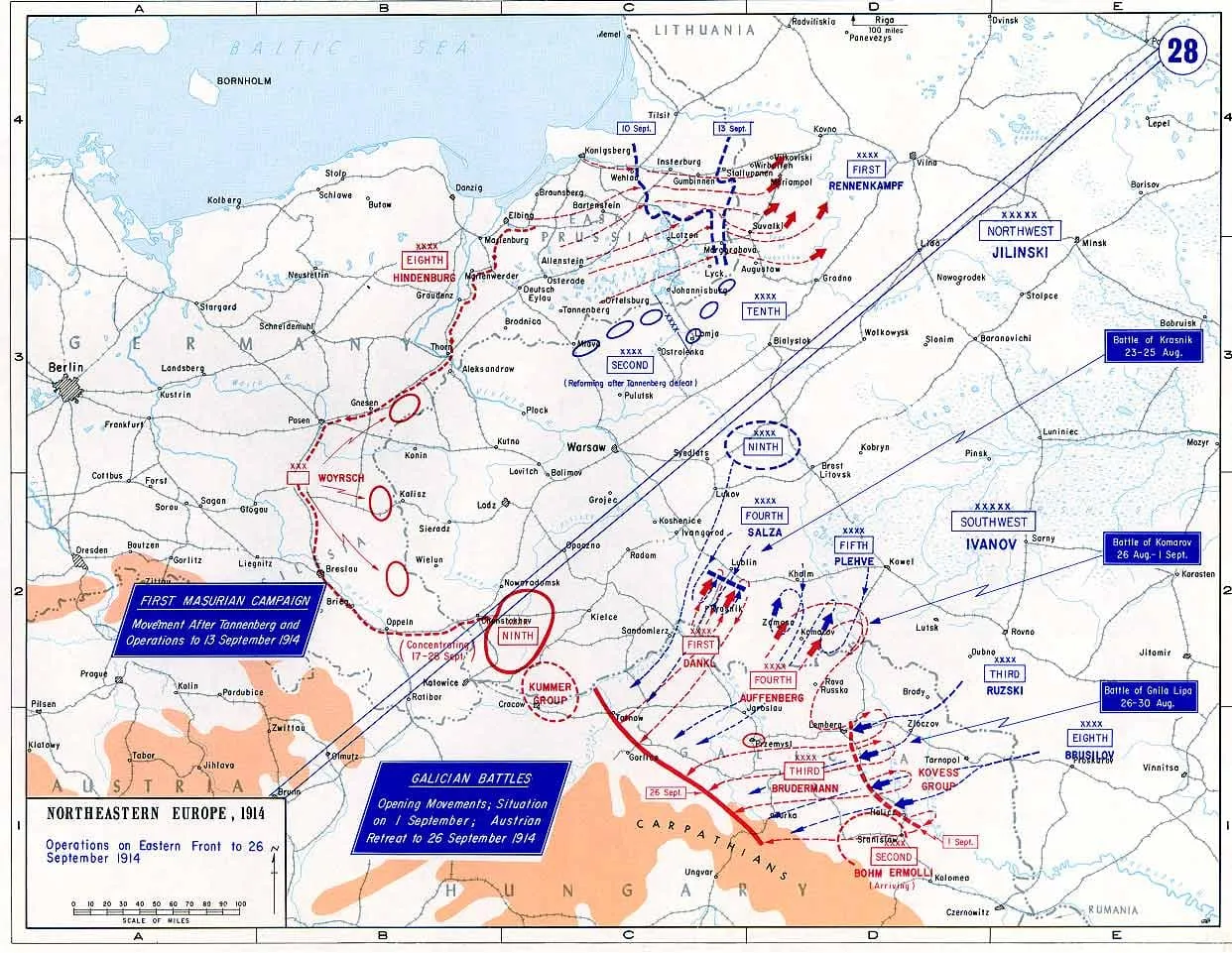
The Battle of Tarnawka was fought in September 1914 in the Lublin region, on the hilly fields around the villages of Tarnawka, Giełczew and Zakrzew, a dozen or so kilometres south of Lublin. Here Russian troops broke the defence of the Austro-Hungarian First Army of General Viktor Dankl and of the German corps supporting it. It was part of the great Battle of Galicia, although the fighting took place not in Galicia but in the Kingdom of Poland.
Dates and name
A British chronology of the war records the start of the battle under 7 September and places it, inaccurately, in Galicia. German accounts give the dates 7–9 September. Local historical studies from the Zakrzew commune speak of fighting on 6–9 September and date the Russian breakthrough at Tarnawka to 8 September (26 August by the Julian calendar, then in force in Russia). In reality the fighting in this sector was part of a wider Russian counter-offensive that had begun a few days earlier. The former village of Tarnawka is today the villages of Tarnawka Pierwsza and Tarnawka Druga in the Zakrzew commune. In Austria the battle was remembered together with the August victory, as shown by the title of the military march “Tarnawka-Kraśnik”.
Background
On 23–25 August Dankl’s army defeated the Russian Fourth Army in the Battle of Kraśnik and followed it northwards. At the beginning of September its leading units stood on the hills of the Lublin Upland, on the approaches to Lublin. They got no further, however. The Austro-Hungarian command was focused on the east, around Lviv, where the Russians were winning successes, and could not reinforce Dankl.
The Russians, on the contrary, were strengthening their northern wing. The new commander of the Fourth Army, General Aleksei Evert, received fresh corps, including the Guards Corps, made up of elite regiments stationed in peacetime in St Petersburg, and the Grenadier Corps. On the Vistula the new Ninth Army of General Platon Lechitsky was deploying. On 3 September the command of the Russian South-Western Front ordered a general advance towards the lower San.
Dankl’s only help was the German Landwehr Corps of General Remus von Woyrsch. Made up of older reservists, it had marched from the frontier across the western part of the Kingdom, crossed the Vistula at Józefów on 3 September and was temporarily placed under the Austro-Hungarian First Army.
Course of the battle
The Russian attack on Dankl’s front began around 5 September. Under pressure from superior forces the Austro-Hungarian V Corps of General Paul Puhallo von Brlog began to give way on the Bystrzyca (PL), and the neighbouring X Corps was pushed back to new positions. According to Austrian accounts, around 7 September Dankl’s three corps faced seven Russian corps.
From 7 September the heaviest fighting was around Tarnawka, Giełczew and Zakrzew. Here the Guards, the Grenadier Corps and the III Caucasian Corps attacked, while the Austro-Hungarian V Corps and the German 4th Landwehr Division defended. The fighting was very fierce. According to Russian accounts, on 8 September the Guards regiments broke through the defence around Tarnawka. The German Landwehr men then covered the withdrawing Austrians.
Dankl’s position was also deteriorating on his right wing. Between the First Army and the Austro-Hungarian Fourth Army, fighting at Rawa Ruska, a gap had opened into which the Russian Fifth Army was advancing. Threatened with envelopment, Dankl’s army began to withdraw southwards, towards Kraśnik and the San, and the Landwehr Corps crossed back to the left bank of the Vistula at Zawichost. On 11 September Franz Conrad von Hötzendorf ordered the whole Austro-Hungarian front to retreat behind the San.
Losses
Reliable figures for losses in the battle itself are lacking. Local studies state that tens of thousands of soldiers fell on each side and that more than 250,000 men in all took part in the fighting. These figures are probably exaggerated or cover a wider area and a longer period of fighting, so they should be treated with caution. What is certain is that the losses of both sides were very heavy. The fallen were buried in war cemeteries at Tarnawka and Giełczew, which survive to this day.
Significance
The Battle of Tarnawka undid Dankl’s August success. The breakthrough south of Lublin, together with the defeats at Lviv and Rawa Ruska, forced Austria-Hungary to break off the Battle of Galicia and retreat behind the San, and then further, behind the Dunajec. The Russians took most of Eastern Galicia and surrounded the fortress of Przemyśl.
The fighting at Tarnawka, like the other battles of this campaign, took place on Polish soil. Many Poles fought on both sides, as conscripts of the Russian and Austro-Hungarian armies, and the villages of the Lublin region were badly damaged.
Spotted a mistake?Report an error