1914: The Battle of Galicia
Battle of Galicia
- Dates:
- 23 August – 11 September 1914
- Front:
- Eastern Front
- Location:
- Eastern and Central Galicia and the southern Lublin region (Kingdom of Poland), from the Vistula and Kraśnik to Zamość, Tomaszów Lubelski, Rawa Ruska, Lviv and the DniesterOn the battle map →
- Sides:
- Russian EmpireNikolai Ivanov, Mikhail Alekseyev, Alexei Evert, Pavel Plehve, Nikolai Ruzsky, Aleksei Brusilov, Platon LechitskyAustria-HungaryFranz Conrad von Hötzendorf, Viktor Dankl, Moritz von Auffenberg, Rudolf von Brudermann, Svetozar Boroević, Eduard von Böhm-Ermolli, Hermann KövessGerman EmpireRemus von Woyrsch
- Result:
- Russian victory. Austria-Hungary lost Lviv and most of Galicia and withdrew behind the San, then behind the Dunajec, leaving the fortress of Przemyśl under siege.
- Author:
- Natalia
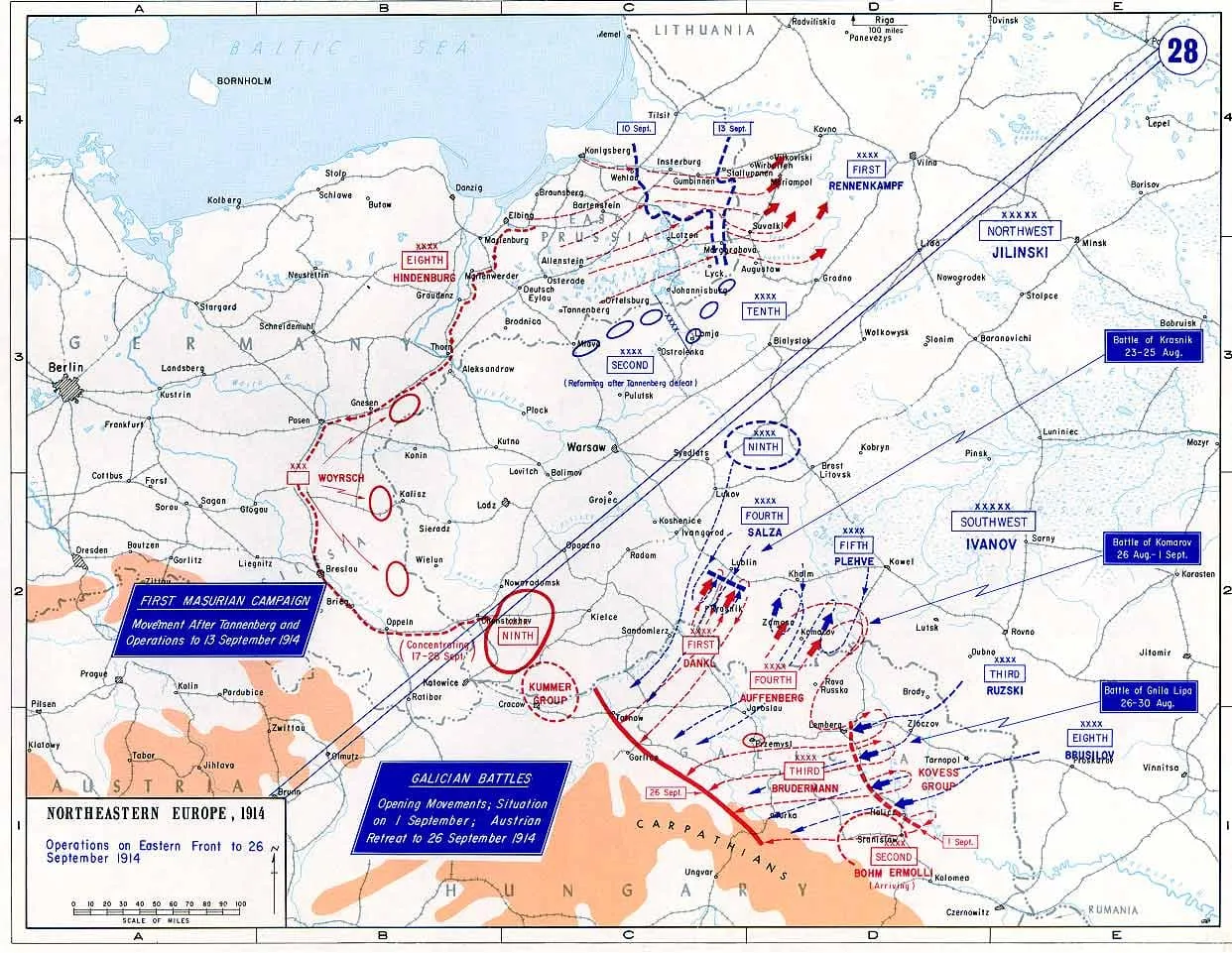
The Battle of Galicia is the name given to a series of great, interlinked engagements in which the main forces of Austria-Hungary and Russia clashed between 23 August and 11 September 1914. The fighting took place on a front some 300–400 kilometres long, from the Vistula to the Dniester, in Austrian Galicia and in the south of the Kingdom of Poland. Nearly two million soldiers took part. The Austro-Hungarian armies began with victories at Kraśnik and Komarów, but at the same time the Russians shattered their weaker right wing on the Złota Lipa and Gniła Lipa and on 3 September took Lviv. An attempt to recapture the city at Gródek and Rawa Ruska, together with the defeat at Tarnawka, ended the campaign with a retreat behind the San. It was the Habsburg monarchy’s first great battle of the war and at the same time a blow from which its army never fully recovered.
Name and dates
The Polish name “Battle of Galicia” is a convention, since much of the fighting took place not in Galicia but in the Kingdom of Poland, in the Lublin and Zamość regions. Polish literature also uses the term “Galician war”, which usually covers the whole struggle for Galicia in 1914–1915. Russian historiography uses the same name (Галицийская битва), while Soviet historiography divided it into two operations: the Lublin–Kholm operation in the north and the Galich–Lvov operation in the east. In Germany and Austria writers spoke of the battle in Galicia or of the battles of Lemberg. The Austrian official history calls the whole the first campaign of Austria-Hungary against Russia and distinguishes within it the battles of Kraśnik and Komarów, the battle of Złoczów, the battle of the Gniła Lipa and the battle of Rawa Ruska and Lviv. English-language literature uses the name Battle of Galicia or Battle of Lemberg.
The dates also vary. We take 23 August, the day of the first great battle at Kraśnik, and 11 September, when the chief of the Austro-Hungarian General Staff, Franz Conrad von Hötzendorf, ordered the retreat behind the San. Most German and English-language literature dates the battle the same way. Some works, including the Polish Wikipedia, begin it as early as 18 August, when the Russian Eighth Army crossed the border river Zbruch. Russian works usually give the dates 5 (18) August – 8 (21) September according to the Julian and Gregorian calendars, and some extend the battle to 13 (26) September, counting the pursuit of the retreating Austrians.
Background
Austria-Hungary entered the war against two opponents at once. Conrad first sent strong forces against Serbia, and only after the declaration of war on Russia on 6 August did he turn his main effort east. Some of the troops, especially the Second Army, had already gone by rail to the Sava and the Drina, where the Battle of Cer was under way. It returned to Galicia late and entered the fighting piecemeal only at the end of August. Conrad also moved the concentration of his armies westward, behind the San and the Dniester, because he feared a faster Russian mobilisation than had been assumed. According to some historians, the Russians knew the pre-war Austrian plans, partly thanks to the treason of Colonel Alfred Redl, and expected the enemy’s main forces near Lviv.
Conrad’s plan envisaged a thrust northwards, deep into the Kingdom of Poland, between the Vistula and the Bug. It was to be carried out by the First Army of General Viktor Dankl towards Lublin and the Fourth Army of General Moritz von Auffenberg towards Chełm. Beyond the Vistula the left wing was covered by the army group (PL) of General Heinrich Kummer, and later also by the German Landwehr Corps of General Remus von Woyrsch. Eastern Galicia and Lviv were only to be screened, by the Third Army of General Rudolf von Brudermann and the army group of General Hermann Kövess, which, once the troops from the Serbian border arrived, became the Second Army of General Eduard von Böhm-Ermolli. The nominal commander-in-chief was Archduke Friedrich, but operations were directed by Conrad. He counted on Germany quickly defeating France and coming to his aid; until then the Russians had to be beaten before they could assemble all their forces.
On the Russian side, the advance on Galicia was made by the South-Western Front of General Nikolai Ivanov, whose chief of staff was General Mikhail Alekseyev. The Russian plan was a mirror image of the Austrian one. From the north, from the area of Lublin and Chełm, the Fourth Army of General Anton Salza and the Fifth Army of General Pavel Plehve were to strike southwards. From the east, from Volhynia and Podolia, the Third Army of General Nikolai Ruzsky and the Eighth Army of General Aleksei Brusilov marched on Lviv. Both sides thus threw their main forces in opposite directions: the Austrians northwards, and the strongest Russian armies westwards, against the exposed Austrian flank.
Estimates of strength vary according to the source. The Austrian official history speaks of about 900,000 soldiers in the field army, while other works give as many as a million. According to various authors the Russians had between a million and 1.2 million men, and their superiority grew as the battle went on, because the railways brought up further corps. At the end of August a new Russian Ninth Army under General Platon Lechitsky began to form on the Vistula. The first clashes on the border, including the great cavalry battle at Jarosławice on 21 August, preceded the main battle. At the same time in East Prussia the Germans, after their defeat at Gumbinnen, were preparing for the Battle of Tannenberg.
Successes in the north: Kraśnik and Komarów
On 23 August Dankl’s army collided south of Kraśnik with the Russian Fourth Army. After three days of fighting the Russians, threatened with envelopment, fell back towards Lublin, and Salza lost his command. His place was taken by General Alexei Evert. It was the Austro-Hungarian army’s first victory of the war. Dankl pressed on northwards, and at the turn of August and September his leading units stood on the hills before Lublin.
On 26 August, to his right, Auffenberg’s army entered the Battle of Komarów. For a week it fought in the Zamość region, between Zamość, Komarów and Tomaszów Lubelski, against Plehve’s Russian Fifth Army. After a crisis on 27–28 August the Austrians outflanked the Russians on both wings, and it seemed they would repeat the success the Germans had just won over Samsonov’s army. The pincers, however, did not close. During the night of 1–2 September Plehve withdrew his battered army north-east, behind the Bug. Komarów was Austria-Hungary’s greatest victory of the whole campaign, but an incomplete one.
Defeat in the east: the Złota Lipa and the loss of Lviv
In those same days the fate of eastern Galicia was being decided. Conrad believed that only weak Russian forces were approaching from the east and ordered Brudermann to attack. On 26 August three corps of the Third Army set off eastwards, towards the Złota Lipa, and near Złoczów and on the hills of Gołogóry ran into the vanguards of two Russian armies. The Austro-Hungarian infantry, attacking in close order, suffered enormous losses from artillery and machine-gun fire. After two days Brudermann withdrew westwards to the Gniła Lipa. There on 29–30 August the corps of Ruzsky and Brusilov broke through his defences, even though the first units of the Second Army were already arriving to help. The shattered army fell back behind Lviv, to the river Wereszyca (PL), in the area of Gródek Jagielloński.
Lviv was not prepared for defence. On 30 August the Galician authorities began evacuating the government offices; on 2 September the last Austro-Hungarian units left the city, and on 3 September the Russians entered it without a fight. In the first days of September Brusilov’s Eighth Army also took Halicz on the Dniester. Brudermann was dismissed, and command of the Third Army passed to General Svetozar Boroević. Russia placed the occupied territory under the administration of Governor-General Georgy Bobrinsky, and in St Petersburg, recently renamed Petrograd, the capture of the Galician capital was celebrated as a great victory that offset the defeat in East Prussia.
Conrad’s turn: Rawa Ruska, Gródek and Tarnawka
Conrad would not accept the loss of Lviv. He judged that the Russians beaten at Komarów were weakened enough for him to turn Auffenberg’s main forces southwards. From 3–4 September the Fourth Army marched towards Rawa Ruska to strike the flank of the Russians advancing west from Lviv. In the north, on the Huczwa, only the weak group of Archduke Joseph Ferdinand remained, and an ever-wider gap opened between Auffenberg’s army and Dankl’s army, fighting alone near Lublin. The Russian command did the opposite. On 3 September Ivanov ordered a general offensive: the Ninth, Fourth and Fifth Armies were to strike from the north towards the lower San, and the Third Army north-westwards, into the flank and rear of the Austrians. Only Brusilov’s Eighth Army was left facing the armies of Boroević and Böhm-Ermolli.
Instead of a flank attack at Rawa Ruska, from 6 September a heavy encounter battle broke out with the Russian Third Army, in the forests and marshes between Rawa, Magierów and Niemirów. On 8 September Boroević and Böhm-Ermolli went over to the attack from the Wereszyca, on a front from Janów to the Dniester. Brusilov had to throw his last reserves into the fight, and at Austrian headquarters it was believed for a moment that Lviv was within reach. The exhausted regiments, however, could not break the Russian defence, and by 10 September their attack had petered out.
The outcome of the battle was decided by events in the north. There, from the beginning of September, the reinforced Russian Fourth and Ninth Armies, including the Guards Corps and the Grenadier Corps, had been attacking Dankl’s army. Woyrsch’s Landwehr Corps, which crossed the Vistula on 3 September and took its place alongside the First Army, was of little help. In the Battle of Tarnawka, south of Lublin, the Russians broke through the Austrian and German defences on 7–9 September, and on 9 September Dankl began to fall back towards the San. Meanwhile Plehve’s reconstituted Fifth Army entered the gap between the Austro-Hungarian armies and threatened the rear of the Fourth Army. On 11 September the Russian XI Corps broke through the front of the Austro-Hungarian XVII Corps at Rawa Ruska, and Russian cavalry was already appearing behind Auffenberg’s lines. That evening Conrad, fearing that he would be cut off from the San crossings and encircled, ordered all his armies into a general retreat.
Retreat behind the San and Przemyśl
The retreat took place in pouring rain, along sodden roads crowded with supply columns, artillery and fleeing civilians. Thousands of stragglers were taken prisoner, and some units surrendered without a fight. The Russians set off in pursuit late, because they themselves were exhausted and their supplies, especially of artillery ammunition, could not keep up with the front. The Austro-Hungarian armies crossed the San in mid-September but could not hold that line. At the end of September they fell back further, behind the Dunajec and the Biała and into the Carpathians. The Russians occupied most of Galicia as well as northern Bukovina with Czernowitz, and stood at the Carpathian passes, from where they could threaten Hungary.
In their path remained the fortress of Przemyśl, which held more than 100,000 soldiers under the command of General Hermann Kusmanek. Conrad decided not to evacuate it, so that it would tie down Russian forces. At the end of September the Russian Third Army, taken over after Ruzsky’s move to the North-Western Front by General Radko Dimitriev, closed a ring around it. The first siege of the fortress began, and for the next six months the whole monarchy followed its fate.
Poles in the Battle of Galicia
Almost the entire battle was fought on Polish lands, and Poles fought in it on both sides of the front. In the Austro-Hungarian army they served in Galician regiments from the Kraków, Przemyśl and Lviv corps districts, and in the Russian army as conscripts from the Kingdom of Poland. A few days before the battle Grand Duke Nicholas Nikolaevich called on the Poles to fight alongside Russia, promising the unification of the Polish lands under the Tsar’s sceptre. On the other side the Polish Legions were being formed. The units of Józef Piłsudski were then operating in the Kielce region, on the left bank of the Vistula, outside the main battlefield, and in the second half of September they covered the northern flank of the retreating armies on the Vistula. The Eastern Legion, being formed in Lviv, was evacuated westwards before the Russians entered and was disbanded on 21 September.
For the civilian population, Polish, Ukrainian and Jewish, the battle meant marching armies, requisitions, burnt villages and mass flight. Hundreds of thousands of refugees set off westwards, to Kraków and further into the interior of the monarchy. The retreating Austro-Hungarian troops arrested, and sometimes shot, Ruthenians suspected of pro-Russian sympathies. The Russian occupation of Lviv and eastern Galicia, which lasted until June 1915, brought Russification, persecution of the Greek Catholic Church and hostility towards the Jews, and at the end of September also a pogrom in Lviv.
Losses
Exact figures cannot be established, and estimates vary considerably. The Austrian official history admits that of the roughly 900,000 soldiers who went into action in August, fewer than two-thirds returned to the San, and it considers the Russian communiqués of 250,000 killed and wounded and about 100,000 prisoners to be only slightly exaggerated. According to various authors Austria-Hungary lost between about 320,000 and 400,000 soldiers killed, wounded, missing and taken prisoner, including 100,000 to 130,000 prisoners, as well as several hundred guns. The most painful loss was that of experienced NCOs and, by frequent estimates, about a third of the professional officers, who could never be replaced.
Russian losses are usually estimated at about 225,000–250,000 men, including about 40,000 taken prisoner. The Austrian official history likewise speaks of about 250,000 soldiers missing from the million with which Ivanov’s armies began the campaign. Russian commanders themselves admitted that the exhaustion and heavy losses of their troops prevented a vigorous pursuit.
Significance
The Battle of Galicia was Russia’s greatest victory of the first year of the war and a great defeat for Austria-Hungary. The Habsburg army’s first independent campaign against Russia ended with the loss of Lviv and most of Galicia, and the army lost the core of its pre-war cadres. From then on the monarchy depended more and more on German help. As early as the end of September the Germans formed a new Ninth Army in Silesia, which together with the Austrians launched an offensive on the Vistula and the San. It briefly lifted the siege of Przemyśl. The weakening of the Austro-Hungarian army in the east also affected the Serbian front, where the monarchy could not throw all its forces against Serbia.
For Russia, the victory in Galicia offset the defeat at Tannenberg and enhanced the fame of Ruzsky and Brusilov. Russian propaganda presented the occupied lands as recovered “Russian” land. The victors, however, failed to destroy the defeated armies. Przemyśl, besieged again from November, capitulated in March 1915, but as early as May and June 1915, after the breakthrough at Gorlice, the Central Powers recovered Przemyśl and Lviv. For the Poles, the Battle of Galicia was their first great experience of a war that swept across their lands and in which soldiers of the same nation faced one another in the uniforms of the partitioning powers.
Spotted a mistake?Report an error
Battles and phases
(05)- 23–25 August 1914Battle of KraśnikAustria-Hungary's first victory of the war. On 23–25 August 1914 Dankl's army drove the Russians back from Kraśnik towards Lublin.
- 26 August – 2 September 1914Battle of KomarówVictory of Auffenberg's Austro-Hungarian Fourth Army over Plehve's Russian Fifth Army in the Zamość region, 26 August – 2 September 1914.
- 26–30 August 1914Battle of the Złota LipaOn 26–30 August 1914 the armies of Ruzsky and Brusilov routed Brudermann's army east of Lviv. A few days later the Russians took Lviv.
- 7–9 September 1914Battle of TarnawkaIn September 1914, south of Lublin, the Russians broke the front of Dankl's Austro-Hungarian First Army, which sealed the Austrian retreat behind the San.
- 8–11 September 1914Battle of Gródek and Rawa RuskaIn September 1914 Austria-Hungary tried to retake Lviv. The counter-offensive at Gródek and Rawa Ruska collapsed and Conrad ordered a retreat behind the San.