1914: The fighting in East Prussia
Battle of Gumbinnen
- Dates:
- 20 August 1914
- Front:
- Eastern Front
- Location:
- Around Gumbinnen (Polish Gąbin, now Gusev), East PrussiaOn the battle map →
- Sides:
- Russian EmpirePaul von RennenkampfGerman EmpireMaximilian von Prittwitz, Hermann von François, August von Mackensen
- Result:
- Russian victory. The German 8th Army broke off the battle and withdrew, and its commander lost his post.
- Author:
- Łukasz Skowroń
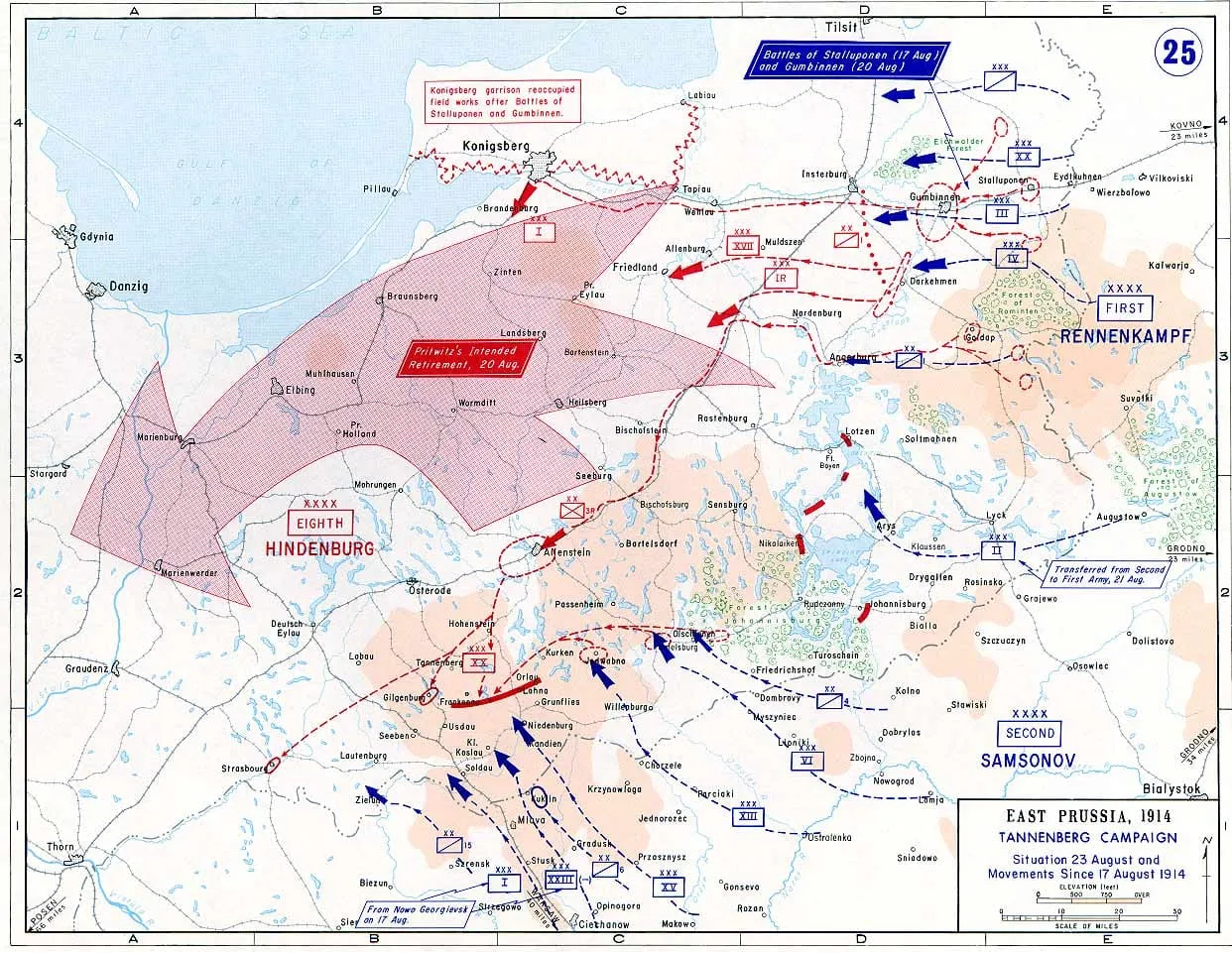
The Battle of Gumbinnen, known in Polish as the Battle of Gąbin, was fought on 20 August 1914 in East Prussia, near the town that today bears the name Gusev. It was the first great battle on the Eastern Front and the only major Russian victory in the East Prussian campaign.
The Russian offensive
Russia had undertaken to France to strike at Germany as soon as possible, in order to draw part of the German forces away from the Western Front. It therefore began its offensive into East Prussia before it had fully completed its mobilisation. The 1st Army of General Paul von Rennenkampf entered from the east, and the 2nd Army of General Alexander Samsonov was to come from the south.
The German 8th Army of General Maximilian von Prittwitz, defending the province, was numerically weaker. On 17 August at Stallupönen the commander of I Corps, General Hermann von François, attacked the Russians against orders and inflicted losses on them. Prittwitz decided to give battle before the two Russian armies could join up.
Course of the battle
On the morning of 20 August the Germans struck Rennenkampf’s army. On the northern wing François’s corps succeeded in pushing back the Russians. In the centre the attack of XVII Corps under General August von Mackensen, carried out without adequate reconnaissance, broke down under the fire of Russian artillery and of infantry concealed in trenches. The Germans suffered heavy losses, and some units withdrew in disorder. On the southern wing a German reserve corps was unable to tip the balance.
The losses on both sides were high: the Germans lost about 14,600 men, the Russians about 18,800 killed, wounded and taken prisoner. Even so, the battlefield remained in Russian hands.
Panic in the command
The defeat in the centre and the news that Samsonov’s army was approaching from the south threw Prittwitz into a panic. He considered retreating as far as behind the Vistula, which meant giving up the whole of East Prussia. The chief of the German General Staff, Helmuth von Moltke, considered this unacceptable. On 22 August Prittwitz was recalled, and command of the 8th Army was taken over by General Paul von Hindenburg and his chief of staff, Erich Ludendorff, the hero of the fighting at Liège.
Significance
The victory at Gumbinnen was short-lived for the Russians. Rennenkampf did not pursue the defeated enemy, giving the Germans time to regroup. Hindenburg and Ludendorff sent almost the entire 8th Army against Samsonov and at the end of August destroyed his army in the Battle of Tannenberg. The Russian offensive nonetheless had important consequences: the alarmed German command transferred two corps from the Western Front to the east, which weakened the German advance on France before the Battle of the Marne.
Spotted a mistake?Report an error