1916: The conquest of Montenegro and northern Albania
Battle of Lovćen
- Dates:
- 8–11 January 1916
- Front:
- Balkan Front
- Location:
- The Lovćen massif above the Bay of Kotor, from the Austro-Hungarian border near Kotor across the Krstac pass and the ridges above Budva to the plateau around Njeguši and Cetinje (Montenegro)On the battle map →
- Sides:
- Austria-HungaryHermann Kövess, Stjepan Sarkotić, Ignaz Trollmann, Viktor WeberMontenegroNicholas I of Montenegro, Prince Peter of Montenegro
- Result:
- Austro-Hungarian victory. The Montenegrins lost Lovćen and all their heavy artillery, and their troops in the west of the country began to melt away. The government asked for an armistice, and on 13 January the Austrians entered Cetinje.
- Author:
- Łukasz Skowroń
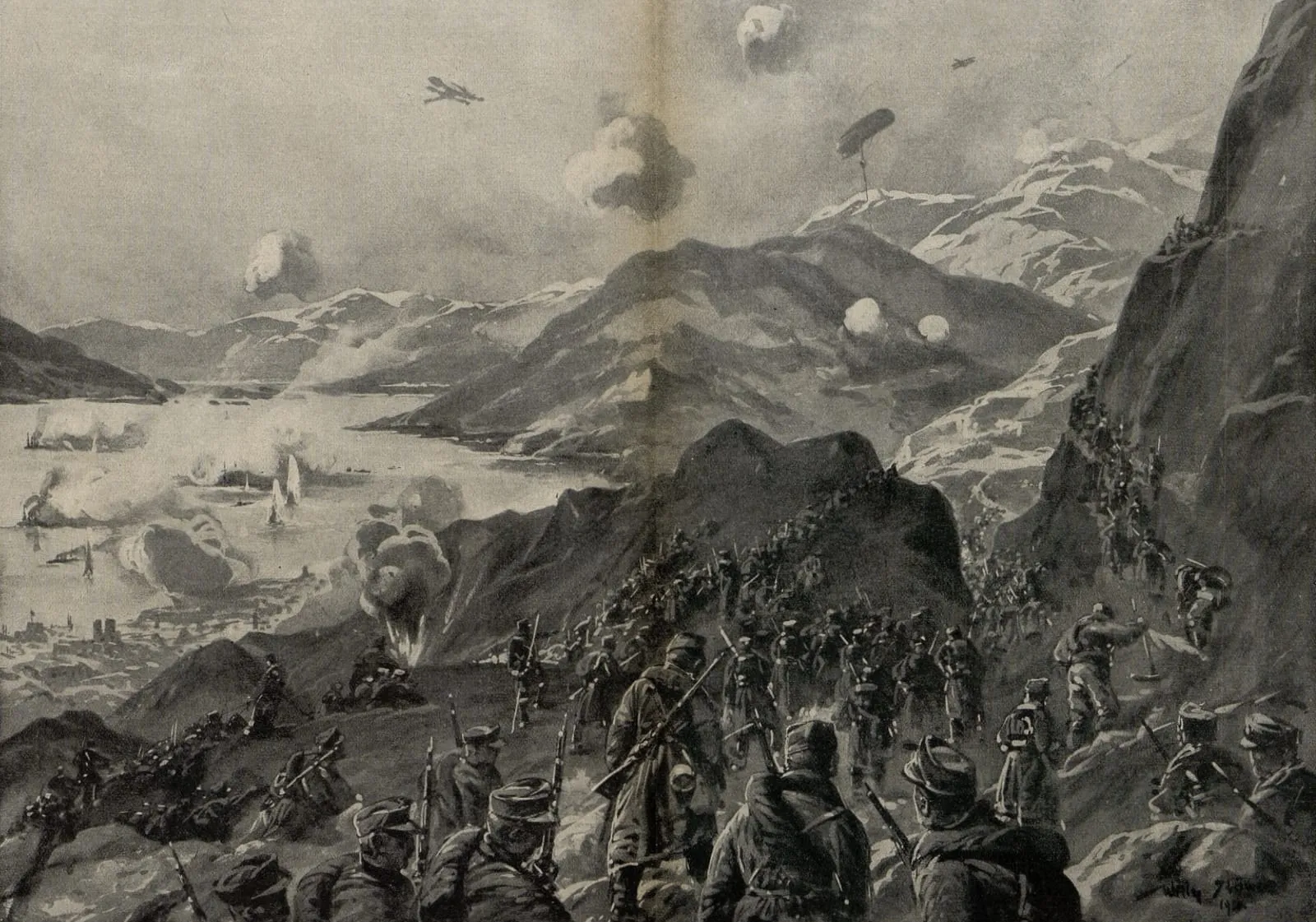
The Battle of Lovćen was the most important engagement of the Austro-Hungarian conquest of Montenegro. The Lovćen massif, rising almost two kilometres above the Bay of Kotor, was for the Montenegrins a sacred mountain and a natural fortress shielding the country’s capital, Cetinje. For Austria-Hungary it was a threat to its southernmost naval base at Kotor. On 8 January 1916 the XIX Corps of Feldmarschalleutnant Ignaz Trollmann, after a massive bombardment by hundreds of land guns and by warships, began to climb the rocky slopes. After three days of fighting in rain and snow the defence collapsed: on the evening of 10 January the Austrians stood on the summit, and on 11 January their forward units reached the edge of the plateau, from which it was only a few kilometres to Cetinje.
Name and dates
There is no established name for this engagement in Polish literature. The Austrian official history speaks of the “capture” and the “storming” of Lovćen, while the English Wikipedia speaks of the “Third bombardment of Mount Lovćen”, counting the earlier bombardments of 1914. We adopt the simple name “Battle of Lovćen”.
On this page we use the dates 8–11 January 1916. According to the Austrian official history the main attack, preceded by massive artillery fire, began on the morning of 8 January. One group, under Lieutenant-Colonel Lottspeich, attacked on the northern flank as early as 7 January (and had taken the first hill near the border on 28 December 1915) in order to draw off the defenders’ forces, which is why the English Wikipedia gives the dates 7–11 January. The Austrians took the summit of Lovćen at dusk on 10 January, and on 11 January the Montenegrin defence in the west of the country ceased to exist and the advance guards stood on the hills above Cetinje, among them Jezerski vrh with the chapel-mausoleum of Prince-Bishop Njegoš. The Austro-Hungarian communiqué announced the capture of Lovćen on 11 January, and some studies give that date. The British chronology of the war records the taking of the mountain under 10 January.
Background
Lovćen lies just beyond the old border of Austro-Hungarian Dalmatia. Its highest peak, Štirovnik, is 1,749 metres high and rises almost a thousand metres above the hills surrounding the bay. From its slopes the whole naval base could be seen, and guns placed there could shell the port and the forts. As early as 5 August 1914 Montenegro entered the war, and a few days later its batteries on Lovćen began shelling the fortifications of Kotor. In the autumn of 1914 the French hauled eight naval guns up the mountain, but Austro-Hungarian warships, especially the battleship SMS Radetzky, forced them to withdraw. Lovćen remained in Montenegrin hands and for a year and a half was a thorn in Vienna’s side.
When at the end of 1915 the remnants of the Serbian army retreated through Montenegro and Albania to the Adriatic, and the Austrians took Peć, the chief of the Austro-Hungarian General Staff, Franz Conrad von Hötzendorf, decided on 22 November to prepare a strike against Lovćen. Over the following weeks the plan grew into an intention to conquer the whole of Montenegro with the Third Army of General Hermann Kövess. The attack from the direction of Kotor was entrusted to the troops of General of Infantry Stjepan Sarkotić, the commander in Bosnia, Herzegovina and Dalmatia, and its execution to Trollmann’s XIX Corps. Overloaded narrow-gauge railways meant that the attack had to be postponed from 20 December to the beginning of January. Several brigades were brought to Kotor by rail and sea, among them the 14th Mountain Brigade transferred from the Isonzo, together with a great mass of heavy artillery.
Conrad wanted to strike straight at the Krstac pass, over which the serpentine road from Kotor to Cetinje ran. Sarkotić and the commander of the 47th Infantry Division, Feldmarschalleutnant Viktor Weber, considered an attack on a thousand-metre rock face suicidal. After reconnaissance Trollmann decided to direct his main forces at the Solar ridge south of the pass and to outflank the position on both sides: from the coast near Budva and from the north. The terrain was karst, without water or roads. Supplies were to be carried by pack animals and columns of porters, and the Third Army reminded the troops to capture Cetinje’s waterworks intact if possible.
The Montenegrins knew of the preparations, because the inside of the bay could be seen well from Lovćen. In November the Austrians estimated the defenders of this sector at 6,000–10,000 men, and modern studies speak of about 9,000 in four brigades, with about 50 guns. The Lovćen sector was commanded by the youngest son of King Nicholas I, Prince Peter. The Montenegrin army had been hungry for months, was poorly clothed and had little ammunition. The Serbs who might have reinforced it had been withdrawn to Scutari at the beginning of January at the king’s request, because the Montenegrin authorities complained of their requisitions and looting.
Course
8 January. At six in the morning, in the darkness before dawn, the fortress artillery and the field batteries under Colonel Franz Portenschlag opened fire on the positions on Lovćen, the Krstac pass and the Peštingrad hill. At the same time the ships of Rear-Admiral Hansa’s 5th Division joined the bombardment: three old Monarch-class coastal defence ships and the cruiser SMS Aspern. According to the American naval historian Ryan Noppen, the battleship Budapest was heeled over by a few degrees so that her guns could reach positions high on the mountain. Montenegrin howitzers and mortars on the Krstac pass and the Kuk hill replied accurately, and the ships had to change their anchorages several times, but by noon the superior Austro-Hungarian artillery had silenced most of the batteries. Then clouds covered the mountains, and rain and snow began to fall.
The infantry of the 47th Division moved off at eight. The 14th Mountain Brigade and Lieutenant-Colonel Törk’s group attacked the narrow, rocky Krimalj ridge on the way to Solar. Two bombardments by heavy artillery failed to destroy the machine guns hidden among the boulders, and by noon the attack had stalled. Only when the heavy guns took them as their target did the defenders abandon the position, and the Austrians advanced below Solar as far as the last bends of the road. On the coast the group of Feldmarschalleutnant Sorsich, supported by the warships, took the village of Vranović. On the northern flank the Montenegrins held firmly on the hills east of Orahovac and on the Bjeloš ridge.
9 January. After a stormy night, at six o’clock on Sunday, the artillery opened fire again. On the coast Schiess’s brigade took the Prčija glava hill, and Prince Peter’s units fell back to the next hills. In the afternoon the cruiser Aspern shelled them from the sea, but had to flee to port from a stronger Entente force of two cruisers and four destroyers. The main forces of the 47th Division took Solar and the neighbouring peaks, breaking through the Montenegrin line of defence on the edge of the plateau. In the afternoon a hit blew up the ammunition depots near Kuk, at the end of the second road to Cetinje. According to the Serbian General Staff, the defenders had by then lost all their heavy artillery. In the north, facing Lottspeich’s group, the Montenegrins gave up the Gomilice and Prosjenik hills only after a stubborn defence.
10 January. During the night the defenders’ main forces, shaken by the bombardment, fell back to the Štirovnik–Dolovi–Trestanik line. By noon the Austrians had passed all the hills on the edge of the plateau, and in the evening they reached the peaks of Lovćen itself. The last defenders of the Krstac pass abandoned their positions under the fire of the naval guns, which opened the road from Kotor to the Austrians. At dusk bonfires on the summit announced that the forward units of Törk’s group had climbed to the top. The Montenegrin command ordered a night counter-attack, but according to the Austrian official history, which here relies on Serbian sources, the soldiers refused to carry out the order. They said that after several days of hunger, “naked and barefoot”, they could not withstand even the winter, let alone a superior enemy. The appeals of Princes Mirko and Peter were of no avail.
11 January. Everywhere in front of the XIX Corps the Montenegrins were falling back. Before noon the advance guards of the 47th Division reached the Blatište–Jezerski vrh–Golobrdo line and directly threatened Cetinje. On the evening of 10 January the government had proposed to the king that an armistice be requested. Nicholas refused, but on the morning of 11 January, when his appeals to the retreating soldiers went unheeded, he gave way. The same day Montenegrin envoys handed the Austrians on Golobrdo a request for a six-day truce.
Losses
The Austrian official history gives no total losses for the battle. It states only that some units on the northern flank suffered heavy losses from frost (one battalion of Zhuber’s group recorded 327 cases of frostbite). Montenegrin losses are likewise unknown. The defenders lost all their heavy artillery, and most of their units dispersed to their homes. The most important, however, were the moral consequences: the surrender of Lovćen, regarded as impregnable, broke the will to fight of the army and the government.
Significance
The fall of Lovćen sealed the fate of Montenegro. On the same day, 10 January, the Austrians took Berane in the east, although in the north the Montenegrins held their ground at Mojkovac. From then on the disintegration spread across the whole western front: soldiers from every district that was abandoned went home. On 13 January the Austrians entered Cetinje without a fight, and a dozen or so days later the Montenegrin army laid down its arms. Kotor ceased to be threatened from the land and until the end of the war served as a safe base for Austro-Hungarian and German submarines in the Mediterranean. Sarkotić received the title of baron “von Lovćen”, Trollmann later became baron “von Lovćenberg”, and he and Weber received the Knight’s Cross of the Military Order of Maria Theresa. The Austrians later moved the remains of Prince-Bishop Petar II Petrović-Njegoš from the chapel on Jezerski vrh to Cetinje.
The mountain’s swift fall aroused suspicion from the start. Opponents of the dynasty, supporters of union with Serbia, claimed after the war that Prince Peter had ordered the retreat prematurely and that the king, counting on the Austrians stopping at Lovćen, had prevented a counter-attack. They cited the report of a Serbian officer, Colonel Petar Pešić, who was then chief of staff of the Montenegrin army. According to this report, after the fall of Kuk the king opposed a counter-attack, and Pešić obtained only the removal of Prince Peter from command. The king’s defenders replied that the defeat was the result of hunger, lack of ammunition and the enemy’s enormous superiority. The Austrian official history describes hard fighting on the first two days and makes no mention of any understanding. The charge of treason was never proven, but it became one of the arguments of King Nicholas’s opponents.
Spotted a mistake?Report an error