1916: The conquest of Montenegro and northern Albania
Battle of Mojkovac
- Dates:
- 6–7 January 1916
- Front:
- Balkan Front
- Location:
- The hills north and north-east of the small town of Mojkovac on the Tara river, between Bijelo Polje and Kolašin, in north-eastern MontenegroOn the battle map →
- Sides:
- MontenegroJanko VukotićAustria-HungaryHermann Kövess, Wilhelm von Reinöhl
- Result:
- Montenegrin defensive success. Both sides suffered heavy losses and the Austrians failed to take Mojkovac, but this did not change the outcome of the campaign, decided on Lovćen.
- Author:
- Łukasz Skowroń
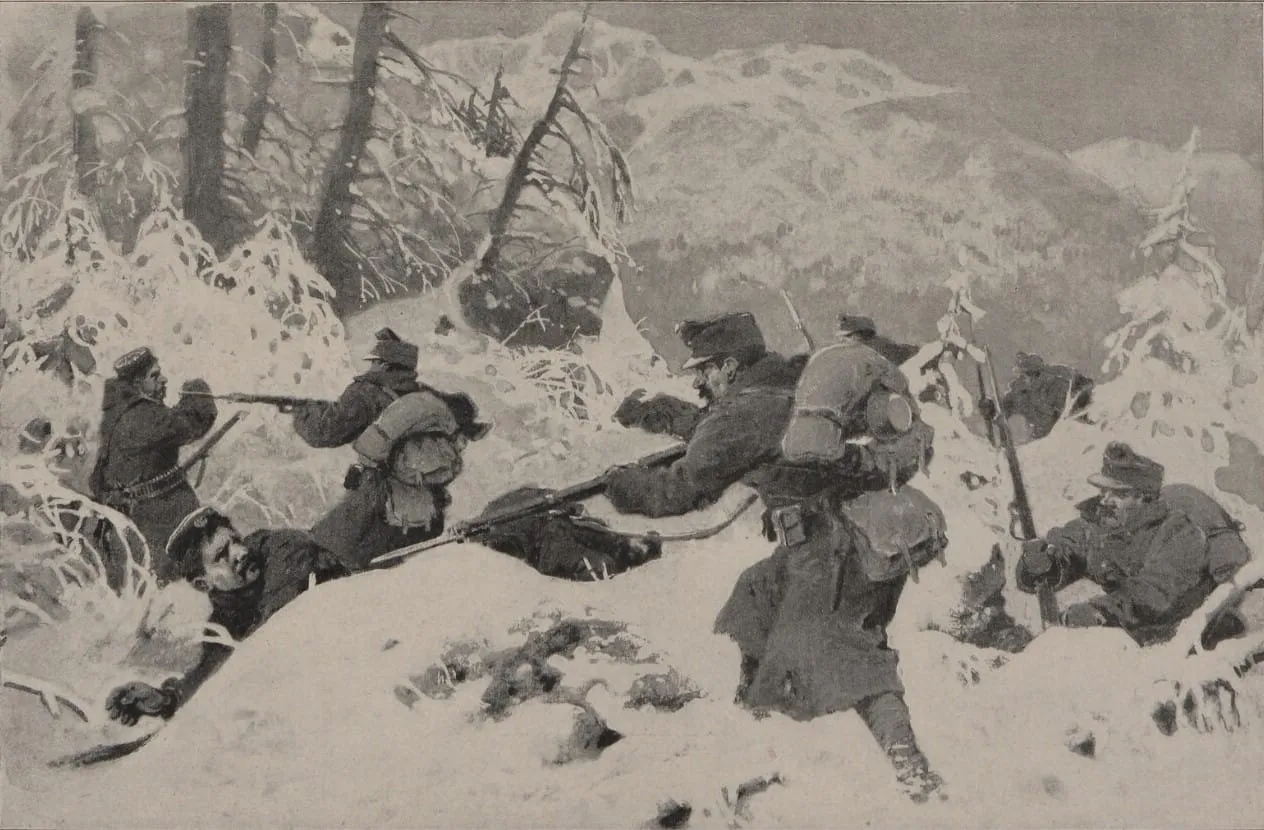
The Battle of Mojkovac was the last major battle of the Montenegrin army and its only significant success during the conquest of Montenegro by Austria-Hungary. On 6 and 7 January 1916, on Orthodox Christmas Eve and Christmas Day, Landsturm units under General Wilhelm von Reinöhl attacked Montenegrin positions on the Tara river near the small town of Mojkovac. For two days the Montenegrins of Serdar Janko Vukotić beat off the attacks and launched counter-attacks of their own, in snow, fog and frost, often with the bayonet. The Austrians did not take Mojkovac, and their units lacked the strength to advance further. In Montenegro and Serbia the battle became a symbol of the heroism of the Montenegrin soldier. It could not save the country, however, because in those same days the Austro-Hungarians broke through the defences on Lovćen and moved on Cetinje.
Name and dates
Montenegrin, Serbian and Austrian sources agree on the date of 6–7 January 1916. The Montenegrins then used the Julian calendar, under which these days were 24 and 25 December 1915, that is, Christmas Eve and the first day of Orthodox Christmas. That is why in Montenegro the battle is also called “Bloody Christmas”. According to the Austrian official history, fighting at Mojkovac continued at lower intensity on 8 January, and the two sides faced each other until the middle of the month. In Montenegrin and Serbian historiography the battle is the culmination of the so-called “Mojkovac operation”, the defence of Montenegro’s northern border by the Sanjak Army from the autumn of 1915.
Background
In the autumn of 1915 the main forces of the Montenegrin army, known as the Sanjak Army, defended the country’s northern and eastern border in the Sanjak. In doing so they covered the retreat of the Serbian army, which after the fall of Serbia was withdrawing through the Montenegrin mountains and Peć towards Scutari. In December the Austro-Hungarian 62nd Infantry Division took Pljevlja and Bijelo Polje, and its left wing reached Mojkovac. The Montenegrins, however, held all the crossings on the southern bank of the Tara.
Mojkovac lay on the road from Bijelo Polje to Kolašin, and from there to Podgorica, in the very heart of the country. According to the plan of the commander of the Austro-Hungarian Third Army, General Hermann Kövess, however, the forces in the north were mainly to tie down the Montenegrin forces, while the decisive blows were being prepared elsewhere: from the Bay of Kotor against Lovćen and from the Sanjak against Berane. The Austrians did not expect a breakthrough at Mojkovac.
General Reinöhl’s group took up position at Mojkovac. According to the Austrian official history it consisted of three battalions of the Austrian 205th Landsturm Brigade and three battalions of the Hungarian 6th Landsturm Regiment. Some of the soldiers still had no winter clothing. The same sources put the strength of the Montenegrin Mojkovac group at 6,500 rifles and 25 guns. Yugoslav works, for example the Yugoslav military encyclopaedia, give the same figures for the Montenegrin side but credit the Austrians with about 20,000 men and 45 guns, which probably covers all the Austro-Hungarian forces on this sector of the front. The Montenegrins were short of ammunition, and many of them carried rifles without bayonets and wore their own clothes brought from home.
Course
6 January. In the morning, after an artillery preparation, Hungarian Landsturm units attacked and took one of the mountain saddles north-east of Mojkovac. The Montenegrins immediately counter-attacked. According to the Austrian official history the Hungarians beat them off only by throwing in all their reserves and the reinforcements brought up, and both sides suffered heavy losses. The Montenegrins also attacked at night. According to Serbian and Montenegrin accounts, by the evening of 6 January the Austrians held several hills in front of Mojkovac, including Bojna Njiva, and threatened the road to the town.
7 January. In the morning the Hungarians renewed their attack on the hills south-east of Mojkovac, but quickly stalled. Around noon the Montenegrins struck on a broad front. The main blow went north from Mojkovac, against the Austrian 409th Landsturm Regiment. In thick snow and fog the Montenegrins broke into the Austrian trenches in places and fought hand to hand. Serbian and Montenegrin accounts describe how battalions from around Kolašin and Drobnjak recaptured Bojna Njiva after several failed assaults. According to the Austrian official history Reinöhl personally led the last reserves in a counter-attack, and the Montenegrins broke off the fight under cover of fog and night. Both sides regarded the day as their success. For this action Reinöhl received the Knight’s Cross of the Military Order of Maria Theresa.
The following days. On 8 January the Austrians resumed the attack to improve their position. They threw back across the Tara a Montenegrin detachment that had crossed the river below the town, but Mojkovac and the hills south-east of it remained in Montenegrin hands. The exhausted Landsturm could go no further, and Reinöhl decided to resume the advance only after careful artillery preparation. It never took place.
Losses
According to the Austrian official history the Landsturm units lost more than 700 men in these days, including 224 killed. On the ground abandoned by the Montenegrins the Austrians buried 205 of their dead. These figures were adopted by the Yugoslav military encyclopaedia. Some works, including Polish-language ones, give Austrian losses in thousands killed, or even more than 20,000 men, but these figures have no basis in the sources.
Significance
At Mojkovac the Montenegrins halted the Austrians in the north and kept control of the Tara valley. They held the Tara line, and further east the passes towards Andrijevica, for the following days, according to the Serbian historian Andrej Mitrović until 18 January. Montenegrin and Serbian tradition holds that the Montenegrins thereby gave the Serbian army time to escape to the Adriatic. In reality most of the Serbs were by then already on the coast, between Scutari and Durrës, and the last Serbian units had been withdrawn from Montenegro on 4 January.
The fate of the country was decided by events in the west. On 10 January the Austrians took Lovćen, and on 13 January Cetinje. The Montenegrin government asked for an armistice and the king left the country. On 21 January Vukotić, appointed chief of staff of the army a few days earlier, ordered the army to disband, and he himself was taken prisoner by the Austro-Hungarians. The Battle of Mojkovac remained the last victory of the army of the Kingdom of Montenegro. Today it is one of the most important sites of memory in Montenegro, and the question of whether it was primarily a Montenegrin or a Serbian battle has become part of present-day disputes over the country’s national identity.
Spotted a mistake?Report an error