1916: The Italian front
Battle of Asiago
- Dates:
- 15 May – 25 June 1916
- Front:
- Italian Front
- Location:
- The Folgaria, Lavarone and Vezzena plateaus in the southern Tyrol and the Italian Tonezza and Asiago (Sette Comuni) plateaus, from the Adige valley near Rovereto and the Pasubio massif to the Valsugana valley, on the border of Austria-Hungary and Italy (now the provinces of Trento and Vicenza)On the battle map →
- Sides:
- Austria-HungaryFranz Conrad von Hötzendorf, Archduke Eugen of Austria, Viktor Dankl, Hermann Kövess, Archduke CharlesItalyLuigi Cadorna, Roberto Brusati, Guglielmo Pecori Giraldi, Pietro Frugoni
- Result:
- Inconclusive. The Austro-Hungarians pushed the front between a dozen and some twenty-odd kilometres into Italy, but did not reach the plain and went over to the defensive after the Brusilov offensive.
- Author:
- Natalia
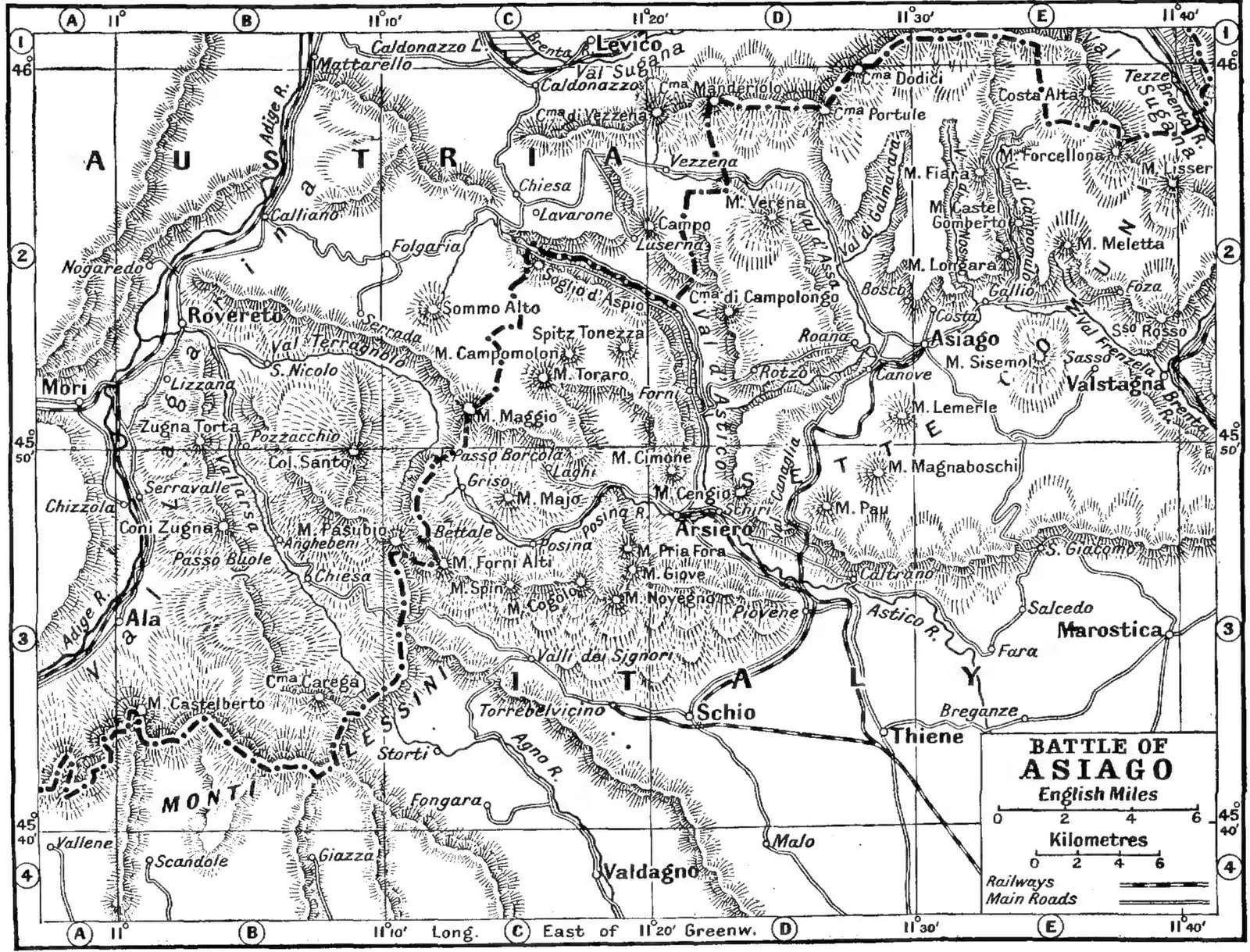
The Battle of Asiago was Austria-Hungary’s only great offensive on the Italian Front between Italy’s entry into the war in May 1915 and the autumn of 1917. On 15 May 1916 two Austro-Hungarian armies struck from the southern Tyrol, from the territory of today’s province of Trento, across the high plateaus between the Adige valley and the Valsugana valley. They were to descend onto the Venetian plain near Vicenza and Bassano, and so threaten the rear of the Italian armies fighting on the Isonzo. For the first two weeks the attack went according to plan: the Austrians smashed several Italian divisions, took tens of thousands of prisoners and captured the small towns of Asiago and Arsiero. They came to a halt, however, on the last ridges above the plain, when General Luigi Cadorna threw reinforcements from the Isonzo against them. After the Russian Brusilov offensive began, the Austro-Hungarian high command broke off the offensive, and at the end of June it withdrew its troops to a shorter line of defence.
Name and dates
The Polish name “bitwa pod Asiago” (Battle of Asiago) comes from the largest town on the plateau of the Seven Communes (Sette Comuni), where the heaviest fighting took place. The Italians speak of the battle of the plateaus (battaglia degli Altipiani), but most often of the “punitive expedition” (Strafexpedition). This German name was meant to emphasise that the Austrians wanted to punish their former ally for changing sides in 1915. It does not, however, appear in Austro-Hungarian documents. According to Italian historians it first appeared in the record of the interrogation of a Czech deserter at the end of April 1916, and it was only Italian authors after the war who made it widespread. The Austrians wrote of the offensive in the southern Tyrol (Südtiroloffensive), the spring offensive or the May offensive. Their official history divides the fighting into two battles: of Folgaria and Lavarone (from 15 May) and of Asiago and Arsiero (from 27 May to 16 June).
The limits of the battle are drawn in different ways. All serious sources agree that the main attack began on the morning of 15 May. The British chronology of the war, on which our timeline is based, records its start under 14 May, when the Austrians opened a feint bombardment on the Isonzo, and popular Italian works often write of the shelling of Trentino as early as the night of 14–15 May. The British chronology puts the end of the offensive on 3 June, Treccani at the end of May, and the Austrian official history on 16 June, when the order came to go over to the defensive. The Italians also include their own counter-attacks in the battle and end it on 27 July. We adopt the dates 15 May – 25 June 1916: from the first assault to the night of 24–25 June, when the Austrians gave up Asiago and Arsiero and withdrew to a new line of defence.
Background
General Franz Conrad von Hötzendorf, chief of the Austro-Hungarian General Staff, had long believed that Italy could most easily be defeated by a blow from the Tyrol. The Tyrolean wedge cut deep into Italian territory, and from its plateaus to the plain near Vicenza was a mere few dozen kilometres. If the Austro-Hungarian armies descended into the valley at this point, the Italian forces on the Isonzo and in Carnia would have to withdraw or be cut off. In December 1915 Conrad proposed a joint offensive to the chief of the German General Staff, Erich von Falkenhayn. Falkenhayn refused, and on 3 February 1916 at Pless he refused again, because his armies were already preparing to attack at Verdun. Conrad decided to strike alone. On 6 February the headquarters at Teschen issued the first orders.
The offensive was to be carried out by the Army Group of Archduke Eugen, with fourteen divisions and 64 batteries of heavy artillery. The first to attack was to be the 11th Army of General Viktor Dankl, formed from the Tyrol defence command. Behind it stood the 3rd Army of General Hermann Kövess, brought from Montenegro, which was to exploit the breakthrough and advance onto the plain. Troops were drawn from the whole monarchy: III Corps and the 18th Division from the Isonzo, which weakened the front there to the limits of risk, VIII Corps from the Balkans, and from the Eastern Front the headquarters of I Corps and several divisions. One of the corps, XX Corps, was commanded by the heir to the throne, Archduke Charles. The monarchy’s heaviest guns were brought to the Tyrol: 30.5 cm mortars, 42 cm howitzers, two new 38 cm howitzers from the Škoda works and a converted 35 cm naval gun, which shelled Asiago from a railway line near Calceranica. In all more than a thousand guns were assembled. The Austrian official history estimates the strength of the troops in the Tyrol at about 220,000 men.
The plan envisaged a breakthrough on a narrow sector of the Folgaria and Lavarone plateaus and a march to the Thiene–Bassano line at the foot of the mountains. The preparations were kept secret: the artillery transports were described as armament for the fortress of Trento, attacks were feigned on the Isonzo, and in March private communications with the Tyrol were cut. The weather, however, upset the timetable. In March several metres of snow fell on the plateaus, avalanches buried the roads, and by 10 March the railways had delivered only a third of the planned transports. The attack set for 10 April had to be called off, because the soldiers were sinking up to their hips in snow. The date was postponed several more times, until Dankl finally set 15 May. At the beginning of May Falkenhayn, through his plenipotentiary, once more urged Conrad to abandon the offensive and give part of his troops to the Western Front. Conrad refused.
During these weeks the Italians lost the element of surprise, but did not draw the full conclusions from this. From March reports had been reaching them of the concentration of troops in the Tyrol, and deserters were giving away details. Cadorna strengthened the 1st Army, but to the end he did not believe in a large-scale offensive in such difficult terrain, and kept his main reserve, six divisions, on the Tagliamento. According to his figures, on 15 May the 1st Army had 176 battalions and about 850 guns between Lake Garda and the Brenta. It was an army deployed for attack, not for defence: the forward lines were poorly connected and the artillery stood too close to the front. On 8 May Cadorna dismissed the commander of the 1st Army, General Roberto Brusati, who had been warning of the danger for weeks, and replaced him with General Guglielmo Pecori Giraldi. The new commander did not have time to change the deployment of the troops.
Course
Breakthrough on the Folgaria plateau (15–20 May)
The feint bombardment on the Isonzo began on the afternoon of 14 May. The battle proper began at six in the morning on 15 May. The six-kilometre sector of the front of XX Corps on the Folgaria plateau was hit by the fire of about 370 guns of that corps and the neighbouring III Corps. The Italian artillery replied weakly and too high. Around noon the infantry moved off, and towards evening the Kaiserschützen and the Upper Austrian 14th Infantry Regiment took the Costa d’Agra and Monte Coston ridges, breaking through the first main line of defence of the Italian 35th Division. On the right wing VIII Corps attacked the Zugna Torta ridge above Rovereto and the Terragnolo valley. On 16 May Monte Maronia and the rock fortress of Soglio d’Aspio fell, and on 17 May Monte Maggio. On 18 May the Italians began evacuating the civilian population, and at night they abandoned the powerful forts on Monte Toraro and Monte Campomolon. By 19 May the whole Folgaria plateau was in Austrian hands. XX Corps alone took about 6,800 prisoners and more than 60 guns in five days.
Around 19–20 May VIII Corps took Col Santo, north of the Pasubio (PL) massif. The way to the Pasubio and the Pian delle Fugazze pass lay open for a moment, but the Austrians halted to replenish their troops, and the Italians managed to bring up the Volturno Brigade by lorry and occupy the summit. The Italians held the main Pasubio ridge, which later became one of the most fiercely defended places on the Alpine front.
The advance on Asiago (20–28 May)
On 20 May III Corps went over to the attack. Its artillery, which since 15 May had supported its neighbour with flanking fire, now smashed the Italian 34th Division on the Vezzena plateau. The Austrians took the fortifications on the Costesin and Marcai ridges, the Italians abandoned the armoured forts of Verena and Campolongo, wrecked by the fire of the heavy guns, and on 24 May Monte Portule (Kempel), which dominates the Assa valley, fell. Meanwhile Cadorna was going through the hardest days of the war. On 20 May he summoned the commanders of the Isonzo armies to Udine and instructed them to think over a retreat. On 21 May he ordered the formation in the Vicenza–Padua–Cittadella triangle of a new 5th Army under General Pietro Frugoni, which was to stop the enemy if he descended onto the plain. Tens of thousands of soldiers were moved to the plateaus by rail and lorry. According to Italian calculations, about 100,000 men were transported in eleven days. Many went into battle straight from the wagons, without maps or mountain equipment.
On 24 May, the first anniversary of Italy’s entry into the war, Prime Minister Antonio Salandra convened the council of ministers, which learnt that the Isonzo front might be attacked from the rear. On 26 May Cadorna sent out a circular ordering that those guilty of fleeing the battlefield be shot without trial. From 28 May summary executions took place, and in the following weeks also the decimation of units accused of flight. Meanwhile, on 26 May, the Italians blew up the bridges at Arsiero and abandoned Fort Casa Ratti in the Astico valley. The Austrians occupied Arsiero on 27 or 28 May. After the destruction of the 34th Division the Italian command also withdrew its troops from the Assa valley, and on the evening of 28 May the first Austrian company entered the abandoned and bombarded town of Asiago.
The last ridges (29 May – 16 June)
Beyond Asiago and Arsiero rose the last mountains before the plain: Monte Cengio, Monte Paù, Monte Lemerle, Monte Novegno and Monte Summano. Here the attack began to falter. The Austrians had to drag heavy guns along ruined roads, and rain and fog hampered the artillery. On 30 May, at the Buole pass west of the Pasubio, the Italians beat off the last attacks of VIII Corps. Italian memory called this defence the “Italian Thermopylae”. Heavy fighting raged for Monte Cengio on the edge of the plateau, defended by the Grenadiers of Sardinia. The Austrians took its successive domes from 31 May to 3 June, but from there there was no longer an easy way down. In the east the 3rd Army took the Melette massif on 7 June, and on 8 June Gallio and the slopes of Monte Sisemol, but the Italians held Monte Lemerle and Monte Zovetto above the plain.
On 4 June the Russians began their offensive in Volhynia and Bukovina. The Austro-Hungarian armies in the east began to fall back, and on 6 June Conrad warned Eugen that the division promised to him would not come. On 8 June Conrad went to Berlin, where he had to promise Falkenhayn to transfer troops from the Tyrol to the east. The last attacks of the 11th Army on Monte Giove failed on 12 and 13 June, and those of the 3rd Army between Monte Lemerle and Monte Zovetto on 15 June. On the evening of 16 June the order came to the Army Group’s headquarters in Bolzano to give up two more divisions and go over to the defensive. General Dankl, at odds with the Army Group command, asked to be relieved in mid-June, and command of the 11th Army soon passed to General Franz Rohr. Archduke Eugen announced in an order to the troops that they had taken more than 47,000 prisoners, including almost a thousand officers, 318 guns and 191 machine guns.
Retreat and Italian counter-attacks (to 25 June)
The Italians began to counter-attack before the Austrians had stopped attacking. As early as 9–11 June the Italian 44th Division attacked in the Vallarsa valley below the Pasubio. Sources date the start of the Italian counter-offensive differently: the British chronology gives 16 June, Treccani 14 June, and German works count it from 26 June, when the Italians struck the enemy’s new positions. On the night of 24–25 June the Austrians fell back in good order by a few kilometres, to a line prepared in advance running from the Pasubio through Monte Cimone above Arsiero, Roana and Monte Interrotto to the Ortigara massif. They gave up Asiago and Arsiero without a fight. The Italians occupied the abandoned ground, but were unable to break through the new positions. The counter-attacks lasted until July and gained them only a few hundred metres.
Losses
According to the Austrian official history, from 15 May to 15 June the troops in the Tyrol lost about 5,000 killed, 23,000 wounded, 14,000 sick and 2,000 prisoners, a total of about 44,000 men. Italian figures cited in the literature speak of about 73,000–76,000 men lost by the Italians in the same period, of whom about 6,000 killed, 24,000–28,000 wounded and more than 40,000 missing, most of them taken prisoner. Archduke Eugen’s order spoke of more than 47,000 prisoners. The Italian counter-attacks from June to July cost both sides further tens of thousands of men. Figures more often quoted on the internet, such as 300 battalions and 2,000 guns on the Austro-Hungarian side, are greatly exaggerated.
Significance
The offensive brought Austria-Hungary its largest territorial gains on the Italian Front before 1917. At the deepest point Conrad’s troops advanced about 25 kilometres, and after the retreat to the new line they still stood between a dozen and twenty kilometres inside Italy. They did not, however, achieve their aim. The Austrian official history points out that the attack was too methodical: commanders waited for the artillery to be brought up before each successive assault, which gave the Italians time to bring up reinforcements. Conrad’s critics added that striking from only one direction, without simultaneous pressure on the Isonzo, allowed Cadorna to strip his eastern front safely.
For Italy the battle was a shock. For the first time the war entered Italian territory, Asiago was razed to the ground, and thousands of inhabitants of the plateaus fled to the plain. Salandra’s government fell in June 1916, and a new cabinet was formed by Paolo Boselli. Cadorna kept his post, and the transfer of the 5th Army was regarded as an organisational success. Some of the troops brought into the mountains later returned to the Isonzo, where in August they took part in the offensive that gave the Italians Gorizia.
Austria-Hungary paid the highest price for the Tyrolean offensive in the east. Several divisions and a dozen or so batteries of heavy artillery were taken from the Eastern Front to the Tyrol, and the troops that remained there were routed by Brusilov in June. After the defeat in the east the monarchy had to accept ever greater control by the German command over its armies, and Conrad’s prestige never recovered after this double failure.
Spotted a mistake?Report an error