Austria-Hungary · The Central Powers
Archduke Eugen of Austria
Commander of the forces in the Balkans (1914–1915), commander of the South-Western Front against Italy (1915–1917), field marshal
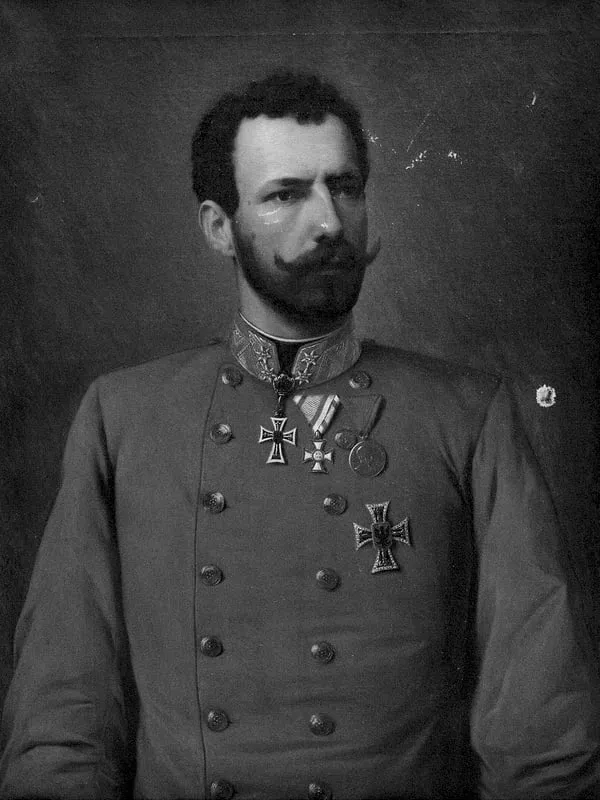
- Born:
- 21 May 1863, Židlochovice (Gross Seelowitz) in Moravia (Czech Republic)
- Died:
- 30 December 1954, Merano (Italy)
- Author:
- Łukasz Skowroń
- Photo:
- Josef Büche, domena publiczna, Wikimedia Commons

Archduke Eugen was one of the few members of the imperial family who were professional, thoroughly trained soldiers. After Oskar Potiorek’s defeat in Serbia he took over the forces in the Balkans in December 1914, and from May 1915 he commanded for two and a half years on the front against Italy, which stretched from the Swiss border to the Adriatic. Under his authority the Austro-Hungarian army held off the first battles of the Isonzo, carried out the Trentino offensive in 1916 and in the autumn of 1917, together with the Germans, routed the Italians at Caporetto. Modest, direct and liked by his soldiers, he was above all a figurehead and a coordinator: the plans of operations were drawn up at the high command and in his staff, in which the energetic General Alfred Krauß played the leading role. When Emperor Karl reorganised the army command, he went into retirement at the beginning of 1918. He was the last Habsburg at the head of the Teutonic Order.
Before the war
He was born on 21 May 1863 at the castle of Gross Seelowitz, today Židlochovice near Brno in Moravia, the youngest son of Archduke Karl Ferdinand. His grandfather was Archduke Charles, Napoleon’s conqueror at Aspern in 1809. His elder brother, Archduke Friedrich, was the nominal commander of the entire Austro-Hungarian army in 1914–1916, and another brother, Karl Stephan, was an admiral. The family upbringing was strict. At the age of fourteen Eugen joined the regiment of the Tyrolean Kaiserjäger and in 1877 became a lieutenant. In 1883–1885 he was the only archduke to go through the full, several-year training of a general staff officer. He then commanded in turn a battalion, infantry and hussar regiments, a brigade in Olomouc and a division in Vienna.
In 1894, after the death of his uncle Wilhelm, he became Grand Master of the Teutonic Order, which had survived in Austria as an order of knighthood tied to the dynasty. As a member of the order he never married. He expanded the order’s medical service and hospitals, which proved much needed during the war. From 1900 he commanded XIV Corps in Innsbruck, being responsible at the same time for the defence of the Tyrol, and in 1901 he became a general of cavalry. In Innsbruck one of his subordinates was the divisional commander Franz Conrad von Hötzendorf, and according to some authors it was also Eugen who recommended him as chief of the general staff in 1906. During the Bosnian crisis of 1908–1909 he was named among the future army commanders in the event of war with Serbia. In 1911, however, he retired from active service, officially on grounds of health. Conrad later suggested in his memoirs that in reality the heir to the throne, Franz Ferdinand, had been jealous of his position.
1914–1915: the Balkans and the Isonzo
When the war broke out Eugen volunteered for service, but for the first months he was entrusted only with the patronage of war relief organisations. In December 1914, after the defeat on the Kolubara and the Serbian recapture of Belgrade, the emperor dismissed Oskar Potiorek, and the archduke took command of all the forces in the Balkans, merged into a single Fifth Army. His headquarters were set up at Petrovaradin on the Danube. Together with his chief of staff Alfred Krauß, an able military theorist and a hard man, he rebuilt the shattered units and defended the line of the Sava and the Danube. During the first months of 1915 relative calm prevailed on this front.
On 22 May 1915, the day before Italy’s declaration of war, Eugen was made colonel-general, and in the last days of May commander of the South-Western Front, with headquarters at Marburg (Maribor). Under him were the forces in the Tyrol, in Carinthia and on the Isonzo, where at the end of May Svetozar Boroević took over the Fifth Army. The monarchy, committed in Galicia, had few troops on the Italian border, and the front command decided to defend the line of the river and of the Karst plateau without giving up an inch of ground without a fight. In the first, second, third and fourth battles of the Isonzo the defenders withstood successive Italian attacks, paying for it with very heavy losses. The archduke often toured the front and the headquarters. On 29 July 1915, during the second battle, he came to VII Corps headquarters at Kostanjevica to confer on how to reduce the losses on the Karst, and his staff pressed for heavy artillery and for trenches to be hewn into the rock instead of building low stone walls. He also looked after supplies and the rear of the front, and became very popular among the soldiers.
1916: the Trentino offensive
For 1916 Conrad planned a thrust from the Tyrol into the rear of the Italian army on the Isonzo. In March the front command was turned into the command of an army group in the Tyrol, and Boroević was henceforth directly subordinate to the high command. Eugen moved his headquarters to Bolzano and took over two armies: Viktor Dankl’s Eleventh Army and Hermann Kövess’s Third Army. The group numbered fourteen divisions and more than a thousand guns. On 15 May the offensive began, known to the Italians as the “punitive expedition”. In the Battle of Asiago the archduke’s troops broke through the Italian lines on the plateaux of Folgaria and Lavarone and took Asiago and Arsiero, but did not descend to the plain. The army group command and the high command reproached Dankl for too slow a pace, and the general, at odds with his superiors, asked to be relieved in mid-June. When the Brusilov offensive began in the east, Conrad had to take more and more divisions from the Tyrol, and on 16 June he ordered a shift to the defensive. The archduke’s order to the troops spoke of more than 47,000 Italians taken prisoner. On the night of 24–25 June his troops withdrew to a line prepared in advance, shorter and easier to defend, and repelled the Italian counter-offensive.
In the following months the Tyrol front had to give up more units to the Isonzo, where in August the Italians took Gorizia. According to Austrian authors Eugen, who had been bound up with the Tyrol for years, was nevertheless unwilling to shorten the front at the cost of giving up ground. On 23 November 1916, two days after Karl I came to the throne, he was made a field marshal together with Conrad.
1917: Caporetto and dismissal
In March 1917, after the reorganisation of the high command, Eugen again took over the entire South-Western Front, with headquarters at Marburg. During the tenth and eleventh battles of the Isonzo he had to divide scanty reserves between the Tyrol and the Isonzo, and in May he refused to let Boroević move a division behind a threatened sector, because the high command had announced that there would be no reinforcements. In the autumn he had under him Boroević’s army group and the new German Fourteenth Army of General Otto von Below, which on 24 October broke through the front at Bovec and Tolmin. In the Twelfth Battle of the Isonzo, known as the Battle of Caporetto, the Italians fell back beyond the Piave and lost nearly 300,000 prisoners. The archduke was the nominal head of the whole operation, although its plan was prepared by German officers of Below’s staff and by the Austro-Hungarian high command, and Conrad’s army group in the Tyrol was not directly subordinate to him. During the pursuit the Austrian and German commands often issued contradictory orders, for which according to some authors the front staff was also to blame. On 11 November Eugen ordered the armies on the Piave to prepare a methodical crossing of the river, and Krauß’s group to strike across the Grappa massif towards the plain. In the First Battle of the Piave, however, these attacks failed.
On 18 December 1917 the emperor relieved him of his command, and on 11 January 1918 placed him on the retired list. The front command was abolished, and Conrad’s and Boroević’s army groups were placed directly under the high command. Austrian authors see this as a consequence of the restructuring of command rather than a punishment: the front had become shorter, Karl wanted to direct the war himself, and a field marshal could not take a subordinate post. Eugen kept great authority. In April 1918, during the Sixtus affair, the foreign minister Ottokar Czernin is said to have urged the emperor to hand over the government for a time, on the grounds of an alleged illness, to him of all people as regent, but Karl refused.
After the war
In April 1919 the archduke left Austria and for fifteen years lived modestly in Switzerland, mainly in Basel. In 1923 he resigned the dignity of Grand Master to protect the property of the Teutonic Order from confiscation as Habsburg property. In the following years the order was transformed into a clerical order. In 1934 Eugen returned to Austria and settled in the order’s castle at Gumpoldskirchen near Vienna, taking part in veterans’ reunions and legitimist meetings. After the annexation of Austria by Germany in 1938 the Nazis dissolved the order in Austria, and the archduke had to move to Vienna. After the Second World War he lived at Igls near Innsbruck. He died on 30 December 1954 in Merano at the age of 91 and was buried in St. James’s Cathedral in Innsbruck.
Assessment
In his own time Eugen enjoyed great respect. A British encyclopaedia of 1922 wrote that the battles fought under his direction on the Isonzo and in the Tyrol made up a series of successes and that his unassuming character had made him very popular. His monument still stands in Innsbruck. He was regarded as a commander who cared for his soldiers and was often seen in the front line.
Historians, however, assess his influence on the course of the war cautiously. The most important strategic decisions were taken at the high command, by Conrad and later by Emperor Karl; the day-to-day direction of operations lay in the hands of the chiefs of staff, especially Krauß; and the defence on the Isonzo was in practice conducted by Boroević. The Trentino offensive, although it gained ground and prisoners, did not reach its goal and weakened the Eastern Front on the eve of the Brusilov offensive. Even the victory at Caporetto is attributed above all to the Germans and to lower-ranking Austrian commanders. In the eyes of most scholars the archduke was a conscientious and competent soldier and an efficient coordinator who gave his staffs freedom of action, but not an outstanding commander.
Sources
Spotted a mistake?Report an error
Commanded in battles
(09)- 23 June 1915 – 9 November 1917Battles of the IsonzoItalian Front
- 23 June – 7 July 1915First Battle of the IsonzoItalian Front
- 18 July – 3 August 1915Second Battle of the IsonzoItalian Front
- 18 October – 4 November 1915Third Battle of the IsonzoItalian Front
- 10 November – 2 December 1915Fourth Battle of the IsonzoItalian Front
- 11–16 March 1916Fifth Battle of the IsonzoItalian Front
- 15 May – 25 June 1916Battle of AsiagoItalian Front
- 24 October – 9 November 1917Twelfth Battle of the IsonzoItalian Front
- 10 November – 26 December 1917First Battle of the PiaveItalian Front
Mentioned in battles
(01)Often appears with
People who appear in the same events.