1917: The Italian front
Eleventh Battle of the Isonzo
- Dates:
- 17 August – 12 September 1917
- Front:
- Italian Front
- Location:
- The Isonzo front from Krn and Tolmin to the Adriatic. The main attack on the Bainsizza plateau (Banjška planota) between Kanal and Plava and on Monte Santo and Monte San Gabriele above Gorizia, the second on the Karst plateau from Fajti hrib and Kostanjevica to Selo, Flondar and the foot of Hermada, Austria-Hungary (now Slovenia and Italy)On the battle map →
- Sides:
- ItalyLuigi Cadorna, Luigi Capello, Prince Emanuele Filiberto, Duke of Aosta, Enrico Caviglia, Pietro BadoglioAustria-HungarySvetozar Boroević, Wenzel von Wurm, Ludwig Goiginger, Alois Schönburg-Hartenstein
- Result:
- Inconclusive. The Italians crossed the Isonzo and took the western part of the Bainsizza plateau and Monte Santo, but did not take Monte San Gabriele or break the front on the Karst. Exhausted, Austria-Hungary decided on a counter-offensive with German help.
- Author:
- Natalia
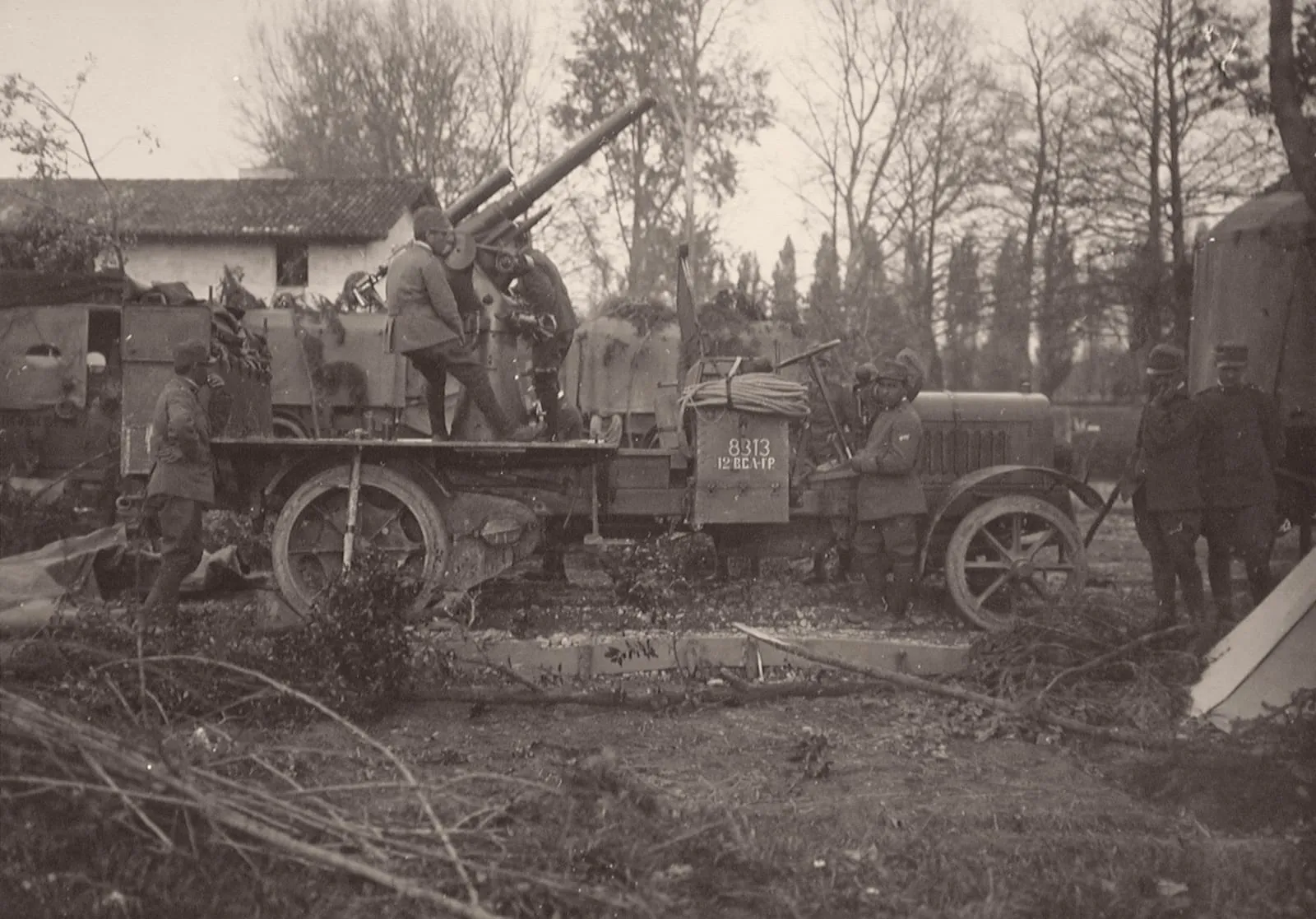
The Eleventh Battle of the Isonzo was the largest offensive of the Italian army in the whole war. General Luigi Cadorna massed 51 divisions on the Isonzo, three quarters of his infantry, and, according to the Austrian official history, about 5,200 guns and trench mortars. This time the main blow was struck by General Luigi Capello’s 2nd Army. On the night of 18–19 August its soldiers crossed the Isonzo above Plava and within a few days took most of the Bainsizza plateau, and on 24 August they climbed Monte Santo above Gorizia. General Svetozar Boroević had to pull his troops back to a new line, but the Italians could no longer break the front. Until the middle of September they stormed Monte San Gabriele in vain, and on the Karst plateau their 3rd Army, after its first gains, was halted once again below Hermada. The two sides together lost about a quarter of a million men. The Austrians held out, but concluded that they might not survive another such battle.
Name and dates
In Italian the battle is called the undicesima battaglia dell’Isonzo or the battaglia della Bainsizza, after the plateau on which the Italians won their greatest successes. In German it is the elfte Isonzoschlacht. The dates of the battle differ from source to source. The Italian official history gives 17–31 August 1917. On 17 August the Italian artillery on many sectors was already firing ranging fire so dense that, according to Cadorna, it differed little from a barrage, and the full bombardment from Tolmin to the sea began at dawn on 18 August. The infantry attacked along the whole front on the morning of 19 August. The Austrian official history (Österreich-Ungarns letzter Krieg) describes the assault from 18 August, but elsewhere states that the battle began on 17 August, and an illustrated monograph published in Vienna bears the title “The Eleventh Battle of the Isonzo. 17 August to 8 September”. The Treccani encyclopaedia dates the battle to 18 August – 12 September. The fighting for Monte San Gabriele went on at full strength on 12 and 13 September, and locally even longer. We adopt the dates 17 August – 12 September 1917.
Background
After the Tenth Battle in May and June 1917 both armies on the Isonzo prepared for the next one. Cadorna counted on help from his allies. In July he asked the French and British for at least a hundred heavy guns and wrote to General Ferdinand Foch that for lack of ammunition he would not resume the attack before the end of August. Prime Minister David Lloyd George still wanted to smash Austria-Hungary with a joint blow on the Isonzo. At the conference in Paris at the end of July Cadorna demanded ten divisions and 400 guns for such an offensive, but the Chief of the Imperial General Staff, General William Robertson, would agree to it only after the end of the offensive in Flanders. For the time being, therefore, the Italians had to attack on their own. Over the summer they formed six new divisions and received many new batteries of heavy artillery.
This time Cadorna issued no detailed written orders. The 3rd Army of the Duke of Aosta, Emanuele Filiberto, was to take the Karst as far as Komen, and the 2nd Army the Trnovo plateau east of Gorizia, seizing the Bainsizza plateau (in Slovene Banjška planota) on the way. This high, stony and waterless ground on the eastern bank of the Isonzo, between Kanal, the valleys of the Idrijca and Čepovan and Monte Santo, linked the Austro-Hungarian sectors at Tolmin and at Gorizia. Capello, the ambitious conqueror of Gorizia in 1916, widened his army’s task. He made his main objective the Austro-Hungarian bridgehead at Tolmin, which he wanted to take by a blow from the south. His three corps, General Vanzo’s XXVII, General Enrico Caviglia’s XXIV and General Pietro Badoglio’s II, were to cross the Isonzo and force their way onto the plateau. According to the Treccani encyclopaedia the 2nd Army had six corps and 26.5 divisions, the 3rd Army four corps and 18 divisions, and six and a half divisions stood in the reserve of the Supreme Command. About 600 of the Italian army’s 887 battalions were assigned to the attack, with 2,400 medium and heavy guns, 1,200 field and mountain guns and 1,700 trench mortars.
At the beginning of July Boroević’s army, called the Isonzo Army, had only one division more than before the May battle. The Russian offensive in Galicia made it impossible to bring reinforcements from the east, so the Austrian command took individual battalions and batteries from the Tyrol and Carinthia. According to Treccani, Boroević had three corps with 13 divisions facing the Italian 2nd Army and two corps with 9 divisions facing the 3rd Army. On the Bainsizza plateau, which until May had been regarded as a quiet sector, the positions were weak and still under construction. The ground had no roads or water, and from the Kuk and Vodice ridge, taken in May, the Italians could see everything that happened there. The bank of the Isonzo north of Kanal was guarded by overstretched units: two Hungarian Landsturm battalions of the 22nd Mountain Brigade on a six-kilometre sector and, further south, the 21st Rifle Division. From 14 August the Italian artillery shelled the rear areas, roads and headquarters, and in the middle of the month more and more Italian deserters came over to the Austrian side shouting “To Mauthausen!”, where there was a prisoner-of-war camp. From their statements the Austrians knew that the assault would begin on 18 August.
Course
The crossing and the first days (17–21 August)
After the ranging fire of 17 August the Italian artillery opened a bombardment of the whole front from Krn to the sea at dawn on 18 August. By evening villages and woods were burning in the Austrian rear, from Tolmin to the slopes of Hermada. On the night of 18–19 August the engineers of the 2nd Army began building bridges on a stretch of about 12 kilometres between Anhovo and Doblar. According to Cadorna, the sluice gates of the dam at Caporetto were lowered to bring down the level of the river. Fourteen crossings were planned, but only about half could be built. The XXVII Corps fared worst: at Javor the defenders prevented the building of bridges and its units had to crowd onto the single crossing at Doblar. The XXIV Corps was more successful, building four bridges and two footbridges. Before dawn Bersaglieri of the 47th Division, supported by Alpini, were already on the left bank in large numbers; they broke through the positions of the 42nd Rifle Brigade and climbed to the edge of the plateau. The 60th Division, by contrast, was held up in front of fortified Kanal.
On the morning of 19 August the Italian infantry went in to the assault along the whole front from Tolmin to the sea. In the north the attacks on Mrzli vrh and in front of the Tolmin bridgehead were repulsed. At Gorizia the Italian VIII Corps attacked after a gas bombardment from San Marco to Vertojba and gained nothing. On the Karst four corps of the 3rd Army struck. The Austro-Hungarian VII Corps held its positions from Fajti hrib to Kostanjevica, but General Armando Diaz’s XXIII Corps broke into the lines of the Austrian 12th Division at Veršič and Selo, and by the sea the Italians took some of the positions between the railway tunnels below San Giovanni. Heavy guns at the mouth of the Sdobba and around Monfalcone shelled the area behind Hermada, and in the evening a British monitor fired a few rounds at Trieste.
On 20 August the Italians widened their gains. At Kanal the Bersaglieri outflanked the fortified little town and opened the way for the 60th Division. The Austrian reserves that tried to counter-attack in the Vrh basin were shattered by artillery fire. On the Karst the 12th Division was pushed back to the switch line from Stara lokva to Kostanjevica, and the hills of Flondar and the area around Medeazza below Hermada were fought over until late at night. On 21 August, at about 3 p.m., the Italian XXIV Corps took Kuk hill (711 m), defended mainly by companies of the Galician 45th Infantry Regiment, and advanced to Jelenik. On the Karst the Italians were still storming Fajti hrib and Hill 378, and below Hermada the fighting moved from line to line.
On the Karst, however, the attack was not producing the expected results. On the evening of 21 August Cadorna halted the 3rd Army’s offensive. He ordered it to hold the ground it had taken and to hand over two divisions and several dozen batteries to Capello, who was to exploit his success on the Bainsizza plateau. Cadorna later explained that the result of the first attack, “usually the most fruitful”, had been too modest on the Karst to go on bleeding the army.
Crisis on the Bainsizza plateau (22–25 August)
From dawn on 22 August heavy artillery wrapped Jelenik hill in smoke and gas. In the afternoon the Italian infantry took it, broke the front by the road to Bate and came out onto the middle of the plateau. The centre of the Austrian 106th Landsturm Division, which had held out for four days in the Rohot valley below Rutaršče, also gave way. That day Emperor Charles I came to the front. He watched the battlefield from the Trnovo plateau, while on the other side of the Isonzo, by chance at the same hour, the King of Italy, Victor Emmanuel III, was looking at it too. The Chief of the Austro-Hungarian General Staff, General Arthur Arz von Straussenburg, told Boroević that progress on the Russian front would soon make it possible to strike at the Italians from the Tolmin and Bovec area.
At 9 p.m. Boroević unexpectedly told his chief of staff that he was giving up the whole Bainsizza plateau. The front of the XXIV Corps was to fall back to the edge of the Trnovo plateau and the eastern side of the Čepovan valley. The order was issued at 9 a.m. on 23 August, and the retreat began on the night of 23–24 August. General Ludwig Goiginger, commander of the newly arrived 73rd Division, and the commanders of both corps persuaded the army, however, to stop earlier, on a line from Log through Kal and Madoni to Zagorje and Monte San Gabriele. At the same time Arz asked Field Marshal Paul von Hindenburg to transfer four or five divisions from the Russian front to the Isonzo.
The Italians did not notice in time that the enemy was giving way. On 23 August their attack clearly weakened, and on 24 August Capello called his corps commanders to a conference. During it news arrived that Monte Santo was in Italian hands. At about noon units of General Antonio Cascino’s 8th Division occupied the summit with the ruins of the monastery, fought over in vain in May, and other units climbed Vodice. According to the Treccani encyclopaedia the Italian flag had already been flying on the summit the evening before. According to Cadorna the Italians took more than 19,000 prisoners and 125 guns on the plateau (135 according to Treccani). The defenders occupied the new line in good order, and on the evening of 25 August Boroević ordered it to be held permanently. That same day the Austrian Supreme Command divided the Isonzo front into two armies: General Wenzel von Wurm’s 1st Isonzo Army on the Karst and at Gorizia, and the 2nd Isonzo Army on the Bainsizza and Trnovo plateaus, with Boroević taking command of the whole army group.
The fighting for Monte San Gabriele (25 August – 12 September)
After the fall of Monte Santo the key to the defence became Monte San Gabriele, which could now be attacked from the west and from the north. On 25 August the Italian 11th Division broke onto its western slopes. On 28 August the Italians attacked along the whole sector from Madoni to San Marco. On the northern summit, Veliki hrib, the fighting went on until nightfall, when both sides, exhausted, lay down a grenade’s throw apart. On 29 August Cadorna broke off the attack on the Bainsizza plateau. Lack of ammunition also forced him to give up resuming the offensive on the Karst. He ordered Capello to prepare a new attack on the hills around Gorizia for the middle of September, but Capello did not wait and continued the assault on San Gabriele. He brought up about 700 medium and heavy guns and several hundred mortars against it. According to Cadorna, this was the greatest concentration of artillery on so small an area in the war.
At dawn on 4 September, after a tremendous bombardment, the 11th Division, helped by storm troops from the first arditi unit, took Hill 552 and the main summit, 646, capturing, according to the Austrians, more than a thousand prisoners. The defenders taken by surprise were from two Landsturm regiments that had only taken over the positions during the night. By noon the Moravian 25th Landsturm Regiment had retaken the summit, and the slopes were still fought over on 5–7 September. On the same day, 4 September, on the Karst, the Austro-Hungarian XXIII Corps counter-attacked at the foot of Hermada and regained the front line between Flondar and the sea. Many Italians died in the burning railway tunnel below San Giovanni. According to the Austrian official history, 163 officers and 6,620 men were taken prisoner there, and on 5 September the counter-attack was repeated and the Italian attacks finally ceased.
From 8 to 10 September Capello tried to force the defenders of San Gabriele to surrender by a “siege by fire”: his batteries shelled the mountain and the ground behind it without a break, day and night, firing about 45,000 shells. On the night of 11–12 September the Upper Austrian 14th Infantry Regiment attacked Hill 552, took it and captured 600 prisoners just as the Italians were preparing to assault. On 12 September heavy fighting for the summit brought the Italians no gains, and after a last attack on 13 September the bombardment gradually died down. The Italians called San Gabriele “the mountain of death”.
Losses
According to the Austrian official history the Italians lost 40,000 killed, 108,000 wounded and 18,000 missing, about 166,000 men in all. Cadorna wrote of 148,000 killed and wounded in August and early September. Other studies give about 158,000–160,000. According to the Austrian official history the losses of the Isonzo Army amounted to more than 10,000 killed, more than 45,000 wounded and about 30,000 missing, and together with 20,000 sick about 110,000 men in all. Cadorna stated that the Italians took 858 officers and 29,813 men prisoner and captured 145 guns. From 18 August to 6 September the Austrian artillery fired about one and a half million shells from light guns, more than a quarter of a million from medium guns and 22,000 from heavy mortars, a third more than in May.
Significance
In this battle the Italians won their greatest territorial success of all the battles on the Isonzo. On the Bainsizza plateau they advanced about 10 kilometres and occupied roughly a hundred square kilometres, and Monte Santo, which for two years had barred their way north of Gorizia, was at last in their hands. It was not, however, a breakthrough. San Gabriele and Hermada still blocked the way to Gorizia and Trieste, and the troops on the plateau, without roads or water and with their artillery left far behind, could go no further. In Italy the disappointment was all the greater because victory had been expected. Cadorna, who had lost about 300,000 men in the tenth and eleventh battles and had no ammunition, informed the Allies on 21 September that he was going over to the defensive.
The Austrians regarded the battle as a defensive victory, but their official history called it a Pyrrhic victory. The losses could no longer be made good, and the command feared that the Isonzo front would not survive a twelfth such battle. On 25 August Arz decided to mount a counter-offensive before the winter. On 26 August Emperor Charles asked Wilhelm II for German troops to replace the Austro-Hungarian divisions in the east, since he wanted to fight the Italians with his own troops alone. The Germans refused, but sent General Konrad Krafft von Dellmensingen, experienced in mountain warfare, to the Isonzo to examine the possibility of a joint attack. From this decision was born the Austro-German offensive from Tolmin, which in October 1917 led to the disaster at Caporetto. According to many historians, the 2nd Army’s weakly fortified positions on the Bainsizza plateau, stretched across both banks of the Isonzo, made the attackers’ task easier at that time.
Spotted a mistake?Report an error