1915: The Italian front and the Battles of the Isonzo
Third Battle of the Isonzo
- Dates:
- 18 October – 4 November 1915
- Front:
- Italian Front
- Location:
- The Isonzo valley from Bovec and the Krn massif to the Adriatic, the Tolmin bridgehead, the Plava bridgehead, the Gorizia bridgehead (Sabotino, Oslavia, Podgora) and the Karst plateau (Monte San Michele, San Martino del Carso, Sei Busi, the hills near Monfalcone), Austria-Hungary (now Italy and Slovenia)On the battle map →
- Sides:
- ItalyLuigi Cadorna, Prince Emanuele Filiberto, Duke of Aosta, Pietro Frugoni, Luigi CapelloAustria-HungarySvetozar Boroević, Archduke Eugen of Austria, Archduke Joseph August of Austria
- Result:
- Austro-Hungarian defensive victory. The Italians took only isolated stretches of trench near San Martino, on Podgora and near Plava, while Gorizia and Monte San Michele remained in the defenders' hands.
- Author:
- Natalia
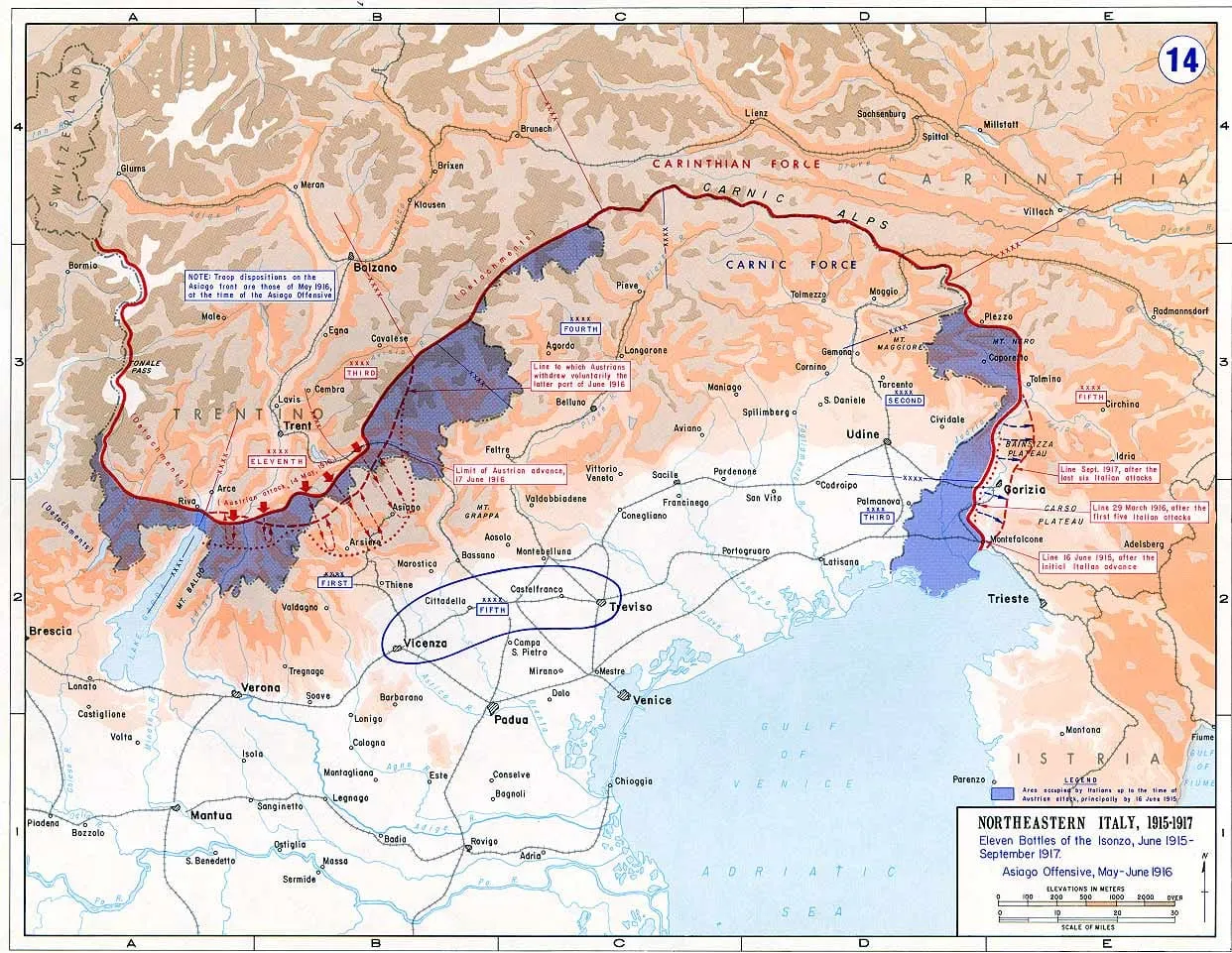
The Third Battle of the Isonzo was the Italian army’s first autumn offensive on the Isonzo and the largest of its operations so far. From 18 October to 4 November 1915 the 2nd and 3rd Armies, together 338 battalions with more than 1,300 guns, attacked the Austro-Hungarian 5th Army of General Svetozar Boroević along the whole front, from the mountains above Bovec to the Adriatic coast. The objective was Gorizia, which the Italians meant to envelop with thrusts from the north, from Plava, and from the south, across the Karst plateau. The battle opened with a three-day bombardment such as this front had never yet seen. Even so, the defenders, less than half as strong, held almost all their positions. The Italians lost about 67,000 men, the Austrians nearly 42,000.
Name and dates
In Italian the battle is called the terza battaglia dell’Isonzo, in German the Dritte Isonzoschlacht, and in Slovene the tretja soška bitka. The Italian and Austro-Hungarian official histories date it 18 October – 4 November 1915, and that is what we adopt on this page. The bombardment began at noon on 18 October, and on the evening of 4 November General Luigi Cadorna ordered the attacks to be halted. Some works count the battle only from 21 October, when the infantry went in. Dates shifted by a day (17 October – 3 November) also occur. The Austrian official history points out that the name “third battle” was given because of the pause that came on 5 November. In reality this was only the first part of the autumn offensive, for as early as 10 November the Fourth Battle of the Isonzo began, lasting until December.
Background
After the Second Battle of the Isonzo the Isonzo front fell quiet for more than two months. General Luigi Cadorna brought his bled-white divisions back up to strength and assembled artillery. Heavy batteries were brought in from the fortresses of Verona and Venice, from the fortifications on the Tagliamento and from the Tyrolean front, and French 260 mm howitzers and naval guns arrived. The infantry received more machine guns, heavy trench mortars, elongated explosive charges for destroying barbed wire, steel helmets and portable shields. According to the Austrian official history, a million artillery shells had been stockpiled by 17 October, an average of about 725 per gun.
Italy also needed a success for political reasons. After five months of war enthusiasm had clearly waned, there were strikes in the industrial districts, and the socialists were demanding that parliament be convened on 1 December. Paris and London pressed Cadorna to attack as soon as possible and relieve Serbia, which Austria-Hungary and Germany had attacked on 6 October. Cadorna, however, did not want to begin before he had accumulated ammunition. He set the attack for 18 October.
The plan envisaged two phases. First the strong wings were to push the defenders off the two salients on either side of Gorizia: General Pietro Frugoni’s 2nd Army from Plava onto the Bainsizza plateau (Slovene Banjšice), and the Duke of Aosta’s 3rd Army from the edge of the Karst onto the Doberdò plateau. Only then was General Luigi Capello’s VI Corps to strike frontally at the Gorizia bridgehead, between Mount Sabotino and Podgora hill. In the north the IV Corps was to attack the Krn massif and the Tolmin bridgehead for the third time. According to the Italian official history, the 2nd Army had 163 battalions and 654 guns, the 3rd Army 125 battalions and 546 guns, and the supreme command’s reserve 49 battalions and 172 guns. In all this made 338 battalions and 1,372 guns, including 305 heavy and medium pieces. Other works give a round 1,200–1,250 guns.
The Austrians knew what was coming. From the beginning of October radio intercepts, airmen, prisoners and deserters reported concentrations of troops and new batteries. From 14 to 17 October the Italians carried out reconnaissance in force against the Austrian advanced positions below Monte San Michele. On the Isonzo Boroević had 12 divisions: 137.5 battalions, about 128,600 rifles and 634 guns. The Italians were estimated at 300,000–350,000 rifles. Archduke Eugen’s South-Western Front had almost no reserves, and the high command had just committed large forces against Serbia and Russia.
Course
Bombardment (18–20 October)
At noon on 18 October the Italian artillery opened fire along the whole front, from the snow-covered peaks of Krn to the coast. The Austrian official history calls it a seventy-hour artillery preparation. The fire fell on trenches, barbed wire, reserve positions, approach roads, headquarters and batteries. The exposed salient of the front on the Karst suffered most. On the first day smaller infantry detachments were already attacking the slopes of Monte San Michele and Krn, but they were repulsed everywhere. For the first time on this front the Italians also used aircraft on a large scale. On the morning of 19 October bombers, among them Capronis, dropped more than a hundred bombs in two hours on the Austrian airfield at Ajševica near Gorizia. From then on raids on railway stations, headquarters, Gorizia and Trieste were repeated regularly, and the Austrians had too few anti-aircraft guns to defend themselves.
On 20 October the bombardment was still going on, and heavy trench mortars began destroying the barbed wire on Sabotino and Podgora. The defenders, stripped of cover, lay in shell craters and karst hollows. At night they repaired what they could. Austrian artillery smashed a pontoon bridge that the Italians were trying to throw across the Isonzo near Mainizza.
Attack along the whole front (21–24 October)
On the morning of 21 October the bombardment reached its greatest intensity. On the Karst the Italian infantry went in just after ten o’clock (Italian sources say the signal to attack was given at nine), and on the upper Isonzo at noon. On the plateau the XIV Corps struck with four brigades on a front about two kilometres wide at Monte San Michele and the village of San Martino del Carso. From the rubble of trenches in which, after three days of bombardment, no one expected anyone to be alive, came a hail of rifle and machine-gun fire. The first waves reached the Austrian trenches on the western summit of San Michele, but by the afternoon a counter-attack by the reserves of the 20th Honvéd Division had pushed them off the hill. Twenty officers and about five hundred men were taken prisoner. Near Monfalcone and Selz the attacks of the VII Corps broke down under flanking artillery fire from Hermada hill. On the first day alone the defenders of the Karst lost about 950 killed, 3,800 wounded and 800 missing.
At the same time the Italians were attacking in the north. On Krn, on the Mrzli vrh and Vodil vrh ridges and against the Tolmin bridgehead, attacks by a dozen or so battalions of infantry and Alpini were repeated for four days, more than once ending in hand-to-hand fighting in the Austrian trenches. An attempt by the VIII Corps to cross the Isonzo in boats at Loga and Ajba near Kanal (Canale) was crushed by the defenders’ fire before dawn. At Plava the II Corps stormed the hills around the bridgehead in vain, and the Viennese battalion of the “Hoch- und Deutschmeister” regiment particularly distinguished itself in the defence. By 24 October the Austrian XV Corps on the upper Isonzo had lost about 2,900 men and had not given up a single important position.
On 22 October the Italians committed further divisions on the Karst. They broke into a stretch about a kilometre wide north-west of San Martino and pushed the bled-white 17th Honvéd Regiment back to the second line. In the centre, in front of Sei Busi hill, the Landsturm of the 106th Division barely held its positions, while the Italian 16th Division lost about 4,000 men in two days near Monfalcone. On 23 and 24 October the battle for San Michele reached its climax. The Duke of Aosta received new divisions from Cadorna and at 3 p.m. on 24 October, after several hours of hurricane fire, threw some four and a half divisions into the assault on the sector from the Isonzo to Sei Busi. Seven or eight regiments attacking San Michele broke down in front of the Austrian lines. The 43rd Infantry Regiment from the Banat, made up largely of Romanians, particularly distinguished itself here. In the evening Cadorna ordered the 3rd Army to take a short pause. According to the Italian official history, from 21 to 27 October the two Italian armies lost 39,000 men.
Pause and second wave (25–30 October)
During the pause on the Karst the Italians attacked the Gorizia bridgehead. On 23 and 24 October their reconnaissance in force on Sabotino and near Oslavia was repulsed. According to the Austrian official history, the Italians then used artillery shells with poison gas for the first time. On 25 and 26 October the Dalmatian 23rd Landwehr Infantry Regiment beat off two assaults on Podgora. On the upper Isonzo a snowstorm began on 27 October and put an end to the fighting on Krn. On 29 October near Kanal Austrian artillery smashed the boats and pontoons of the last Italian attempt to cross the river.
On 28 October the battle flared up again. Cadorna no longer wanted to wait for successes on the wings and decided to strike straight at Gorizia, which was meant to calm an impatient public opinion. General Capello’s VI Corps attacked the bridgehead from Sabotino through Oslavia to Podgora with three divisions. On Sabotino machine-gun fire and flanking artillery from the opposite bank threw back the 4th Division and the Grenadier Brigade. On Podgora the Italian 12th Division got as far as the crest, from where the soldiers could see Gorizia at their feet in the setting sun. Five companies of Dalmatian riflemen, however, pushed them off the hill with a counter-attack. The defence of the bridgehead was commanded by General Erwin Zeidler of the 58th Division, and on 29 October the commander-in-chief of the Austro-Hungarian army, Archduke Friedrich, watched the fighting on Podgora.
On the Karst on 28 October seven Italian divisions attacked on a front only seven kilometres wide, from Peteano to Sei Busi. For two days the Italians broke into the Austrian trenches several times near San Martino and at hill 111, but night counter-attacks by the 39th Infantry Regiment and the 24th Feldjäger Battalion retook the lost stretches. On 30 October Cadorna again briefly halted the attacks.
The last assault (31 October – 4 November)
The last phase of the battle began on the afternoon of 31 October. On 1 November, supported by a new division from the reserve, seven divisions of the 3rd Army attacked Monte San Michele, San Martino and hill 111. Under cover of a storm that blinded the defenders, the Italians broke into the trenches of the Austrian 17th Division, but by nightfall a counter-attack had thrown them out of almost all the stretches they had taken. On 2 November, a rainy All Souls’ Day, the battle on the Karst reached its peak. The Austrians again lost several stretches of trench and again retook them with their last strength.
At Gorizia on 1 and 2 November the Italians stormed Sabotino, Oslavia and Podgora. The Italian 11th Division took the village of Oslavia with its church, but on the night of 2–3 November General Zeidler’s last reserve, a battalion of the Dalmatian 37th Landwehr Infantry Regiment, retook it together with several hundred prisoners. General Capello pressed on and on 3 November threw his divisions at Podgora, where some of the Italians got onto the southern slopes. On the morning of 4 November the exhausted defenders drove them out of there almost completely. The same day the last attacks near San Martino were repulsed on the Karst. On the evening of 4 November Cadorna, in view of the exhaustion of his troops and the torrential rain, ordered the offensive halted, but also ordered preparations for its swift resumption.
Casualties
According to the Italian official history, the 2nd Army lost 24,800 men and the 3rd Army 42,200, about 67,000 in all, or almost 23 per cent of their strength. Some regiments on the Karst lost half their men. The attempts to break through at Gorizia alone cost the Italians about 300 officers and 10,000 men. By its own figures the Austro-Hungarian 5th Army, together with the 44th Rifle Division, lost 41,847 men: 8,228 killed, 26,418 wounded and 7,201 missing. On top of this there were about 6,000 sick. The heaviest losses, almost 24,000 men, were suffered by the VII Corps of Archduke Joseph August, fighting on the Karst. Shelling and air raids also killed about 50 and wounded 70 of the inhabitants of Gorizia who had stayed in the town.
Significance
After eighteen days of fighting the Italians had taken only the advanced positions near Peteano and on the slopes of Monte San Michele, about a kilometre of trenches west of San Martino and as much again at hill 143, and isolated stretches of the front line on the western slopes of Podgora, near Plava and on the slopes of Mrzli vrh. Gorizia, Monte San Michele, Sabotino and the Tolmin bridgehead remained in Austrian hands. The battle showed that even very numerous artillery, dispersed along the whole front and firing schematically, could not destroy a defence that quickly patched breaches with counter-attacks by reserves. The Italians blamed the quality of their guns and ammunition and the poor training of their gunners.
Nor did the offensive bring Serbia the help the Allies had counted on. Austria-Hungary held the front while bringing only one division (the 6th Infantry Division) to the Isonzo from the Eastern Front, and individual battalions from the Tyrol, Carinthia and Pola. For both sides it was the first great “battle of matériel” on this front. Cadorna gave his troops only a few days’ rest. On 10 November the fourth of the Battles of the Isonzo began.
Spotted a mistake?Report an error