1916: The Italian front
Fifth Battle of the Isonzo
- Dates:
- 11–16 March 1916
- Front:
- Italian Front
- Location:
- The Gorizia bridgehead (Podgora), the northern part of the Karst plateau (Monte San Michele, San Martino del Carso), the area of Selz near Monfalcone, and in the north the Tolmin bridgehead and the Mrzli vrh ridge, Austria-Hungary (now Italy and Slovenia)On the battle map →
- Sides:
- ItalyLuigi Cadorna, Prince Emanuele Filiberto, Duke of Aosta, Pietro FrugoniAustria-HungarySvetozar Boroević, Franz Rohr, Archduke Eugen of Austria
- Result:
- Austro-Hungarian defensive victory. The Italians took no important position and did not prevent the transfer of Austro-Hungarian divisions to the Tyrol.
- Author:
- Natalia
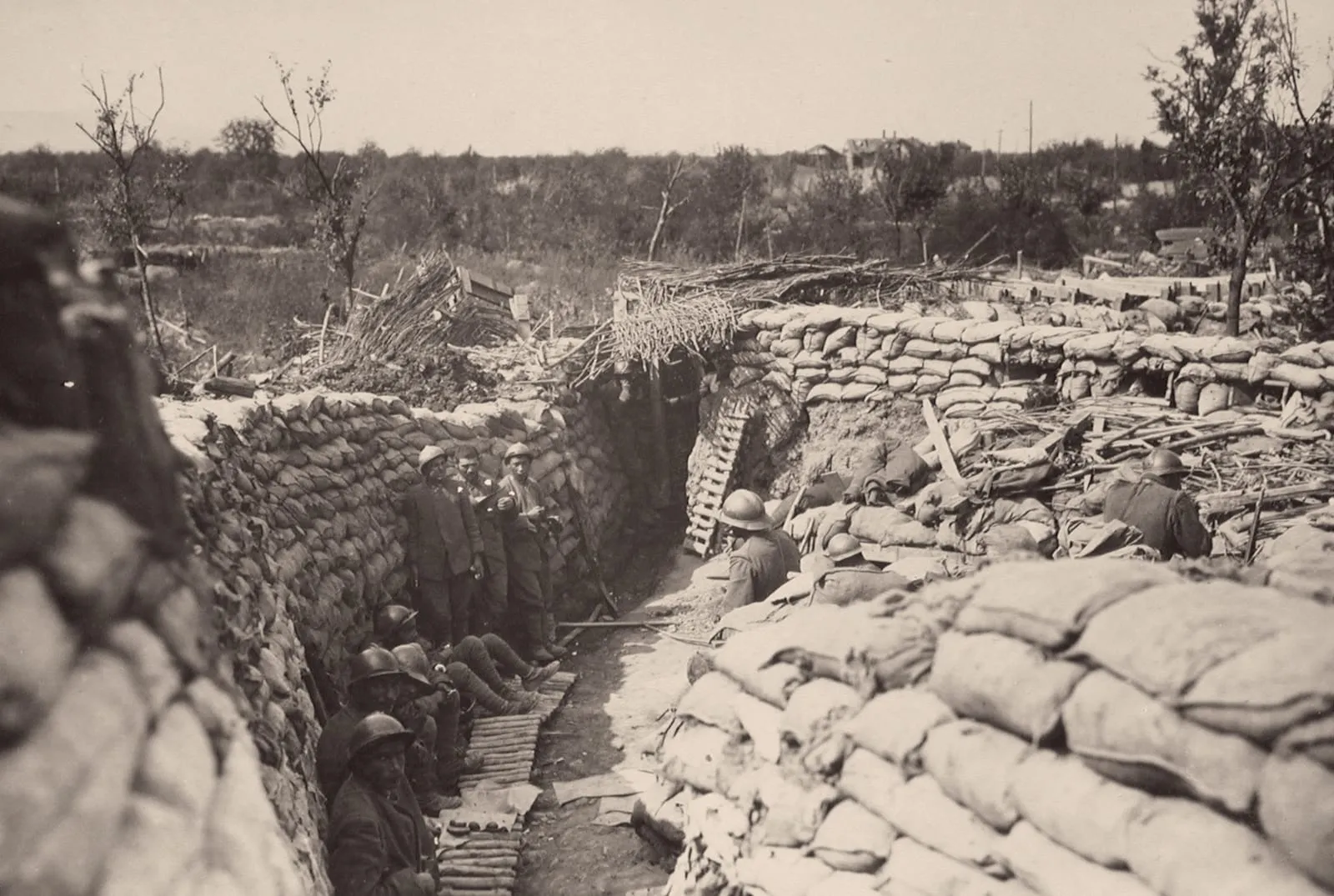
The Fifth Battle of the Isonzo was the shortest and smallest of the Italian offensives on the Isonzo so far. General Luigi Cadorna began it in March 1916 not because he was ready for it, but because the French, fighting at Verdun since 21 February, had called on their allies for relief attacks. For several days the Italian artillery shelled the Austro-Hungarian positions from Tolmin to the sea, and the infantry attacked individual stretches of trench in the Gorizia bridgehead and on the Karst plateau. None of these attacks succeeded, and after a few days snow, rain and fog brought the fighting to a halt. Each side lost about 2,000 men, many times fewer than in the autumn battles of 1915.
Name and dates
In Italian the battle is called the quinta battaglia dell’Isonzo, in German the Fünfte Isonzoschlacht, and in Slovene the peta soška bitka. Its limits are a matter of convention, because the offensive had no single clear beginning or end. The Italian army and most Italian studies give 9–15 March 1916, some Polish and other lists 9–17 March. The Austro-Hungarian official history counts the battle from 11 to 16 March. According to it, the Italians planned to begin with small feint attacks on 8 March, and on 11 March their artillery opened heavy fire along the whole front. This date is usually regarded as the real beginning, and we adopt it on this page. The infantry launched larger attacks only on 13 March, and the last of them collapsed on 16 March. Cadorna himself wrote after the war more broadly of attacks at various points of the front from 6 to 22 March. The British chronology of the war wrongly states that the battle began as early as 15 February.
Austrian historians considered that this scattered fighting did not deserve to be called a battle at all. In their view the Italians named it the “Fifth Battle of the Isonzo” chiefly to convince the enemy that they were taking it seriously, and to conceal the transfer of their own troops from the Isonzo front.
Background
After the fourth battle, which ended in early December 1915, a winter pause in the great offensives set in on the Isonzo, but not in the fighting. In January 1916 General Erwin Zeidler, commanding the Gorizia bridgehead, ordered the recapture of the ridge below the church at Oslavia, taken by the Italians at the end of November. The first night raid on 14 January ended after three days with the loss of the captured trenches. The second, on 24 January, according to the Austrian official history restored the whole line held before the fourth battle and brought in about 1,200 prisoners. In February the Italians stepped up their shelling and night skirmishes at Plava, at Oslavia, on Podgora and on the Karst. Cadorna later recalled noticeable progress at Plava and attacks in the area of Monte San Michele, while the Austrians wrote of a failed attack by several companies at San Martino on 13 February and of a brief break-in by one battalion into their trenches at Peteano on 27 February.
At the Second Chantilly Conference in December 1915 the Allies agreed on simultaneous offensives on all the main fronts in 1916 and on a promise that a state attacked by the enemy would receive help in the form of relief attacks. The great Italian offensive was not due to start until the summer, but the German blow at Verdun forced the French to call for that help sooner. The order of the Italian supreme command began with the sentence that the general situation and allied obligations required the enemy forces opposite to be pinned down with the greatest energy and prevented from being transferred to other fronts. Cadorna was not eager for this offensive, because his intelligence reported a concentration of Austro-Hungarian troops in the southern Tyrol, and the weather in the mountains still made larger operations impossible.
On the Austro-Hungarian side the high command was preparing exactly what Cadorna feared. General Franz Conrad von Hötzendorf had decided to strike in the spring from the Tyrol into the rear of the Italian army, and he was taking the troops for this offensive largely from the Isonzo. On 8 February the first order was issued to prepare the III Corps with the 6th, 22nd and 28th Divisions for departure, and later also the 18th Division. On the Karst the III Corps was replaced by the VII Corps of Archduke Joseph August. On 15 February the commander of the 5th Army, General Svetozar Boroević, warned that the weakening of his front had reached the limit. He learned of the plans for the offensive in the Tyrol only on 3 March. According to the Austrian official history, in mid-March, just during the fighting, the number of battalions in his army fell from 147 to about 100, more than half of them Landsturm (militia) battalions, and the number of guns from 693 to 467. The upper Isonzo with the Tolmin bridgehead was defended by the 10th Army of General Franz Rohr. Popular summaries state that in March the Italians had 286 battalions (and 90 in reserve) and 1,360 guns on the Isonzo, and the Austrians 100 battalions (and 30 in reserve) and 470 guns.
Course
Cadorna did not impose a single plan. He left the army commanders to choose their objectives, reminding them only that the main objectives remained, as in the previous battles, Gorizia and Tolmin. Because deep snow lay in the mountains, the main burden fell on the 3rd Army of the Duke of Aosta, which since 30 January had also been responsible for the Gorizia bridgehead. Its VI Corps was to take Podgora, the XI Corps to attack between Monte San Michele and San Martino del Carso and try to cross the Isonzo at Mainizza, and the XIII and VII Corps to take selected stretches of trench, among others at Selz near Monfalcone.
On 11 March the Italian artillery opened heavy fire of all calibres on the defenders’ positions and approach roads along the whole front of the 5th Army. Despite poor visibility it fired through the night and the whole of the next day, while assault detachments tried to destroy the wire in front of the Austrian trenches. Only on 13 March did the infantry go over to the attack, each time on narrow sectors, in the same places as in the autumn. The heaviest attack that day was made by the Italian 21st Division at San Martino, where according to the Austrian official history the Hungarian 46th Infantry Regiment repulsed six assaults by six to eight battalions. The same day the Italians struck at Selz, on 14 March at Hill 111 near Polazzo, on 15 March at Hill 197 west of San Martino and on 16 March at Peteano, each time with forces of between a battalion and a regiment. On Podgora, defended by Dalmatian riflemen, one battalion of the Italian VI Corps broke into a narrow stretch of trench on Hill 184 near Lucinico on 14 March, but did not hold it.
In the north, in General Pietro Frugoni’s 2nd Army, the IV Corps was to take the Mrzli vrh ridge and the VIII Corps the hills of the Tolmin bridgehead. According to the Austrian official history, this came to no more than heavy shelling and feeble attempts to approach, which nowhere succeeded. Italian sources also list Mount Sveta Maria near Tolmin among the objectives of the attacks. Around the middle of March both corps broke off operations because of bad weather.
According to the Austrian official history, all the attacks collapsed. The Italian army states that despite the bad weather some ground was gained at San Martino and at Selz. After 16 March the fighting died away in snow, rain and fog. During and after the battle the Austrians, wishing to conceal the departure of their divisions, simulated movements of reinforcements and carried out several raids. On 26 March Dalmatian riflemen briefly took Italian trenches on the Grojna ridge on Podgora, capturing more than 600 prisoners.
Losses
According to the Austrian official history, the Italian 3rd Army lost 83 officers and 1,800 men during the battle, and the Austro-Hungarian 5th Army 485 killed and 1,500 wounded. The Italian army gives 1,882 men for its side: 296 killed, 1,271 wounded and 315 missing. The two figures therefore agree. Compared with the fourth battle, in which the Italians lost almost 49,000 men, these were very small losses, which shows well how limited these attacks were.
Significance
The Fifth Battle of the Isonzo did not move the front and did not fulfil its purpose. According to the Austrian official history, it did not keep the Austro-Hungarian troops on the Isonzo, because it was precisely on the days of the heaviest attacks that the divisions of the III Corps and the 18th Division were leaving the front. From 12 to 26 March they were taken away towards the Tyrol. The reinforcements Boroević received in exchange consisted mainly of militia, and the 34th Division, sent to him from the Eastern Front on 14 March, was also directed to the Tyrol at the beginning of April. It could have helped the French at most indirectly, because only German troops were fighting at Verdun. Cadorna wrote after the war that he knew of nothing to suggest that the Allied staff seriously believed such attacks could effectively draw enemy forces away from Verdun.
What the Italians failed to notice at the time proved more important. The divisions transferred from the Isonzo went into the Austro-Hungarian offensive in the Trentino in May 1916, which forced Cadorna to move a considerable part of his army from the Isonzo front into the mountains. The next great Italian offensive on the Isonzo began only in August 1916 and brought the Italians Gorizia.
Spotted a mistake?Report an error