1916: The Italian front
Sixth Battle of the Isonzo
- Dates:
- 6–17 August 1916
- Front:
- Italian Front
- Location:
- The Gorizia bridgehead (Monte Sabotino, Oslavia, Podgora), the northern part of the Karst plateau (Monte San Michele, San Martino, Doberdò), and after 8 August the hills east of Gorizia from Monte San Gabriele to the Vipava valley and the eastern edge of the Vallone valley; also the Plava bridgehead and the area of Monfalcone, Austria-Hungary (now Italy and Slovenia)On the battle map →
- Sides:
- ItalyLuigi Cadorna, Prince Emanuele Filiberto, Duke of Aosta, Luigi Capello, Settimio PiacentiniAustria-HungarySvetozar Boroević, Wenzel von Wurm, Archduke Joseph August of Austria, Erwin Zeidler
- Result:
- Italian victory. The Italians took the Gorizia bridgehead with Monte Sabotino, Monte San Michele, the town of Gorizia and the Doberdò plateau, but did not break the new Austro-Hungarian defensive line east of the town.
- Author:
- Natalia
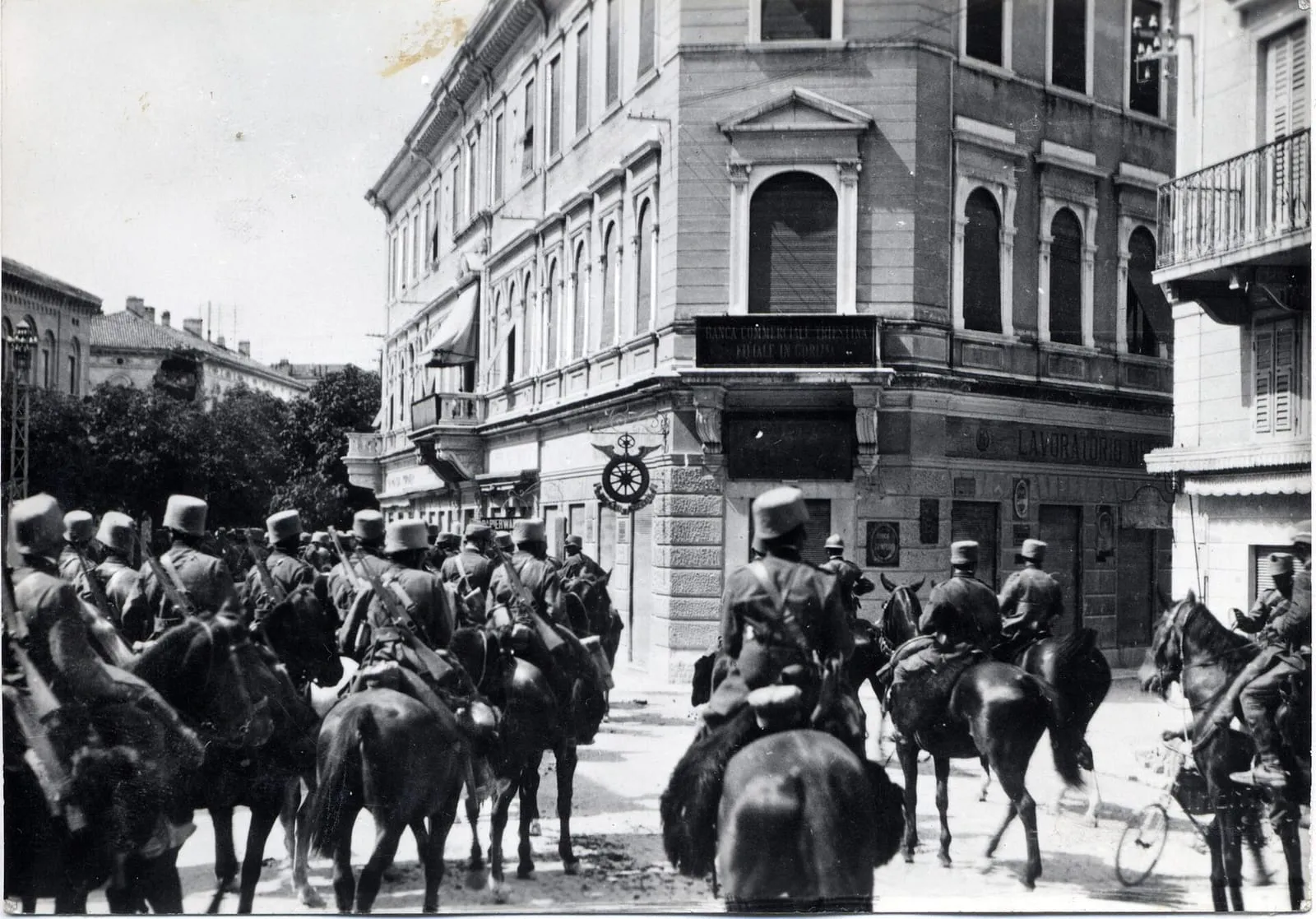
The Sixth Battle of the Isonzo was the Italian army’s first great victory of the First World War. After fifteen months of bloody and fruitless attacks on the Isonzo, General Luigi Cadorna secretly moved more than a dozen divisions and hundreds of heavy guns from the Trentino to the lower Isonzo, and on 6 August 1916 he struck at the Gorizia bridgehead and at Monte San Michele on the Karst plateau. The Austro-Hungarian 5th Army, weakened by sending troops to the Eastern Front, could not repel the blow. On the very first day the Italians took Monte Sabotino, held by the Austrians since the start of the war, and the summit of San Michele, and on 8 August the defenders gave up the whole bridgehead on the western bank of the Isonzo. On 9 August the first Italian units entered Gorizia, and the Austrians abandoned the Doberdò plateau. On the new defensive line, on the hills east of the town, the Italians were stuck just as they had been before the bridgehead. On 17 August Cadorna halted the attack.
Name and dates
In Italian the battle is called the sesta battaglia dell’Isonzo, but much more often people speak of the Battle of Gorizia or the capture of Gorizia (battaglia di Gorizia, presa di Gorizia). In German it is the Sechste Isonzoschlacht, in Slovene the šesta soška bitka. Italian studies usually count it from 4 to 17 August 1916, because on 4 August the Italians had already made a feint attack near Monfalcone. The Austro-Hungarian official history gives 4–16 August in its chapter title, although in the text it still describes the last attacks of 17 August and states that it was their halting on that day which ended the battle. We adopt the dates of the British chronology of the war on which our timeline is based: from 6 August, when the main attack on the Gorizia bridgehead and Monte San Michele began, to 17 August.
Background
Cadorna had planned a great offensive on the Isonzo for the second half of June 1916, in agreement with the allies, who at the Chantilly conference had promised one another simultaneous attacks on all fronts. He intended to take the Gorizia bridgehead and the Monte San Michele ridge with San Martino del Carso, but set no further objectives. This plan was thwarted by the May Austro-Hungarian offensive in the Tyrol, which forced him to move a large part of the army into the mountains. When the danger had passed in mid-June, and the Brusilov offensive was developing in the east, Cadorna returned to his original intention. On 26 June he told the commander of the 3rd Army, the Duke of Aosta, Emanuele Filiberto, that at the first opportunity he would attack on the Isonzo again, this time on a narrow sector and using, as he wrote, “an imposing mass of artillery of all calibres”. When the counter-attacks on the Asiago plateau brought no success, and on 20 July the last of the attempts to recover the lost positions collapsed, Cadorna broke off the fighting in the mountains and set the start of the Isonzo offensive for 4 August.
The transfer of troops was prepared very carefully. From 27 July railways and motor columns carried heavy batteries and mortars to the Isonzo, and from 31 July whole corps. According to the Italian historian Segato, quoted by the Austrian official history, about 300,000 soldiers, more than 57,000 horses and mules and almost 10,000 wagons were moved in 23 days. The transports travelled at night, the roads were sprinkled with water so as not to raise dust, rumours of an attack in the Tyrol were spread to mislead the enemy, and Cadorna himself was still showing himself in Feltre, far from the Isonzo, on 30 July. The 3rd Army, which was to carry out the attack, numbered at the beginning of August, by Austrian reckoning, 16 infantry divisions and a cavalry division, more than 200 battalions in all. Italian sources state that it had more than 1,200 guns and 770 trench mortars. On a sector of only 31 kilometres from the sea to Monte Sabotino this was an enormous concentration of force. The strongest was the VI Corps of General Luigi Capello, which with six divisions and about 500 guns faced the Gorizia bridgehead. North of it, the 2nd Army of General Settimio Piacentini was only to pin the enemy down, especially at Plava and Tolmin.
The Austro-Hungarian 5th Army of General Svetozar Boroević was then weaker than ever before. In the spring it had given up divisions for the offensive in the Tyrol, and after the defeats in Galicia further units left for the Eastern Front. According to the Austrian official history, at the beginning of August it had 8 divisions between the Krn and the sea, 106 battalions, a third of them from the territorial reserve (the Landsturm), and fewer than 600 guns. Facing the Italian 3rd Army stood only 78 battalions and 384 guns. The Gorizia bridgehead was defended by the 58th Division of General Erwin Zeidler from the XVI Corps of General Wenzel von Wurm: 18 and a half battalions, including many Landsturm battalions that had never been in a great battle, and only 87 guns with a very small supply of ammunition. The Austrian command noticed the transfer of some Italian brigades from the Adige, but did not expect a great attack before mid-August. It believed that the Italians, weakened by the fighting in the mountains, would move only when Romania entered the war.
Course
The attack on the bridgehead and Monte San Michele (4–8 August)
On 4 August the Italian VII Corps made a feint attack on the Austro-Hungarian positions near Monfalcone on the southern edge of the Karst. The attack was repulsed, but it did its job: it drew the defenders’ attention away from Gorizia. On 5 August new Italian batteries ranged on the bridgehead and Monte San Michele, and the fire of the heavy guns set part of the town alight.
On 6 August at about seven in the morning the Italian artillery opened fire along the whole front from Tolmin to the sea. After a few hours the trenches of the bridgehead had been turned into rubble, the entrances to the caverns buried and communications cut. At about four in the afternoon the infantry of the VI Corps went over to the assault. On the northern wing the 45th Division of General Giuseppe Venturi attacked Monte Sabotino, which was defended by one battalion of the Dalmatian 37th Rifle Regiment. One of the assault columns was led by Colonel Pietro Badoglio, chief of staff of the VI Corps, who had been preparing this attack for months. The defenders, caught in their caverns, were overpowered in a short time. According to Venturi, his division took about 1,200 prisoners for a loss of fewer than 1,200 men. On the southern wing the 11th and 12th Divisions attacked Podgora, which the Italians called Monte Calvario. The Dalmatian riflemen held the main ridge, but Italian units broke through in several places right down to the Isonzo.
That same afternoon, after a bombardment lasting many hours, the Italian XI Corps attacked Monte San Michele, the mountain dominating Gorizia and the northern part of the Karst, which had been fought over without result since the summer of 1915. The Catanzaro and Brescia Brigades took all four summits in about an hour. Hungarian battalions of the 20th Honvéd Division from the VII Corps of Archduke Joseph August counter-attacked that night and on the morning of 7 August, briefly recovering the eastern summit, but in the face of the superior Italian artillery they had to dig in on the reverse slope. The defenders held San Martino del Carso.
During the night of 6–7 August Austro-Hungarian reserves recaptured some of the lost positions in the bridgehead, taking, according to the Austrian official history, more than 2,000 prisoners at Podgora and several hundred at Pevma, but the counter-attack on Monte Sabotino failed. On 7 August Capello threw further divisions into the fight and assaulted the remains of the bridgehead all day. The defenders’ artillery almost stopped firing because it had run out of ammunition, and the battalions had shrunk to half strength. In the evening Boroević left it to Zeidler to decide whether to go on defending the bridgehead. On 8 August at 1.30 a.m. Zeidler ordered it to be abandoned. About 5,000 surviving soldiers out of the nearly 18,000 who had defended the bridgehead on 6 August crossed to the eastern bank of the Isonzo, and the sappers blew up the bridges.
The occupation of Gorizia and the withdrawal from the Karst (8–10 August)
Boroević’s order required the eastern bank of the Isonzo to be held at all costs, but in August the river south of Gorizia was shallow and could be forded. On the morning of 8 August a patrol of the 28th Infantry Regiment from the Pavia Brigade under Second Lieutenant Aurelio Baruzzi crossed the Isonzo near Lucinico and planted the Italian flag on the railway station in Gorizia. Further units of the 12th Division crossed the river after it. In the evening Boroević agreed to the withdrawal of the 58th Division to the second position, prepared a few kilometres east of the town, from Monte San Gabriele across the hills above Gorizia to the Vipava valley. During the night of 8–9 August the defenders left the town, and the sappers blew up the last stone railway bridge, at Solkan. That same evening Boroević also decided to abandon Monte San Michele and the whole Doberdò plateau, whose defence had become pointless after the fall of the bridgehead. In his report to the high command he wrote that the defenders of Gorizia had lost two-thirds of their strength, and the 20th Division half.
On 9 August the Italians entered Gorizia, the first large town of Austria-Hungary taken by the Italians. The Austrian official history and some Italian historians believe, however, that Cadorna and his generals then missed the chance of a breakthrough. Throughout 9 August the main Italian forces were crossing the river or standing on the western bank, and the cavalry sent in pursuit ran into Austrian outposts a few kilometres beyond the Isonzo. Cadorna himself wrote after the war that the hills east of the town would have fallen on 9 August had they been attacked as he had ordered. During the night of 9–10 August the Austro-Hungarian VII Corps withdrew unnoticed from Monte San Michele and San Martino behind the Vallone valley, and on 10 August the Duke of Aosta made a ceremonial entry into Gorizia.
Attacks on the new line (10–17 August)
From 10 August the Italians attacked the new defensive line, but the defenders had already had time to settle into it, and reinforcements began to arrive from the Tyrol and from the Eastern Front: mountain brigades, and then a composite division under General Hrozny. Capello’s group, subordinated to the 2nd Army from 11 August, assaulted the Santa Caterina hill at the foot of Monte San Gabriele and Hills 171 and 174 east of Gorizia. On the Karst the 3rd Army struck at the Nad Logem hill on the northern edge of the plateau and at the trenches near Lokvica and Oppacchiasella. On 12 August the Italians took the summit of Nad Logem, but could advance no further. The strongest attack along the whole front from Plava to Oppacchiasella came on 14 August, and the last great assaults on 15 and 16 August, when the Italians attacked with the help of armoured cars, brought no further gains. On 17 August, after the last failed attacks, Cadorna halted the offensive, stating that the Austrians were defending themselves not on rearguard positions but on real fortified lines that would have to be assaulted methodically.
Casualties
According to Italian figures quoted by the Austrian official history, the Italian army lost about 1,750 officers and 49,500 men in the battle, about 51,000 killed, wounded and missing in all. The Austro-Hungarian 5th Army, according to its official history, lost about 41,000 men in the two weeks, including about 3,700 killed, nearly 20,000 wounded and about 13,800 missing, most of them taken prisoner, the rest being sick. The heaviest loss, more than 18,000, was suffered by the XVI Corps, which had defended the Gorizia bridgehead. Each side took several thousand prisoners.
Significance
The Italians moved the front forward by 4 to 6 kilometres on a sector of about 24 kilometres and for the first time crossed to the eastern bank of the lower Isonzo. They took Monte Sabotino and Monte San Michele, before which they had been bleeding since 1915, the Doberdò plateau and the town of Gorizia. The victory aroused enormous enthusiasm in Italy, strengthened the position of Cadorna, which had been shaken by the spring setbacks in the Tyrol, and raised Italy’s standing among the allies. Badoglio was promoted to general for the capture of Monte Sabotino, which was the beginning of his great career. Shortly after the battle Italy, which had been at war with Austria-Hungary since 1915, declared war on Germany as well.
Militarily, however, the victory was limited. Gorizia lay in a basin overlooked by hills still held by the Austrians, and Trieste, the main objective of Italy’s war on the Isonzo, was still far away. Cadorna himself knew that behind the captured line another line of trenches was waiting. The Austrians, for their part, considered that they had managed to avert the worst. Their official history admits that the Italians prepared and carried out the attack superbly, and attributes the loss of the bridgehead above all to the enormous superiority of the Italian artillery, and not, as some claimed, to the treachery of deserters who had handed the Italians plans of the fortifications before the battle. The hills around Gorizia were fought over for more than a year afterwards, and as early as mid-September 1916 Cadorna began the seventh battle on the Isonzo.
Spotted a mistake?Report an error