1916: The Italian front
Seventh Battle of the Isonzo
- Dates:
- 14–18 September 1916
- Front:
- Italian Front
- Location:
- The Karst plateau east of the Vallone valley, from the Vipava valley (San Grado di Merna, Nad Logem hill) through Lokvica, Oppacchiasella and Nova Vas to hills 208 and 144 by the sea; secondary attacks at Gorizia, Plava and on the Rombon above Bovec, Austria-Hungary (now Slovenia and Italy)On the battle map →
- Sides:
- Austria-HungarySvetozar Boroević, Archduke Joseph August of Austria
- Result:
- Inconclusive, in practice an Austro-Hungarian defensive victory. The Italians took San Grado di Merna, part of the ridge above the Vipava and a few stretches of trench on the Karst, but did not break the front and halted the attack after four days.
- Author:
- Natalia
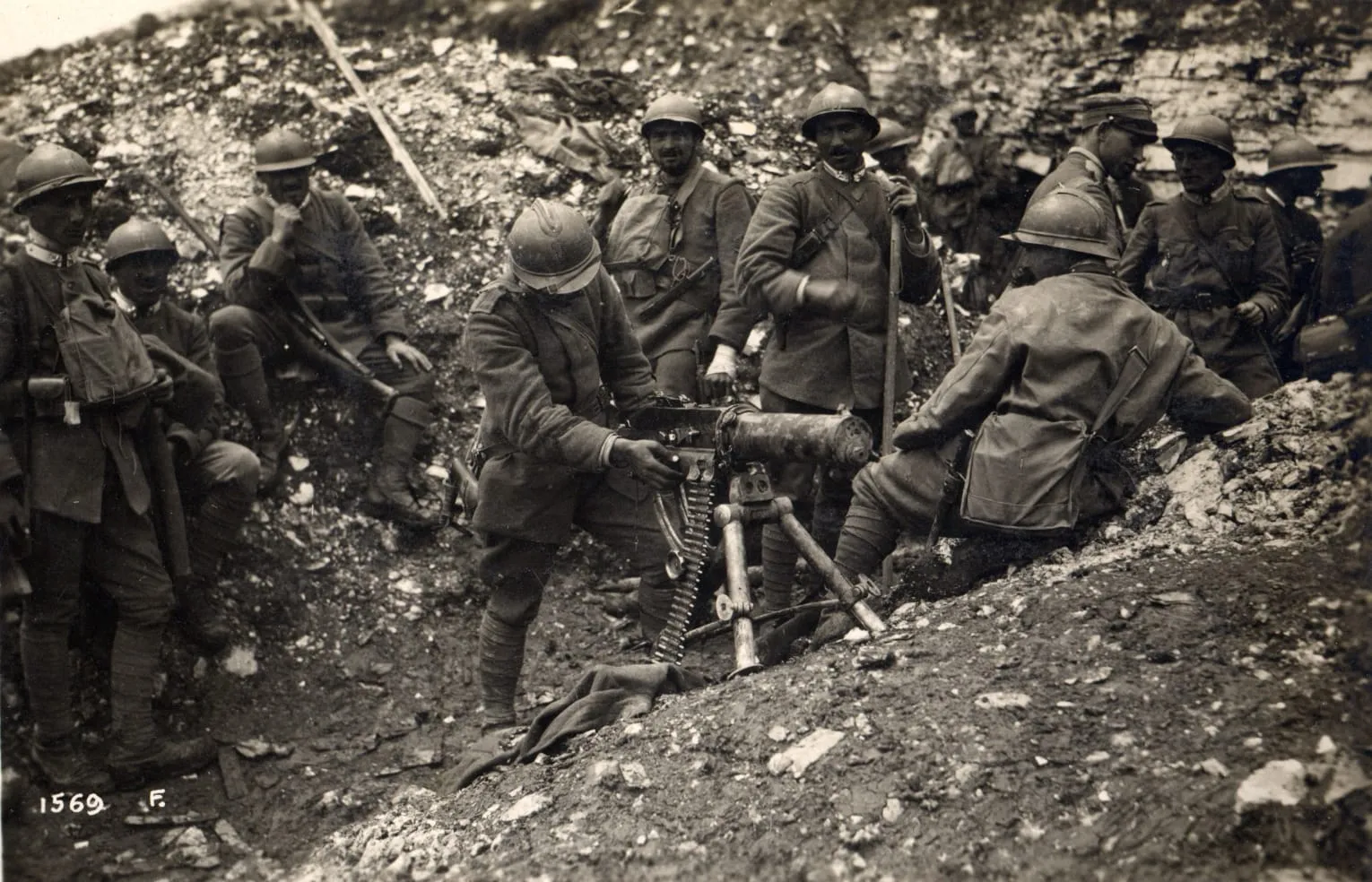
The Seventh Battle of the Isonzo was a short, four-day attack by the Italian 3rd Army on the Karst plateau (Italian: Carso), a month after the capture of Gorizia. General Luigi Cadorna wanted to exploit the August victory and strike before the Austrians could fortify their new line of defence beyond the Vallone valley. After several days of artillery preparation, on the afternoon of 14 September the army of the Duke of Aosta, Emanuele Filiberto, went over to the assault on a front of about 13 kilometres, from the Vipava valley to the sea. It had a threefold superiority in artillery, but in four days of fighting, in rain, thunderstorms and gales, it took only the church hill of San Grado di Merna above the Vipava, part of the ridge on the northern edge of the plateau and a few stretches of trench at Oppacchiasella and by the sea. On the evening of 17 September Cadorna halted the attack.
Name and dates
In Italian the battle is called the settima battaglia dell’Isonzo, but Cadorna in his memoirs called it simply the “first offensive on the Karst” in the autumn of 1916. In German it is the siebente Isonzoschlacht, and the Austro-Hungarian official history also calls it the Battle of the Karst (Karstschlacht). That history dates the battle to 14–17 September, because on the evening of 17 September Cadorna issued the order to break off the attack. The fighting did not stop at once, however: both sides went on trying to improve their positions for several more days, and Austrian reinforcements were still reaching the front on 18 September. For this reason some studies, including German and Italian ones, take 18 September as the last day of the battle. The British chronology of the war, on which our timeline is based, dates it the same way, and we keep to these dates, 14–18 September.
Background
On 17 August, when he halted the sixth battle, Cadorna announced that the attack would be resumed as soon as possible. First the 2nd Army was to take the hills east and north of Gorizia, which still dominated the town and the bridges over the Isonzo, and only then was the 3rd Army to strike on the Karst. On 25 August, however, he changed the order. Reconnaissance showed that the wooded hills at Gorizia could not be attacked without long preparations, while on the Karst the Italians already stood beyond the Vallone valley, on the hills of Nad Logem and Oppacchiasella. The main objective therefore became the northern edge of the plateau. The left wing of the 3rd Army was to advance along the ridge above the Vipava to Fajti hrib hill and on to Trstelj, from where it could strike the hills at Gorizia in the flank and the rear of the Karst defences as far as the Hermada, the last great obstacle on the road to Trieste. The 2nd Army was only to neutralise the Austrian artillery in the Vipava valley and to simulate preparations for an attack at Gorizia with its fire. To mislead the enemy, the Italian command also spread rumours of an attack in the Brenta valley, and on 10 September it attacked in the mountains on the Pasubio to tie down the Austrian reserves in the Tyrol.
The Austrians knew that the Italians would attack again, but for a long time they could not guess where or when. For three weeks General Svetozar Boroević’s 5th Army made good its losses and received reinforcements from the Tyrol and from Galicia. According to the Austrian official history, at the end of August it again numbered about 148,000 men, against an estimated 240,000 Italians. The new positions on the Karst were, however, very weak. On the rock slab of Nad Logem, crucial for the defence of the northern edge of the plateau, the defenders lay in trenches 50–60 centimetres deep, shielded by low stone walls and sandbags, because the hard rock could not be dug under fire. Romania’s declaration of war on 27 August made the situation even worse, because the army needed troops to defend Transylvania. The Chief of the General Staff, Franz Conrad von Hötzendorf, despite German pressure, nevertheless refused to take any of the mountain brigades away from the Isonzo until the Italians’ intentions became clear. At the beginning of September it poured with rain at the front, the Isonzo burst its banks and destroyed some of the Italian bridges, and the trenches along the Vertojbica stream turned into mud. When the weather cleared on 7 September, the Italian artillery began ranging, and on 10 September the fire on the sector from Nad Logem to Nova Vas grew markedly heavier.
Forces
According to the Austrian official history, based on Italian data, on 14 September the Duke of Aosta’s 3rd Army had 150 battalions and 24 squadrons of dismounted cavalry, and behind it stood a further 36 battalions of the supreme command’s reserve. On the five-kilometre sector from the Vipava to Oppacchiasella XI Corps attacked with three divisions in line and a fourth in reserve, further on, as far as Lake Doberdò, XIII Corps, and from the lake to the sea VII Corps. The army had 954 guns and 586 trench mortars, to whose construction and use the Italians had attached enormous importance since the end of 1915. Facing them was the southern wing of Boroević’s army: 59 battalions, 284 guns and 255 mortars. The sector from the Vipava to Nova Vas was defended by the VII Corps of Archduke Joseph August with the 17th and 28th Divisions, and the sector from Nova Vas to the sea by the group of General Alfred von Schenk with the 9th Division and a Landsturm mountain brigade. Behind them stood scanty reserves, including the Hungarian 20th Honvéd Division and the 44th Rifle Division. The Austrian official history notes that of more than 180 Italian battalions only about a hundred actually fought, so the superiority in infantry was no greater than in the previous battles. The threefold superiority in artillery, on the other hand, told on the defenders as never before.
Course
14 September
The battle was heralded by heavy Italian artillery fire on the afternoon of 13 September, and opened with a raid by three squadrons of Caproni bombers on Trieste, which did not, however, cause much damage. At dawn on 14 September the artillery and mortars of the 3rd Army opened fire along the whole front from the Vipava to the sea. The fire of the heavy guns reached far into the rear and cut all the telephone lines, and smoke and dust hid the battlefield so that the Austrian commanders long did not know what was happening in the front line. Heavy fire also fell on the positions at Gorizia, Plava and on the upper Isonzo, to mislead the defenders. According to the Austrian official history, after nine hours of shelling, in the afternoon, the Italian infantry went over to the assault, according to Cadorna in pouring rain.
On the slopes above the Vipava the attack collapsed under the fire of the Austrian artillery, which fired from the valley into the flank of the attackers. The heaviest fighting took place on Nad Logem. At about 3.30 p.m. three regiments of the Italian 23rd Division struck at a forward stretch of the defences, held by the Hungarian 61st Infantry Regiment, of which little more than a battalion was left after the shelling. The defenders had to withdraw, but the reserves stopped the Italians on the chord of the arc. At Lokvica and Oppacchiasella most of the attacks broke against the barrage, while at Nova Vas and on hill 208 the Italians broke into the trenches in several places, from which counter-attacks drove them out by evening. Cadorna wrote that his soldiers took Nova Vas and hill 208 in the first rush, but that artillery fire forced them to retreat. In the south, by the sea, the Italian 16th Division attacked hill 144 in the evening and after fierce hand-to-hand fighting pushed the defenders out of their ruined trenches back to a position on the ridge. The same day Italian long-range guns shelled the waterworks at Aurisina, from which water flowed to Trieste, but caused little damage. At night a thunderstorm passed over the battlefield, and after it the bora sprang up, a cold and violent wind off the Karst.
15 September
On the morning of 15 September the Austrians retook by counter-attacks most of the trenches lost the day before, but at noon Italian fire destroyed their freshly occupied positions. Archduke Joseph August later called this day one of the hardest of the entire war. In the afternoon the Italian XI Corps threw three brigades into the fighting between the Vipava and Lokvica. In the Vipava valley Italian grenadiers took the positions held by one battalion and the hill with the church of San Grado above the village of Merna (now Miren). The Austrian corps command long did not know of this, because communications with the front were not working. The situation was saved by the neighbouring XVI Corps from the Vipava, which sent two battalions to counter-attack, and the Italians advanced no further. At dusk the defenders also gave up the forward arc of trenches on the northern slope of Nad Logem. Further south an attack at Oppacchiasella and Lokvica forced one Austrian battalion to retreat, but the reserves recovered almost the whole position, while the fighting for hill 144 and hill 208 went on without a decision.
16 and 17 September
On 16 September the Italian attack lost its cohesion, but not its strength. In the north the Italians could not advance beyond San Grado, so they shifted their main effort to the south of the plateau, between Nova Vas and hill 144, where XIII Corps committed the fresh 34th Division. In the afternoon the Italians took hill 208 and, contrary to their habit, immediately pressed on eastwards. At about 2 p.m. the defenders’ situation became critical, but a counter-attack by the 11th Landsturm Regiment recovered all the positions by 5 p.m. The fighting lasted until 10 p.m., when, as the Austrian official history puts it, “general exhaustion lowered the weapons”. The Italians held only a few nests in the tangle of trenches on hill 208, and the summit of hill 144, shelled by both sides, became no man’s land. The same day, far to the north, Alpini attacked Mount Rombon above Bovec, but were bloodily repulsed.
On the evening of 16 September the position of the 5th Army seemed serious to the Austrians. Boroević knew that the Italians had not yet committed their reserves, while he himself had to bring up his last reserves from other sectors. He demanded reinforcements from the Tyrol, and the command allotted him a mountain brigade from the supreme command’s reserve. On 17 September, however, it turned out that the Italians were exhausted too. At Lokvica, Oppacchiasella and Nova Vas their brigades broke into the Austrian trenches several more times, but each time they were thrown out by counter-attacks, and after 4 p.m. the infantry fighting ceased. In the evening Cadorna decided to break off the attack without committing his reserves.
18 September
On 18 September the fighting clearly died down. The last battalions of the Austrian mountain brigade were reaching the front, and both sides were now only trying to improve their positions. The Austrian official history writes that the battle “only slowly burned itself out” over the following days: the Italians replaced their exhausted brigades with fresh troops from the reserves, which looked for opportunities to fight, while Schenk’s group tried in vain to retake hill 144 and the trenches on hill 208.
Losses
According to Italian figures cited by the Austrian official history, the Italian army lost 706 officers and 16,864 men in the battle, about 17,500 killed, wounded and missing in all. Other Italian tallies give higher figures, about 21,000. The southern wing of the Austro-Hungarian 5th Army lost in the whole of September about 320 officers and 20,000 men killed, wounded and taken prisoner. The Austrian official history estimates that in the battle itself this may have been about 15,000 men. According to Cadorna the Italians took 4,104 prisoners, including 111 officers.
Significance
The result of the battle was disappointing for the Italians. Despite careful preparations and an enormous superiority in artillery, they took only a small scrap of ground on the northern edge of the Karst. Fajti hrib and Trstelj remained in Austrian hands, and Trieste was as far away as in August. Cadorna himself admitted that the results were modest compared with the means employed. He attributed them above all to the bad weather, which hampered the observation of fire and made the use of gas shells impossible, and also to gaps in the wire that were too narrow, belated infantry assaults and the dispersal of artillery fire onto the rear lines before the first had been destroyed. After this battle the Italian supreme command ordered that no major attacks be launched without good visibility. The Austrians attributed their victory to the endurance of the defenders and the accurate fire of their artillery, and the Italian defeat to poor leadership at the lower levels, which was unable to exploit the initial successes.
The battle opened a series of short attacks lasting a few days, with which Cadorna tried in the autumn of 1916 to wrest the Karst plateau from the Austrians step by step. Each of them, as Italian historians call them, was another “shoulder push” (spallata) against the same front. For Austria-Hungary this meant that the army on the Isonzo, despite its successful defence, could not release troops to other fronts, although Conrad sent one mountain brigade to Transylvania as early as the second half of September. Cadorna’s order of 17 September directed that the captured positions be fortified and everything be prepared for the earliest possible resumption of the fighting. The next attack on the Karst began as early as 10 October.
Spotted a mistake?Report an error