1917: The Italian front
First Battle of the Piave
- Dates:
- 10 November – 26 December 1917
- Front:
- Italian Front
- Location:
- The front line from the mouth of the Piave on the Adriatic along the lower course of the river to the Montello hill, the Monte Grappa massif between the Piave and the Brenta (Monte Tomba, Monfenera, Monte Pertica, Monte Asolone) and the Asiago plateau (Seven Communities) with the Meletta massif, Veneto (Italy)On the battle map →
- Sides:
- Italy (from early December also French and British divisions)Armando Diaz, Mario Nicolis di Robilant, Prince Emanuele Filiberto, Duke of Aosta, Guglielmo Pecori Giraldi, Herbert Plumer, Émile FayolleAustria-Hungary and GermanyArchduke Eugen of Austria, Franz Conrad von Hötzendorf, Svetozar Boroević, Otto von Below, Alfred Krauss
- Result:
- Italian defensive victory. The Austrians and Germans took several peaks in the Grappa massif and on the Asiago plateau and some tens of thousands of prisoners, but did not cross the Piave or descend from the mountains onto the Venetian plain. On 2 December Emperor Karl ordered the offensive halted.
- Author:
- Natalia
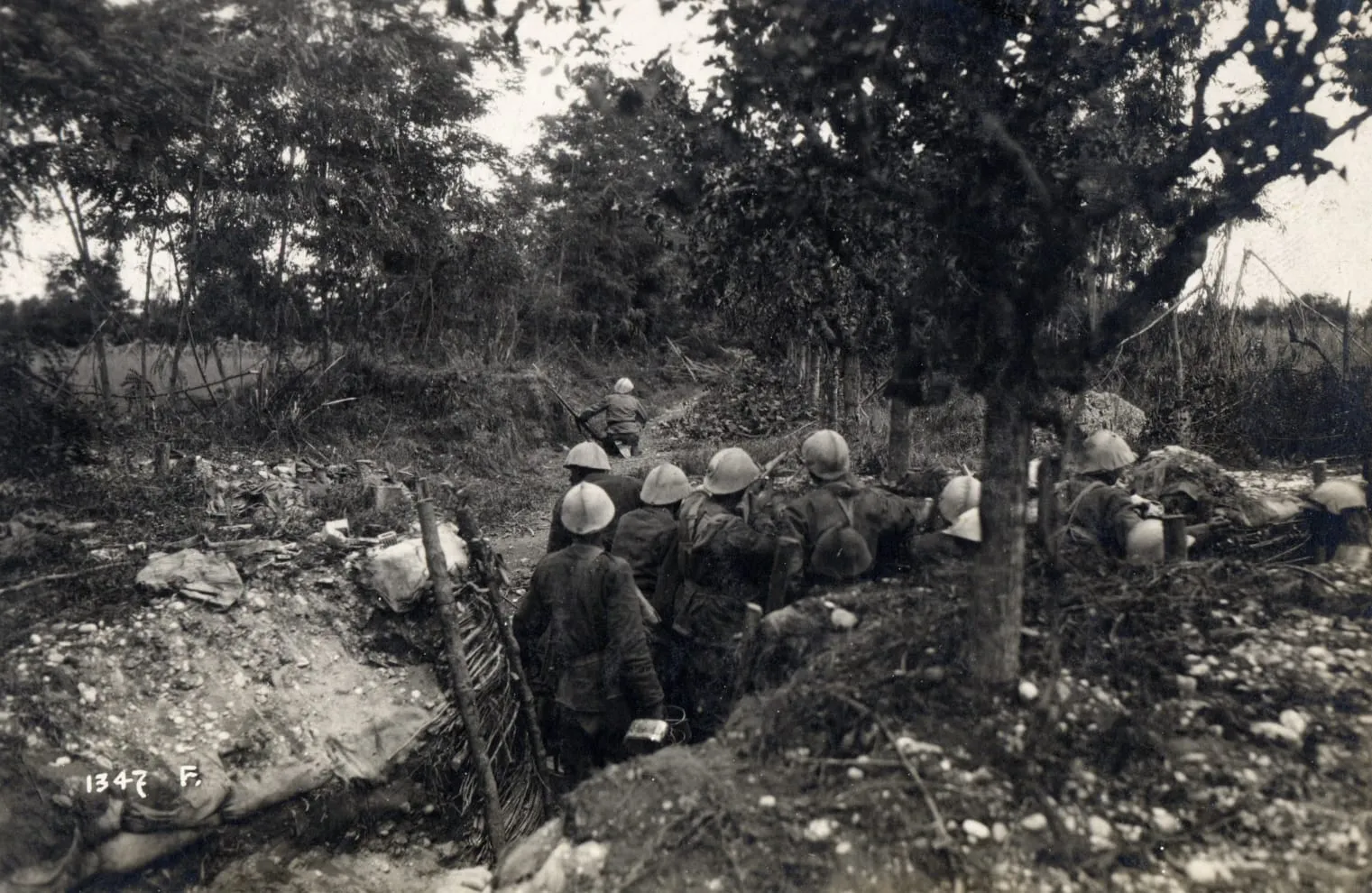
The First Battle of the Piave was a defensive battle in which the Italian army, shattered a few weeks earlier at Caporetto, stopped the pursuit by the Central Powers’ troops. After the retreat from the Isonzo the Italians took up a new line, which General Luigi Cadorna had still laid down himself: from the Adriatic along the lower Piave, through the Monte Grappa massif between the Piave and the river Brenta, to the Asiago plateau. From 10 November 1917 the Austrians and Germans tried to cross the river and descend from the mountains onto the Venetian plain before French and British reinforcements arrived. The new chief of staff of the Italian army, General Armando Diaz, however, gave the commanders on the spot a great deal of freedom, and the soldiers, among them eighteen-year-old recruits of the class of 1899, defended themselves with a tenacity that nobody had expected after Caporetto. The enemy took several peaks but did not cross the Piave or descend onto the plain. On 2 December Emperor Karl I ordered the offensive halted, and the December fighting for winter positions in the mountains ended in the last days of the year.
Name and dates
The Italians call this battle the prima battaglia del Piave, the first battle of the Piave, or the battaglia d’arresto, the battle of the halt, and the fighting in the mountains also the first battle of Monte Grappa. In German it is the first battle of the Piave (erste Piaveschlacht). The Austrian official history (Österreich-Ungarns letzter Krieg) does not treat it as a separate battle: it describes the November fighting as the “attack on the area west of the Piave” and the December fighting as the “fighting for permanent positions”. The dates in the sources vary. The German Wikipedia ends the first battle of the Piave on 26 November, while the English one counts the fighting for Monte Grappa from 11 November to 23 December; Italian studies speak generally of November and December. We adopt the dates 10 November – 26 December 1917. On 10 November the Central Powers’ troops stood on the Piave along its whole length from the sea to the mountains, and on the Asiago plateau they attacked the first Italian positions; on 26 December, after the last Austro-Hungarian attack on the plateau, they abandoned the bridgehead at Zenson, the only one they had held on the western bank of the lower Piave.
Background
In the Twelfth Battle of the Isonzo the Germans and Austrians broke through the front at Caporetto on 24 October and within two weeks drove the Italians from the Isonzo across the Tagliamento to the Piave. On 9 November the last Italian rearguards crossed to the western bank of the river. Italy had lost nearly 300,000 prisoners and almost half its artillery, and the 2nd Army had ceased to exist as a fighting force. According to the Austrian official history, however, the new front line was only about 130 kilometres long from the sea to Asiago, 220 kilometres shorter than that of 24 October. Cadorna had long foreseen a defence on the Piave and Monte Grappa: as early as the autumn of 1916 he had roads, caverns, cableways and a water supply built in the massif, and on 4 November, when ordering the retreat from the Tagliamento, he divided the sectors of the new line among the armies. The 3rd Army of the Duke of Aosta took up position behind the Piave from the sea to the Montello hill, the 4th Army of General Mario Nicolis di Robilant, which had withdrawn from the Cadore and the Belluno mountains, occupied the Grappa massif, and the 1st Army of General Guglielmo Pecori Giraldi held its old positions on the Asiago plateau, pulling back only its right wing onto the Meletta massif.
On 8 November King Victor Emmanuel III dismissed Cadorna, and on 9 November Diaz took command, with Generals Pietro Badoglio and Gaetano Giardino as his deputies. According to the Austrian official history, Diaz fully adopted his predecessor’s plan and rejected suggestions that the army should fall back further, to the Adige or the Mincio. According to some studies, he had only about 33 divisions fit for combat, roughly half of what he had had before Caporetto. Britain and France, which at the Rapallo conference had made their help conditional on a change of commander-in-chief, were sending five British and six French divisions to Italy. The British were commanded by General Herbert Plumer, who arrived from Flanders on 13 November, and the French from 16 November by General Émile Fayolle. Their divisions, however, were being unloaded in Lombardy, far behind the front, and were meant to form a reserve in case of a breakthrough. Only on 12 November, partly under pressure from Italian public opinion, was it decided to move them closer, to the area of Vicenza.
On the Central Powers’ side, the two Isonzo armies of General Svetozar Boroević’s army group and the German 14th Army of General Otto von Below stood on the Piave, all under the command of Archduke Eugen. From the Tyrol the 11th Army of the army group of Field Marshal Franz Conrad von Hötzendorf, who had dreamed since 1916 of descending from the mountains into the Italians’ rear, was to strike at the Asiago plateau. The victorious troops, however, had growing difficulties. They were short of bridging equipment and ammunition, and on 9 November the railway reached only the old frontier, a hundred kilometres or more from the front. The German Supreme Army Command announced that it intended to carry the offensive only as far as the Piave and then to take its divisions to the Western Front.
Course
The Asiago plateau, 10–24 November. In thick snow on 10 November the Austro-Hungarian III Corps followed the withdrawing Italians through the ruins of Asiago and took the small town of Gallio, but an Italian counter-attack threw it back to its starting positions. On 11 November the 6th Division twice took and lost Mount Longara, and only on the evening of 12 November did it hold Gallio and Longara. The planned major attack on Bertiaga, which was to open the way to the plain at Bassano, had to be postponed because the Italians of XX Corps held firmly the Meletta massif, which jutted out to the north. The attack on the Meletta on 22 and 23 November, made in the presence of Emperor Karl I, broke down in the fog under Italian counter-attacks, and on the evening of 23 November the emperor ordered it stopped. According to Austrian figures, Conrad’s army group lost about 15,000 men between 10 and 24 November, including nearly 7,000 sick, while the Italians on the Tyrolean front lost more than 10,000 prisoners in the same period.
The Piave, 10–17 November. On the lower Piave the Austrians had been sending small detachments onto the island of Grave di Papadopoli since 10 November. On 12 November mountain riflemen of the 44th Rifle Division crossed the river at Zenson and formed a small bridgehead on the western bank, and over the following days the Hungarian 41st Honvéd Division seized scraps of ground in the river delta near Cortellazzo. A great crossing of the Piave along the whole front was set for 16 November. On the evening of 15 November the German 12th Division failed to cross the river at Vidor, so the crossing at Nervesa was called off. On 16 November two battalions of the Austro-Hungarian 92nd Infantry Regiment crossed the Piave at Fagarè, took two batteries and more than 500 prisoners, but under Italian fire it was impossible to bring over reinforcements or boats for a withdrawal. The next day those who had survived the counter-attacks were taken prisoner. In an order of 18 November Diaz credited this success partly to the soldiers of the class of 1899, who had just received their baptism of fire. The Italians also cut the embankments in the delta, flooding the ground in front of the Hungarians. Until the end of the battle the lower Piave remained relatively quiet.
Monte Grappa, 13–26 November. The main weight of the fighting fell on the Grappa massif, where General Alfred Krauss’s group of the 14th Army tried to descend between the Brenta and the Piave to Bassano. On 13 and 14 November eight battalions of Alpini held it on the forward peaks of Roncone, Peurna and Tomatico. On 15 November the Italians had to give up these positions and fall back to the main defence line, suffering heavy losses, and on 17 November the enemy took Quero in the Piave gorge. From 18 November Germans of the Alpine Corps and the Jäger Division (Jäger-Division) stormed Monte Tomba and Monfenera, and the Austrians the peaks above the Brenta valley. On 22 November the Austro-Hungarian 3rd Rifle Regiment took Monte Pertica, and the Germans the ridge of Monte Tomba from the summit to the Piave, but the Italians held on to its southern slopes. The Württemberg Mountain Battalion, in which Lieutenant Erwin Rommel was serving, took Hill 1611 on 21 November together with Austrian Kaiserschützen, but in heavy fighting over the following days it failed to take Monte Spinoncia. The last attacks on Col dell’Orso and Col della Berretta on 25 and 26 November brought no decision. According to Italian historians, about half the defenders of the Grappa were units that had withdrawn from the shattered 2nd Army, the very army whose soldiers Cadorna had accused of cowardice in his communiqué of 28 October.
The offensive halted. The Central Powers’ commands planned a new, methodical attack at the turn of November and December, but ammunition and equipment were reaching the front with difficulty, and winter had set in on the Grappa. Austro-Hungarian divisions without winter uniforms lay on the snow and rocks, and by 27 November the Edelweiss division numbered only about 2,000 rifles. Moreover, more and more French and British divisions were standing behind the Italians. On 29 November Erich Ludendorff asked the Austrian command whether it would not be better to end the offensive on the Piave line, which was well suited to defence, and Below judged that a new attack had no chance. On 2 December Emperor Karl ordered: “Halt the offensive! Establish permanent positions”, while at the same time instructing that preparations for a further attack be feigned. The Germans began withdrawing their divisions to the Western Front. In early December the British 23rd and 41st Divisions relieved the Italians on the Montello, and the French took over the Monte Tomba and Monfenera sector.
December. The fighting for better winter positions nevertheless went on. On 4 and 5 December Conrad’s troops at last took the Meletta massif, routing the Italian 29th Division and, according to Austrian figures, taking more than 16,000 prisoners and 90 guns. From 11 December the corps of Generals Goiginger and Tutschek attacked Col della Berretta, Monte Spinoncia and Monte Asolone in the Grappa massif, and after taking Asolone on 18 December they repelled Italian counter-attacks until 22 December, having taken more than 8,000 prisoners. On 23 December on the Asiago plateau the Austrians took the hills of Col del Rosso and Col d’Echele, capturing more than 8,000 further prisoners. The Italian counter-attacks went on until Christmas, and in repelling them the Austrians, by their own figures, took about 2,000 more prisoners. On 26 December the Austrians abandoned the bridgehead at Zenson, which the Italians had been shelling and attacking for weeks. On 30 December the French 47th Chasseurs Alpins Division attacked Monte Tomba and took its ridge back from the Austrians, but that was already a separate operation, the first French attack in Italy.
Losses
There are no complete figures for the losses in this battle. The Austrian official history gives only partial data: Conrad’s army group lost 878 killed, 6,614 wounded, 6,962 sick and 599 missing between 10 and 24 November, while the Italians lost more than 10,000 prisoners on the Tyrolean front between 10 and 25 November. In December, according to the same data, more than 16,000 Italians were taken prisoner on the Meletta, more than 8,000 in the Grappa massif and about 10,000 at Col del Rosso. The Wikipedias give about 21,000 killed for the Central Powers in the fighting for Monte Grappa, but for the Italians sometimes about 12,000 and sometimes about 43,000 killed and wounded; these figures are hard to verify. Both sides suffered heavily, and to the combat losses must be added thousands of sick and frostbitten soldiers in the winter mountains.
Significance
The battle settled that Italy would not drop out of the war. After Caporetto many in Italy and abroad, and in the Italian command itself, doubted whether the shattered army would stop at all. Yet it stopped by itself: the French and British divisions entered the front only in early December, when the main attack had already been repulsed. General Gaetano Giardino, Diaz’s deputy, later wrote that the Italian soldier had recovered his will to fight “of his own accord”. The chief of staff of the German 14th Army, General Konrad Krafft von Dellmensingen, wrote that the Grappa had become the Italians’ “sacred mountain” and that they could be justly proud of having defended it against the best Austro-Hungarian troops and their German comrades.
The success also owed much to the shorter front, the positions prepared in advance in the mountains and a new style of command. Diaz did not interfere in every move of his army commanders, and the 4th Army on the Grappa conducted an elastic defence with swift counter-attacks. The Central Powers were also halted by the lack of ammunition, bridging equipment and railways, and by the Germans’ decision to save their strength for the great offensive in France in the spring of 1918. The Piave and Grappa line held until the end of the war. In June 1918 Austria-Hungary tried once more to break it in the Battle of the Piave and suffered defeat, and in October 1918 the Italian army set out precisely from the Piave and the Grappa for the victorious Battle of Vittorio Veneto. The soldiers of the class of 1899, the “ragazzi del ’99”, became in Italy a symbol of this defence, and the Piave is sometimes called the “sacred river” of the fatherland.
Spotted a mistake?Report an error