1914: Przemyśl, the San and the Vistula
First siege of Przemyśl
- Dates:
- 24 September – 9 October 1914
- Front:
- Eastern Front
- Location:
- Fortress of Przemyśl and its approaches on the San, Galicia, Austria-HungaryOn the battle map →
- Sides:
- Austria-HungaryHermann Kusmanek von Burgneustädten, Svetozar BoroevićRussian EmpireRadko Dimitriev, Dmitry Shcherbachev
- Result:
- Austro-Hungarian victory. The garrison repelled the assault of 5–8 October, and the Russians lifted the siege in the face of the Central Powers' counter-offensive.
- Author:
- Łukasz Skowroń
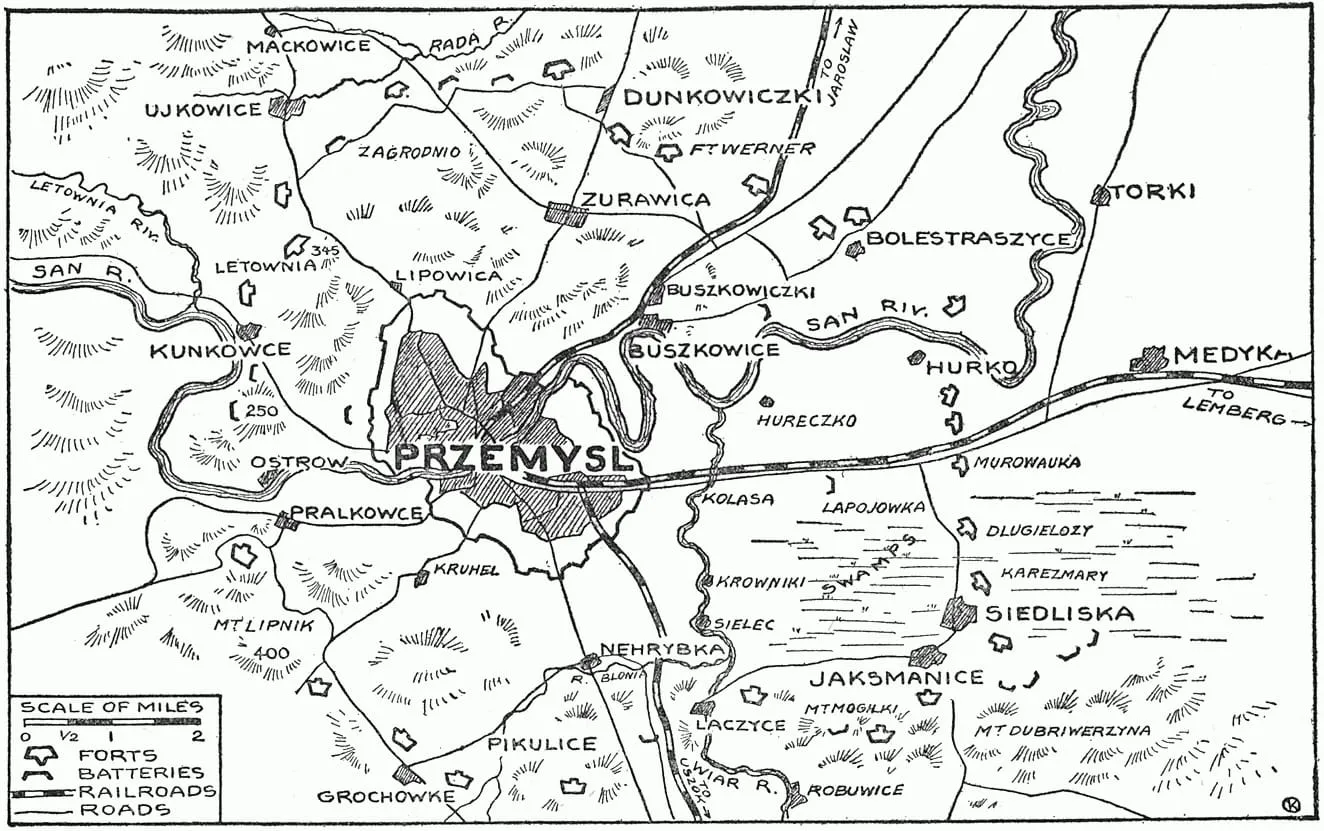
The first siege of the fortress of Przemyśl lasted from the second half of September to 9–11 October 1914. After the defeat in the Battle of Galicia the Austro-Hungarian armies withdrew westwards, leaving more than 120,000 soldiers under General Hermann Kusmanek von Burgneustädten in the encircled fortress on the San. The Russian 3rd Army of General Radko Dimitriev tried to take the fortress by storm, but on 5–8 October it suffered heavy losses and achieved nothing. Immediately afterwards the siege was lifted by an Austro-Hungarian relief force. This was the first part of one of the longest sieges of the First World War, which ended with the fortress’s capitulation in March 1915.
Dates of the siege
On this page we adopt the dates 24 September – 9 October 1914, following the British chronology of the war. Under 24 September it records the cutting off of Przemyśl, and under 9 October its relief. Polish studies usually begin the siege on 17 September, when the first shot was fired from Fort “Popowice” at a Russian cavalry patrol, and English-language ones often on 16 September. The encirclement of the fortress took several days, and the ring closed completely around 26 September. The end of the siege is also spread over several days. The Russians began to move away from the forts on 9 October, and on the same day the first Austro-Hungarian cavalry units reached the fortress. That is why we take that day as the end of the siege. Polish sources, however, most often give 10 October, when the Russian troops withdrew along the whole line, and some studies, especially English-language ones, 11 October. The main relief forces arrived on 11–12 October.
The fortress
Przemyśl barred the road from Eastern Galicia to Kraków and to the Carpathian passes. The Austrians had been building fortifications here since the middle of the 19th century. The outer ring of forts was about 45 kilometres in circumference and had 17 main forts, supplemented by smaller forts, batteries and shelters. The inner ring surrounded the city. Most of the fortifications, however, dated from the 19th century and were not prepared for bombardment by modern heavy artillery. In the summer of 1914 the garrison and thousands of labourers hastily dug trenches between the forts, strung out barbed-wire entanglements and built new gun positions. To clear the field of fire, forests were cut down and the buildings of many surrounding villages demolished.
Forces
According to various sources the garrison numbered from about 120,000 to over 130,000 men. Its core was the Hungarian 23rd Honvéd Infantry Division (PL). According to Polish estimates there were 35,000–40,000 Hungarians in all. The rest consisted mainly of brigades of the territorial reserve (Landsturm), made up of older reservists from many nations of the monarchy. Many Poles and Ukrainians served in the regiments from Galicia. According to various estimates between 18,000 and 30,000 civilians also remained in the city.
The Russians sent several divisions of Dimitriev’s 3rd Army to Przemyśl. The forces directly besieging the fortress were commanded by General Dmitry Shcherbachev. According to Polish studies the Russians used over 90,000 soldiers in the assault. They had no heavy siege artillery, however, and their light and medium guns could not effectively destroy the forts.
Course of events
Second half of September. Russian cavalry appeared before the forts on 16–17 September, as the last columns of the field army were passing westwards through Przemyśl. The Russian divisions gradually occupied the approaches to the fortress, took the surrounding villages and cut the roads and railway lines. Around 24–26 September the ring closed. The garrison carried out reconnaissance and small sorties.
4 October. A Russian envoy arrived at the fortress with a summons to capitulate. Kusmanek rejected it.
5–6 October. The Russian artillery shelled the forts, and the infantry crept ever closer to the line of defence, in places to within a few hundred metres.
7 October. At about 3 a.m. the Russians launched the main assault. They attacked most heavily in the south-eastern sector around Siedliska, above all Fort “Łysiczka”, and also the forts “Hurko” and “Borek”. In places the Russian infantry reached the very foot of the forts, but the defenders drove it back with fire and counter-attacks.
8 October. The Russians attacked the forts in the northern sector of the fortress. The attack came to a halt at the wire.
9–11 October. With the Austro-Hungarian 3rd Army of General Svetozar Boroević approaching, the Russians broke off the siege and withdrew to the east bank of the San. On 9 October Austro-Hungarian cavalry entered Przemyśl, and over the following days the main relief forces.
Losses
Estimates of Russian losses in the assault vary greatly. Polish studies usually speak of about 10,000 killed, wounded and captured, including 3,000–4,000 killed. Some authors, especially English-language ones, give as many as 40,000. The defenders’ losses were many times smaller, according to some figures about 2,000 killed, wounded and missing.
After the relief
The relief did not solve the fortress’s problems. Within a few weeks great masses of field troops passed through Przemyśl and used up part of its supplies. The command managed only partly to replenish food and ammunition and to evacuate the wounded. The Central Powers’ counter-offensive on the San and the Vistula brought no decision, and at the beginning of November the Austro-Hungarian armies withdrew again. The Russians surrounded Przemyśl for the second time. The second siege lasted until 22 March 1915, when the starving garrison, after blowing up the forts and magazines, capitulated. About 117,000–120,000 soldiers went into captivity.
Significance
The defence of Przemyśl in the autumn of 1914 was one of Austria-Hungary’s few successes in the first months of the war. For several weeks the fortress tied down considerable Russian forces and barred their way deeper into Galicia. Thanks to this, the battered Habsburg armies were able to rest and bring their units back up to strength on the Dunajec and the Biała. The repulse of the assault also had enormous propaganda value. Yet the first siege also foreshadowed the tragedy to come. The fortress, which the army could not abandon, became a burden to it. The winter attempts to relieve it in the Carpathians cost Austria-Hungary enormous losses, and the capitulation of Przemyśl in March 1915 was one of the monarchy’s greatest defeats.
Spotted a mistake?Report an error