1917: The Romanian front
Battle of Mărășești
- Dates:
- 6 August – 3 September 1917
- Front:
- Balkan Front
- Location:
- The plain on the right bank of the Siret and the Carpathian foothills north of Focșani, between the towns of Mărășești and Panciu and the village of Muncelu, in the valleys of the Putna, Șușița and Zăbrăuți rivers, in the Vrancea region (Moldavia, Romania)On the battle map →
- Sides:
- Romania and RussiaConstantin Cristescu, Eremia Grigorescu, Aleksandr RagozaGermany and Austria-HungaryAugust von Mackensen, Johannes von Eben, Curt von Morgen, Karl von Wenninger
- Result:
- Romanian and Russian victory. The Germans advanced 6–7 kilometres but did not break the front, did not reach Adjud and had to abandon the conquest of Moldavia.
- Author:
- Łukasz Skowroń
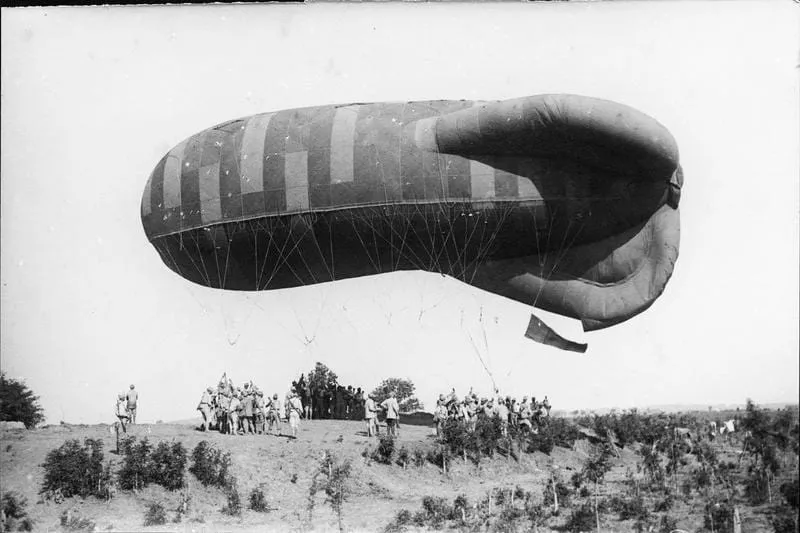
The Battle of Mărășești was the largest battle on the Romanian front during the First World War and the last attempt to force Romania out of the war. On 6 August 1917 the German 9th Army of Field Marshal August von Mackensen’s army group attacked northwards from the Putna river, along the Siret, towards Adjud. The front there was held by the disintegrating Russian 4th Army, whose divisions fled on the very first day. The gap was closed on the run by divisions of the Romanian 1st Army, which had just been due to relieve the Russians. For four weeks, in the worst heat of summer, the Germans and Austrians stormed the positions near the town of Mărășești, near Panciu and on the Muncelu hills. They advanced a few kilometres but did not break the front. For the Romanians Mărășești became the symbol of the rebirth of an army that had been shattered a year earlier.
Name and dates
The Romanians name the battle after Mărășești, a town with a railway junction on the line from Focșani to Adjud and Tecuci, whose station, sugar factory and manor house stood in the middle of the battlefield. The Germans spoke of the “breakthrough battle on the Putna and Șușița” (Durchbruchsschlacht an der Putna und Susita), and the Austrian official history (“Österreich-Ungarns letzter Krieg”) of the “battle of Focșani”.
The dates given for its end differ. The Romanian historian Constantin Kirițescu limited the battle to 14 days of continuous fighting, from 6 to 19 August, when the last great German assault collapsed. General Gheorghe Dabija, author of the Romanian official history, and after him most modern Romanian studies count it from 6 August to 3 September: 29 days, including 15–16 days of fighting and over a dozen days of relative calm. We take the dates 6 August – 3 September 1917, because on 3 September both the German commander of the 9th Army and the Romanian commander of the 1st Army issued orders to halt attacks and fortify the lines held. Some sources extend the battle to 8 September. In Romania, which reckoned time by the Julian calendar, the battle lasted from 24 July to 21 August.
A British chronology of the war treats the fighting at Mărășești as the “second phase” of a battle whose first phase was supposedly the fighting from 22 July to 1 August. That fighting, however, took place near the village of Mărăști, 30 kilometres further north-west, and was a separate Battle of Mărăști, a Romanian offensive. At Mărășești it was the Germans who attacked.
Background
By the summer of 1917 Romania was left with only Moldavia, with its government in Iași. Since January the front had run along the Putna and the Siret, and much of it was held by Russian troops. In July the Romanians and Russians were to take part in a joint offensive, but while Averescu’s army was breaking through the front at Mărăști, Russian divisions in Galicia were fleeing before the counter-offensive of the Central Powers. The offensive on the Romanian front was halted, and the attack of the Romanian 1st Army at Nămoloasa on the lower Siret never began at all. At the beginning of August the Austrians and Germans were retaking Bukovina and reaching the northern border of Moldavia.
The German Supreme Army Command, with Field Marshal Paul von Hindenburg and General Erich Ludendorff, decided to exploit the collapse of the Russian army and occupy Moldavia. The Austrian official history writes that the aim was “to break the will of Russia and Romania to wage war”. Mackensen had originally wanted to force the Siret at Nămoloasa and advance east, between the Siret and the Prut. The offensive at Mărăști, however, forced him to bring his reserves to Focșani. On 29 July the Supreme Army Command ordered him to strike north, along the western bank of the Siret, through Mărășești and Panciu to Adjud, at the mouth of the Trotuș river. At the same time General Friedrich von Gerok’s group of the Austro-Hungarian 1st Army was to attack from the mountains, through the Oituz valley towards Onești. The two arms of the pincer were to meet on the Trotuș and cut off the Romanian 2nd Army and the Russian 4th Army in the Vrancea mountains.
The Germans chose the sector where they expected the weakest resistance. Kirițescu, citing German documents, writes that the Russian 34th and 13th Divisions had been fraternising with the Germans for weeks, and that on 19 July the commander of the German I Reserve Corps, General Curt von Morgen, had even been authorised to conclude an armistice with them. Meanwhile the Russo-Romanian command, fearing an attack from Bukovina, was reorganising the front. Several corps of General Aleksandr Ragoza’s Russian 4th Army were to leave for the north, into reserve in northern Moldavia. Their positions on the right bank of the Siret were to be taken over during the nights of 6 to 10 August by General Constantin Cristescu’s Romanian 1st Army, crossing the river from its eastern bank.
General of Infantry Johannes von Eben’s German 9th Army numbered, according to Kirițescu, 12 divisions, that is 102 infantry battalions, 865 guns and 1,135 machine guns. Among them were Austro-Hungarian divisions (the 62nd Infantry Division and the 13th Rifle Division), and the elite German Alpine Corps had been brought from the Western Front. The Romanian 1st Army numbered about 170,000 men according to Dabija, and the Russian 4th Army about 80,000 infantry according to Kirițescu. The Romanian divisions, rebuilt with the help of General Henri Berthelot’s French military mission, had 12–14 battalions each, the German ones usually nine. On the evening of 5 August Mackensen left Bucharest for the front. According to Kirițescu, he said farewell at the station with the words: “See you in two weeks in Iași”.
Course
The breakthrough (6 August). During the night of 5–6 August the German artillery opened fire on the Russian lines between the Focșani–Mărășești railway and the Siret, towards dawn with gas shells as well. At about 7.30 a.m. Morgen’s three divisions (the 12th Bavarian, the 76th Reserve and the 89th) attacked the Russian 34th Division. The Russians abandoned line after line, and by evening the front had been broken over a width of 10 kilometres. The fleeing Russians, however, burned the pontoon bridge over the Siret, and an attempt to cross to the eastern bank was stopped by Romanian artillery fire. In the evening General Aristide Razu’s Romanian 5th Division crossed the Siret at Cosmești and Furceni, squeezing through crowds of Russian fugitives, and during the night occupied a line from Moara Albă to the Siret, across the direction of the German attack.
Fighting on the Șușița and the counter-attack (7–12 August). On 7 August, on the orders of the German Supreme Army Command, Morgen gave up forcing the Siret and struck north. In scorching heat the Romanian 5th Division repelled wave after wave near Doaga and Străjescu until late at night, but the front of its 32nd Regiment finally gave way and the Germans approached the bend of the Șușița. The Austrian official history admits that the Germans suffered heavily from the flanking fire of Romanian batteries positioned on the high eastern bank of the Siret. Mackensen therefore shifted the weight of the attack westwards, against the Russians between the Șușița and the Putna. By 8 August the breach had widened to 20 kilometres and was 6 kilometres deep, and according to the Austrian official history the Germans had taken 3,300 prisoners. On 10 and 11 August the Romanians and Russians counter-attacked, but without much effect. It was then, near Bătinești, that the German artillery major Eduard Buchner, Nobel Prize laureate in chemistry, was wounded; he died on 13 August in hospital in Focșani. On 11 August the Russians fell back again, and the Romanians anchored their exposed flank on the station at Mărășești. The Alpine Corps also entered the fighting and on 12 August passed through Panciu.
Crisis of command (11–13 August). On the evening of 11 August Romanian headquarters recalled Cristescu, who had quarrelled with Ragoza, and gave the 1st Army to General Eremia Grigorescu, the defender of the Oituz pass in the autumn of 1916. His slogan “Pe aici nu se trece!” (“They shall not pass here!”) became the motto of the whole battle. During the night the Russian commander of the Romanian Front, General Dmitry Shcherbachev, subordinated the 1st Army to Ragoza, who on the morning of 13 August ordered the Romanians to fall back 6 kilometres and give up Mărășești. Grigorescu refused: a retreat in broad daylight under the eyes of the enemy threatened disaster. The chief of the Romanian general staff, Constantin Prezan, and Shcherbachev agreed with him. Ragoza was recalled, and Grigorescu took command of the whole sector, including the Russian VIII Corps. The Romanians took over sector after sector from the exhausted Russian divisions.
Panciu and Băltăreți (14–18 August). On 14 August the Germans attacked in two directions. The German 216th Division captured the Romanian bridgehead at Băltăreți on the Siret. The Romanian 5th Division, which by 15 August had lost 3,500 prisoners and 16 guns there according to the Austrian official history, had to be withdrawn. The Alpine Corps advanced beyond Panciu, but there it was stopped by the Romanian 10th Division. Threatened from the rear, General Alexandru Averescu’s Romanian 2nd Army abandoned the Soveja basin, captured in July at Mărăști, during the night before 14 August. At the same time, from 8 August, the Third Battle of Oituz was being fought in the mountains, in which the Romanians stopped the second arm of the German pincer. For the next few days both sides regrouped their forces.
Răzoare (19 August). For 19 August Mackensen and Archduke Joseph August planned a simultaneous assault at Mărășești and in the Oituz valley. Five divisions (the 13th Rifle Division, the 115th, the 12th Bavarian and the 76th Reserve, with the 89th in reserve) attacked the Romanian 9th and 13th Divisions between Panciu and Mărășești. After a heavy bombardment, including gas, the Germans took the first line, the sugar factory on the edge of Mărășești and the Răzoare wood. There Captain Grigore Ignat’s entire machine-gun company was killed, defending itself to the last man. At about noon the commander of the 13th Division, General Ioan Popescu, threw the division’s entire reserve into a counter-attack, while the Romanian artillery wrought havoc in the German ranks. By evening the Germans had been thrown back. According to the Austrian official history, they managed to hold only the captured station at Mărășești. Kirițescu writes that they occupied only part of its buildings. The attack in the Oituz valley also failed.
Muncelu and the end of the battle (20 August – 3 September). After 19 August the intensity of the fighting fell. On 22 August the German Supreme Army Command instructed Mackensen to limit the offensive, because the fighting on the Western Front prevented it from replacing the 9th Army’s losses. It ordered him to give up Mărășești and to take only the hills near Muncelu, which commanded the road into the mountains. Two days later it also demanded the return of the Alpine Corps, needed in view of the crisis on the Isonzo. On 28 August the Alpine Corps and the 216th Division attacked Muncelu and Irești. Russian units again largely abandoned their positions, but the Romanians of the 1st and 2nd Armies stopped the attack with counter-attacks. In this fighting, on 3 September, Ecaterina Teodoroiu was killed, a former teacher and nurse who in the spring had been given the honorary rank of second lieutenant and commanded an infantry platoon. She was hit by a burst of machine-gun fire while leading her soldiers in a counter-attack. The Germans gained some ground and over 1,500 prisoners but did not break the front. On 3 September Eben ordered attacks to be halted and the lines held to be fortified. Grigorescu issued the same order that day.
Losses
According to General Dabija’s Romanian official history, the 1st Army lost 27,410 men, about 16 per cent of its initial strength: 5,125 killed, 12,467 wounded and 9,818 missing. Kirițescu, who counted only the fighting from 6 to 19 August, gives 450 officers and 21,000 men. Dabija estimated the losses of the Russian 4th Army at about 25,600 men. The Germans did not publish their losses. Romanian historians put them at 60,000–65,000 killed, wounded and missing, but this is only an estimate. On 18 August Eben reported to Mackensen that a battalion of the 76th Division now averaged only 340 men, of the 89th Division 400, and of the others about 500. On 8 September, after the attack had ended, the commander of the German XVIII Reserve Corps, Lieutenant General Karl von Wenninger, was killed by artillery fire near Muncelu.
Significance
The Germans moved the front 6–7 kilometres, from the bank of the Putna to the hills between the Șușița and the Zăbrăuți, and only because the first blows fell on the Russians. They achieved none of their objectives: they did not cross the Siret, did not reach Adjud, did not cut off the Romanian 2nd Army and did not occupy Moldavia. The Romanian government, which at meetings in Iași at the beginning of August had considered evacuating to southern Russia, could breathe again. General von Morgen admitted in his memoirs that on his corps’ front the Romanians had launched 61 counter-attacks in 14 days and had become a “respectable opponent” who fought better than in 1916. Hindenburg devoted a single sentence to the battle in his memoirs: the later attempt to destroy the Romanian army in Moldavia by an attack near Focșani “failed”.
It was the last great offensive of the Central Powers against Romania. The Alpine Corps left for the Italian front, where in October it fought at Caporetto. Romania was eliminated from the war only by the Bolshevik revolution: isolated after the collapse of the Russian army, it concluded the armistice of Focșani in December 1917 and in May 1918 signed the Treaty of Bucharest. In Romanian memory Mărășești, together with Mărăști and Oituz, became the “heroic triangle” of the summer of 1917. In 1938 a mausoleum was unveiled at Mărășești, in which the soldiers killed in the battle, General Grigorescu and Captain Ignat lie.
Spotted a mistake?Report an error