Russian Empire · The Entente
Anton Denikin
Commander of the Western and South-Western Fronts (1917), commander of the Volunteer Army (from 1918)
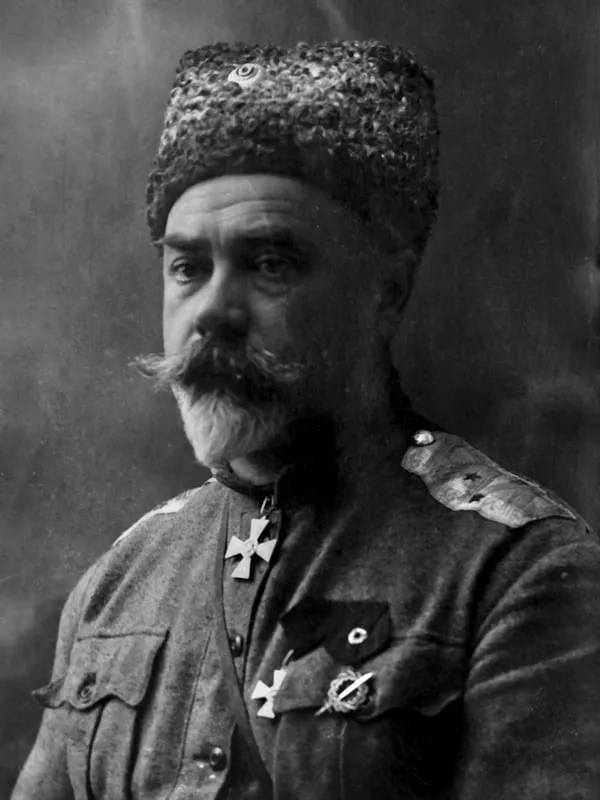
- Born:
- 16 December 1872, Szpetal Dolny near Włocławek (Congress Poland)
- Died:
- 7 August 1947, Ann Arbor (United States)
- Author:
- Natalia
- Photo:
- autor nieznany, domena publiczna, Wikimedia Commons

General Anton Denikin was one of the best Russian field commanders of the war and at the same time the loudest critic of the revolutionary changes in the army in 1917. His 4th Rifle Brigade, known as the “Iron” Brigade, was among the most decorated units of the Tsarist army. After the February Revolution he was chief of staff to the supreme commander and commander of two fronts, and for supporting General Lavr Kornilov he ended up in prison. After the Bolshevik coup he helped found the White Volunteer Army, and after Kornilov’s death he took command of it. In 1919 his forces came to within a few hundred kilometres of Moscow. He spent most of his life in exile, where he wrote multi-volume memoirs, one of the most important sources for the history of the revolution and the civil war.
Before the war
He was born on 16 December 1872 (4 December by the Julian calendar) in Szpetal Dolny (PL), on the left bank of the Vistula opposite Włocławek. His father, Ivan, was born a serf in Saratov Governorate, was conscripted into the army and after years of service rose to the rank of major in the border guard. His mother, Elżbieta née Wrzesińska, was a Pole and a Catholic. Polish and Russian were spoken at home, and the son was brought up in the Orthodox faith. The family lived in poverty, especially after the father’s death in 1885. Anton completed the Realschule in Łowicz, then the cadet (junker) school in Kiev, and as a second lieutenant of artillery was posted to the garrison in Biała Podlaska.
He graduated from the Nicholas General Staff Academy, but the new commandant struck him off the list of appointments to the General Staff. Denikin lodged a complaint with the Tsar himself, something unheard of for a young officer, and refused to withdraw it in exchange for an appointment. He reached the staff only several years later. In the war with Japan he served on staffs in Manchuria and rose to the rank of colonel. In the following years he wrote for the military press under a pseudonym, criticising bureaucracy, lack of initiative and the poor treatment of soldiers. Politically he was a liberal, close to the Kadets, a supporter of constitutional monarchy and of Stolypin’s reforms. From 1910 he commanded a regiment in Zhitomir, and in June 1914, as a newly promoted major general, he became quartermaster-general of the Eighth Army, commanded by General Aleksei Brusilov.
The Iron Brigade
Staff work did not satisfy him. At the beginning of September 1914, during the Battle of Galicia, he himself asked to take over the 4th Rifle Brigade, which owed the name “Iron” to the war with Turkey of 1877–1878. Brusilov agreed. Only a few days later the brigade was repelling Austrian attacks in the Battle of Gródek, for which Denikin received the Golden Sword of St George. On 24 October at Chyrów, without artillery preparation, he took the village of Łużek Górny, which according to Denikin housed the headquarters of Archduke Joseph August’s group, and forced the staff into a hasty flight. For this he received the Order of St George, 4th Class.
In November the brigade crossed the Carpathians and, according to Russian figures, took Medzilaborce in Hungary, capturing several thousand prisoners. In February 1915, during the Winter Battle in the Carpathians, it took the hills near Lutowiska and threw the Austrians back across the San. Denikin received the Order of St George, 3rd Class. In April the brigade was expanded into a division. Throughout the summer of 1915 it retreated from Galicia in heavy defensive fighting, with a severe shortage of ammunition.
At the end of September 1915, when Brusilov went over to a counter-offensive in Volhynia, Denikin’s division burst into Lutsk and, according to Russian figures, took almost 10,000 prisoners. Brusilov recalled that Denikin drove into the town by car and reported its capture from there. For this action he was promoted to lieutenant general. The town soon had to be given up when the front was straightened, and in October the division briefly took Czartorysk on the Styr. In June 1916, in the first days of the Brusilov offensive, the iron riflemen took Lutsk again. Denikin received a diamond-studded Sword of St George inscribed “For the twofold liberation of Lutsk”. In September 1916 he took over VIII Corps and led it to Romania, where he fought during the retreat through Wallachia and Moldavia.
1917
He received the February Revolution with understanding, but from the first weeks he feared anarchy. The war minister Alexander Guchkov brought him to Stavka in Mogilev, where Denikin became deputy and soon chief of staff to the supreme commander, General Mikhail Alekseyev. He fought the “democratisation” of the army, the soldiers’ committees and the declaration of soldiers’ rights. He later called the Petrograd Soviet’s Order No. 1 “the first, main impulse” for the disintegration of the army. In May, at a congress of officers in Mogilev, he gave a fiery speech in which he accused the authorities of having thrown the officers to the mercy of the soldier mob. The speech was reprinted all over Russia.
When at the beginning of June the government dismissed Alekseyev, Denikin did not want to be chief of staff to Brusilov, whom he considered an opportunist, and took command of the Western Front. His attack near Krewo in July, intended to support the Kerensky offensive in Galicia, collapsed because after the first successes the infantry refused to go any further. On 29 July, at a conference at Stavka, Denikin listed for the prime minister Alexander Kerensky how the committees and the government’s policy had destroyed discipline. It was the sharpest speech of the day and an open break with the prime minister. Two days later Lavr Kornilov became commander-in-chief, and Denikin, in accordance with his wishes, swapped posts in August with General Pyotr Baluyev and took over the South-Western Front.
In September, during the Kornilov affair, he telegraphed the government that he “would not go along” with an authority that was again destroying the army. He probably took no active part in Kornilov’s preparations, but his telegram was enough. On 11 September the front commissar had him arrested together with his staff in Berdichev. For a month he expected the soldiers to break into his cell, and while being taken to the railway station he was nearly lynched by a crowd. In October he was moved to Bykhov, where he was held together with Kornilov.
The Volunteer Army
On 2 December 1917, a few hours before the Bolshevik commander-in-chief Nikolai Krylenko arrived in Mogilev, General Nikolay Dukhonin ordered the Bykhov prisoners released. Denikin shaved off his beard and, with papers in the name of Aleksander Dąbrowski, a Polish nobleman, made his way in the second half of December to Novocherkassk. He was the author of the compromise under which power in the nascent Volunteer Army was shared by Alekseyev, Kornilov and the Don ataman Aleksey Kaledin. At the beginning of 1918 he commanded its first division, and in the Ice March to the Kuban he was Kornilov’s deputy.
When Kornilov was killed near Yekaterinodar on 13 April 1918, Denikin took command, broke off the hopeless assault and led the remnants of the army back to the Don. This decision saved the volunteers from annihilation. In June he set out on the Second Kuban Campaign, in August he took Yekaterinodar, and after Alekseyev’s death in October 1918 he became the sole leader of the Whites in the south. He believed that the war with Germany was still going on and, unlike the Don ataman Pyotr Krasnov, rejected cooperation with the Germans occupying Ukraine. He counted on the Entente, and after the Armistice of Compiègne he did indeed receive weapons and money from it, and the French landed in Odessa.
After the war
In January 1919 Denikin became head of the Armed Forces of South Russia. He recognised the authority of Admiral Alexander Kolchak, although in practice he had greater strength than the Supreme Ruler. In the summer of 1919 his armies took Kharkov, Tsaritsyn, Kiev and Kursk, and in October Orel, about 350 kilometres from Moscow. Then came defeat. The Red Army’s counter-attack, peasant uprisings in the rear, overstretched supply lines and conflicts with the Kuban Cossacks and with the nations of the former empire forced the Whites to retreat. The slogan of “Russia, one and indivisible” alienated the Ukrainians, Georgians and Poles. Józef Piłsudski, who did not believe that the Whites would recognise Polish independence within decent borders, did not support Denikin’s offensive in the autumn of 1919 and even concluded an informal agreement with the Bolsheviks to halt the fighting. Denikin later believed that it was Poland that had saved Soviet power. In the areas they occupied, White units, mainly Cossack ones, carried out pogroms of Jews. Denikin issued orders against them, but did not enforce them.
After the disastrous evacuation from Novorossiysk in March 1920, on 4 April he handed over command to General Pyotr Wrangel and left Russia on a British warship. He lived in Belgium, Hungary and France. He wrote the five-volume “Sketches of the Russian Turmoil”. During the Second World War he rejected German offers of collaboration and urged émigrés not to fight against their own country. In 1945 he left for the United States. He died on 7 August 1947 in Ann Arbor. In 2005 his remains were moved to the Donskoy Monastery in Moscow.
Assessment
As a commander in 1914–1916 Denikin is rated highly. He was brave, energetic and able to seize the moment, and his brigade and division repeatedly decided the success of the Eighth Army’s operations. Brusilov, who did not spare many generals his criticism, admitted that in a field command Denikin had shown “excellent abilities”. In 1917 he became a symbol of the officer corps’ resistance to the revolutionary changes in the army. Some see in this an accurate diagnosis of the army’s disintegration, others a stubbornness that deepened the gulf between officers and men.
Historians such as Peter Kenez also point out that this honest and selfless man was no politician. He failed to put forward a programme that would win over the peasants, could not come to terms with the Cossacks or with the nations that had broken away from Russia, and did not restrain the violence of his own troops. In the Soviet Union he was portrayed as a reactionary and an enemy of the people. For the Russian emigration, and in recent years also for part of opinion in Russia, he was a patriot who remained faithful to his country to the end of his life. His memoirs, despite their partisanship, remain an invaluable source for the history of the Russian Army in 1917.
Sources
Spotted a mistake?Report an error
Mentioned in battles
(01)Often appears with
People who appear in the same events.