Russian Empire · The Entente
Aleksei Kaledin
Commander of the 8th Army (1916–1917), ataman of the Don Cossack Host (1917–1918), general of cavalry
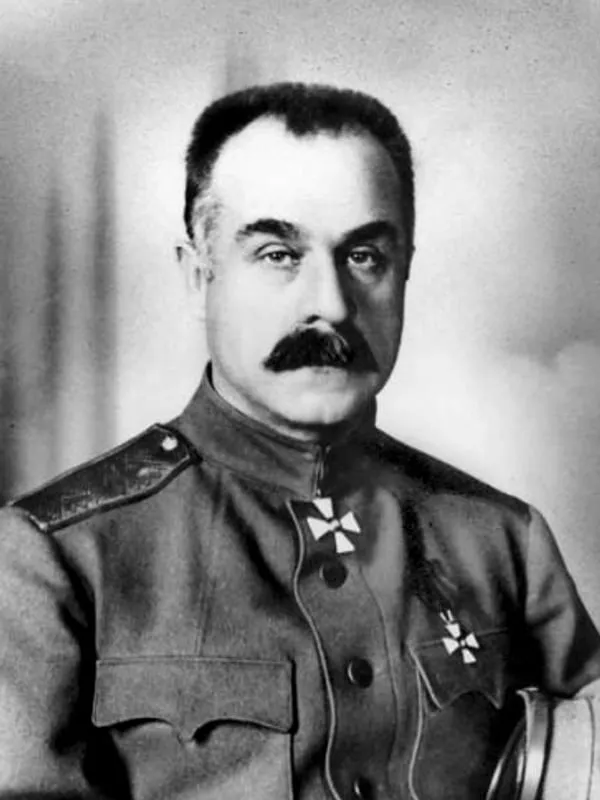
- Born:
- 24 October 1861, Ust-Khopyorskaya (Don Host Oblast)
- Died:
- 11 February 1918, Novocherkassk
- Author:
- Natalia
- Photo:
- autor nieznany, domena publiczna, Wikimedia Commons

Aleksei Kaledin was one of the best Russian cavalry commanders of the First World War, and in 1916 the commander of the army that dealt Austria-Hungary the heaviest blow of the whole war. In June his 8th Army broke the front at Olyka and took Lutsk in three days, opening the Brusilov Offensive. After the February Revolution Kaledin, a man of the old army, could not come to terms with the soldiers’ committees and lost his command, but soon afterwards the Don Cossacks elected him their ataman. After the Bolshevik seizure of power the Don under his rule became the first centre of resistance to the new regime and the cradle of the White Volunteer Army. When in February 1918 it turned out that the Cossacks would not defend their land, the ataman laid down his authority and shot himself.
Before the war
Aleksei Maksimovich Kaledin was born on 24 October 1861 (12 October in the Julian calendar) at the Kaledin khutor in the stanitsa of Ust-Khopyorskaya, in the Don Host Oblast. He came from a Cossack family whose members had earned nobility through service. His father, Maksim, had fought in the defence of Sevastopol in the Crimean War. Aleksei attended the military gymnasium in Voronezh, and in 1882 graduated from the Mikhailovsky Artillery School (PL) in St Petersburg. He began his service as an officer in a horse battery of the Transbaikal Cossacks in the Far East, and in 1889 graduated from the Nicholas General Staff Academy.
Over the following years he held staff posts, including on the staff of the Don Cossack Host. In 1903 he took over the Novocherkassk Cossack Junker School, which he reformed and which brought him his first fame on the Don. From 1906 he was assistant chief of staff of the Don Host, in 1910 took over a brigade of the 11th Cavalry Division, and in December 1912 the 12th Cavalry Division, stationed in Podolia. In 1913 he was promoted to lieutenant-general. He was married to the Swiss-born Maria Granzhan. Their only son drowned at the age of eleven.
1914–1915: cavalry commander
Kaledin’s division became part of General Aleksei Brusilov’s 8th Army, which entered Eastern Galicia in August 1914. In the Battle of the Gnila Lipa, when a gap opened between two Russian corps while an infantry division was still far off, Brusilov threw the 12th Cavalry Division into it. Kaledin dismounted his regiments and held the line by fire until the infantry arrived. For this fighting he received the Order of St George, 4th class. In September, at Gródek, he covered the army’s threatened left flank: according to Brusilov he used nineteen squadrons dismounted and charged successfully with the remaining five. The war confirmed his reputation as a commander who did not send his men into battle but led them himself. So Anton Denikin, whose “Iron” brigade fought in the same army, later wrote of him.
In the winter the division fought in the Carpathians. In February 1915 Kaledin, directing a dismounted cavalry action from a forward post, was seriously wounded in the leg by a shell fragment. His division was taken over by Carl Gustaf Mannerheim. Back on duty, in the summer of 1915 Kaledin commanded two army corps in turn, from July the XII Corps. For the fighting of 1915 he received the Order of St George, 3rd class.
1916: Lutsk
When at the end of March 1916 Brusilov took over the Southwestern Front, he wanted to hand his 8th Army to the front’s chief of staff, General Vladislav Klembovsky. The Tsar, however, “insistently” recommended Kaledin, and Brusilov gave way, which, as he wrote, he later regretted. Alfred Knox, the British military attaché with the Russian army, described the new commander as short-sighted, shy and silent, more of a student than a man of the world. The officers of his staff were afraid of him, and one of them blamed him for a total lack of regard for human life.
The main blow of the offensive fell to him. On a narrow sector west of Olyka Kaledin concentrated about a hundred battalions and over three hundred guns. On 4 June his artillery methodically demolished the trenches of Archduke Joseph Ferdinand’s Austro-Hungarian 4th Army all day, and on the morning of 5 June the infantry broke through the first two lines of defence. On 7 June the Russians entered Lutsk. In three days the breach widened to several tens of kilometres, and the Austro-Hungarian 4th Army was retreating in disorder. Asked by Knox what he put the success down to, Kaledin replied briefly that the offensive had been prepared with exceptional care.
The victory, however, was not exploited. Kaledin advanced cautiously, and the Austrian official history holds that this hesitation saved the Austro-Hungarian front. Instead of directing him on Lviv, Brusilov stubbornly aimed at Kovel, and over Kaledin’s protests sent one of his cavalry divisions north, where it got stuck in the marshes. Kaledin was convinced that with all his cavalry at hand he would have taken Volodymyr-Volynskyi and cut the railways beyond Kovel. In July his troops reached the Stokhid together with the 3rd Army, which on its way had pushed the Polish Legions back from Kostiuchnówka. In August and September, reinforced by the Guard, they stormed the positions in the marshes before Kovel without success. In the autumn the 8th Army was moved south, to the Carpathians and Bukovina.
1917: ataman of the Don Host
After the February Revolution Kaledin could not and would not work with the soldiers’ committees. Brusilov, who had quickly come to terms with the new order, decided that the general had “lost heart” and did not understand the times. In April Kaledin was transferred to the Military Council and in May to the reserve, and the 8th Army was taken over by Lavr Kornilov. Denikin considered the dismissal unjust. Kaledin returned to the Don, where in June the Cossack Great Military Circle elected him ataman. He was the first Don ataman since the early eighteenth century to be elected by the Cossacks themselves rather than appointed by the Tsar.
In August, at the Moscow State Conference, he presented a programme that the right greeted with applause and the left with whistles: the army out of politics, the abolition of soviets and committees in the army and in the rear, the restoration of discipline. A few weeks later, after the failed Kornilov putsch, the war minister ordered his arrest, but the Don would not hand over its ataman. Kaledin reached Novocherkassk by a roundabout route, and Alexander Kerensky cancelled the order a few days later. In the autumn a commission of inquiry found that Kaledin had taken no part in the plot. In November he was elected to the Constituent Assembly.
The Don against the Bolsheviks
On hearing of the coup in Petrograd Kaledin declared it a crime and announced that until a legitimate all-Russian government was formed, full power on the Don belonged to the Don Host government. Refugees from all over Russia streamed to the Don. In mid-November General Mikhail Alekseyev arrived; the ataman received him coolly but allowed him to recruit volunteers. Kornilov followed in December. In December the volunteers helped Kaledin retake Rostov-on-Don from the local Bolsheviks. At the turn of the year the Volunteer Army was formed, and the three generals divided power among themselves: Kornilov took military affairs, Alekseyev politics and finance, and Kaledin the affairs of the Don.
The ataman’s strength, however, was illusory. The Cossack regiments returning from the front were tired of war and unwilling to fight the Bolsheviks, the non-Cossack population of the towns and the workers of the coalfield were hostile, and Kaledin had at his disposal mainly volunteers, schoolboys and cadets. In January 1918 Red columns moved on the Don from several directions, and a congress of front-line Cossacks in the stanitsa of Kamenskaya declared the ataman deposed. On 10 February Taganrog fell, and Kornilov informed Kaledin that the Volunteer Army would withdraw to the Kuban.
On 11 February 1918 (29 January in the Julian calendar) Kaledin convened the Don Host government in Novocherkassk. He announced that 147 bayonets were left at the front to defend the Don, and laid down his powers. When the members of the government began to hold forth at length about the situation, he cut them short with the remark that Russia had perished through idle talk, went into the next room and shot himself through the heart. In a letter to Alekseyev he explained that he was taking his life because the Cossacks had refused to follow their ataman. He was buried in Novocherkassk, and his grave has not survived. Less than two weeks later the volunteers left Rostov and set out for the Kuban.
Assessment
As a military commander Kaledin has a good reputation. The Russian general and historian Nikolai Golovin (PL) counted him among the best Russian generals, and some Russian authors even argue that the Lutsk breakthrough ought to bear his name rather than Brusilov’s, since the decisive work was done by the 8th Army. Critics reproached him for his caution after the breakthrough and for the lost chance of a great victory. Knox saw in him a hard thinker who perhaps lacked the reserve of vital energy needed to carry a difficult operation through.
As a politician Kaledin failed. Soviet historiography called his rule on the Don the “Kaledinshchina” and presented it as a counter-revolution of generals and the Cossack elite. The American historian Peter Kenez, by contrast, stresses that he was the first leader of the Don Cossacks since 1723 to be chosen democratically. Kaledin tried to defend Cossack autonomy and order, but his own Cossacks no longer wanted to fight, and his suicide closed the first chapter of the Russian Civil War.
Sources
Spotted a mistake?Report an error
Commanded in battles
(01)Often appears with
People who appear in the same events.