Finland · The Central Powers
Carl Gustaf Mannerheim
Commander of the Russian 12th Cavalry Division (1915–1917), commander-in-chief of the White Finnish army (1918), Regent of Finland (1918–1919)
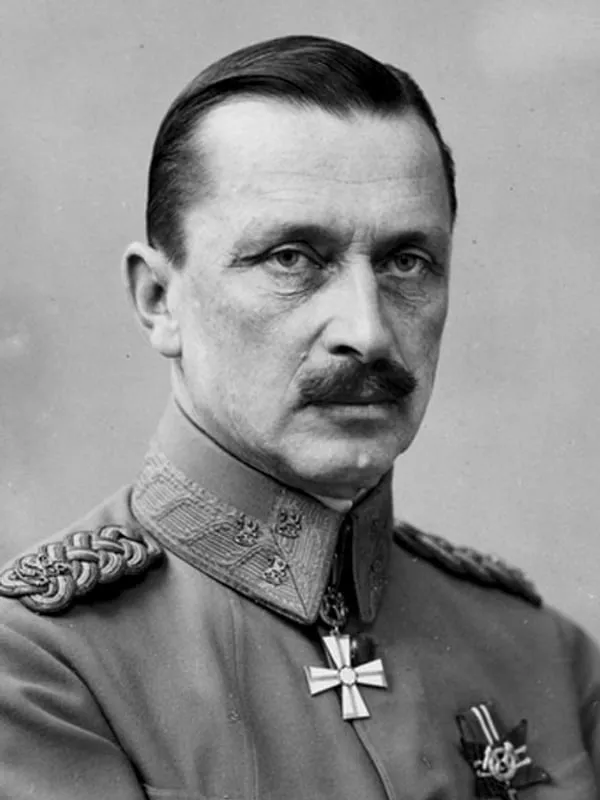
- Born:
- 4 June 1867, Askainen (Finland)
- Died:
- 27 January 1951, Lausanne (Switzerland)
- Author:
- Łukasz Skowroń
- Photo:
- Ulrich Romberg ("Rembrandt"), Schaffhausen, domena publiczna, Wikimedia Commons

Carl Gustaf Emil Mannerheim lived through the Great War in two entirely different roles. Until the autumn of 1917 he was a general of the Russian Army, a cavalry commander who fought the Austrians and Germans in Poland, Galicia, Volhynia and Romania, and who kept a portrait of Tsar Nicholas II in his drawing room for the rest of his life. From January 1918 he was the leader of the Finnish Whites, who defeated the Reds in a bloody civil war, and in December of that year he became regent of independent Finland. What put him on this side of the White–Red divide was not a choice of alliance but the war against Bolshevism. He cooperated reluctantly with the Germans, on whose help the government in Vaasa was counting, and he left when Finland began to subordinate itself to them. That is why it was he, and not the pro-German politicians, whom Finland sent to the victorious Entente after Germany’s defeat. The “side” field of this page, set to the Central Powers, therefore describes the camp in which White Finland found itself in 1918 rather than the views of Mannerheim himself.
Before the war
He was born on 4 June 1867 at the Louhisaari manor in the parish of Askainen on the west coast of Finland, then a Grand Duchy in union with Russia. He came from a Swedish-speaking family of barons who had come to Sweden from Germany in the 17th century. His father went bankrupt and abandoned the family, and his mother died early. He was expelled from the cadet corps in Hamina for absence without leave, so he made his career in the Russian Army: he graduated from the Nicholas Cavalry School (PL) in St Petersburg, served briefly with the dragoons in Kalisz, and from 1891 in the elite Chevalier Guard regiment. At the coronation of Nicholas II in 1896 he stood on the steps of the throne. For years he was a horse expert in the court stables and at the officers’ riding school. To the end of his life he spoke Swedish, Russian and French better than Finnish.
He volunteered for the war with Japan and was promoted to colonel for Mukden. In 1906–1908 he rode some 14,000 kilometres from Russian Turkestan to Peking. Officially he was gathering ethnographic collections, at first with the expedition of the French orientalist Paul Pelliot; in reality he was an intelligence officer of the Russian General Staff, surveying northern China. He then commanded an uhlan regiment, and from 1910 His Imperial Majesty’s Life Guard Uhlan Regiment in Warsaw. In 1911 he became a major-general. He was a member of the Tsar’s suite. In December 1913 he took over the Independent Guards Cavalry Brigade in Warsaw. With it he went to war.
1914–1916: a cavalryman on the Eastern Front
At the start of the war Mannerheim’s brigade covered the left wing of the Russian forces in the Lublin region. On 17 August 1914 it fought a successful skirmish with the Austrians near Kraśnik, a week before the great Battle of Kraśnik, in which the Russian 4th Army was repulsed. Mannerheim received the Golden Sword of St George for it. He fought near Opole Lubelskie, and in early October 1914, during the German-Austrian march on the Vistula, on his own initiative he covered the withdrawal of Russian troops across the river near Opatów before the Battle of Warsaw and Dęblin. In December he received for this the coveted Order of St George, 4th class.
In the spring of 1915 he took over the 12th Cavalry Division from the wounded General Alexei Kaledin and commanded it for two years. He fought on the Dniester and in Eastern Galicia, covering the retreat of the Russian Army after the breakthrough at Gorlice. In June 1916 the division advanced in the centre of the Brusilov offensive in Volhynia. According to Finnish biographers, near Kisielin its squadrons closed a gap several kilometres wide between two Russian corps. Mannerheim was a conscientious and cautious commander who took care of his horses and men, but no decisive victory is attributed to him. In this war cavalry served mainly for reconnaissance, screening and fighting on foot.
In the autumn of 1916, after Romania entered the war, the division covered some 560 kilometres to Moldavia in a few weeks. At the turn of 1916 and 1917 it fought in the mountains, in the Soveja basin, during the fighting for Focșani, subordinated to the Romanian 2nd Army of General Alexandru Averescu.
1917: the end of the Tsarist army
At the turn of February and March 1917 Mannerheim was on leave in Petrograd and witnessed the outbreak of the February Revolution. He was a convinced monarchist and experienced the fall of the dynasty as a catastrophe. He nevertheless returned to the front. In the spring of 1917 he was promoted to lieutenant-general, and in June he took over the 6th Cavalry Corps in northern Bukovina. He did not accept the collapse of discipline, the soldiers’ councils and the commissars, and the new authorities regarded him as a man of the old regime. After a fall from his horse he went to Odessa for treatment, and there in September 1917 he received a telegram saying that he was being transferred to the reserve because he “had not adapted to present conditions”. In early December he left for Petrograd, where he looked in vain for people ready to fight the Bolsheviks, and on 18 December he arrived in Helsinki, a dozen or so days after the declaration of Finnish independence.
1918: leader of the Whites
In January 1918 the senate of Pehr Evind Svinhufvud appointed him to the military committee, and in the middle of the month entrusted him with the conduct of military affairs. Mannerheim went to Vaasa in Ostrobothnia, where the peasant civil guards, known as the White Guard, were strongest. In the early morning of 28 January, a few hours after the Reds had taken control of Helsinki, his troops disarmed the Russian garrisons in Ostrobothnia. Thus the civil war began. Mannerheim created an army almost from nothing. He had the zeal of the northern peasants, weapons captured from the Russians, a few dozen Finnish officers from the Tsarist army and Swedish volunteers. In February the main part of the Jäger battalion returned from Germany: nearly a thousand young Finns who had been secretly trained in the German Army since 1915. He made them his cadre of commanders. He introduced conscription. On 7 March he was promoted to general of cavalry.
From the outset he wanted the Finns to win the war themselves. In an order of 23 February 1918, issued at Antrea on the Karelian Isthmus, he declared that he would not sheathe his sword until order reigned in the country and the last soldier of Lenin had been driven out of Finland and White Karelia. The senate, which in February asked Germany for military help, did so against his position. According to Mannerheim’s memoirs, he accepted it only once he had obtained assurances that the Germans would not interfere in the country’s internal affairs, but he wanted to decide the outcome of the war before they arrived. In mid-March he went over to the offensive and on 6 April, after the bloodiest battle of the war, took Tampere. Three days earlier the German Baltic Division had landed at Hanko under General Rüdiger von der Goltz, and on 12–13 April it took Helsinki. Mannerheim had opposed the German attack on the capital because he wanted to take it himself. His troops moved east and on 29 April took Vyborg. On 16 May, when the war had come to an end, he led a victory parade through Helsinki. He meant it to show that the war had been won by the Finnish army and not by a German division.
The victory had a grim side. More than 7,000 people on the Red side died in executions and killings, and nearly 12,000 died of hunger and disease in the prison camps. As commander-in-chief, Mannerheim was responsible for an army in which mass shootings took place, especially after the capture of Tampere and Vyborg. Some Finnish historians accuse him of having opened the way to arbitrary violence with his proclamation of 25 February 1918, which announced that people caught committing violence and robbery would be shot on the spot, and of doing little himself to stop it. Others point out that the terror was largely the work of local commanders, guards and courts martial over which the high command had little control, and that after the war the camps came under the government, not him.
After the victory Mannerheim demanded a strong and independent position for the army. The government, however, decided to build the armed forces with the help of German officers, under the eye of von der Goltz, and the senate’s policy was moving towards a monarchy with a German prince on the throne. Mannerheim did not want to take part in this. At the end of May he resigned as commander-in-chief and in early June left for Sweden.
Regent
In Stockholm he kept in touch with Entente diplomats and made no secret of his view that Finland’s German orientation was a mistake. When in the autumn of 1918 it was already clear that Germany was losing, the government sent him to London and Paris. From 12 November to 10 December he held talks there with, among others, Robert Cecil and Arthur Balfour. He was told that the condition for recognising Finland’s independence was a break with Germany and the renunciation of Frederick Charles of Hesse, elected king in October. On 12 December parliament elected him regent in succession to Svinhufvud. He returned to Helsinki in the second half of December, after the last Germans had sailed away.
As regent he obtained for Finland what he had been seeking: in the spring of 1919 Great Britain and the United States recognised its independence, and food began to flow into the country. He also discussed with the British a Finnish part in a march on Petrograd, in return for recognition of independence by the White Russians and the annexation of East Karelia, but nothing came of it. On 17 July 1919, albeit reluctantly, he approved the republican constitution. In the presidential election held by parliament on 25 July he lost to Kaarlo Juho Ståhlberg, winning 50 votes to 143. The Social Democrats did not want a “White general” at the head of the state.
After the war
For more than a decade he stayed out of politics: he headed the Finnish Red Cross and the Child Welfare League, travelled and hunted. In 1931 President Svinhufvud made him chairman of the Defence Council, and in 1933 conferred on him the title of field marshal. The fortifications on the Karelian Isthmus were named the Mannerheim Line. In the Winter War and the Continuation War he was commander-in-chief; in 1942 he received the title of Marshal of Finland, and in 1944–1946, as president, he led the country out of the war. He died on 27 January 1951 in a hospital in Lausanne and was buried in Helsinki.
Assessment
In Finland Mannerheim is a national figure whose importance stems above all from the years 1939–1944, not from the First World War. Biographers such as the British historian J.E.O. Screen describe him in 1914–1917 as a capable but not outstanding cavalry commander, valued for his composure and his care for his soldiers. The real test came in 1918. His supporters stress that within a few weeks he created an army that saved independence from a revolution backed by Soviet Russia, and that, unlike most bourgeois politicians, he did not tie the country’s future to Germany. Thanks to this, after November 1918 Finland had someone the Entente was willing to talk to.
His critics, especially the Finnish left and some later historians, see him above all as the “White general”, the leader of the victorious side in the civil war, responsible, at least politically, for the terror and the camps of 1918. They also point to his ambitions regarding East Karelia and his readiness to intervene in Russia in 1919. Both assessments agree on one thing: the year 1918 turned a Russian general into a leader of the Finns, and the division into Whites and Reds that he symbolised weighed on the country for a whole generation.
Sources
Spotted a mistake?Report an error
Mentioned in battles
(01)Often appears with
People who appear in the same events.