Finland · The Central Powers
Pehr Evind Svinhufvud
Chairman of the Senate of Finland (1917–1918), Regent of Finland (1918)
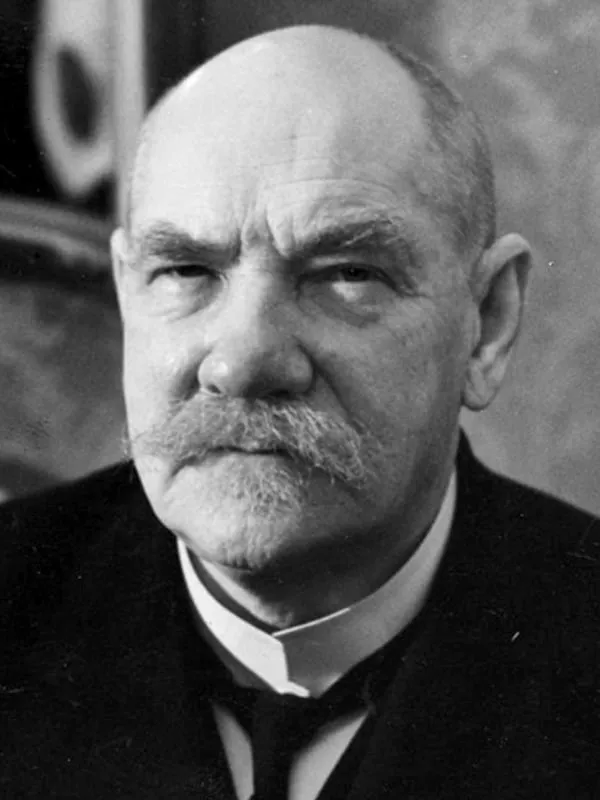
- Born:
- 15 December 1861, Sääksmäki (Finland)
- Died:
- 29 February 1944, Luumäki (Finland)
- Author:
- Natalia
- Photo:
- autor nieznany, domena publiczna, Wikimedia Commons

Pehr Evind Svinhufvud, called “Ukko-Pekka”, or Old Pekka, by his countrymen, fought Russian rule over Finland all his life and during the Great War paid for it with exile to Siberia. After the revolution of 1917 he became head of the Finnish government, presented the declaration of independence to parliament and had to ask Lenin in person to recognise it. In the civil war of 1918 he was the leader of the “White” government, and from May to December regent of the country. It was he and his ministers who based independent Finland on Germany, counting on a German guarantee to protect it from Russia. Germany’s defeat in November 1918 ended both this policy and his regency. Finland did not declare war on the Entente, but in 1918 it was in practice a German satellite.
Before the war
He was born on 15 December 1861 on the Rapola estate in Sääksmäki in southern Finland, into a Swedish-speaking noble family. His father, a ship’s captain, drowned when the boy was two, and he was brought up in Helsinki by his mother. He studied history and then law at the University of Helsinki and became a judge. Although Swedish was spoken at home, he supported the rights of the Finnish language.
His political character was shaped by the years of Russification after 1899. He belonged to the “Constitutionalists”, who defended the autonomy of the Grand Duchy through legal, passive resistance. In 1903 he was removed from the Turku Court of Appeal because he refused to withdraw a charge against a Russian governor. After the reform of 1906 he sat in the new unicameral parliament, the Eduskunta, for the Young Finnish Party, and between 1907 and 1912 was several times its Speaker, elected also with the votes of the Social Democrats, who valued his intransigence towards St Petersburg. His speeches at the opening of successive sessions so irritated the authorities that the emperor dissolved parliament several times. From 1908 he was a district judge in Lappee in south-eastern Finland and lived on the Kotkaniemi estate in Luumäki. He returned to this work when he ceased to be Speaker.
Exile
The war did not halt Russification. In the autumn of 1914 Svinhufvud refused to recognise the Russian Konstantin Kazansky as procurator of the Finnish Senate, because he regarded the appointment as contrary to Finnish law. On 13 November the Governor-General, Franz Albert Seyn, removed him from office, and because Svinhufvud refused to step down, on 25 November he was arrested and exiled to Siberia, to the region of Tomsk. He spent more than two years there. He was allowed to write letters, and his wife visited him in exile. At home he became a symbol of resistance.
Meanwhile some young Finns were looking for another way. From 1915 nearly two thousand volunteers secretly went to Germany, where they were trained in a separate battalion of riflemen, the Jägers, with a view to a future struggle for independence. Svinhufvud’s links with this movement were not direct, as he was in exile, but his later policy grew out of the same conviction: that Finland’s freedom could be won with German help.
Independence
After the February Revolution in March 1917 Svinhufvud returned home and was welcomed as a hero. He became procurator of the Senate, that is, he took up the very office he had refused to surrender to Kazansky. After the Bolshevik coup the bourgeois parties entrusted him with power. On 27 November 1917 he became head of a new Senate, that is, a government, made up exclusively of bourgeois politicians. His main task was to separate the country from Russia as quickly as possible without negotiating with the Bolsheviks, whom he did not regard as a legitimate government.
On 4 December he presented to the Eduskunta the declaration “To the Finnish People” and a draft republican constitution, and on 6 December parliament, by the votes of the bourgeois majority, 100 to 88, adopted independence. Svinhufvud wanted to obtain it without the involvement of Petrograd, but no state was willing to recognise Finland before its former metropolis did, and Germany, already negotiating with the Bolsheviks at Brest, advised turning to the Council of People’s Commissars. At the end of December Svinhufvud therefore travelled with a delegation to Petrograd. On 31 December, a few minutes before midnight, the Soviet government decided to recognise Finland’s independence, and the former exile had to thank Lenin in person at the Smolny. On 4 January 1918 the decision was confirmed by the Central Executive Committee of the soviets, and on the same day France, Sweden and Germany recognised Finland.
Civil war
In a country without an army or police, where tens of thousands of Russian soldiers were still stationed and both sides of the political dispute had armed guards, Svinhufvud’s Senate chose force. On 12 January 1918 parliament authorised it to create a “strong police authority”; in the middle of the month the direction of military affairs was entrusted to General Carl Gustaf Mannerheim, and on 25 January the Senate declared the bourgeois civic guards the government’s army. The left saw this as the prelude to a crackdown on the labour movement. On the night of 27/28 January the Reds seized Helsinki and the civil war began.
Some of the senators managed to get away to Vaasa, which became the capital of White Finland. Svinhufvud hid in Helsinki for several weeks. At the beginning of March the Whites seized the icebreaker Tarmo and took him through the ice to Tallinn, just occupied by the Germans, and from there he reached Vaasa via Germany and Sweden and took over the chairmanship of the Senate. The most important decisions were taken while he was travelling. The Senate’s envoys in Berlin asked for military help, and on 7 March they signed with Germany a peace treaty with a trade agreement and secret undertakings that made the country heavily dependent on the Reich. Svinhufvud fully supported this orientation. He believed that only a strong Germany could guarantee Finland’s security against Russia, whatever kind of Russia it might be. In April the German Baltic Division of General Rüdiger von der Goltz landed at Hanko and took Helsinki, and on 13 April the government announced that the Germans had come at its request. In mid-May the war ended.
Regent
On 18 May 1918 a rump parliament, from which almost the entire left had disappeared, entrusted Svinhufvud with supreme power as regent. At the end of May Juho Paasikivi became head of the Senate. Mannerheim, who would not accept the subordination of the army to German officers, resigned, and von der Goltz became the government’s chief adviser on military affairs. Finland signed treaties with Austria-Hungary and Turkey, and the government sought the annexation of East Karelia. Svinhufvud, a republican by conviction rather than otherwise, supported for political reasons the plan for a monarchy with a German prince on the throne. He believed that a king related to the emperor would bind the Reich most firmly to the defence of Finland. On 9 October parliament elected as king Prince Frederick Charles of Hesse, brother-in-law of Wilhelm II.
The heaviest legacy of the regency was the camps in which about 76,000 Reds were held after the war. In the summer of 1918 nearly 12,000 people died in them of hunger and disease, and special courts dealt with tens of thousands of cases. In the autumn Svinhufvud signed amnesties. On 30 October he pardoned Reds sentenced to up to four years, and more than 30,000 prisoners were released on parole. The amnesty of 7 December covered those sentenced to up to six years, and at the same time freed from liability those Whites who had carried out unlawful executions during and after the war.
Germany’s defeat destroyed his whole policy. The Entente had no intention of recognising a state ruled by a German prince and by men associated with Berlin. At the end of November the Paasikivi government resigned, and according to the Finnish historian Seppo Tiihonen Svinhufvud had already on 17 November sent Mannerheim a telegram with the government’s request that he take the office of regent. He himself stepped down in December (sources give 10 or 12 December), and on 12 December parliament elected Mannerheim. A few days later the last Germans left Finland.
After the war
For several years he worked in banking, and he lost the presidential election of 1925. He returned to politics in 1930 as prime minister, at the time of the nationalist Lapua Movement, and in 1931 parliament elected him president by a majority of two votes. In 1932 a radio speech of his helped to put down the rebellion of Lapua Movement men at Mäntsälä. In 1937 he lost the election because the Social Democrats, whom he had kept out of government, voted against him. He died on 29 February 1944 on his estate in Luumäki.
Assessment
For the Finnish right and for many Finns he was the “father of independence”: the man who survived exile, read out the declaration of independence and led the state through 1918. Historians credit him with intransigence and personal courage, but also point to his limitations. Choosing force in January 1918 instead of an understanding with the moderate left hastened the civil war, though its causes went much deeper. Tying the country to Germany was understandable in 1918, since only Germany gave the Whites real help, but it proved a risky bet on a losing card and almost cost Finland recognition by the victorious powers. The left remembered him for the camps and the one-sided amnesties, while in the 1930s it also owed him his stand against the Lapua Movement. His later support for cooperation with Germany in the Second World War meant that after 1944 his memory faded for a long time.
Sources
Spotted a mistake?Report an error
Often appears with
People who appear in the same events.