Germany · The Central Powers
Georg von Hertling
Minister-President of Bavaria (1912–1917), Chancellor of the German Empire and Minister-President of Prussia (1917–1918)
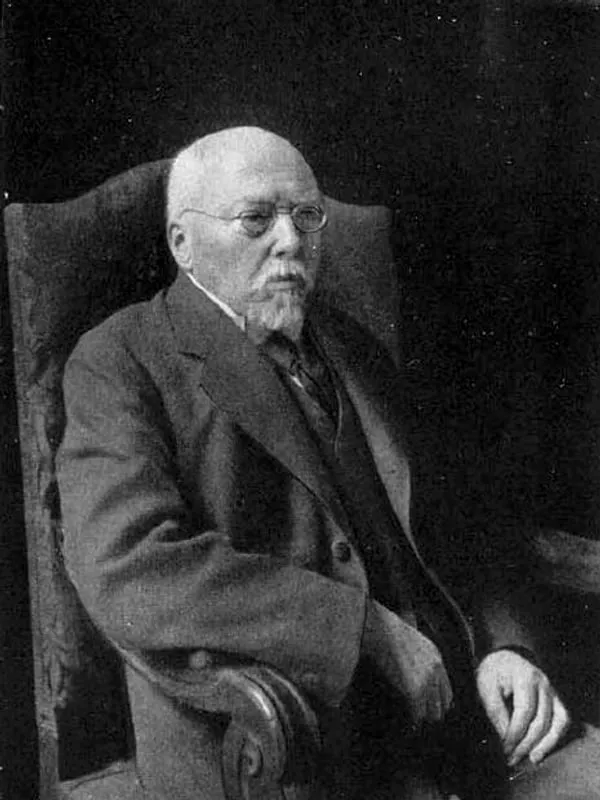
- Born:
- 31 August 1843, Darmstadt (Grand Duchy of Hesse)
- Died:
- 4 January 1919, Ruhpolding (Bavaria)
- Author:
- Natalia
- Photo:
- Bruckmann, F, domena publiczna, Wikimedia Commons

Count Georg von Hertling was the penultimate chancellor of Imperial Germany. He took office on 1 November 1917, at the age of 74, and held it for eleven months, which brought Germany the greatest triumph and the greatest defeat of the war: the peace of Brest with Russia, the great spring offensive in the west, and then retreat and the request for an armistice. He was a Catholic philosopher, a professor in Munich, for many years a deputy and leader of the Centre Party, and from 1912 Minister-President of Bavaria. He was the first Reich Chancellor to come from a political party, and the first to agree a programme with the Reichstag majority before taking office, although he himself was an opponent of parliamentary government. Faced with the Supreme Army Command of Paul von Hindenburg and Erich Ludendorff, however, he was almost powerless.
Before the war
He was born on 31 August 1843 in Darmstadt, into a Catholic family of Hessian officials. His mother came from the Frankfurt Guaita family and was a niece of the poet Clemens Brentano. Under her influence Hertling thought of the priesthood, but chose philosophy, which he studied in Munich, Münster and Berlin. He took his doctorate in 1864 and his habilitation in Bonn in 1867. As a professed Catholic in the time of the Kulturkampf, Bismarck’s struggle against the Catholic Church, he waited a long time for a professorship. He obtained one in Bonn only in 1880, and in 1882 he moved to the chair of philosophy at the University of Munich. In 1876 he co-founded the Görres Society, which promoted scholarship among German Catholics, and he presided over it until his death. He wrote on Aristotle, Albertus Magnus and Saint Augustine, as well as on natural law and social policy.
At the same time he made a political career in the Catholic Centre Party. He was a member of the Reichstag in 1875–1890 and 1896–1912, dealing first with social legislation, then with foreign policy and finance. He was one of those who wanted to reconcile Catholics with the Protestant, Prussian-dominated empire. In 1898, as the only Bavarian Centre deputy to do so, he voted for the first Navy Law, and in 1909–1912 he led the parliamentary group. On 9 February 1912 the Prince Regent Luitpold appointed him Minister-President and Foreign Minister of the Kingdom of Bavaria. For the first time the Bavarian government was led by a man of the party that held the majority in the chamber of deputies. In 1914 he received the title of count.
Bavarian premier during the war
Hertling took no part in the decisions of the July Crisis of 1914. During the war he supported Chancellor Theobald von Bethmann Hollweg when the annexationists came out against him, and Munich became one of the centres of their agitation. In the spring of 1915 the Grand Duke of Oldenburg urged King Ludwig III of Bavaria to demand Bethmann’s dismissal from the Emperor in the name of the German princes. Hertling did not allow it. As chairman of the foreign affairs committee of the Federal Council he knew the inner workings of Reich policy well, and in Bavaria he struggled with food shortages, disputes between countryside and town and growing pressure from Berlin on the economy.
After Bethmann’s fall in July 1917 the Emperor offered him the chancellorship, but Hertling declined, according to contemporary accounts because of his age and health. Georg Michaelis became chancellor. When in the autumn Michaelis lost the confidence of the Reichstag, Hertling decided that he could not refuse a second time.
Reich Chancellor
On 28 October 1917 he came to Berlin and for several days talked with the leaders of the majority parties, that is, the Social Democrats, the Centre and the Progressives, as well as with the National Liberals. He rejected the idea that Michaelis should remain Minister-President of Prussia, accepted their minimum programme, including reform of the Prussian franchise, and on 1 November became chancellor and Minister-President of Prussia. The Progressive Friedrich von Payer became vice-chancellor, and the National Liberal Robert Friedberg vice-president of the Prussian State Ministry. Hertling agreed to them reluctantly, under pressure from deputies, among them Matthias Erzberger, whom he disliked. He was 74, his eyesight was failing and he tired quickly. According to the American historian Klaus Epstein, he sometimes fell asleep at evening meetings.
A week after his appointment the Bolsheviks took power in Petrograd, and in December peace talks began at Brest-Litovsk. These dominated Hertling’s chancellorship. On 24 January 1918 he replied to Wilson’s Fourteen Points. He accepted the general principles, but wanted to discuss the questions of Belgium, France, the Baltic lands and Poland separately with each party concerned, and declared Alsace-Lorraine to be German land. Compared with the conciliatory Austro-Hungarian Foreign Minister Ottokar Czernin he came across as hard, and President Woodrow Wilson called his reply vague and confusing. When in February Leon Trotsky broke off the talks with the formula “neither war nor peace”, Hertling, at the conference at Bad Homburg on 13 February, backed the soldiers against the Foreign Secretary Richard von Kühlmann and agreed to the resumption of hostilities. After an offensive of a few days Russia signed the Treaty of Brest-Litovsk on 3 March. Germany was building a zone of dependent states in the east: on 7 March the chancellor signed the peace with Finland, on 15 March he announced the recognition of Courland, and earlier he had demanded from the Lithuanian Taryba a declaration of perpetual union with the Reich.
From the Polish point of view Hertling’s government is remembered above all for the treaty with Ukraine of 9 February 1918, in which the Central Powers granted the Ukrainians the Chełm land. In the Kingdom of Poland this provoked a wave of protests, and the government of Jan Kucharzewski resigned. Hertling did not want to decide Poland’s future without Vienna, while the generals demanded a broad border strip for Prussia.
In the shadow of the generals
The most important matters were decided by the Supreme Army Command. In January 1918 Hindenburg and Ludendorff forced the Emperor to dismiss the head of his civil cabinet, Rudolf von Valentini. When on 24 June Kühlmann said in the Reichstag that the war could not be ended by military means alone, the chancellor distanced himself from him, and in July the Foreign Secretary had to go. His successor was Admiral Paul von Hintze, the generals’ man. In July Hertling called Belgium a “pledge” in the Reichstag for future negotiations, which abroad was taken as a sign that Germany meant to keep it. At home his government did not enter into talks with the strikers in January 1918, and the reform of the Prussian franchise, promised to the majority parties, stalled in the chambers of the Prussian Diet.
In the spring Germany struck in the west. The offensive, begun with Operation Michael, brought great territorial gains, but no decision. The chancellor’s son later recorded his words that at the beginning of July he had still hoped for peace proposals from the enemy, but that after the counter-offensive of 18 July even the greatest optimist understood that all was lost. Even so, at the conference at Spa on 14 August, after the defeat at Amiens, Hertling held that peace feelers should be put out at a “suitable moment”, preferably after further successes. He also ignored the urgings of Crown Prince Rupprecht of Bavaria and of the government in Munich to seek peace at once.
Resignation and death
At the end of September 1918 events overtook him. On 29 September at Spa Hindenburg and Ludendorff demanded an immediate request for an armistice, and the Foreign Secretary Hintze persuaded the Emperor to a “revolution from above”, that is, a government based on the Reichstag majority. The chancellor arrived at Spa in the afternoon and found matters already settled. He did not want to lead a parliamentary cabinet and asked to be relieved. On 30 September the Emperor accepted his resignation, and on 3 October Prince Max von Baden became chancellor.
Hertling returned to Bavaria. After the war he told a friend that he should not have accepted the office, because for the majority parties his appointment had already been the beginning of parliamentarisation, and he regretted that the Centre, increasingly following Erzberger, had not given him firm support. He watched the revolution and the fall of the monarchy with horror. He died on 4 January 1919 at his home in Ruhpolding in the Bavarian Alps, without having finished his memoirs. Their two volumes were published in 1919–1920, and his son Karl published an account of the year he had spent at his father’s side in the Reich Chancellery.
Assessment
Historians usually judge Hertling harshly. They reproach him for delaying both reform and peace, for being neither able nor willing to stand up to Ludendorff, and for allowing the generals, in concluding the peace of Brest and the peace of Bucharest, to impose terms that negated the Reichstag peace resolution of July 1917. Klaus Epstein wrote that he was a politician whose strength lay in negotiation rather than action. Gerhard Ritter described his chancellorship as a time when the military ruled Germany.
The German historian Ernst Deuerlein, however, drew attention to the other side. Hertling, though an opponent of parliamentarism, accustomed the Centre, the Social Democrats and the Liberals to governing together, and the men he brought into the government took over responsibility for the state in the autumn of 1918 and prevented chaos. His appointment was thus, against his will, an important step from empire to republic. Age, health and views meant, however, that in the hardest year of the war Germany had a chancellor who governed mostly in name only.
Sources
Spotted a mistake?Report an error
Often appears with
People who appear in the same events.