Germany · The Central Powers
Matthias Erzberger
Member of the Reichstag (Centre), state secretary without portfolio (1918), head of the German armistice delegation
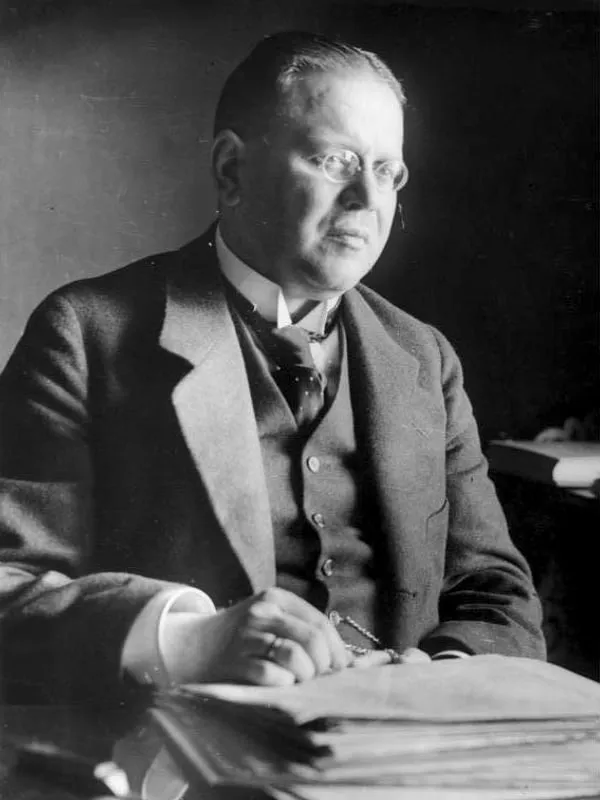
- Born:
- 20 September 1875, Buttenhausen (Württemberg)
- Died:
- 26 August 1921, Bad Griesbach (Baden)
- Author:
- Łukasz Skowroń
- Photo:
- Bundesarchiv, Bild 146-1989-072-16 / Kerbs, Diethart, CC BY-SA 3.0 DE, Wikimedia Commons

Matthias Erzberger was the most energetic, the most influential and the most hated German parliamentarian of the war years. The son of a village tailor from Württemberg and a deputy of the Catholic Centre Party, in 1914 he drew up programmes of vast annexations, and three years later he was one of the first politicians to say publicly that Germany would not win the war. He was the author of the Reichstag’s July peace resolution, helped bring down two chancellors, and on 11 November 1918, as head of the German delegation, signed the armistice in the forest of Compiègne. The right made him the symbol of the “betrayal” that had supposedly robbed Germany of victory. In 1921 he was murdered by nationalist assassins.
Before the war
He was born on 20 September 1875 in Buttenhausen in the Kingdom of Württemberg, into the family of a tailor who earned extra money as a postman. He completed a teachers’ seminary, taught in an elementary school for two years, and in 1896 became a journalist on the Catholic Deutsches Volksblatt in Stuttgart. He was active in Catholic associations and Christian trade unions. In 1903, at the age of 28, he was elected to the Reichstag for the Biberach constituency. He quickly made his mark, although his unceremonious style irritated the Centre’s old leaders. He was hard-working, had an excellent command of figures, and wrote countless articles and pamphlets.
He won fame in 1905–1906 through his campaign against abuses in the colonies. He exposed a series of scandals in the colonial administration at a time when the war against the Herero and Nama was being fought in German South West Africa. The dispute over the colonial budget led to the dissolution of the Reichstag in December 1906, and Chancellor Bernhard von Bülow fought the election campaign against the Centre and against Erzberger personally. Afterwards Erzberger became one of the best experts on state finances in parliament. He helped shape the financial reform of 1909 and the one-off defence levy of 1913. In 1912–1913 he supported the expansion of the army.
Annexationist and agent of influence
In August 1914 Erzberger was carried away by the general enthusiasm. In a memorandum of 2 September, on the eve of the Battle of the Marne, he demanded the annexation of Belgium, of the French Channel coast as far as Boulogne, of the fortress of Belfort and of the Longwy–Briey iron-ore basin, the break-up of Russia into national states dependent on Germany, a great colonial empire in Central Africa and enormous indemnities. In press articles he argued that if all of London could be destroyed, it would be more humane than shedding the blood of even a single German soldier.
Chancellor Theobald von Bethmann Hollweg entrusted him with directing foreign propaganda, especially in Catholic and neutral countries. Erzberger built up an extensive network of informants, from the Vatican to Stockholm, from where news arrived from Russia. He also took part in secret intelligence operations, among them plans for sabotage in the Caucasus. He was on close terms with Pope Benedict XV and with the nuncio in Munich, Eugenio Pacelli. Between February and May 1915 he travelled to Rome three times to help Ambassador Bülow keep Italy neutral and to persuade Vienna to make territorial concessions. The government of Antonio Salandra, however, was already bound to the Entente, and in May Italy entered the war and Germany broke off relations with it. In June 1915 Erzberger went to Vienna and Budapest to persuade the Hungarians to make concessions to the Romanians in Transylvania, but the prime minister, István Tisza, sent him away curtly.
In February 1916 Erzberger came to Constantinople on the matter of the Christian missions in Turkey. On 10 February he spoke with Enver Pasha and Talat Pasha and, at their request, prepared a memorandum on the protection of Christians. It explicitly concerned only Catholic Armenians and went unanswered. Historians nonetheless count him among the few German politicians who tried to do something about the Armenian genocide during the war.
Turn towards peace
From the autumn of 1916 Erzberger doubted victory ever more clearly. He failed to persuade his own party to oppose unrestricted submarine warfare, which Germany began on 1 February 1917. After the February Revolution in Russia, with the chancellor’s consent, he met the Russian intermediary Iosif Kolyshko in Stockholm and prepared a draft armistice, but the Kaiser and Ludendorff, who had known nothing of the talks, broke them off. In the spring of 1917 he received from Emperor Charles I the secret memorandum of 12 April by the Austro-Hungarian foreign minister Ottokar Czernin. Czernin warned that the monarchy would not survive another winter of war.
On 6 July 1917 Erzberger caused a sensation. At a session of the Reichstag’s main committee he showed with figures that submarine warfare would not force Britain to capitulate, that the enemy was growing stronger and that Germany was short of raw materials, and he called on parliament to declare itself for a negotiated peace. That same day the Social Democrats, the Centre and the liberals formed an inter-party committee, the nucleus of the future Weimar coalition. Erzberger hoped that Bethmann, whom he no longer trusted, would be replaced by Bülow. On 12 July he spoke in favour of the chancellor’s departure before the Crown Prince, and a day later Bethmann fell under pressure from Hindenburg and Ludendorff. The new chancellor, however, was not Bülow but Georg Michaelis, who was acceptable to the military. On 19 July the Reichstag adopted, by 212 votes to 126, the peace resolution, whose main author was Erzberger. It rejected “forced” acquisitions but deliberately did not exclude annexations obtained by agreement. Michaelis defused it with the reservation “as I understand it”. Erzberger nevertheless achieved his most important aim: the Social Democrats went on voting for war credits.
From then on the right hated him as it hated no one else. When at a confidential Centre meeting in Frankfurt on 23 July he revealed the contents of Czernin’s memorandum, and the document later reached the Entente, he was accused of treason, although it was never proved that the leak came from him. On 25 July he spoke with Pacelli and supported the proposals that the Pope announced on 1 August in his peace note. He pressed the government in vain to renounce Belgium in its reply. In October, after Michaelis had discredited himself over the naval mutiny, Erzberger negotiated on behalf of the Centre the terms on which Georg von Hertling took office, and forced him to accept the liberal Friedrich von Payer as vice-chancellor.
Brest, Lithuania and Ludendorff
Erzberger supported the Treaty of Brest-Litovsk, although he demanded a fair application of national self-determination in the lands torn from Russia. From the summer of 1917 he supported the creation of an independent Lithuania tied to Germany. In the spring of 1918 he was the chief advocate in Berlin of the candidacy for the Lithuanian throne of a Catholic from Württemberg, Duke Wilhelm of Urach. The Lithuanian Taryba elected him king as Mindaugas II in July, but Berlin never confirmed it. In the summer of 1918 Erzberger wrote a book, Der Völkerbund, with a plan for a league of nations and international arbitration. In September the left wing of the Centre, led by him, openly attacked Hertling, who soon resigned.
Compiègne
On 3 October 1918 Erzberger joined the government of Prince Max of Baden as state secretary without portfolio, responsible for propaganda. On 6 November, when the Lansing note arrived with the news that Marshal Ferdinand Foch would receive German envoys, the government put him at the head of the delegation. The chancellor hoped that a Catholic civilian known as a supporter of peace would be better received than a Prussian general. Erzberger agreed reluctantly. On the evening of 7 November the delegation crossed the front line, and on the morning of 8 November it stood before Foch in the forest of Compiègne. The marshal read out the terms and gave 72 hours for a reply. Erzberger asked for an immediate cessation of hostilities, warning of the disintegration of the army and of Bolshevism, but Foch refused. Only minor concessions were obtained. On the evening of 10 November authorisation arrived from the government, which in the meantime had been taken over by Friedrich Ebert, while Hindenburg reminded the delegates that the armistice had to be signed even without any easing of the terms. At five in the morning on 11 November Erzberger, first of the four German plenipotentiaries, signed the armistice. He also read out a protest against the harshness of the terms, which ended with the words: “A nation of seventy million suffers, but it does not die.”
As chairman of the armistice commission he then negotiated with Foch the successive extensions of the armistice, the first on 13 December 1918 in Trier, each time at the price of new concessions.
After the war
In 1919 he was minister without portfolio in the government of Philipp Scheidemann. Against the foreign minister Ulrich von Brockdorff-Rantzau, he argued that the Treaty of Versailles had to be signed, because refusal would mean occupation, the break-up of the Reich and famine. From June 1919, as vice-chancellor and finance minister, he carried out a reform that gave the Reich its own taxes and fiscal administration, introduced an inheritance tax and placed the burden on the wealthiest. The former vice-chancellor Karl Helfferich attacked him in a pamphlet, Fort mit Erzberger!, accusing him of lying and of mixing private and public interests. In the libel trial that Erzberger brought, the court in March 1920 found some of the charges proven, and Erzberger had to resign. While the trial was still going on, in January 1920, a former ensign shot and wounded him outside the court building. In June 1920 he was re-elected to the Reichstag. On 26 August 1921, while out walking in Bad Griesbach in the Black Forest, he was shot dead by two former naval officers, Heinrich Tillessen and Heinrich Schulz, members of the far-right Organisation Consul. They fled to Hungary and were convicted only after the Second World War.
Assessment
In his lifetime Erzberger had the reputation of an opportunist who changed his views as circumstances dictated. The right never forgave him the peace resolution, the armistice, the Treaty of Versailles and the taxes, and the stab-in-the-back myth made him one of the chief “November criminals”, even though it was the Supreme Army Command that demanded the armistice and ordered it to be signed. Even sympathisers admitted that he harmed himself by his carelessness in money matters and his ruthless way of conducting disputes.
The American historian Klaus Epstein, author of the standard biography of 1959, nevertheless judged him one of the ablest German politicians of his era: a man who in 1917 was the first to understand that his own annexationist dreams of 1914 were an illusion, who brought the Centre into alliance with the liberals and Social Democrats, and who took upon himself responsibility for the consequences of a defeat from which the generals had fled. His more recent biographer, Christopher Dowe, titled his book A Life for Democracy. Historians argue over how much of his turn in 1917 was conviction and how much political calculation, but they agree that without him Germany’s path from empire to republic would have looked different.
Sources
Spotted a mistake?Report an error
Mentioned in battles
(01)Often appears with
People who appear in the same events.
On the timeline
(13)1915
1917
1918
September
October
November
- 08
- German envoys before FochOn 8 November 1918 Erzberger's delegation stood before Foch in the Forest of Compiègne. It heard the armistice terms and was given 72 hours to reply.
- British retake MaubeugeOn the night of 8/9 November 1918 a Grenadier Guards battalion entered Maubeuge unopposed, the Sambre fortress the French had surrendered in September 1914.