Ottoman Empire · The Central Powers
Enver Pasha
Minister of war and deputy commander-in-chief of the Ottoman army (1914–1918)
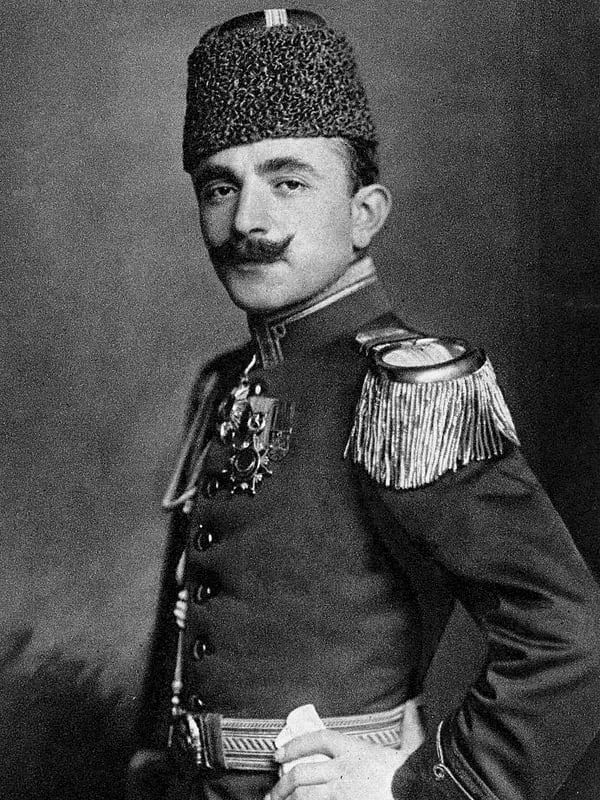
- Born:
- 22 November 1881, Constantinople (Ottoman Empire)
- Died:
- 4 August 1922, near Baljuan (now Tajikistan)
- Author:
- Natalia
- Photo:
- Nicola Perscheid, domena publiczna, Wikimedia Commons

İsmail Enver, known as Enver Pasha, was the youngest and most impetuous of the three Young Turk leaders who ruled the Ottoman Empire during the Great War. Together with Talat, minister of the interior and later grand vizier, and Djemal, minister of the navy, he formed a triumvirate in which he was responsible for the army. At the age of 32 he became minister of war and chief of the general staff, and after the outbreak of war deputy to the sultan as commander-in-chief. It was he who pushed hardest for an alliance with Germany and for war with Russia. In the winter of 1914 he personally led an army to Sarikamish, where it perished in the snow. Historians count him among the principal perpetrators of the Armenian genocide. After the defeat he fled the country, a court in Constantinople sentenced him to death in absentia, and he was killed in 1922 in Central Asia, fighting the Bolsheviks.
Before the war
He was born in Constantinople on 22 or 23 November 1881 (the dates differ in his own accounts of his life), into the family of a minor official, and grew up in Monastir, today’s Bitola. He graduated from the military school and the general staff academy in the capital, and then fought for several years against Bulgarian, Greek and Albanian bands in Macedonia. There he joined the secret Committee of Union and Progress. In the summer of 1908 he took a detachment into the mountains and, alongside Ahmed Niyazi, became a hero of the Young Turk Revolution, which forced the sultan to restore the constitution. He spent 1909–1911 as military attaché in Berlin, where he became an admirer of the German army and met Emperor Wilhelm II. During the war with Italy he led an Arab guerrilla campaign against the Italians in Cyrenaica.
He came to power by force. On 23 January 1913, during the losing Balkan war, he led a group of Unionists into the seat of government and forced the grand vizier Kâmil Pasha to resign, and in the confusion the minister of war was shot dead. In the summer, while the Bulgarians were fighting their former allies, he recaptured Adrianople for Turkey and won fame as its “conqueror”. On 3 January 1914 he was appointed general, that is pasha, and minister of war, and soon also chief of the general staff. In March he married a niece of Sultan Mehmed V and entered the ruling family. He purged the officer corps and worked with the German military mission of General Otto Liman von Sanders, which had been reforming the Ottoman army since the end of 1913.
Road to war
In July 1914 Enver was the most ardent supporter in Constantinople of an alliance with Germany. He proposed it to the German ambassador himself, and on 2 August, with a small circle of leaders, brought about the signing of a secret treaty of which most of the government knew nothing. At the same time the empire ordered mobilisation. In mid-August Enver agreed to let the German warships Goeben and Breslau, pursued by the British, through the Dardanelles, and the German admiral Wilhelm Souchon soon became commander of the Turkish fleet. Some ministers preferred to wait, but Enver and the Germans pressed for a decision. At the end of October he handed Souchon an order to take the fleet into the Black Sea and attack the Russians if an opportunity arose. On 29 October Turkish-German warships shelled Russian ports and war became a fact. On 14 November the sultan proclaimed jihad. Enver believed that Islam would rouse the Muslims in the Entente’s colonies, and that the war would allow the empire to recover the lands lost to Russia and unite the Turkic peoples.
Sarikamish
In the Caucasus the November Russian offensive was repulsed, and Enver concluded that the Russian Caucasus Army was weak. In December he went to the front himself, and when the commander of the Third Army, Hasan İzzet Pasha, opposed his plan and resigned, he took command in person. The plan, inspired by German models of encirclement, was bold: two corps were to cross the snow-covered mountains into the Russian rear and seize the railway station at Sarikamish. The attack began on 22 December. The soldiers, badly clothed and badly supplied, froze on passes more than 2,000 metres high, and the columns lost their way and fired on each other. At Sarikamish the Russians held out, and at the beginning of January they surrounded IX Corps and forced it to surrender. The Battle of Sarikamish was one of the greatest defeats of the Ottoman army. According to the most often quoted figures, of some 90,000 soldiers of the Third Army 18,000 remained by mid-January, and most of the rest died of frost, hunger and typhus. The commander of X Corps, Hafız Hakkı, wrote in his diary: “Ah, Enver! By hastening this winter expedition […] you have stained yourself with the blood of a hundred thousand innocents.”
Enver returned to the capital and never again commanded in person at the front. In Constantinople the defeat was concealed, and the authorities began to shift the blame onto the Armenians, accused of treason and of helping the enemy, although Enver himself still praised the conduct of Armenian soldiers in a letter to the Armenian bishop of Konya.
1915: the Dardanelles and the Armenian genocide
When on 18 March 1915 the forts and mines repulsed the Allied fleet’s attack in the Dardanelles, Enver decided that a landing had to be prepared for, and on 24 March he gave Liman von Sanders command of the new Fifth Army. Liman directed the defence of Gallipoli, and relations between the two men remained cool.
At the same time the destruction of the Armenians began. In February 1915 the ministry of war ordered Armenian soldiers to be disarmed and moved into labour battalions, where many were later murdered. Enver’s brother-in-law, Cevdet Bey, became governor of the vilayet of Van, and his actions led to fighting in the city. From April came the deportations and massacres in which, according to most historians’ estimates, from about 600,000 to more than a million Armenians died in 1915–1916. The main role in organising the deportations is attributed to the minister of the interior, Talat, but historians such as Taner Akçam and Ronald Grigor Suny count Enver, who directed the army and was one of the leaders of the secret Special Organisation, among the principal perpetrators. In May 1915 the Entente powers publicly warned that they would hold members of the Ottoman government personally responsible. The repression also struck Assyrians and Greeks.
1916–1917: leader of a war on many fronts
Enver directed a war stretching from the Caucasus to Arabia and Mesopotamia, with ambitions reaching into Persia and Central Asia. In February 1916 the Russians took Erzurum, and in the spring Trebizond. In the south he won one of his greatest successes: in April the British garrison of General Townshend at Kut surrendered, and Enver rejected an offer of ransom and demanded the unconditional surrender of all men and equipment. Instead of pursuing the British in Iraq, however, he sent XIII Corps into Persia. The historians W.E.D. Allen and Paul Muratoff wrote that the dreamer in him once again got the better of the strategist. In June 1916 Hussein, Sharif of Mecca, rose against the Turks (the Sharif’s proclamation).
At the same time Enver readily sent troops to his allies. Two divisions of XV Corps fought in Galicia, and after Turkey declared war on Romania in August 1916 some 39,000 Turkish soldiers took part in the Romanian campaign. According to the Austrian official history, his suggestions also gave Falkenhayn an argument for creating a joint supreme command of the Central Powers. In February 1917 Talat became grand vizier, while Enver kept the ministry of war and the general staff. After the loss of Baghdad in March 1917 he formed with the Germans the “Yıldırım” army group under Erich von Falkenhayn, which was meant to recapture the city but was eventually sent to Palestine. In December the Turks lost Jerusalem.
1918: march into the Caucasus
The revolution in Russia opened up for Enver the prospect he had dreamed of. After the Russian Caucasus army disintegrated, the Turks recaptured Trebizond in February 1918, and after the Treaty of Brest-Litovsk, which returned Kars, Ardahan and Batum to them, they occupied Batum and Sarikamish in April. Enver did not intend to stop at the 1878 frontier. While the British were advancing in Palestine and Mesopotamia, he kept his best forces in the Caucasus. He forced the Treaties of Batum on Armenia and Georgia and created the Caucasus Army of Islam, commanded by his half-brother Nuri Pasha. The Germans, who themselves wanted oil from Baku and manganese from Georgia, sharply opposed this. Under their pressure Enver gave up the march on Tiflis, but according to Turkish research, while officially forbidding his brother to march on Baku, he secretly encouraged him to do so. On 15 September the Turks and Azerbaijanis entered Baku, and a massacre of Armenians followed in the city. Two weeks later the capitulation of Bulgaria cut the empire off from Germany.
Fall and flight
At the beginning of October 1918 Talat’s government resigned, and Enver left office with it. On 14 October Ahmed İzzet Pasha became grand vizier, the man who years before had handed the ministry of war over to Enver, and on 30 October the Armistice of Mudros was signed. In the night of 1–2 November Enver, Talat and Djemal fled Constantinople on a German ship. In 1919 a court martial in Constantinople sentenced Enver to death in absentia for dragging the country into the war and for the crimes against the Armenians.
After the war
From Berlin Enver made contact with the Bolsheviks. In 1920 he reached Moscow, and in September he spoke in Baku at the Congress of the Peoples of the East. He hoped to place himself at the head of the Turkish national movement, but Mustafa Kemal, who had long regarded him as a dangerous man, kept him out of Anatolia. In the autumn of 1921, sent by the Bolsheviks to Bukhara, he went over to the Basmachi rebels and proclaimed himself leader of the Muslims of Turkestan. He was killed on 4 August 1922 in a clash with a Red Army detachment near Baljuan, in what is now Tajikistan. In 1996 his remains were brought back to Istanbul.
Assessment
Historians judge Enver exceptionally harshly. Almost all of them regard him as the chief culprit for the empire’s entry into the war, which ended in its break-up. As a commander he was brave and full of initiative, but he disregarded logistics, climate and the capabilities of his own soldiers. Sarikamish, where he squandered an army for the sake of a grand manoeuvre, and the expeditions into Persia and to Baku while the British were approaching the heart of the empire, are seen as examples of putting dreams of a great Turkic and Muslim empire above the real interests of the state. Liman von Sanders and some German officers doubted his military ability.
Historians nevertheless credit him as an organiser. The army, rejuvenated after 1913, from which Mustafa Kemal, İsmet İnönü and Kâzım Karabekir later emerged, fought for four years on several fronts at once, held the Dardanelles and inflicted a defeat on the British at Kut. In Turkey, where for decades his image was overshadowed by his rivalry with Atatürk, since the 1990s he has sometimes been presented as a patriot and fighter for the Turkish cause. Outside Turkey he is remembered above all as one of the men responsible for the Armenian genocide.
Sources
Spotted a mistake?Report an error
Commanded in battles
(01)Mentioned in battles
(13)Often appears with
People who appear in the same events.
On the timeline
(55)The 40 most important of 55 events. All tagged “Enver Pasha” (19) →
1911
1913
1914
July
August
September
October
November
- 14
- Turks retake KöprüköyIn mid-November 1914 an Ottoman Third Army counter-offensive pushed the Russians from Köprüköy almost to the border, the first Turkish success in the Caucasus.
- Sultan proclaims jihadOn 14 November 1914 the Sultan-Caliph's call to holy war against the Entente was solemnly proclaimed in Constantinople. Germany hoped for Muslim uprisings.
December
1915
1916
January
February
April
May
- 15
- Russians take RowanduzIn mid-May 1916 a Russian detachment from Persian Azerbaijan stormed Rowanduz in Kurdistan, a few days' march from Mosul.
- Russians halt before KhanaqinIn mid-May 1916 Baratov stood before Khanaqin but did not take it. The Turks were bringing reinforcements from Kut and the Russians were told not to attack.