1915: Mesopotamia, Persia and the Caucasus
Siege of Kut
- Dates:
- 7 December 1915 – 29 April 1916
- Front:
- Middle East
- Location:
- Kut (Kut al-Amara) on a peninsula in a loop of the Tigris, at the head of the Shatt al-Hai canal, and positions on the Tigris downstream as far as Sheikh Saad, central Mesopotamia (present-day Iraq)On the battle map →
- Sides:
- United Kingdom and British IndiaCharles Townshend, John Nixon, Percy Lake, Fenton Aylmer, George GorringeOttoman EmpireNureddin Bey, Colmar von der Goltz, Halil Bey
- Result:
- Ottoman victory. Three relief attempts failed, and on 29 April 1916 the starving garrison surrendered. About 13,000 soldiers and followers were taken prisoner.
- Author:
- Łukasz Skowroń
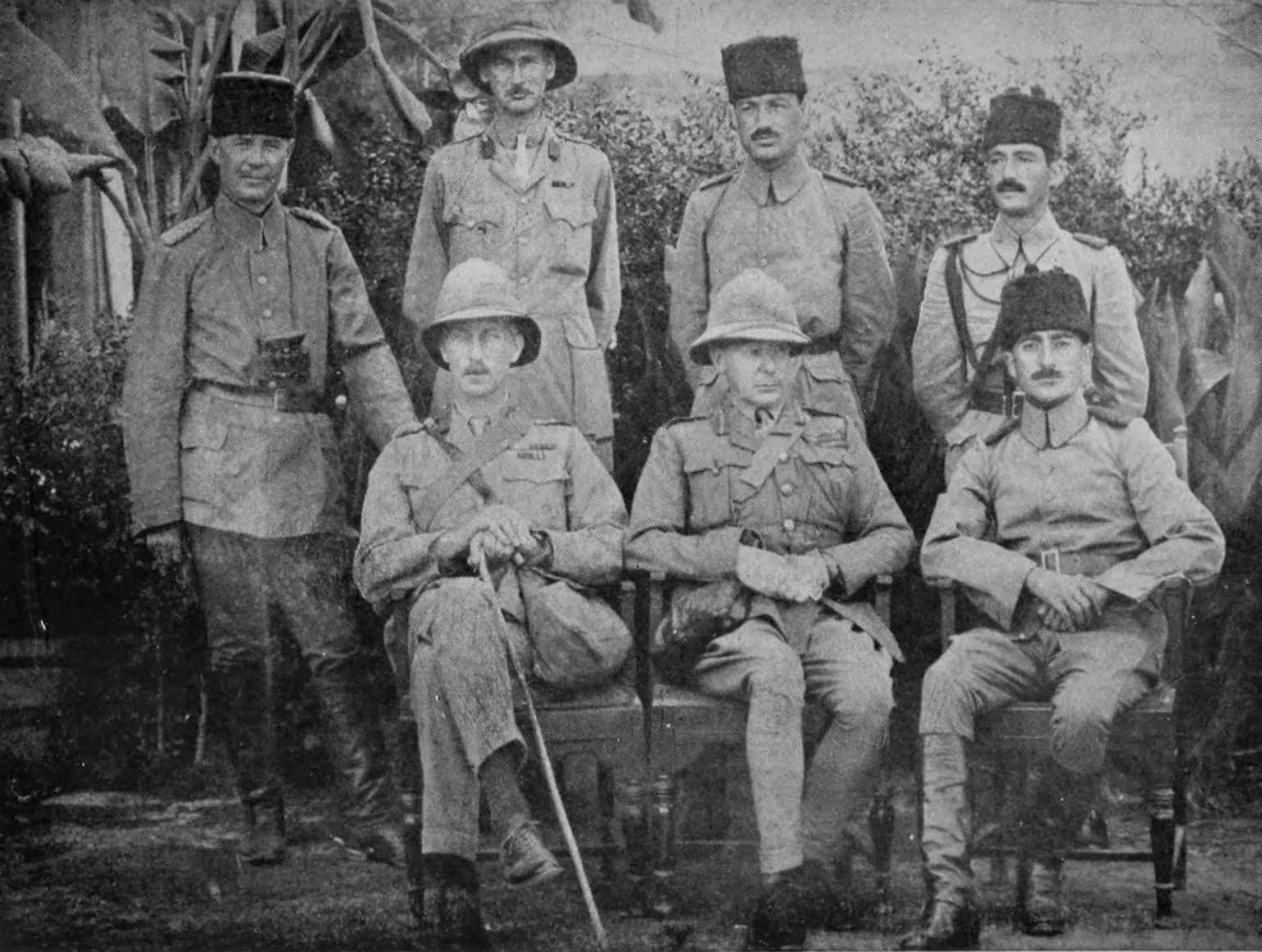
The Siege of Kut was the greatest defeat of the British expedition to Mesopotamia and one of the heaviest British reverses of the entire war. After the Battle of Ctesiphon General Charles Townshend’s 6th (Poona) Division fell back to Kut on the Tigris and decided to await relief there. On 7 December 1915 Ottoman troops began to surround the town. The garrison beat off the assaults, including a great attack on Christmas Eve, but three relief attempts, made between January and April 1916, broke down against Turkish trenches, floods and mud. On 29 April 1916, after 147 days, the starving garrison surrendered. About 13,000 men went into captivity, from which many never returned.
Name and dates
The British official history (Moberly, The Campaign in Mesopotamia, volume II) speaks of the Siege of Kut. In English-language literature the town usually appears as Kut al-Amara, while the Turks speak of the victory at Kutülamare. We adopt the dates 7 December 1915 – 29 April 1916, commonly used in the literature. Townshend entered Kut on 3 December, and the first Turkish shells fell on the town on 5 December, but it was only on 7 December that the Turks began the encirclement and their commander called on the British to surrender. On 29 April Townshend gave up the town. On this page we also describe the fighting of the relief forces, from Sheikh Saad in January to Sannaiyat in April 1916.
Background
Townshend halted at Kut for several reasons. His troops were exhausted after two weeks of fighting and marching. Large stores had been gathered in the town and could not be removed quickly. Kut lay at the head of the Shatt al-Hai canal, down which the Turks could move south towards the weak garrison at Nasiriyah and threaten Basra. Townshend reckoned that by holding the Ottoman army in front of the town he would gain time for reinforcements to concentrate. Two Indian divisions, which had left France in November, were on their way. The commander in Mesopotamia, General John Nixon, backed this decision. Both men were convinced that the relief would break through without much difficulty. Townshend expected this to happen within a month, Nixon spoke of two.
Kut lay on a peninsula about three kilometres long, in a tight loop of the Tigris. The neck of the peninsula was closed by a fort and four blockhouses, built when the town served as a depot for the troops advancing on Baghdad. Townshend expelled about 700 newcomers from the town, but allowed more than 6,000 permanent inhabitants to stay, since in winter those driven out would have perished in the desert. On 6 December he sent the cavalry brigade downstream, and on 7 December the last aircraft. In the town remained 11,607 soldiers and about 3,500 Indian followers, with 43 guns.
December: the assaults
The Ottoman forces were commanded by Colonel Nureddin Bey, the victor of Ctesiphon. In front of Kut stood the same four divisions that had fought at Ctesiphon, about 12,000 men with more than 30 guns, and more were approaching Baghdad. Nureddin, convinced that only part of the British force had remained in the town, tried to take it by storm. On 9 December the Turks drove a detachment of the 67th Punjabis from the bridgehead on the right bank, and during the night British volunteers blew up the bridge. By 13 December several attacks on the northern line of defence had collapsed under rifle and artillery fire. The garrison’s losses in these days reached 150–200 men a day.
On 12 December Field Marshal Colmar von der Goltz, commander of the Ottoman Sixth Army, arrived at Nureddin’s headquarters. He forbade further assaults and decided to starve the town out. For ten days the Turks conducted a regular siege, approaching by saps and shelling the town. On Christmas Eve Nureddin, according to a German officer on Goltz’s staff against the express orders of the absent field marshal, threw the fresh 52nd Division against the fort at the northern corner of the defences. The fighting lasted from noon on 24 December until the early hours of 25 December. The defenders lost about 380 men, the Turks, according to prisoners, at least 2,000. It was the last Turkish assault on Kut.
First relief attempt: Sheikh Saad, the Wadi and Hanna
The relief force, named the Tigris Corps, was commanded by General Fenton Aylmer. Reinforcements arrived from France and India piecemeal, without part of their transport, artillery and medical services, and the shortage of river steamers slowed everything down. Townshend reported that his food would last only until mid-January, so Aylmer set off before he had gathered all his forces. The Turks, for their part, pushed most of their troops downstream and dug in across the path of the relief. They left only part of the army in front of Kut.
On 6–8 January 1916 at Sheikh Saad, about 45 kilometres downstream from Kut, the troops of General George Younghusband and Aylmer forced the Turks to retreat, but lost, according to Aylmer’s report, about 3,800 men. There was nothing with which to dress or evacuate the wounded. At the beginning of January command of the Ottoman forces on the Tigris passed from Nureddin to Halil Bey (Halil Kut), the uncle of the War Minister Enver Pasha. On 13 January at the Wadi stream the Turks slipped away again, and the British lost more than 1,600 men. The Turks shut themselves up in the narrow Hanna defile, between the Tigris and the marshes. On 21 January the attack on Hanna, in a downpour, across a sodden plain, collapsed with heavy losses: about 2,700 killed and wounded. Already on 19 January the sick Nixon had been replaced in Mesopotamia by General Percy Lake.
Then it turned out that starvation was not so close. On 24 January Townshend reported that, having requisitioned the stocks of the inhabitants and merchants and slaughtered the horses and mules, he could hold out much longer. A day later he was already counting on 84 days. Aylmer replied bitterly that had he known this earlier, he would have planned his operations differently. Rations were cut, and the Indians, most of whom long refused to eat horsemeat, suffered the most.
Second attempt: Dujaila
At the beginning of March Aylmer, strengthened by reinforcements, tried to outflank the Turkish position on the right bank. The objective was the Dujaila Redoubt, from where it was only a dozen or so kilometres to Kut. After a long night march the troops stood before the redoubt on the morning of 8 March, but the attack started late, and the Turks had time to bring up reserves. The assault collapsed. On 8 and 9 March the British lost 3,474 men. On 10 March Halil invited Townshend to surrender, and he refused. On 11 March Aylmer was replaced by General George Gorringe. On 14 March the annual Tigris floods arrived. The water flooded the ground in front of the fort and part of the British trenches in Kut, but it also protected the garrison from assault.
Third attempt: Fallahiyah, Sannaiyat and Bait Isa
In April the fresh 13th Division, veterans of Gallipoli, entered the fighting. On 5 April it took the positions at Hanna and Fallahiyah, losing almost 1,900 men. But the next Turkish position, at Sannaiyat, between the river and the Suwaikiya marsh, proved impregnable. The attacks of 6 and 9 April broke down. Gorringe shifted his effort to the right bank. On 17 April his troops took Bait Isa, but that night they beat off a strong counter-attack, losing about 1,600 men. On 22 April the last attack on Sannaiyat, across ground flooded with mud, cost the 7th Division almost 1,300 men. Gorringe concluded that further attempts, in the time that hunger in Kut still allowed, had no chance.
From 15 April British aircraft dropped food to the besieged. This is regarded as one of the first attempts in history to supply troops from the air, but too little was dropped, and some of the packages fell into the river or into the Turkish trenches. On the evening of 24 April the steamer Julnar, armoured and loaded with 270 tons of food, tried to force her way upriver to the town. She was manned by volunteers, Lieutenant Humphrey Firman and Lieutenant-Commander Charles Cowley, an expert on the river from the Lynch shipping company. At Magasis the ship caught on a cable stretched across the river, ran aground and had to surrender. Firman was killed, and Cowley died in captivity in unclear circumstances, rumoured to have been shot by the Turks. Both were posthumously awarded the Victoria Cross.
Surrender
On 19 April 1916 Goltz died in Baghdad, officially of typhus. On 26 April Lake instructed Townshend to open negotiations. The British government authorised him to offer the Turks one million, and then two million pounds, together with an exchange of prisoners, in return for the release of the garrison on parole. Captain Aubrey Herbert and Captain Thomas Edward Lawrence, the future “Lawrence of Arabia”, took part in the talks. Halil was inclined to make concessions, but Enver demanded the unconditional surrender of men, guns and equipment. According to a telegram from Enver that Halil showed to one of Townshend’s officers, the siege had cost the Turks 10,000 men.
On the morning of 29 April Townshend destroyed his guns and most of the ammunition and wrote to Halil that hunger was forcing him to surrender. At 1 p.m. the wireless station in Kut sent out “goodbye” and was destroyed. Townshend was ill, as was Melliss, so the town was handed over to the Turks by General Walter Delamain. That day the garrison numbered 13,309 men, including 10,061 soldiers and 3,248 Indian followers. About 1,100 of the most seriously sick and wounded were exchanged by the Turks for Turkish prisoners. The Turks hanged some of the inhabitants who had helped the British.
Captivity
The Turks treated Townshend with respect. He was taken to Constantinople, where he remained until the end of the war. The officers were separated from the men. The privates and NCOs, weakened by hunger, were driven on foot to Baghdad on 6 May, and then further, across the desert, to the railway and the camps in Anatolia. The Arab escorts beat stragglers with sticks and whips, and many of the sick were left by the roadside. Of the roughly 12,000 men who went into captivity, more than 4,000 died, according to the British official history. Of the British rank and file, more than 70 per cent died in captivity or went missing without trace. Moberly calls this a stain on the Turkish reputation. Some historians attribute these deaths to extreme neglect and incompetence rather than to deliberate policy.
Losses
During the siege the garrison lost, according to Moberly, 3,776 men: 1,025 killed or died of wounds, 721 died of disease, 2,446 wounded (including 488 who later died of wounds) and 72 missing. Among the inhabitants of the town 247 people were killed and 663 wounded. The Tigris Corps, advancing to the relief, lost more than 23,000 men in less than four months. Some studies give as many as about 30,000. Turkish losses are usually estimated at about 10,000. The whole expedition, which was to have ended with the capture of Baghdad, cost the British Empire, according to Moberly, more than 40,000 killed, wounded and taken prisoner.
Significance
The surrender of Kut was a humiliation for the British comparable to the failure at the Dardanelles. Historians often write that so large a British force had not surrendered since the capitulation at Yorktown in 1781. In London the defeat caused a storm. Control of the campaign had already been taken over from the Government of India by the War Office at the beginning of 1916, and the Mesopotamia Commission, set up in the summer of 1916, passed severe judgement on the authorities in India and on the command of the expedition. For the Turks it was, alongside Gallipoli, the greatest success of the war. Halil later took the surname Kut.
The defeat changed the way the war in Mesopotamia was waged. The British built a proper rear: the port of Basra, a river fleet, a railway and hospitals. In December 1916 they set off up the Tigris again, in February 1917 they recaptured Kut, and on 11 March 1917 they took Baghdad.
Spotted a mistake?Report an error
Battles and phases
(05)- 6–8 January 1916Battle of Sheikh SaadOn 6–8 January 1916 Aylmer's Tigris Corps drove the Turks from Sheikh Saad on its way to relieve Kut, but lost about 4,000 men and failed to destroy the enemy.
- 13–14 January 1916Battle of the WadiOn 13 January 1916 the Tigris Corps tried to outflank the Turks on the Wadi stream. It lost over 1,600 men; at night the Turks slipped away to the Hanna defile.
- 21 January 1916First Battle of HannaOn 21 January 1916 the Tigris Corps attacked the Turkish Hanna position frontally in rain and mud. It lost 2,741 men. The first attempt to relieve Kut failed.
- 8–9 March 1916Battle of DujailaOn 8 March 1916 the Tigris Corps, after a night march, faced the weakly held Dujaila Redoubt but delayed its attack. The assault failed; Kut's relief collapsed.
- 5–24 April 1916Third attempt to relieve KutFrom 5 to 24 April 1916 General Gorringe's Tigris Corps tried to break through to Kut. It took Hanna and Fallahiyah but stuck at Sannaiyat and in the floods.