Key event
Siege of Kut begins
- Category:
- Military operations
- Front:
- Middle East
- Date:
- 7 December 1915
- Author:
- Łukasz Skowroń
- Battle:
- Siege of Kut
- Tags:
- British India, Ottoman Empire, Great Britain
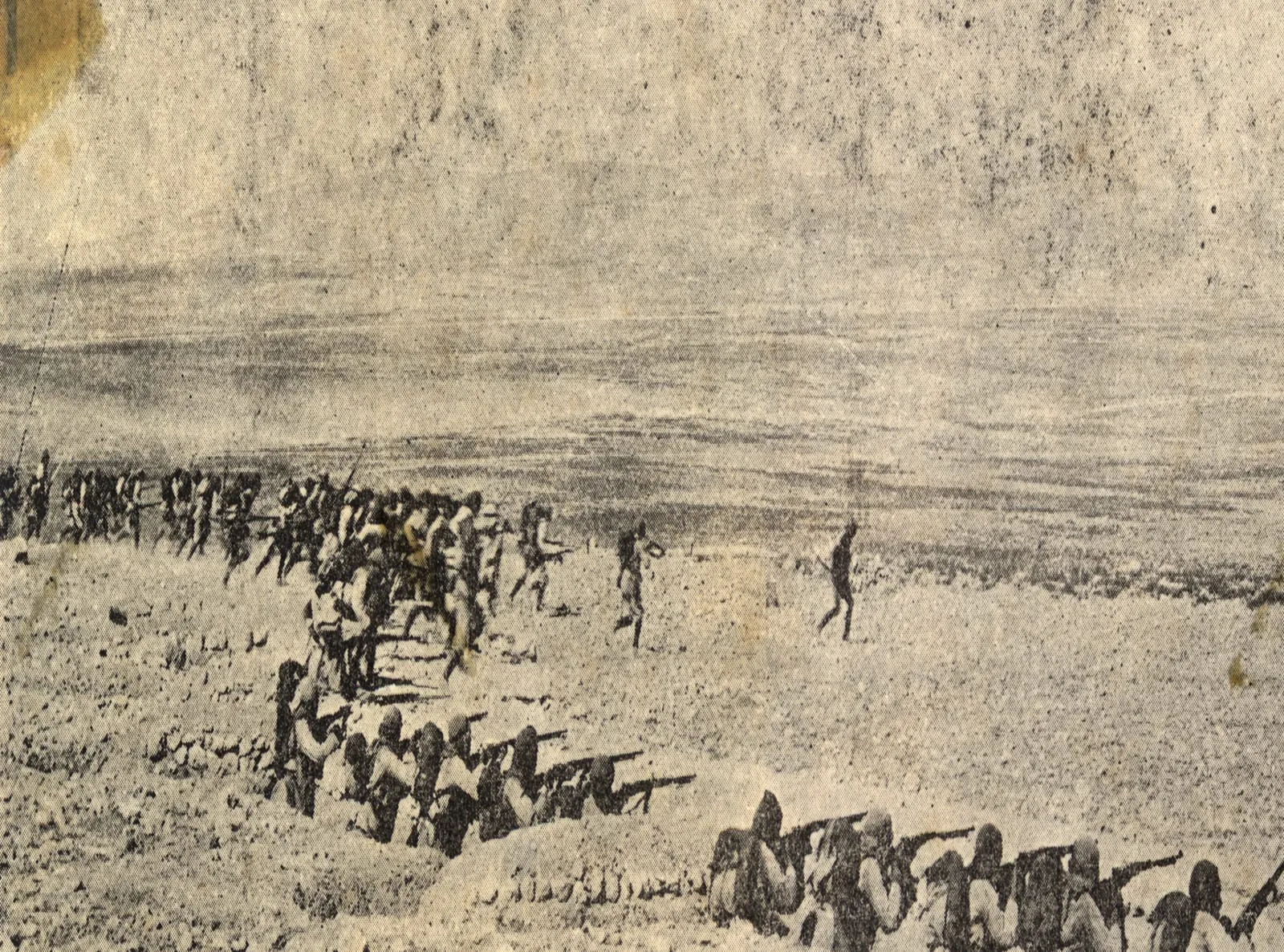
On 7 December 1915 the Ottoman troops of Colonel Nureddin Bey began closing the ring around Kut on the Tigris. According to the British official history (Moberly), Turkish forces estimated at a division with eight guns dug in on the right bank, north-west of the town. On the left bank, also to the north-west, there were about 1,500 men with guns, and a few kilometres upstream the greater part of two divisions. All day Turkish guns shelled the town. That day Nureddin sent General Charles Townshend a letter calling on him to surrender. Moberly notes briefly that only one answer was possible. This day is usually regarded as the beginning of the siege, which lasted almost five months.
The first day
In the afternoon Turkish infantry, using dead ground, advanced under cover of heavy fire to an irrigation ditch about 400 metres north-east of the fort, the most advanced point of the British defences. The shelling of the fort cost 30 killed and wounded that afternoon. In the evening Townshend reported to General John Nixon that his position had been outflanked from the south by a Turkish division which had crossed the Shatt al-Hai a few kilometres from the town, probably to cut the road downstream. According to a report of 14 December, there were about 12,000 Turks around the town with 33 guns. Before Kut stood the same four divisions that had fought at Ctesiphon: the 35th, 38th, 45th and 51st. The new 52nd Division was only just approaching.
The garrison was now on its own. The day before, on 6 December, the cavalry brigade had crossed to the right bank and set off downstream to Ali al-Gharbi. Arabs followed it step by step, but the cavalrymen got through. On the morning of 7 December the last two serviceable aircraft flew away, as there were no spare parts for them in the town. Townshend was still trying to put up a bridge in a better place, higher up the river. Covered by a company of the Oxfordshire and Buckinghamshire Light Infantry ferried to the other bank on a barge, the sappers built about 120 metres of bridge by the evening.
Why defend Kut
The siege began amid a dispute. On 6 December Townshend, convinced that relief in two months meant the destruction of his division, proposed to Nixon that he be allowed to withdraw to Ali al-Gharbi. Nixon refused. He replied that a retreat would open the way for the Turks along the Shatt al-Hai and would have a bad effect on feeling in the region, while the defence of Kut tied down superior enemy forces. He also promised that reinforcements would be at Sheikh Saad and Ali al-Gharbi within a week. At four in the morning on 7 December Townshend replied that this changed his situation and that he would stay. He added that he knew from history the fate of armies that shut themselves up in fortresses. The same day the General Staff in India concluded that it would be better to evacuate Kut, but the decision was left to Nixon.
After the cavalry had left, 11,607 soldiers remained in the town, including 2,851 British and 8,230 Indian rank and file, as well as about 3,500 Indian transport followers and other civilians employed by the army. Townshend had 43 guns. He himself reckoned that he had about 9,000 combatants, and only 5,000–6,000 infantry. The British battalions were, as he wrote, “skeletons”, and the Indian battalions were short of British officers. On top of this there were more than 6,000 inhabitants of the town.
For the moment the Turks were in no hurry to storm the town. They advanced as far as the fire of the British guns allowed, dug in and approached by saps. The first serious attacks came in the following days. On 9 December the Turks drove a detachment of the 67th Punjabis away from the bridge, and that night British volunteers blew the bridge up. By 13 December several attacks on the northern line of defence had been repulsed. The garrison did not expect that nearly five months of siege lay ahead.
Remember the articles you have read? Only in this browser; nothing is sent anywhere.How it works
Read ·
A voice from the front
“I intend to defend Kut-al-Amara and not to retire any further. Reinforcements are being sent at once from Basra to relieve us. The honour of our mother country and the Empire demands that we all work heart and soul in the defence of this place. We must dig in deep and dig in quickly, and then the enemy's shells will do little damage.”
Spotted a mistake?Report an error
Meanwhile
(04)Elsewhere in the same days.
- 7 December 1915 · DiplomacyReports of a French agreement with the Netherlands Overseas TrustThe British chronology states that on 7 December 1915 France concluded an agreement with the Netherlands Overseas Trust. Other sources do not confirm this.
- 6 December 1915 · Balkan FrontBritish economic pressure on GreeceOn 6 December 1915 Britain placed Greece under export restrictions. Halted supplies and detained ships were meant to force Athens to make concessions.
- 6 December 1915 · Balkan FrontCapture of PećIn early December 1915 the Austro-Hungarians took Montenegrin Peć, through which the main Serbian forces had retreated, and found nearly 100 hidden guns there.
- 6 December 1915 · War at seaAustro-Hungarian squadron shells DurrësOn 6 December 1915 the cruiser Helgoland and destroyers sank sailing vessels carrying supplies for the Serbs, some at Durrës. A day earlier Novara raided Medua.
Related events
(04)The same battle, people or subject.
- 25 December 1915 · Middle EastChristmas Eve assault on KutOn 24 December 1915 the Turks made their biggest assault on the Kut fort. Fighting lasted into the night; on Christmas Day the defenders held the ruined fort.
- 12 December 1915 · Middle EastVon der Goltz takes command in MesopotamiaOn 12 December 1915 Field Marshal Colmar von der Goltz reached Nureddin's headquarters before besieged Kut and forbade further assaults, opting for a blockade.
- 3 December 1915 · Middle EastBritish reach KutOn 3 December 1915 Townshend's exhausted division entered Kut after the retreat from Ctesiphon. Townshend decided to defend the town and await relief.
- 25 November 1915 · Middle EastRetreat from CtesiphonOn the evening of 25 November 1915 Townshend pulled his bled-white division back from Ctesiphon to Lajj. The march on Baghdad was over; the retreat led to Kut.