Ottoman Empire · The Central Powers
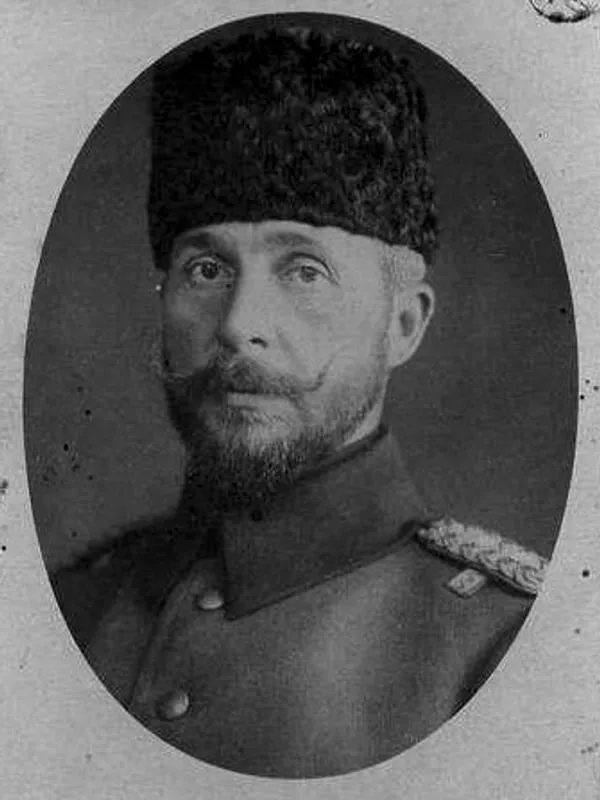
Nureddin Pasha
Commander of Ottoman forces in Iraq (1915–1916), later a corps commander in Anatolia
- Born:
- 17 July 1873, Bursa (Ottoman Empire)
- Died:
- 18 February 1932, Istanbul (Turkey)
- Author:
- Łukasz Skowroń
- Photo:
- NA, domena publiczna, Wikimedia Commons

Nureddin, during the Great War still a colonel, that is Nureddin Bey, and from 1918 Nureddin Pasha, known in Turkey as “the Bearded” (Sakallı), commanded the Ottoman forces in Iraq during the most important six months of the campaign there. In September 1915 he lost to the British at Kut, but in November at Ctesiphon he stopped the march of General Townshend’s division on Baghdad, and then shut it up in Kut. That siege ended in April 1916 with one of the most humiliating surrenders in the history of the British Army, although Nureddin was no longer at the town by then. After the war he was one of the leading commanders of the Turkish national movement. His name is also associated with brutal repression of Greeks and Kurds and with the lynching of the Metropolitan of Smyrna in 1922.
Before the war
He was born in 1873 in Bursa, the son of Marshal İbrahim Pasha, a senior commander of the Ottoman army. His gravestone gives the year 1872, while Turkish biographies also give the exact date of 17 July 1873. In 1893 he graduated from the war college in Constantinople, but unlike most senior commanders of his generation he did not pass through the general staff academy. He knew Arabic, French, German and Russian. In the war with Greece in 1897 he was aide-de-camp to the commander-in-chief Edhem Pasha, and then aide-de-camp to Sultan Abdul Hamid II. He fought guerrillas in Macedonia, and before the revolution of 1908 he joined the Committee of Union and Progress, against his father’s warnings.
His career did not run smoothly. In 1909, during a purge of the officer corps, he was reduced from colonel to major. He rebuilt his position fighting rebels in Yemen, and in 1913 he returned from there with a regiment for the last phase of the Balkan War. He then served in the model unit formed with the help of the German military mission of General Otto Liman von Sanders. In the spring of 1914 he took over the 4th Division.
1915: Iraq
In the spring of 1915 the front in Iraq was in a poor state. In November 1914 the British and Indians had taken Basra, and in April 1915 the Ottoman commander in Iraq, Süleyman Askerî, lost the Battle of Shaiba and took his own life. On 20 April Nureddin was appointed in his place, also receiving the powers of governor of the provinces of Baghdad and Basra. He reached Iraq in June. He found a shattered army, made up largely of Arab soldiers of doubtful value, and with no prospect of reinforcements, because everything the empire had was being swallowed by the Dardanelles and the Caucasus. Meanwhile the British were advancing up the rivers. In June they took Amara on the Tigris, and in July Nasiriyah on the Euphrates.
Nureddin decided to stop them on the Tigris in front of Kut. For several months he built a position there across the river, on the banks of an old canal, which the British regarded as the strongest in the whole campaign. General Charles Townshend did not, however, attack it frontally. On 26–28 September 1915, in the First Battle of Kut, he feinted an attack along the river, while moving his main force to the other bank and outflanking the Turkish left wing through the marshes. According to the British official history, a few deserting sepoys betrayed the real plan to the Turks, but Nureddin took this for a ruse. He lost the battle and, according to the British, about 4,000 men and 14 guns, but during the night he skilfully extricated his army before the trap closed. The British entered Kut without a fight, but they had not destroyed the enemy.
Ctesiphon
Nureddin fell back to Ctesiphon, about 35 kilometres from Baghdad, and spent seven weeks fortifying a new position there. This time reinforcements arrived: two new divisions, including the 51st Division made up of Anatolian Turks, the best in the army. The British did not know about it. When Townshend attacked on 22 November, he had fewer than 14,000 soldiers against about 18,000 Turkish infantry. On the first day of the Battle of Ctesiphon the British took the first line of trenches, but Nureddin threw his last reserve into a counter-attack and won back part of their gains. Both sides suffered terrible losses. Gloom reigned in the Turkish staff, and on the night of 24–25 November Nureddin, misled by a report of a supposed outflanking movement, ordered the whole army to fall back to the Diyala. When it turned out that the British were not advancing, he turned back. The British official history observes that both commanders took important decisions on the basis of false information, and that Nureddin first withdrew needlessly and then returned only because his opponent had gone.
Yet he turned out to be the victor. Townshend, who had lost about a third of his force, began a retreat, and Nureddin set off in pursuit. On 1 December at Umm al-Tubul his army stumbled on a British camp and in the confusion some of his troops took to flight, but the British could not exploit it. On 3 December Townshend reached Kut and decided to defend it. The victory at Ctesiphon is sometimes attributed to Field Marshal Colmar von der Goltz, appointed commander of the Ottoman Sixth Army in Iraq, but the German field marshal was still on his way at the time. The battle was fought and won by Nureddin.
The siege of Kut
On 7 December Nureddin’s troops surrounded Kut, and he himself called on Townshend to surrender. Convinced that only part of the British force had remained in the town, he tried to take it by storm, but successive attacks broke down under fire. On 12 December Goltz arrived at his headquarters, forbade further assaults and decided to starve the town out. Nureddin did not accept this. According to a German officer on Goltz’s staff, when the field marshal left for Persia, Nureddin, against his explicit orders, threw the fresh 52nd Division at the fort in the northern corner of the defences on Christmas Eve. The assault cost the Turks, according to prisoners, at least 2,000 men and was the last attempt to take the town by force.
At the beginning of January 1916 a British relief force approached. Nureddin, again in Goltz’s absence, left small forces at Kut and sent the rest downriver. At Sheikh Sa’ad his troops inflicted heavy losses on the British for three days and then withdrew in good order. That was the end of his campaign. Around 10 January command of the troops on the Tigris passed to Halil Bey, uncle of the minister of war Enver Pasha. According to Turkish studies, Enver’s formal order was dated 20 January. It was Halil who accepted the surrender of Kut at the end of April, and it was he who went down in history with the byname “Kut”.
The rest of the war
Nureddin was transferred to the Caucasus, where according to Turkish sources he took over the IX Corps. In the autumn of 1916 he was entrusted with the defence of the western coast of Anatolia, in the area of Muğla and Antalya, and with the newly formed XXI Corps headquartered at Aydın. This sector was threatened at most by raids of the Allied fleets, so until the end of the war Nureddin took no further part in major battles. In 1918 he was promoted to general, that is pasha. After the Armistice of Mudros he commanded a corps at Smyrna and was governor of the province of Aydın. He supported the local committees for defence against the partition of the country, and in the spring of 1919, under Allied pressure, he was recalled. A few weeks later the Greeks entered Smyrna.
After the war
In 1920 he joined the national movement of Mustafa Kemal. As commander of the Central Army at Amasya he bloodily suppressed the revolt of the Kurdish tribes in the Koçgiri region in 1921 and carried out deportations of the Pontic Greeks, which historians count among the crimes known today as the Pontic Greek genocide. The atrocities were such that some deputies in Ankara demanded that he be put on trial. He was recalled, but Kemal protected him from prosecution. In 1922, as commander of the First Army, he took part in the great offensive against the Greeks and on 9 September entered Smyrna. He then handed over the Greek Metropolitan Chrysostomos to the mob, which lynched him. The Turkish journalist Falih Rıfkı Atay also held him partly responsible for the great fire of Smyrna. A few weeks later in İzmit Nureddin’s men lynched the journalist and former minister Ali Kemal, who had been abducted from Constantinople.
After the war he came into conflict with Kemal. In 1924 he was elected deputy for Bursa as an independent candidate and criticised some of the reforms, and Kemal attacked him sharply in his great speech of 1927. He died on 18 February 1932 in Istanbul.
Assessment
As commander in Iraq Nureddin long remained in the shadows: the British attributed the victory at Ctesiphon to Goltz, and the Turks remembered above all Halil, who accepted the surrender of Kut. More recent research does him justice. From a shattered army and meagre reinforcements he built a force that stopped the march on Baghdad and trapped a whole British division. Historians nevertheless point to his mistakes at Kut and at Ctesiphon, where he almost gave away a battle he had won, his nervousness at moments of crisis and the bloody, needless assaults of December 1915, undertaken against his superior’s orders. In the memory of Greeks, Armenians and Kurds his name is linked above all with the violence of 1921–1922.
Sources
Spotted a mistake?Report an error
Commanded in battles
(05)Mentioned in battles
(01)Often appears with
People who appear in the same events.