1915: Mesopotamia, Persia and the Caucasus
Battle of Shaiba
- Dates:
- 12–14 April 1915
- Front:
- Middle East
- Location:
- Shaiba and Barjisiyah wood, some fifteen kilometres south-west of Basra, near Zubair, lower Mesopotamia (present-day Iraq)On the battle map →
- Sides:
- United Kingdom and British IndiaJohn Nixon, Charles Melliss, Charles Fry, Walter DelamainOttoman EmpireSüleyman Askerî, Ali Bey, Ajaimi al-Sadun
- Result:
- British victory. The attack on Basra collapsed, the Ottoman troops fled in disorder back to the Euphrates, and their commander committed suicide.
- Author:
- Łukasz Skowroń
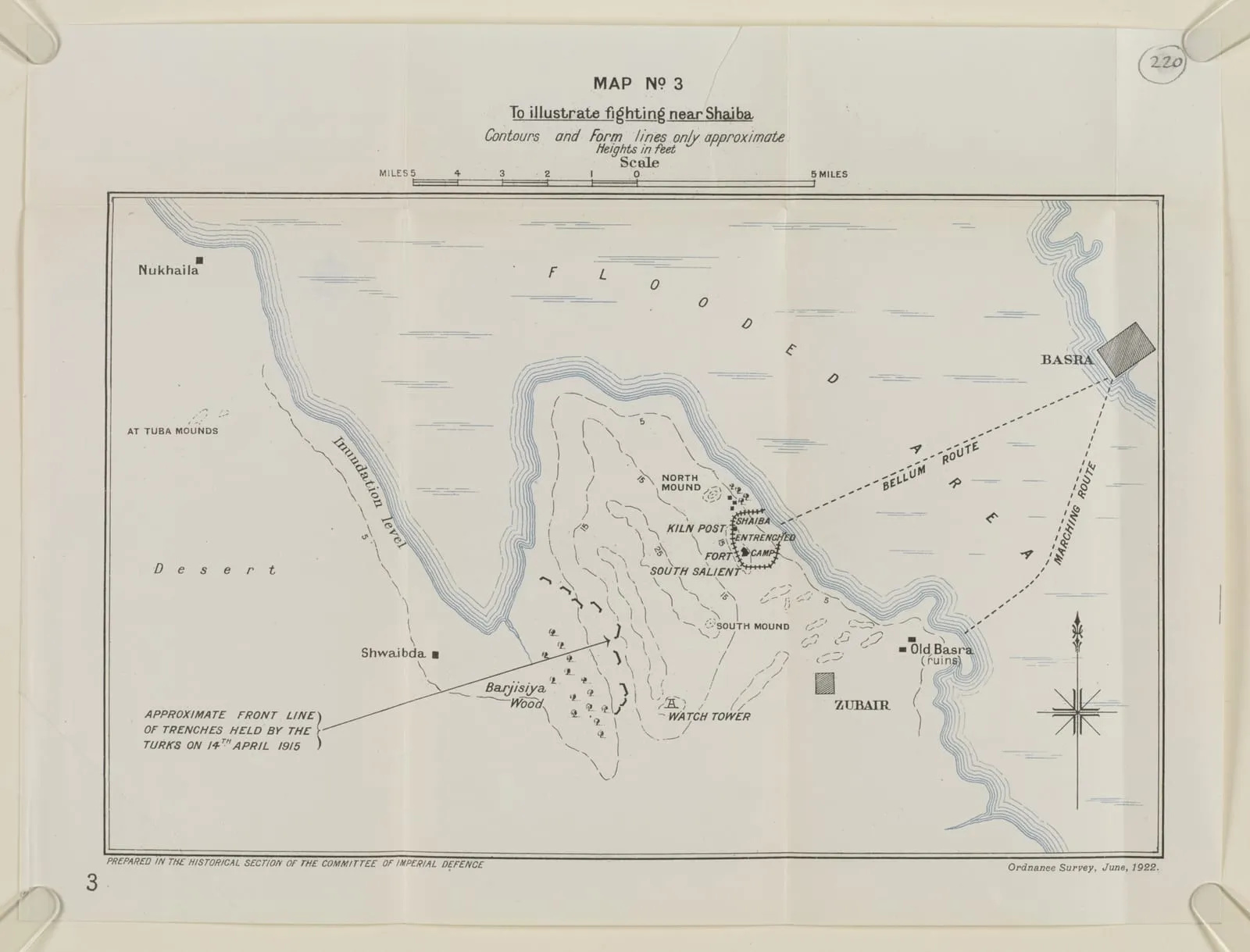
The Battle of Shaiba was the biggest Turkish attempt to recapture Basra, taken by the British in November 1914. Ottoman troops and thousands of Arab tribal warriors under Lieutenant-Colonel Süleyman Askerî attacked the British camp at Shaiba, on the edge of the desert west of the city, on 12 April 1915. For a day and a night the defenders beat off successive assaults; on 13 April they went over to the counter-attack, and on 14 April, in heavy fighting that long hung in the balance, they took the Turkish trenches in front of Barjisiyah wood. The Turks fled, plundered on the way by their erstwhile allies, and Askerî took his own life. Basra was never threatened again for the rest of the war.
Name and dates
The British Battles Nomenclature Committee and the British chronology of the war date the battle to 12–14 April 1915, and we adopt these dates. Turkish works speak of the Battle of Şuaybe (Şuaybiye) and sometimes count it from 11 April, when the Ottoman troops approached the British positions and cavalry skirmishes took place. The name comes from Shaiba, a small settlement with a brick-built serai around which the British had set up their camp. The heaviest fighting on 14 April, however, took place a few kilometres further on, on the rise in front of Barjisiyah wood, where the Turkish camp stood.
Background
After the occupation of Basra and the capture of Qurna in December 1914, Indian Expeditionary Force D controlled lower Mesopotamia up to the confluence of the Tigris and the Euphrates. At the turn of 1914 and 1915 the Ottoman command in Iraq was taken over by Lieutenant-Colonel Süleyman Askerî, a young and ambitious officer from the circle of Enver Pasha and formerly head of the secret Special Organisation. He resolved to retake Basra by combining the few regular troops with the forces of the Arab tribes, who were being called to jihad against the infidels. In January Askerî was badly wounded in a clash near Qurna and spent several weeks recovering in Baghdad, but in the spring he returned to the front, although he still could not walk. He concentrated his main forces on the Euphrates around Nukhaila, from where the shortest route to Basra led across the desert past Zubair and Shaiba. A weaker left wing was at the same time to threaten the British in Persian Arabistan, around Ahwaz.
The British expected an attack. At the beginning of April their scouts reported a concentration of Turks at Nukhaila, and further brigades from India and Egypt were arriving in Basra. The spring floods, however, had turned the ground between Basra and the camp at Shaiba into a vast shallow lake. Supplies were carried in flat-bottomed boats called bellums and on pack mules wading belly-deep in the water, so the command kept in the camp only as many troops as it could feed. On 9 April a new commander, General John Nixon, arrived in Basra and took over the troops from the ailing General Arthur Barrett. On 11 April the British spotted approaching Turkish columns and decided to reinforce Shaiba with General Charles Melliss’s 30th Brigade. The Turks attacked before the reinforcements could set out.
Forces
In the camp at Shaiba stood General Charles Fry with General Walter Delamain’s 16th Brigade, his own 18th Brigade, the 6th Cavalry Brigade, the 48th Pioneers and several batteries of field, horse and mountain artillery. The perimeter of the camp, surrounded by trenches and wire, was more than five kilometres long. Its rear rested on the flooded ground. On the evening of 12 April Melliss arrived with part of the reinforcements and, as the senior officer, took command. According to the British official history, 4,595 infantry and 733 cavalry went into the attack on 14 April. Other works state that the whole garrison of the camp numbered 6,000–7,000 men.
The Turkish strength is hard to establish precisely. The British estimated it at 12,000 regulars and more than 10,000 Arabs. According to Turkish sources quoted in the British official history, Askerî had fewer than 7,000 regulars with 21 guns: battalions of the 35th Division, filled out with Kurdish volunteers, two battalions of the Istanbul fire brigade regiment, a military formation considered one of the best in Mesopotamia, the Osmancık volunteer battalion and Arab units. Popular accounts most often speak of about 4,000 regulars and 14,000 tribal warriors. In any case there were more than 18,000 Arabs, including 3,700 horsemen. The largest contingents were brought by Sheikh Ajaimi al-Sadun of the Muntafiq tribal confederation. The wounded Askerî directed the expedition from his bed in the camp at Barjisiyah wood, while the troops were actually commanded by Ali Bey, commander of the fire brigade regiment.
Course of the battle
12 April. At about 5 a.m. the Turks opened rifle fire on Shaiba fort, and at sunrise twelve Turkish guns came into action. The British artillery quickly silenced most of them. An infantry attack on a salient corner of the trenches south of the fort was repulsed by 8 a.m. The Arabs, who had occupied a hillock called North Mound north-west of the camp, could not get any closer. In the afternoon the Turks renewed the attack from the south, and a squadron of the 7th Hariana Lancers under Major George Wheeler dispersed the Arab riflemen in a daring sortie. At dusk came another strong assault, and all night long the Turks tried to cut through the wire. The last attack was beaten off at about 3.30 a.m. The British lost only five killed and 66 wounded.
Meanwhile in Basra Nixon tried in vain to send reinforcements across. The local boatmen had fled, and the 30th Brigade, which set off on foot through water above knee height, had to turn back. Only in the evening did volunteers of the 20th Punjabis push about 80 bellums across the floodwater carrying Melliss, the staff of the 6th Division and part of the 24th Punjabis.
13 April. At dawn Melliss took command and went over to the counter-attack. The first attack by the cavalry brigade on North Mound failed, and Major Wheeler was killed charging alone at the enemy’s standards. He was posthumously awarded the Victoria Cross. At about 11 a.m., however, three of Delamain’s battalions, supported by the fire of all the artillery, took the hillock and then, wheeling south-west, cleared the ground west of the camp of Turks and Arabs. The 104th Wellesley’s Rifles took several lines of trenches with the bayonet, and the 24th Punjabis captured two abandoned Turkish mountain guns. In the afternoon the troops returned to camp. The day brought more than 400 prisoners for British losses of 132 men.
14 April. In the morning Melliss left the camp with most of his force. The cavalry came upon the Turks near the so-called Zubair Watch Tower, and Melliss found that their main body held a position more than five kilometres wide in front of Barjisiyah wood, with the Arabs on the flanks. He abandoned the idea of an outflanking move, and at about midday the 16th and 18th Brigades attacked frontally. On the crest of the rise the British and Indian battalions came under heavy fire from well-concealed trenches. Mirage and the lie of the land prevented the artillery from shelling them effectively. For several hours the exchange of fire went on in the heat, and only here and there did the soldiers manage to crawl closer. At about 4 p.m. Melliss was already preparing to withdraw, but then the Turkish guns fell silent and the defenders’ fire slackened. At about 4.15 p.m. some of the men from both brigades rose to charge with the bayonet, and the whole line followed them. By 5 p.m. the Turks had abandoned their first line of trenches, the garrison of the second hoisted a white flag, and a mass of fugitives poured out of the wood.
The exhausted British did not pursue the enemy and returned to camp in the evening. Melliss did not yet know that the battle was won and expected the Turks to continue their defence at the wood. Only on 15 April did cavalry patrols establish that the Turks had left the area of Old Basra, Zubair and Barjisiyah. The fleeing units were attacked and plundered by the Arabs, and the remnants of the Turkish troops stopped only at Khamisiyah on the Euphrates, about 140 kilometres from Shaiba. The British river flotilla, which since March had been blocking the Turkish supply route on the Euphrates, destroyed or captured a dozen or so boats carrying fugitives. After the defeat Askerî gathered his officers, accused the Arabs of treachery and shot himself. Turkish sources give 14 April as the date of his death.
Losses
According to the British official history, the British and Indians lost 71 men on 12 April, 132 on 13 April and 1,062 on 14 April, including 161 killed, in all nearly 1,300 killed and wounded. Other works give figures from about 1,100 to 1,600. The heaviest losses were suffered by the 120th Rajputana Infantry, the 24th Punjabis and the Dorset battalion, which lost between a fifth and nearly a third of their strength.
The British estimated Turkish losses at about 6,000 killed and wounded, including 2,000 Arabs, and took 18 officers and 724 men prisoner. Turkish sources speak of fewer than 3,000 killed and wounded among the regulars and about 800 prisoners. The losses of the Arab tribes, which dispersed after the battle, are unknown.
Significance
For the British in Mesopotamia Shaiba was a decisive battle. It finally removed the threat to Basra and to the refinery at Abadan, and incidentally broke the Turkish plans to provoke a general jihad in lower Mesopotamia. The attack on Ahwaz, which was to accompany the blow at Shaiba, collapsed before it had properly begun, when the local Arabs refused to take part in the fighting. Ottoman authority over the tribes weakened markedly. The Arabs, who had failed at Shaiba and turned against the beaten Turks, ceased to believe in their strength, and in the following months revolts against the Ottoman authorities broke out in the Shia towns of central Iraq, above all in Najaf.
The British official history observes that the victory was owed not to manoeuvre but to the tenacity of the officers and men. Melliss himself called Shaiba “a soldiers’ battle”. The Turks, despite weak artillery and the disappointment of their Arab allies, very nearly repulsed the decisive attack. The ease with which the British then routed them in flight, however, strengthened Nixon’s conviction that the enemy was weak. By the end of May his troops were advancing up the Tigris on Amara, and in the summer up the Euphrates on Nasiriyah. This march ended in 1916 with the capitulation of General Charles Townshend’s division, besieged in Kut.
Spotted a mistake?Report an error