1914: The Ottoman Empire enters the war
Battle of Qurna
- Dates:
- 4–9 December 1914
- Front:
- Middle East
- Location:
- Qurna, at the confluence of the Tigris and the Euphrates, in lower Mesopotamia (present-day Iraq)On the battle map →
- Sides:
- United Kingdom and British IndiaCharles Fry, Arthur Hayes-SadlerOttoman EmpireSubhi Bey
- Result:
- British victory. The Qurna garrison capitulated, and the British occupied the town and closed the first stage of the Mesopotamian campaign.
- Author:
- Natalia
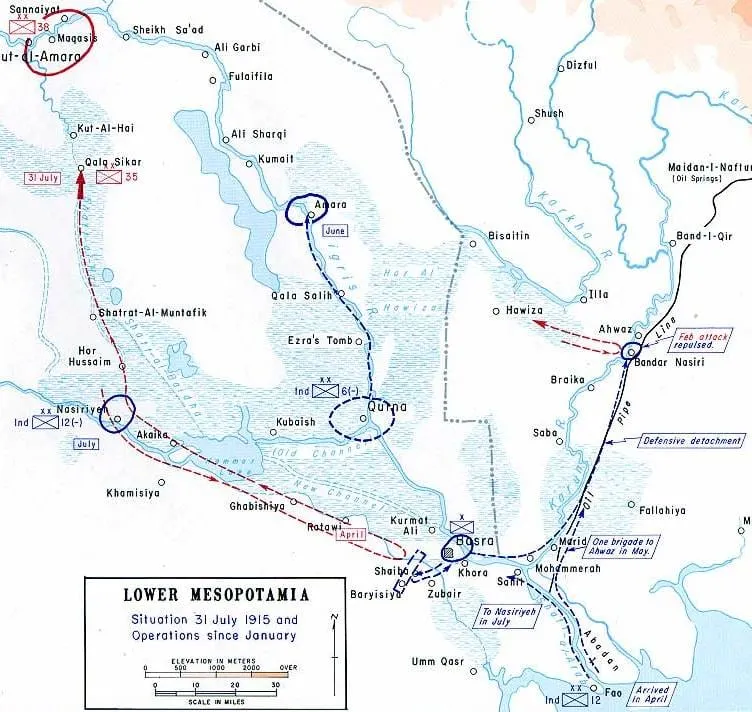
The Battle of Qurna, called in British historiography the “first action at Qurna”, was the last engagement of the first phase of the Mesopotamian campaign. After the capture of Basra, Indian Expeditionary Force “D” moved upriver to drive the Turks out of Qurna, a small town at the confluence of the Tigris and the Euphrates. The fighting lasted, with breaks, six days. It ended with the capitulation of the Turkish garrison, which had allowed itself to be cut off from its line of retreat to the north.
Why Qurna
After the defeat at Sahil and the loss of Basra, the vali of Basra, Subhi Bey, withdrew the remnants of his troops about 75 kilometres upriver, to Qurna. The place lay on a spit of land between the two rivers, which join here to form the Shatt al-Arab. According to local tradition, the biblical Garden of Eden was located precisely here.
For the corps commander, Lieutenant-General Arthur Barrett, Qurna was a natural forward post covering Basra. Whoever held it controlled the waterway up the Tigris towards Baghdad and could threaten Turkish communications with the area of Nasiriyah on the Euphrates. On 25 November the sloops HMS Espiegle and HMS Odin came within a few kilometres of the town and shelled the Turkish guns and the gunboat Marmaris, but could go no further because of shoals and a lighter sunk in the channel. On 29 November Barrett informed India that he intended to take Qurna as soon as he had unloaded his supplies at Basra.
Forces
At first Barrett sent to Qurna a small detachment under Lieutenant-Colonel Frazer of the 110th Mahratta Light Infantry: two Indian battalions, a company of the Norfolk Regiment, half a company of sappers and two field guns. When this proved too little, Brigadier-General Charles Fry, commander of the 18th Brigade, arrived with further battalions and batteries. According to the British official history his force eventually numbered about 3,700 men with twelve guns.
An enormous part was played by the flotilla of the senior naval officer, Captain Arthur Hayes-Sadler: the sloops Espiegle and Odin, the Royal Indian Marine armed ship Lawrence, the small armed launches Miner, Shaitan and Lewis Pelly, and the Lynch company’s river steamers Mejidieh and Blosse Lynch, on which two 18-pounder field guns had been mounted. On the flat ground covered with date groves, where mirage hampered observation from the ground, the gunners on the ships could see much more from the height of their decks than those on land.
The Turkish forces are difficult to establish. Before the fighting the British estimated them at 1,200 to 1,500 men on the left bank of the Tigris and about 800 in Qurna itself, and after the battle at about 3,000 on both banks. They were mainly the remnants of the 38th Division, gendarmerie and artillery units, supported by Arab volunteers who behaved rather passively during the fighting.
Course
On 4 December Frazer’s detachment landed a few kilometres below Qurna, on the left bank of the river, and drove the Turks out of the village of Muzaira (in some accounts Mazera), lying opposite the town. It was unable to cross the Tigris and in the evening returned to the landing place. Barrett then sent Fry upriver with reinforcements.
On 7 December Fry attacked Muzaira, which the Turks had meanwhile reoccupied and fortified. The Norfolks and the Indians took the village with the bayonet before 1 p.m., and then drove the enemy out of the palm groves as far as the bank of the Tigris. That day the Turks lost about 200 killed, 130 prisoners and three guns. The commander of the launch Shaitan, Lieutenant-Commander Elkes, was killed by fire from Qurna. During the night some of the Turkish troops left northwards by steamer.
On 8 December the British crossed the Tigris above the town, out of sight of the defenders, and threatened to cut off the garrison. That same night Turkish envoys came to the British ships. On 9 December Subhi Bey surrendered together with his soldiers, and the British entered Qurna.
Losses
According to various counts the British and Indians lost about 30 killed and from 200 to almost 300 wounded. The first day of fighting cost them the most killed, the attack of 7 December the most wounded. Turkish losses are uncertain. The days of 4 and 7 December alone cost the Turks several hundred killed and wounded, and over 200 prisoners fell into British hands before the capitulation. In Qurna itself 45 officers (42 according to some sources) and 989 men surrendered. Total Turkish losses are usually estimated at 1,500 men or more.
The Turkish assessment
After the war an Ottoman General Staff officer, Muhammad Amin, sharply criticised the conduct of this battle in a pamphlet published by the Turkish staff. He pointed out that the hasty retreat from Basra had dispersed forces that could have been concentrated at Qurna. On 4 December the town’s garrison watched from the other bank as the detachment at Muzaira was beaten and did not come to its aid, although it had the means to cross the river. Several battalions stationed a few kilometres further up the Tigris did not move at all, and the Turkish commander-in-chief was even further away, at Ezra’s Tomb, and did not coordinate operations.
Name and dates
In many studies the battle is dated 3–9 December, because on 3 December Frazer’s detachment sailed from Basra. The first fighting, however, took place on 4 December, and we take that day as the start of the battle. The British chronology of the war records the end of the fighting on 8 December and the occupation of Qurna on 9 December, when the garrison capitulated. The British speak of the “first action at Qurna” to distinguish it from the fighting in the same area at the end of May 1915, when British troops set out from here up the Tigris towards Amara.
Significance
The capture of Qurna closed the first phase of the Mesopotamian campaign. Within five weeks of the landing at Fao, Barrett’s corps had broken the Turkish forces in lower Mesopotamia in successive engagements and secured the refinery at Abadan, Basra and the whole course of the Shatt al-Arab. Qurna became a forward post on the Tigris, covering Basra from the north. The displays of British strength did not escape the notice of the Arab tribes of the Persian Gulf either, whose goodwill both the British and the Turks depended on.
The ease of these victories proved treacherous, however. It confirmed the British in the belief that the Ottoman army in Mesopotamia was weak, which in the following year led them to ever more distant expeditions up the Tigris, up to the defeat at Kut in 1916.
Spotted a mistake?Report an error