1916: The relief of Kut and the Erzurum Offensive
Battle of Dujaila
- Dates:
- 8–9 March 1916
- Front:
- Middle East
- Location:
- Dujaila Redoubt on the right flank of the Turkish Es Sinn (Sabis) position, on the right bank of the Tigris, a dozen or so kilometres south-east of Kut, central Mesopotamia (present-day Iraq)On the battle map →
- Sides:
- United Kingdom and British IndiaFenton Aylmer, George Gorringe, George Kemball, Henry KearyOttoman EmpireHalil Bey, Ali İhsan Bey, Colmar von der Goltz
- Result:
- Ottoman victory. The assault on the redoubt failed, the British lost 3,474 men and fell back to the Wadi. The second attempt to relieve Kut had collapsed.
- Author:
- Natalia
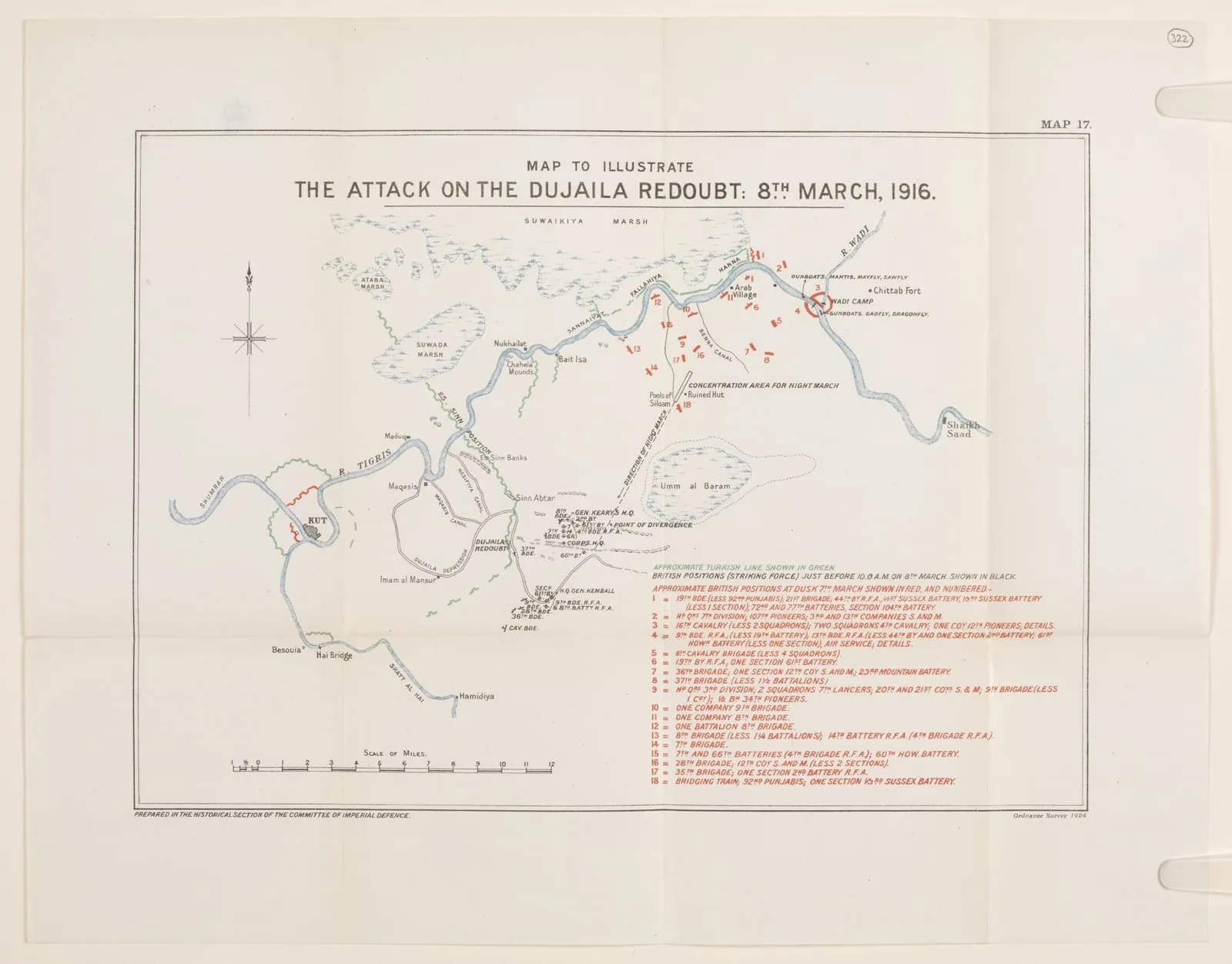
The Battle of Dujaila was the second attempt to relieve General Charles Townshend’s Anglo-Indian division, besieged in Kut on the Tigris. After the defeat at Hanna in January, Lieutenant-General Fenton Aylmer decided not to attack frontally on the left bank again, but to outflank the Turkish position on the right bank and take the Dujaila Redoubt, which closed its right flank. On the night of 7/8 March 1916 about 20,000 soldiers crossed the desert in the dark and at dawn stood before the weakly held Turkish right flank. The column that was to attack first, however, was late and halted to deploy, and the artillery opened fire before the infantry moved off. The Turks had time to bring up reserves. The attack from the south stalled far short of the redoubt, and the evening assault from the east broke into it only for a moment. On 9 March Aylmer withdrew his troops to the Wadi. The British lost 3,474 men.
Name and dates
The British official history (Moberly, The Campaign in Mesopotamia, volume II) speaks of the “second attempt to relieve Kut” and the attack on the Dujaila Redoubt. The Turks call the engagement the Battle of Sabis (Sâbis Muharebesi), after the position the British called Es Sinn. The main fighting lasted a single day, 8 March 1916. On this page we take 9 March as the end of the battle, because on that day the British withdrew from the battlefield under fire from the pursuing Turks, and the losses given by the official history cover both days. Turkish studies date the battle to 8–10 March.
Background
After the January defeats the Tigris Corps spent the whole of February making good its losses and waiting for reinforcements. On 28 January Major-General George Gorringe became Aylmer’s chief of staff. In February the War Office in London took over the direction of the campaign, and the 13th Division, veterans of Gallipoli, was on its way from Egypt to Basra. Townshend reported that after requisitioning the stocks in the town he could hold out until mid-April. Time was pressing, however, for another reason. In March the annual floods from the melting snows began on the Tigris, which would turn the plain into a swamp, and the Turks, standing upstream, could flood the British trenches.
On the left bank the Turkish position in the Hanna defile, linked by trenches to the positions at Fallahiyah and Sannaiyat, was too strong. Aylmer and the commander of the forces in Mesopotamia, General Percy Lake, concluded that the best chance lay in a blow on the right bank, where the main Turkish line ran south from the river, across the Sinn banks, to two redoubts on mounds: Sinn Abtar and Dujaila. Until the beginning of March Dujaila formed the right flank of the position. Only in the last few days had the Turks begun digging short trenches south-west of it, towards the Shatt al-Hai canal. Aylmer also counted on Townshend striking out from Kut to meet the relief force. Townshend replied that he would begin crossing the river only once the attack had started, and that the crossing would take several hours.
The attack was fixed for 6 March, but bad weather postponed it twice by a day. On the left bank Aylmer feigned preparations for a crossing above Hanna and shelled the Turkish position to mislead the enemy. He knew that the Turks learned a great deal from Arab boatmen and deserters.
Forces
For the march on the right bank Aylmer assigned, according to the official history, 1,268 cavalry, 18,891 infantry and 68 guns, that is seven infantry brigades and a cavalry brigade. On the left bank General George Younghusband, with about 5,000 infantry and 22 guns, was to pin down the Turks at Hanna. The force was divided into three groups. The first, under Major-General George Kemball, made up of the 36th, 9th and 28th Brigades, was to go round the redoubt from the south and capture it. The cavalry brigade followed it. The third, under the commander of the 3rd Division, Major-General Henry Keary (the 7th, 8th and 37th Brigades and the corps artillery), was to take up position east of the redoubt and support Kemball’s attack, and then attack the Sinn Abtar Redoubt. Aylmer entrusted the main attack to Kemball rather than Keary, because Keary disagreed with his plan. Critics later reproached him for not giving the task to the only complete division he had on the right bank.
British intelligence estimated the Turkish forces at Es Sinn at 8,500 infantry, 1,500 cavalry and 32 guns. According to the German officer Hans von Kiesling and the Turkish General Staff, both cited by Moberly, the line from the Tigris to the Dujaila Redoubt was held by two regiments of the 35th Division, about 2,000 men. A third regiment stood in an advanced position at Beit Aiessa. The right flank was covered by Turkish cavalry and Arab irregulars, and four battalions of the 2nd Division stood in reserve, some distance behind the line. On the left bank stood the 51st and 52nd Divisions, while the 45th Division was besieging Kut. The troops on the Tigris were commanded by Halil Bey (Halil Kut), and the whole Sixth Army by Field Marshal Colmar von der Goltz. Turkish studies credit the defence of the Sabis position to the XIII Corps of Ali İhsan Bey, who later took the surname Sâbis from it.
The night march
On the evening of 7 March the troops assembled at the pools the British called the Pools of Siloam. Several artillery batteries had a few kilometres further to go and arrived late, so the column, about three kilometres long, set off only at 10.22 p.m. instead of 9 p.m. It was led by Captain K. Mason of the sappers, who checked direction and distance with a compass, a bicycle wheel and pedometers. The night was clear and starry. At midnight the column was halted for an hour, because the staff believed that Keary’s rear column had lost touch. At the point where Kemball’s group was to branch off, at about 2.30 a.m., a further delay was caused by pulling the transport and ambulances out of the column. The drivers were sleeping so soundly that it was hard to wake them. Then the way was barred by an empty Turkish trench, which had to be bypassed through a narrow passage.
At dawn, at about 6.30 a.m., the head of Kemball’s column was still about 1,400 metres short of its deployment point in the Dujaila depression, an old river bed. The redoubt was clearly visible a few kilometres to the north-west. The commander of the leading battalion, the 26th Punjabis, and the commander of the 36th Brigade, General Christian, saw no movement on the Turkish side and wanted to push on. Kemball refused. He knew from experience that Turkish trenches in Mesopotamia always looked empty until they opened fire, and that an attack without reconnaissance usually ended in loss of direction. He ordered the Punjabis back and had the whole group hidden in the depression to sort itself out. Many British officers later heard from the Turks that they had been completely surprised and asleep, and the Turkish General Staff blamed this on the negligence of its own cavalry.
The fighting on 8 March
At 6.35 a.m. Kemball reported that he had arrived unobserved and needed an hour to deploy. Aylmer, who stood with Gorringe on a mound by the corps artillery, judged that the Turks must see his troops by now anyway, and at about 7.00 a.m. ordered fire to be opened on the Turkish camp and the redoubt. The Arab irregulars and part of the Turkish cavalry fled towards the Shatt al-Hai. According to German and Turkish sources their commander was killed. The bombardment, however, alerted the Turks. Halil brought the regiment from Beit Aiessa and the battalions of the 2nd Division over to the right flank, and began ferrying further units from the left bank across the crossing at Magasis. British airmen saw thousands of men being ferried across in boats and on rafts in the morning. According to Kiesling this was the 51st Division. The war correspondent Edmund Candler wrote of the 52nd Division and of about 8,000 men who, according to the airmen, crossed the river during the day.
Kemball’s group took a long time to extricate itself from the depression, in which battalions, guns, ammunition wagons and ambulances had become mixed up. The 36th Brigade moved off only at 9.35 a.m., and the 9th Brigade against the redoubt at 9.45 a.m., with the 28th Brigade behind it. From the first moments the infantry met heavy rifle and machine-gun fire from trenches the airmen had not spotted, because the Turks had camouflaged them with brushwood. Soldiers of the 2nd Division, sent to the right flank, were manning these trenches in full view of the British. By noon the 9th and 28th Brigades, losing many men, had come within a few hundred metres of the Turkish line, but that line ran about 1,400 metres in front of the redoubt. The 36th Brigade occupied trenches abandoned by the Turks in the direction of the tomb of Imam al-Mansur. Meanwhile the 37th Brigade had stood since morning a few hundred metres east of the redoubt and reported that it was weakly held. It had orders, however, to wait for Kemball’s attack, and the 7th Brigade was not to go into action at all before the attack on Sinn Abtar.
The battle was fought amid a chaos of false reports. Heat, mirage and the lack of landmarks made units misjudge distances. Around noon a Gurkha battalion reported that it was 450 metres from the redoubt and could take it, when in fact it was 1,400 metres away. For most of the day Kemball and Aylmer believed that his brigades were right under the redoubt, so all the artillery fired at the redoubt rather than at the trenches that had stopped the infantry. An attack ordered for 2.10 p.m. made only slight progress. At times the fire of the 37th Brigade fell on Kemball’s neighbouring brigades.
Before 4 p.m. Aylmer realised that Kemball would not take the redoubt on his own, and ordered Lieutenant-Colonel Dunsford’s 8th Brigade to storm it from the east together with two battalions of the 37th Brigade, while Kemball attacked simultaneously from the south. The 8th Brigade advanced from a distance of about 2.7 kilometres. In the Dujaila depression it ran into crossfire from the redoubt and the trenches on both sides, and into accurate Turkish artillery fire which, in the opinion of veterans from France, was every bit as good as the German. After 5.15 p.m. the 1st Battalion of the Manchester Regiment, supported by men of the 59th Rifles, the 2nd Rajputs and the 1/2nd Gurkhas, broke into the redoubt and took two lines of trenches. The attackers cleared them with grenades, but the setting sun shone in their eyes and the grenades soon ran out. The Turks counter-attacked from both flanks, according to Kiesling with units of the 51st Division freshly arrived from the left bank, and at dusk drove out the remnants of the attackers. The withdrawal was covered by the 47th Sikhs, who twice beat off attempts at pursuit. Kemball’s attack from the south, without artillery support, again stalled far short of the redoubt.
The withdrawal on 9 March
In the evening Aylmer concluded that a renewed assault would end in disaster. The troops were exhausted after thirty-six hours of marching and fighting, some of them were short of water, there was no means of evacuating the wounded, and the Turks were bringing more and more men across to the right bank. He also feared that a counter-attack would cut him off from the river and the steamers. On the morning of 9 March Kemball reported that the Turkish camps had vanished and that in his view the Turks had abandoned their trenches. The airmen, however, still saw Turkish troops and guns in position, so Aylmer ordered a withdrawal. The Turkish General Staff later claimed that it not only had no intention of retreating but was preparing a counter-attack. The British withdrew in good order, beating off a feeble pursuit. Exhausted and thirsty soldiers trailed into the camp on the Wadi until late at night, and the last rearguard units reached it after midnight. Townshend kept two brigades ready to cross throughout 8 March, but because of the mirage and the lack of news he did not move out of Kut. The Turkish General Staff later criticised his passivity.
Losses
According to the official history the British lost 3,474 men on 8 and 9 March: 512 killed, 2,465 wounded and 497 missing. The heaviest losses fell on the 8th Brigade, which stormed the redoubt. Moberly estimates its losses at a third of its strength. Candler states that the brigade went into action more than 2,300 strong and came out about 1,100 strong, and that the 2nd Rajputs lost all their British officers. The evacuation of the wounded went much more smoothly this time than in January, although many suffered in jolting carts, because there were few real ambulances in the country. Turkish losses, according to Kiesling, amounted to 26 officers and 1,259 men. The American historian Edward J. Erickson gives a similar figure, about 1,290.
Significance
Moberly writes that no battle of this campaign provoked so much comment and so much criticism. According to Candler, the commander in Mesopotamia, General Lake, indirectly blamed Kemball for the delay in his report. Candler, who accompanied the Tigris Corps as a correspondent, considered it an unpardonable mistake to have halted that column at dawn, when a weakly held gap in the Turkish defences yawned before it, and he blamed Aylmer and Gorringe. The plan, with a night march of the whole army in a single column and detailed orders that left commanders no freedom, rested on surprise, and the surprise was squandered in the first few hours.
On 10 March Halil called on Townshend to surrender, and he refused. On 11 March, according to the official history, Gorringe succeeded Aylmer in command of the Tigris Corps (some studies give 12 March). A few days later the Tigris floods came and inundated the area around Kut. The third and final relief attempt began in April, with the 13th Division taking part, and it too failed.
Spotted a mistake?Report an error