United Kingdom · The Entente
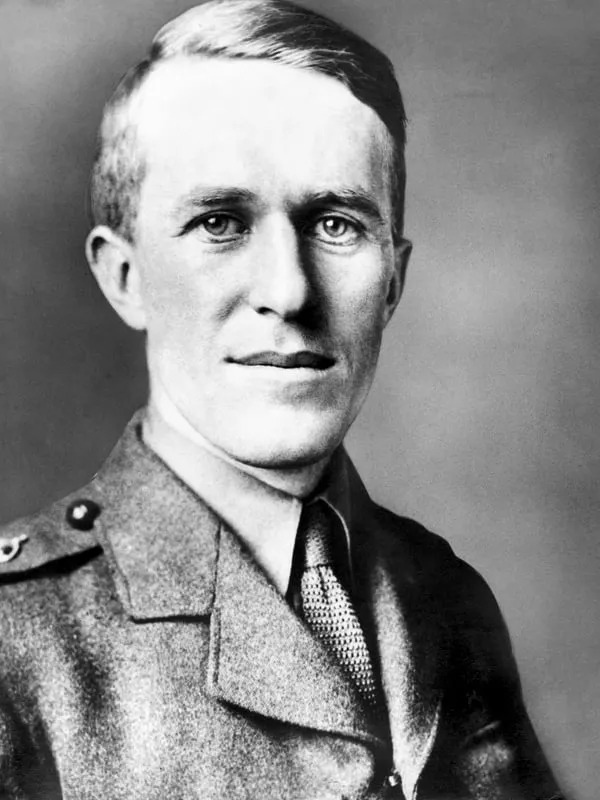
T. E. Lawrence
British intelligence officer in Cairo, liaison officer with Emir Faisal in the Arab Revolt (1916–1918)
- Born:
- 16 August 1888, Tremadog (Wales)
- Died:
- 19 May 1935, Bovington Camp (Dorset, England)
- Author:
- Natalia
- Photo:
- Harris & Ewing, domena publiczna, Wikimedia Commons

Thomas Edward Lawrence, known as “Lawrence of Arabia”, was a young Oxford archaeologist who during the Great War became the most famous British officer in the Middle East. From the autumn of 1916, as liaison officer and adviser to Emir Faisal, he helped to lead the Arab Revolt against the Turks: he helped to devise the plan for the march on Wejh, conceived and led the expedition to Aqaba, blew up trains on the Hejaz Railway and in the autumn of 1918 rode into Damascus with the Arabs. His influence on the desert war was great, though smaller than the legend claimed. That legend was created by the American journalist Lowell Thomas and by Lawrence himself, author of “Seven Pillars of Wisdom”, one of the best-known books about the war. After the war he fought for the Arab cause in Paris and London, and then fled from fame, serving under an assumed name as a private in the air force.
Before the war
He was born on 16 August 1888 in Tremadog in Wales, the second of five sons of Thomas Chapman, an Anglo-Irish landowner, and the governess Sarah Junner. His parents were not married and lived under the assumed name Lawrence. From 1896 the family lived in Oxford. Lawrence read history at Jesus College, University of Oxford. In the summer of 1909 he walked alone some 1,600 kilometres through Ottoman Syria and Palestine, studying crusader castles, and on that basis wrote his thesis, which was awarded first-class honours.
From 1910 he worked for the British Museum on the excavations at Carchemish on the Euphrates, under his mentor David Hogarth and later Leonard Woolley. There he learned Arabic, got to know the local workmen and leaders, and watched at close quarters the German engineers building the nearby bridge of the Baghdad Railway. At the beginning of 1914 he and Woolley surveyed the Negev desert for the Palestine Exploration Fund. The archaeological expedition was a cover for a military mapping survey of the ground that a Turkish army advancing on Egypt would have to cross. Lawrence also reached Aqaba and Petra at that time.
Cairo and Kut
After the outbreak of war he was commissioned in October 1914 as a second lieutenant and interpreter, and in December he arrived in Cairo to join the intelligence department of the British army staff in Egypt. He drew maps, interrogated prisoners, wrote reports on the Ottoman army and argued for a landing in the Gulf of Alexandretta. In 1915 two of his younger brothers, Frank and Will, were killed. In 1916 he moved to the newly created Arab Bureau, the centre of British Arab policy in Cairo, headed by Gilbert Clayton, with Hogarth as one of its leading figures. He wrote for its secret bulletin and belonged to a group of young officers who believed that an Arab revolt could break the Ottoman Empire apart from within.
In the spring of 1916 he was sent to Mesopotamia, where the Turks were besieging General Townshend’s British division in Kut. He was to find out whether an Arab revolt could be stirred up behind the Turkish lines, and together with Captain Aubrey Herbert he took part in the talks with Halil Pasha in which the British offered one million, and then two million, pounds for the release of the garrison. The talks came to nothing, and on 29 April Townshend surrendered. Lawrence returned to Cairo sharply critical of the British command in Mesopotamia.
With Faisal in the Hejaz
In June 1916 the Sharif of Mecca, Hussein bin Ali, launched the revolt. In the autumn it stalled before Medina, and in Cairo and London there was argument over whether to send British troops to the Hejaz. In October Lawrence went to Jeddah with the Oriental Secretary, Ronald Storrs. He talked with the Sharif’s son Abdullah and then travelled inland to Faisal’s camp in Wadi Safra, which he reached on 23 October. He later wrote that he knew at first glance that this was the leader Arabia needed. His reports convinced his superiors that Faisal was the man to back, and also that British troops in the Hejaz would do more harm than good. At the end of 1916 Lawrence, by then a captain, returned to the Hejaz as liaison officer at Faisal’s headquarters and, at Faisal’s request, stayed there. He began wearing Arab dress, which made life among the Bedouin easier.
After the December crisis, when the Turks drove the Arabs back to Yanbu, Lawrence supported the plan for a march north along the coast to Wejh and coordinated it with the commander of the British ships in the Red Sea. In March 1917, ill with dysentery in Abdullah’s camp in Wadi Ais, he rethought the aims of the revolt. He concluded that taking Medina made no sense, since its garrison, tied to the city, did the Turks more harm than good. It was better to harass the Hejaz Railway, on which its supplies depended, keeping the line alive but barely working, and to carry the revolt north towards Syria. The Arabs were to act like a gas, dispersed over a vast space, with no front that could be attacked. He later set out this theory of guerrilla warfare in the article “The Evolution of a Revolt” (1920) and in “Seven Pillars of Wisdom”. In August 1917 he also published “Twenty-Seven Articles” in the Arab Bureau’s bulletin, practical advice for officers working with the Bedouin.
Aqaba
Lawrence’s most famous exploit was the expedition to Aqaba. Lawrence believed that the port had to be taken from the land, not from the sea, and that the Arabs had to do it themselves, without the French and the British. He did not let his superiors into the details. On 9 May 1917 a small party under Sharif Nasir and the Howeitat sheikh Auda abu Tayi set out from Wejh. It skirted the Turkish posts through the desert, and in June Lawrence made a lone and risky reconnaissance journey north, to the area of Damascus and Baalbek. On 2 July the Arabs routed a Turkish battalion at Aba el Lissan, and on 6 July they entered Aqaba from the landward side. Lawrence crossed Sinai by camel to Suez to bring in food, and in Cairo he reported the success to the new commander, General Edmund Allenby. Allenby understood that the Arabs could cover the right flank of his army, and from then on gave Lawrence a great deal of freedom. Lawrence was promoted to major and received the Order of the Bath. The Victoria Cross was even considered.
The railway war
From the autumn of 1917 Lawrence operated from Aqaba. In September, near Mudawwara, he blew up a train with an electrically detonated mine, and such ambushes became his speciality. In November he tried to blow up a bridge over the Yarmuk, which was meant to cut the Turks’ route out of Palestine during Allenby’s offensive. The raid failed. In “Seven Pillars of Wisdom” Lawrence described how on 20 November, in disguise and reconnoitring in Deraa, he fell into Turkish hands, and the local commander and his guards beat and abused him, sexually as well. There is no independent evidence of this incident. Some biographers regard the account as true and see in it the key to Lawrence’s later life; others think it was exaggerated or invented. On 11 December, in a borrowed uniform, he walked in the procession of Allenby as he entered Jerusalem.
In January 1918, as adviser to Emir Zeid, Faisal’s younger brother, he directed the Battle of Tafileh, one of the few conventional battles of the revolt, for which he received the Distinguished Service Order and promotion to lieutenant-colonel. He himself later judged it harshly as a needless display. In February, after a dispute with Zeid over money, he asked in discouragement to be relieved, but was sent back to Faisal. In the spring and summer he took part in planning operations around Ma’an and in liaison with the British during the raids across the Jordan, though the chief British liaison officer with Faisal’s army was by then Lieutenant-Colonel Pierce Joyce. Lawrence gathered around himself a personal bodyguard of several dozen well-paid riders and moved between Allenby’s headquarters, Aqaba and the desert, organising raids and recruiting tribes.
Deraa and Damascus
In September 1918 Lawrence went with an Arab column with armoured cars and a French battery, which on 16 and 17 September cut the railway around the junction at Deraa and drew Turkish reserves there just before Allenby’s blow at Megiddo. On 27 September near the village of Tafas the Arabs came upon a retreating Turkish column that had massacred the villagers. Lawrence wrote that he then gave the order to take no prisoners and that his men killed the Turks. Historians dispute how accurate this account is, but a retaliatory massacre certainly took place. On 1 October Lawrence drove into Damascus by car, after the Australian Light Horse had already passed through. He helped install an Arab administration and fostered the belief that the Arabs had liberated the city. On 3 October he interpreted at the meeting between Faisal and Allenby at which Faisal was told that Lebanon and the coast would go to France. The next day Lawrence left Damascus. He knew at least the general content of the Sykes–Picot Agreement and, as he wrote later, was constantly ashamed before the Arabs, because he had encouraged them to fight with promises he himself did not believe would be kept.
After the war
On 30 October 1918, at a private audience, he declined to accept from King George V the decorations he had been awarded, explaining that Britain would not keep the promises made to the Arabs. In 1919 he accompanied Faisal as adviser and interpreter at the Peace Conference in Paris. In the same year Lowell Thomas began film shows and lectures in London about “Lawrence of Arabia”, which drew huge audiences. Lawrence, elected a fellow of All Souls College, was writing his war memoirs. He lost the first manuscript at Reading railway station and had to write it again.
In 1921 Winston Churchill, the new Colonial Secretary, took him on as an adviser. Lawrence took part in the Cairo Conference, which gave Faisal the throne of Iraq and his brother Abdullah Transjordan, and went to Jeddah to persuade Hussein to sign a treaty with Britain. The King refused. Lawrence nonetheless judged that the Cairo settlement had largely paid Britain’s debt to the Arabs. In 1922 he left politics. Under the name John Hume Ross he enlisted as a private in the Royal Air Force. When the press revealed who he was, he was removed from the air force. Under the name T. E. Shaw, which he adopted officially in 1927, he served in the Tank Corps, and from 1925 again in the RAF, including in British India. In 1926 he published “Seven Pillars of Wisdom” for subscribers, and in 1927 the abridgement “Revolt in the Desert”, which became a bestseller. He translated the Odyssey and worked on fast air-sea rescue boats. He left the service at the beginning of 1935. On 13 May he crashed his motorcycle near his cottage, Clouds Hill, in Dorset, and died six days later in the military hospital at Bovington Camp. Churchill attended the funeral.
Assessment
In his lifetime Lawrence was a hero, and his first biographers, the poet Robert Graves and the military historian Basil Liddell Hart, portrayed him as a strategist on a par with the great captains. In 1955 the writer Richard Aldington, in a much-discussed book, accused him of systematic lying and exaggeration. Today it is known that both extremes were false. Lawrence himself edited passages of books about himself and tolerated untruths in them, and “Seven Pillars of Wisdom”, a literary masterpiece, is not a reliable source in its details. At the same time, documents such as the reports from the Hejaz and the British official history confirm that he played an important role: he was the ablest of the British officers with the Arabs, enjoyed the trust of Faisal and Allenby, and his ideas, such as the march on Aqaba and the abandonment of the siege of Medina, shaped the campaign. His authorised biographer Jeremy Wilson and later authors such as Scott Anderson largely defend his credibility.
Arab historians, such as the Jordanian scholar Suleiman Mousa, point out that the Lawrence legend erased the Arab leaders of the revolt, Faisal, Sharif Nasir, Auda and Nuri al-Said, and that the revolt had its own causes and its own heroes. Militarily, the Arab campaign was a sideshow, and its success depended on the British fleet, British gold and Allenby’s army. As a politician Lawrence was both a sincere champion of Arab independence and an officer of the empire who wanted a Middle East under British influence and without France. His theory of guerrilla warfare remains a classic of military literature to this day, and David Lean’s 1962 film “Lawrence of Arabia”, starring Peter O’Toole, fixed his myth around the world.
Sources
Spotted a mistake?Report an error
Commanded in battles
(02)Mentioned in battles
(04)Often appears with
People who appear in the same events.
On the timeline
(14)1916
1917
1918
January
- 28
- Arabs destroy the Dead Sea flotillaAt dawn on 28 January 1918 Abdullah al-Fair's Bedouin raided the Al-Mazraa landing, sank the Turkish grain flotilla on the Dead Sea and took 60 prisoners.
- End of the operations at TafilehOn 28 January 1918 the operations at Tafileh ended. The Arabs held the town and stopped shipping on the Dead Sea, but snow halted their march north.