Key event
Battle of Megiddo begins
- Category:
- Military operations
- Front:
- Middle East
- Date:
- 19 September 1918
- Author:
- Łukasz Skowroń
- Battle:
- Battle of Megiddo
- Tags:
- Great Britain, Ottoman Empire, British India, aviation
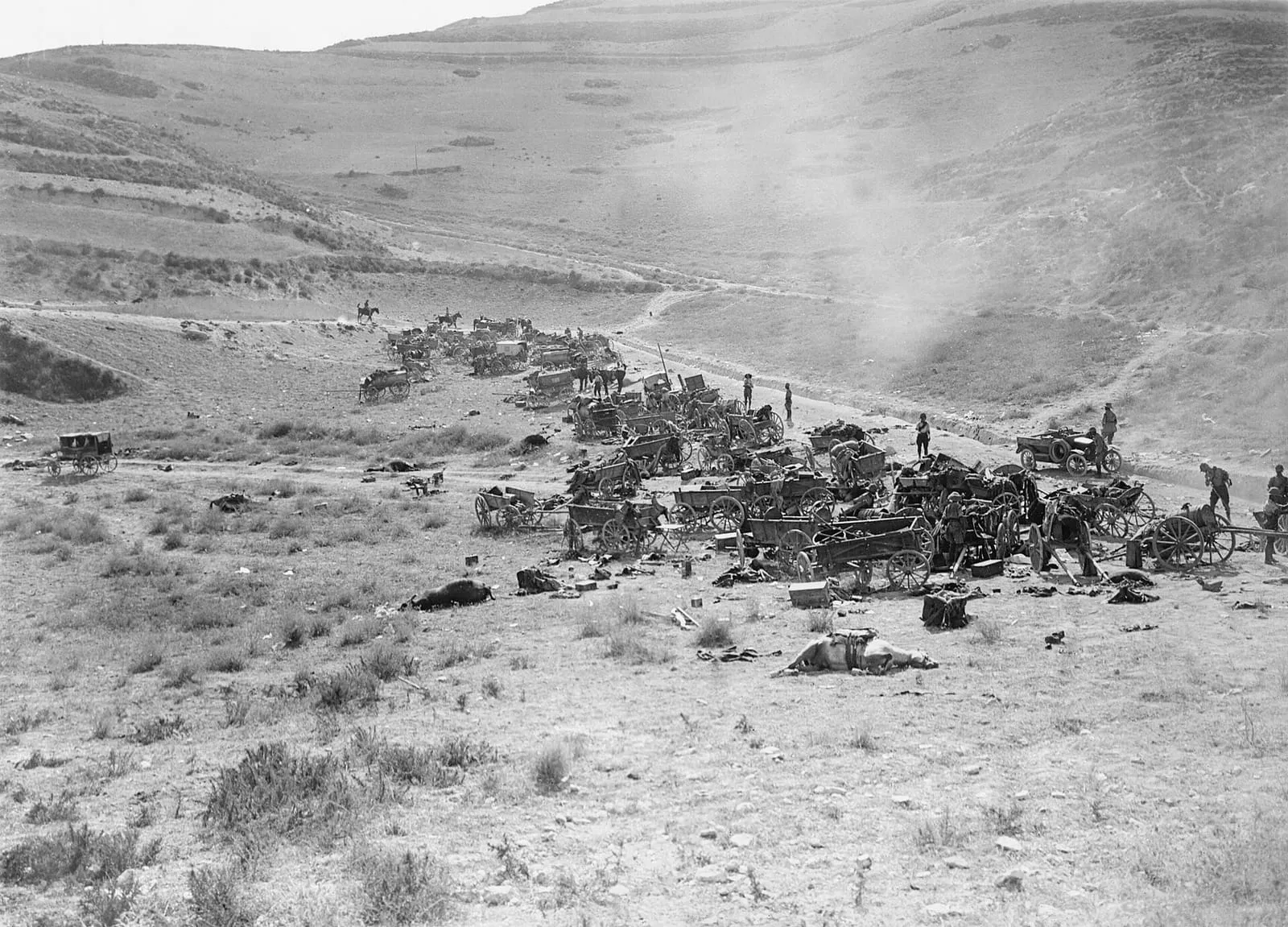
At 4.30 a.m. on 19 September 1918 several hundred British guns thundered over the coastal Plain of Sharon, a dozen or so kilometres north of Jaffa. So began the last great offensive of General Edmund Allenby in Palestine. Before nightfall his infantry had broken through the entire Turkish trench system by the sea and swung like a door on its hinges into the depths of the Samarian hills, and three cavalry divisions of the Desert Mounted Corps passed north through the open gap. That day the Turkish Eighth Army ceased to exist as an organised force, and the army group headquarters in Nazareth did not know for many hours what was happening on its right flank.
The night before the battle
Allenby had been preparing this blow since August, in the deepest secrecy. All summer he had confirmed the Turks in the belief, drawn from the spring raids on Amman and on Es Salt, that next time he would again strike across the Jordan. In the Jordan valley stood empty tents and canvas dummy horses, mules dragged sledges along the roads to raise dust, and horse races were announced near Jaffa for 19 September. Meanwhile division after division was moved to the coast by night. On the evening of 18 September, on the front from the hills near Rafat to the sea, stood five infantry divisions of the XXI Corps of Lieutenant-General Edward Bulfin and the French Détachement Français de Palestine et Syrie, supported by more than 380 guns and howitzers, and in the orange groves behind them waited the three cavalry divisions of Lieutenant-General Harry Chauvel. According to Cyril Falls, author of the British official history, Allenby had on the whole front about 12,000 sabres, 57,000 rifles and 540 guns against the enemy’s roughly 3,000 sabres, 26,000 rifles and 370 guns, and he concentrated most of this superiority by the sea.
One question tormented everyone at Allenby’s headquarters: were the Turks still in their trenches? On 17 September a havildar, an Indian non-commissioned officer, deserted to the Turkish lines and announced a great attack on the coast. According to the Turkish General Staff, the commander of the Eighth Army, Cevat Pasha, and the commander of the coastal XXII Corps, Colonel Refet Bey, asked General Otto Liman von Sanders to let them fall back to the second line, so that the British bombardment would “exhaust itself on empty trenches”. Liman judged the deserter to be a plant of British intelligence and forbade giving up even a scrap of ground. A Turkish intelligence map of 17 September, later found in Nazareth, showed Chauvel’s cavalry still in the Jordan valley. Nor did the Turks know what events far to the east meant: on 16 and 17 September the Arab column of Emir Faisal, with British armoured cars and a French mountain battery, accompanied by Major Thomas Edward Lawrence, blew up the track around the railway junction at Daraa, and aircraft bombed the station there. Liman sent reinforcements there from Haifa.
During the night the Turkish line was restless. In the hills east of the Jerusalem–Nablus road the Welsh 53rd Division of XX Corps made a preliminary attack, so the Turks sent up more flares than usual, and on the 54th Division’s sector their artillery laid down a barrage several times. The British infantry nevertheless deployed unhindered on lines marked out with tape. The hour of attack was chosen so that after moonset 35 minutes of darkness would remain before dawn.
The breakthrough
At 4.30 a.m. all the guns, trench mortars and machine guns of XXI Corps opened fire, joined from the sea by two destroyers. There was no preliminary bombardment: the thunder of the guns was also the signal for the assault. More than a thousand shells a minute fell on the Turkish trenches. The heavy artillery engaged the Turkish batteries, which after a few minutes were firing wildly or had fallen silent, and shelled headquarters and telephone exchanges. According to Falls, staff officers, seeing thousands of Turkish signal rockets and the first crowds of prisoners, felt that although everything still lay ahead, the battle was already won: the enemy was in place, and therefore lost.
The infantry broke into the Turkish trenches before the first light of day pierced the smoke and dust. Right by the sea the 180th Brigade of the London 60th Division, in which three Indian battalions were going into action for the first time, took all three trench lines by about 5.50 a.m. The 2nd Battalion of the 50th Kumaon Rifles took an advanced redoubt in two minutes, capturing 110 prisoners, and the 2nd Battalion of the Guides reached the third line at 5.40 a.m. At 7.20 a.m. a London battalion took the road bridge over the Nahr al-Falik, and Indian pioneers cleared the wire from the beach. In less than three hours the brigade advanced more than five kilometres and took about 600 prisoners. To its right the Indian 7th (Meerut) Division took the trenches at Tabsor and the crossing through the marshes at Zerkiye, where 40 men of the Indian 125th Rifles took five times as many prisoners. The toughest resistance came from the village of Et Tire, surrounded by trenches and gardens in a thicket of cactus and defended by the Turkish 46th Division. It was commanded by the German Major Tiller, the defender of Gaza in the First Battle in March 1917. The British 75th Division took it only at about 11 a.m. On the right flank, at the foot of the hills, French tirailleurs and a battalion of the Légion d’Orient, made up mainly of Armenian volunteers, took the hills near Rafat by 5.45 a.m. and captured 212 prisoners.
The door opens
The cavalry waited in readiness behind the infantry lines. At about 7 a.m. the commander of the 60th Division reported that the beach south of the Nahr al-Falik was no longer under fire, and the leading regiment of the 5th Cavalry Division, the Indian Hodson’s Horse, set off at a trot along the shore. The 4th Cavalry Division of Major-General George Barrow, who feared a repetition of the delays of the Battle of Cambrai, waited for permission to pass through the gap. At 8.40 a.m. Barrow met the commander of the 7th Division in captured Tabsor and obtained his consent. At 8.58 a.m. the Indian Jacob’s Horse entered a gap in the Turkish wire, followed by the whole division. Falls wrote that at this sight it seemed as though the clock had been put back and war had regained the old splendour that long-range weapons had taken from it. By 1 p.m. the division had passed the marshes and was riding on north without meeting resistance. At the sight of a plain full of cavalry a Turkish depot regiment in the third line near Qaqun fled, and the Indian horsemen rounded up more than two hundred prisoners. By evening both cavalry divisions stood at the entrances to the passes through the Carmel hills, with the Australian Mounted Division following them. During the night the Indian 2nd Lancers set off through the Musmus pass towards the Jezreel Valley.
Meanwhile the infantry was wheeling to the right. In the afternoon the Australian 5th Light Horse Brigade, riding round the battlefield, cut the road and railway east of Tulkarm, where the Eighth Army had its headquarters, and seized about 2,000 fugitives with 15 guns. At 5 p.m. the London infantry entered the town and the railway station. By midnight the XXI Corps front ran from Bidya through Azzun and Et Taiyibe to Tulkarm. The corps had taken about 7,000 prisoners and 100 guns, and the remnants of two Turkish divisions from the plain were fleeing in panic to the north-east. British losses were, for such a success, very small. In the hills near Nablus, held by the Seventh Army of Mustafa Kemal, the XX Corps of Lieutenant-General Philip Chetwode moved to its main attack when success on the coast was already certain.
A blinded enemy
Much of the victory was owed to the airmen of the Royal Air Force, who in July and August had all but driven the Germans from the sky. The junction at El Afule on the Jezreel plain, with the army group’s telephone exchange, was bombed three times: at night, at dawn and before noon. Bombs also fell on the headquarters of the Seventh and Eighth Armies at Nablus and Tulkarm. The road from Tulkarm through Anebta to Nablus, the main line of retreat, was blocked several times by wrecked wagons and dead horses. According to Falls, more than 11 tons of bombs were dropped that day and 66,000 machine-gun rounds were fired at ground targets. The Arabs meanwhile cut many telephone lines.
Liman recalled that telephone and telegraph communication between Tulkarm and his headquarters in Nazareth broke down at about 7 a.m. He received the first news of the breakthrough on the coast and of cavalry moving north along the shore only between 9 and 10 a.m., second-hand, through the Seventh Army’s headquarters. From the Eighth Army’s headquarters he received no report all day. At noon he ordered a depot unit from Nazareth to go to El Lajjun and close the Musmus pass, and in the afternoon he issued instructions in case of a general retreat. In the evening the commandant of Haifa reported that no enemy was to be seen in the area. Liman decided to stay the night in Nazareth and manned the roads into the town with pickets of German clerks, orderlies and drivers. He did not know that the British cavalry was already on its way through the hills, and that one of its brigades had orders to capture him in particular.
Remember the articles you have read? Only in this browser; nothing is sent anywhere.How it works
Read ·
A voice from the front
“The three shining aeroplanes had much restored the Arabs, who lauded the British, and their own bravery and endurance, while I told them the scarce-credible epic of Allenby’s success:—Nablus taken, Afuleh taken, Beisan and Semakh and Haifa. My hearers’ minds drew after me like flames. Tallal took fire, boasting; while the Rualla shouted for instant march upon Damascus.”
Spotted a mistake?Report an error
Meanwhile
(04)Elsewhere in the same days.
- 18 September 1918 · Western FrontBattle of ÉpehyOn 18 September 1918, in rain and fog, the British and Australians attacked the outposts of the Hindenburg Line. They took over 9,000 prisoners and Épehy.
- 18 September 1918 · Asia and the PacificThe Japanese take BlagoveshchenskOn 18 September 1918 Amur Cossacks and a Japanese detachment crossed the Amur and took Blagoveshchensk without a fight. Soviet power on the Amur collapsed.
- 16 September 1918 · War at seaSinking of the GlattonOn 16 September 1918 a magazine fire broke out on the monitor Glatton in Dover harbour. To save the town, the British sank the ship with their own torpedoes.
- 16 September 1918 · Western FrontLast air raid on ParisOn the night of 15/16 September 1918 German bombers attacked Paris for the last time. Bombs fell on the northern and eastern districts and the suburbs.
Related events
(04)The same battle, people or subject.
- 25 September 1918 · Middle EastCapture of AmmanOn 25 September 1918 New Zealand and Australian horsemen took Amman and cut the Hejaz Railway. That day the battles of Megiddo came to an end.
- 15 October 1918 · Middle EastCapture of HomsIn mid-October 1918 the British 5th Cavalry Division and Faisal's Arabs occupied Homs, abandoned by the Turks. The road to Aleppo lay open.
- 1 October 1918 · Middle EastCapture of DamascusOn 1 October 1918 Australian horsemen galloped through Damascus, followed by Faisal's Arabs with Lawrence. Four hundred years of Turkish rule were over.
- 23 September 1918 · Middle EastCapture of Haifa and AcreOn 23 September 1918 lancers from Jodhpur and Mysore took Haifa by a charge, and Acre fell almost unopposed. Beyond the Jordan New Zealanders took Es Salt.