1918: Palestine, Syria and Persia
First raid on Amman
- Dates:
- 21 March – 2 April 1918
- Front:
- Middle East
- Location:
- The Jordan Valley north of the Dead Sea (the Ghoraniyeh and Makhadet Hajlah fords near Jericho), the mountains of Moab and the plateau east of the river, from Shunet Nimrin through Es Salt to Amman and the Hejaz Railway (Ottoman Transjordan, today Jordan)On the battle map →
- Sides:
- United Kingdom, Australia and New ZealandEdmund Allenby, Philip Chetwode, John Shea, Edward ChaytorOttoman Empire and GermanyOtto Liman von Sanders, Mehmed Djemal Pasha
- Result:
- British defeat. The British crossed the Jordan and held Es Salt for a week, but did not take Amman or destroy the railway viaduct. On 2 April they returned across the river, keeping a bridgehead at Ghoraniyeh.
- Author:
- Łukasz Skowroń
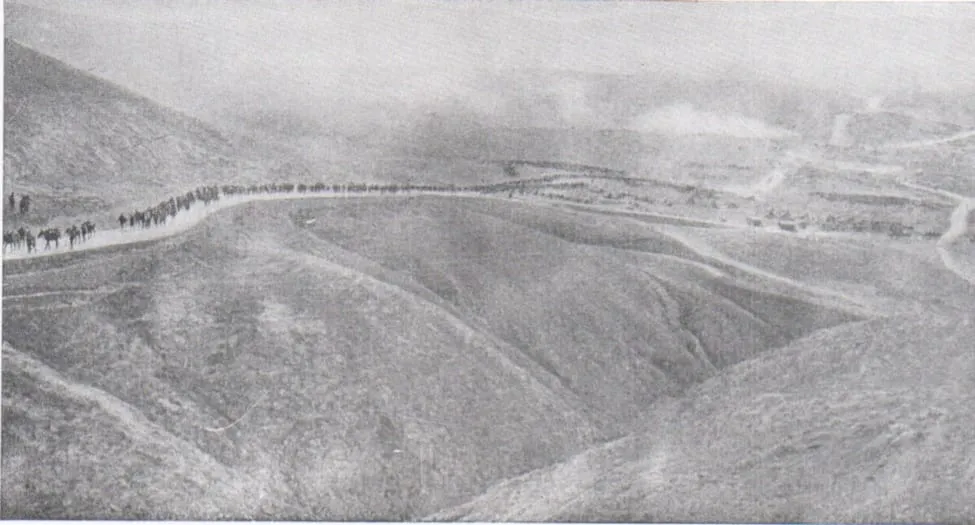
The first raid on Amman was the first expedition of British troops to the eastern bank of the Jordan. General Edmund Allenby sent across the river the force of Major-General John Shea, made up of the London 60th Division, the Anzac Mounted Division and the Imperial Camel Corps Brigade. It was to climb onto the Transjordan plateau, take the town of Es Salt and destroy, near Amman, the viaduct and tunnel of the Hejaz Railway, the only line supplying the Turkish garrisons in the south, as far as Medina. In the night of 21–22 March 1918, a few hours before the great German offensive began in France, London swimmers dragged ropes across the swollen river. The expedition began well, but the delayed crossing, torrential rain and mud gave the Turks time to bring up reinforcements. After four days of fighting at Amman the British had to withdraw. It was the first defeat of British troops in Palestine since the Second Battle of Gaza in April 1917.
Name and dates
The British official history (Cyril Falls, Military Operations: Egypt and Palestine, vol. II), on which the account below is based, calls the operation the raid on Amman or the first raid across the Jordan, and counts it from the concentration of the troops on 21 March to the return across the river on 2 April 1918. According to some studies the British Battles Nomenclature Committee named the whole the “First Attack on Amman”, and within it are distinguished the crossing of the Jordan (21–23 March), the first action of Es Salt (24–25 March) and the actual fighting for Amman (27–30 March). The Turks call these events the First Battle of the Jordan. British, Australian and New Zealand accounts differ in details, for example on the times of the crossing and of the infantry’s entry into Es Salt. We note such discrepancies below.
Background
After the capture of Jericho in February 1918 the British stood on the Jordan. Since January Allenby had been thinking of a strike at the Hejaz Railway near Amman. He was supported by General Jan Smuts, sent to Egypt by the War Cabinet in February. Smuts believed that destroying a dozen or so kilometres of track would cut off the Turkish garrisons in the south and spur further tribes to rise. There were also the successes of the Arab allies. The forces of Emir Faisal, based at Aqaba, had taken Tafilah in the winter and threatened Ma’an, the most important station between Deraa and Medina. The Turks sent a strong detachment with a German battalion against them from Amman, which at the beginning of March drove the Arabs out of Tafilah. Allenby counted on this group not having time to return, and on the strike at Amman drawing it north and allowing Faisal to attack Ma’an. The British were also to make direct contact with the Arabs for the first time. Major T. E. Lawrence with horsemen of the Beni Sakhr tribe was to wait near Madaba and join the British after the capture of Es Salt. Before the raid, on 8–12 March, the British corps moved the front in Judea a few kilometres north, to widen the base for the raid.
East of the Jordan the ground rises at first gently, then very steeply, up to a limestone plateau higher than the mountains of Judea. From the ford at Ghoraniyeh an old road ran through a gorge at the foot of the mountains near Shunet Nimrin to Es Salt, and further through Suweile to Amman. It alone was fit for wheels. The other routes onto the plateau, from the Makhadet Hajlah ford through the village of Naur and from the foot of the mountains through the Circassian village of Ain es Sir, were tracks for horses and pack animals. Es Salt, a town on a hillside about 800 metres above sea level, had before the war about 10,000 inhabitants, half of them Christians. Amman, the biblical capital of the Ammonites and the Greek Philadelphia of the Decapolis, was then a small town among Roman ruins, inhabited mainly by Circassians settled there by the Turks. The railway station lay about three kilometres from the town. The weakest point of the line was the section south of the station, where the track ran over a ten-span viaduct and through a tunnel about 140 metres long.
Shea’s force, known as “Shea’s Force”, comprised the 60th Division, Major-General Edward Chaytor’s Anzac Mounted Division, the Imperial Camel Corps Brigade, a heavy battery, a mountain artillery brigade, light armoured cars and pontoon units. Supplies were to go by rail to Jerusalem, by lorry to the Jordan, and from there on the backs of several thousand camels of the Egyptian Camel Transport Corps. British intelligence believed that Amman was defended by part of the Turkish 150th Regiment, and the roads to the Jordan by two battalions and irregular Circassian cavalry. It did not know that the German 703rd Battalion of the Asia Corps, very strong in machine guns, had already returned from the expedition to Tafilah. Since 1 March the Turks in Palestine had been commanded by General Otto Liman von Sanders, successor to Erich von Falkenhayn.
Course
Crossing of the Jordan (21–23 March)
The crossing was planned for the night of 19–20 March, but March was exceptionally wet, the river rose and the operation was postponed by two days. In the night of 21–22 March the 180th Brigade was to force the Jordan in two places at once, at Ghoraniyeh and at Makhadet Hajlah. At Ghoraniyeh all attempts failed: the current swept away boats and rafts, and the swimmers were carried downstream under the fire of Turkish outposts. At Hajlah nine picked swimmers from the 2/19th Battalion, London Regiment and a few Australian engineers swam the river with a rope and hauled the first raft across. By morning the whole battalion had crossed, and at 8.10 a.m. the engineers of the mounted division finished a pontoon bridge. During the day the whole 180th Brigade crossed at Hajlah, but the dense thickets along the bank and Turkish machine guns stopped it a few hundred metres from the river. An attack at midnight pushed the bridgehead out to about a kilometre. At Ghoraniyeh another attempt failed again.
On the morning of 23 March the New Zealand Auckland Mounted Rifles crossed at Hajlah and galloped north along the eastern bank, scattering one Turkish outpost after another. At noon it was at Ghoraniyeh, with 68 prisoners and four machine guns. The river had fallen somewhat, and the swimmers of the 2/24th Battalion at last managed to haul ropes across. By evening five bridges stood over the Jordan. The crossing cost little, but took a day longer than planned. Falls later judged that this loss of time seriously harmed the whole expedition.
Capture of Es Salt (24–26 March)
On 24 March the infantry set off along the road to Es Salt. Resistance was weak. On the hill of El Haud the Londoners took prisoner 36 soldiers of the German 703rd Battalion, and near the hill of Tell el Mistah they captured three guns. The mounted division split into three columns. Chaytor’s headquarters with the 2nd Light Horse Brigade and the Camel Brigade went towards Amman by the track through Naur, the New Zealand Mounted Rifles Brigade by the track through Ain es Sir, and the Australian 1st Light Horse Brigade covered the left flank in the Jordan Valley. The track through Naur proved impassable for wagons, and ammunition and explosives had to be reloaded onto camels. On 25 March sleet fell all day. The camels slipped on the stones and broke their legs, and several Egyptian drivers died of exposure. The infantry covered only 13–15 kilometres on the sodden road. In the evening, meeting no resistance, a squadron of the Australian 3rd Light Horse Regiment rode into Es Salt, and a few hours later the 179th Brigade entered it. The inhabitants, especially the Christians, greeted the British joyfully.
On 26 March the mounted columns assembled on the plateau near Ain es Sir. Australians of the 5th Light Horse Regiment broke up a Turkish column on the road from Es Salt to Amman and captured a dozen or so lorries, which however got stuck in the mud. Men and horses were exhausted after three night marches, and the camels could go no further, so Chaytor postponed the attack on Amman until the next morning. During the night a New Zealand patrol blew up the track a dozen or so kilometres south of Amman.
Fighting for Amman (27–30 March)
On the morning of 27 March Chaytor’s division approached Amman and attacked at once: the New Zealanders from the south against the dominating Hill 3039, the Camel Brigade from the west, and the 2nd Light Horse Brigade from the north-west. The only artillery was the Hong Kong and Singapore mountain battery. The Turks and Germans had placed machine guns at various heights on the hills around the town and on the citadel, and stopped the attack along the whole line. The engineers blew up the track south and north of the town, but the viaduct remained untouched, and the Turks quickly patched up the damage. A column of two battalions of the 181st Brigade with three mountain batteries, sent from Es Salt, got stuck on the way near Suweile, where Christians from Fuheis were fighting the Circassians. The column’s commander first had to separate the combatants.
On 28 March at 1 p.m. Chaytor renewed the attack, now with infantry, although its commander advised striking after dark. The attack across open ground, with weak artillery support, again stalled a few hundred metres short of the Turkish trenches. Meanwhile reinforcements were pouring into Amman by rail from the north, and on 28 March the defence was taken over by the commander of the Turkish Fourth Army, Mehmed Djemal Pasha, known as Little Djemal to distinguish him from Ahmed Djemal. Liman von Sanders ordered all available units from along the railway and from Damascus to be sent to Amman, and instructed the Seventh Army to send across the Jordan the detachment of Esad Bey, about 1,800 men, which crossed the river by the bridge at Jisr ed Damieh and threatened British communications. On 29 March the Turks took the hills north of Es Salt, and German aircraft bombed the encampment at Shunet Nimrin. The Jordan rose again, and for a time only one bridge was in use.
In the night of 29–30 March, in pouring rain, Chaytor threw all his forces, reinforced by three more infantry battalions, into a last attack. The New Zealanders with the 4th Battalion of the Camel Brigade took Hill 3039 with the bayonet. The 2/22nd Battalion advanced much further, took 80 prisoners and repulsed a counter-attack, taking another 50. The citadel, however, held, and its machine guns stopped the rest of the attack. By day the Turks counter-attacked and regained the hill north of the town. A last attempt to take the citadel at 2 p.m. also failed. Shea, having asked Chaytor whether there was a chance of taking Amman by night and been told that it was slight, broke off the fight. At 5.45 p.m. General Philip Chetwode’s XX Corps ordered a withdrawal across the Jordan.
Withdrawal (31 March – 2 April)
The withdrawal took place during the night and over the following days, in cold and rain. The Turks followed the British cautiously and, as Liman wrote, “without cavalry they could follow them, but not pursue”. The hardest part was withdrawing the infantry of the 181st Brigade with the camel caravans and the wounded along the muddy track through Ain es Sir. On the morning of 1 April Circassians fired at close range from a mill on the last New Zealand squadron leaving the village. The roads from Es Salt were filled with refugees, mainly Christians, who feared revenge for their friendly welcome of the British. The wounded suffered greatly in litters strapped to camels, which slipped and fell on the steep tracks. By the evening of 2 April the whole force, apart from one brigade in the bridgehead, was back on the western bank of the Jordan.
Losses
According to the official history Shea’s force lost 1,348 men: 215 killed, 1,010 wounded and 123 missing. It was one of the rare cases in which the mounted troops lost more than the infantry: the mounted division and the Camel Brigade accounted for over half the losses. The Turks lost 986 prisoners, including 61 Germans, and four guns. Sources do not give their losses in killed and wounded precisely. Falls thought they were probably higher than the British, and some studies estimate them at about 1,700 men. According to Turkish reports, on 27 March the Amman garrison numbered 1,841 rifles, 34 machine guns and 8 guns, and with the Germans about 2,150 rifles, 70 machine guns and 10 guns. By 30 March about 2,000 reinforcements had reached it, and later still more.
Significance
The raid did not achieve its aim. The viaduct near Amman was not destroyed, and the Turks quickly repaired the damage to the track. Lawrence, on hearing of the abandonment of Es Salt, called off his part of the plan and turned back. Faisal’s Arab regular troops nevertheless attacked the railway around Ma’an in mid-April. For the Turks, after a series of defeats from Beersheba to Jericho, it was the first victory, which raised the morale of their troops and marked a good start to Liman’s command. Falls saw the causes of the defeat in the day’s delay in the crossing, the exceptionally wet weather, which made it impossible to bring field artillery up to Amman, and the stubborn defence, especially by the German battalion. The commander of that battalion, Captain (Hauptmann) Grassman, was nevertheless surprised that the British did not exploit their night success of 30 March, because in his view they could no longer have been stopped at that point.
The British kept the bridgehead at Ghoraniyeh, which repulsed a Turkish attack on 11 April, and on 30 April they set off on the second raid across the Jordan, against Shunet Nimrin and Es Salt, which ended in a similar withdrawal. According to many historians the two raids convinced the Turks that Allenby was preparing his main blow across the Jordan, which in September made it easier for him to surprise them on the coast, at the Battle of Megiddo. For the time being, however, the German offensive in France, launched on the same day as the raid, deprived Allenby of the possibility of larger operations. In the following weeks he had to give up many experienced British units to the Western Front, and their places were taken by divisions and regiments from India.
Spotted a mistake?Report an error