1918: Palestine, Syria and Persia
Capture of Jericho
- Dates:
- 19–21 February 1918
- Front:
- Middle East
- Location:
- The Judaean Desert east of Jerusalem, from Mukhmas, Ras et Tawil and El Muntar to Talat ed Dumm, Nebi Musa and the edge of the escarpment above the Jordan Valley, with Jericho and the northern shore of the Dead Sea (Ottoman Palestine, today the West Bank)On the battle map →
- Sides:
- United Kingdom, Australia and New ZealandEdmund Allenby, Philip Chetwode, John Shea, Edward ChaytorOttoman Empire and German EmpireErich von Falkenhayn, Fevzi Pasha, Ali Fuad Bey
- Result:
- British victory. The Turks withdrew across the Jordan, and the British took Jericho and secured the right flank of the front in Palestine. They took 144 prisoners and lost 510 men.
- Author:
- Łukasz Skowroń
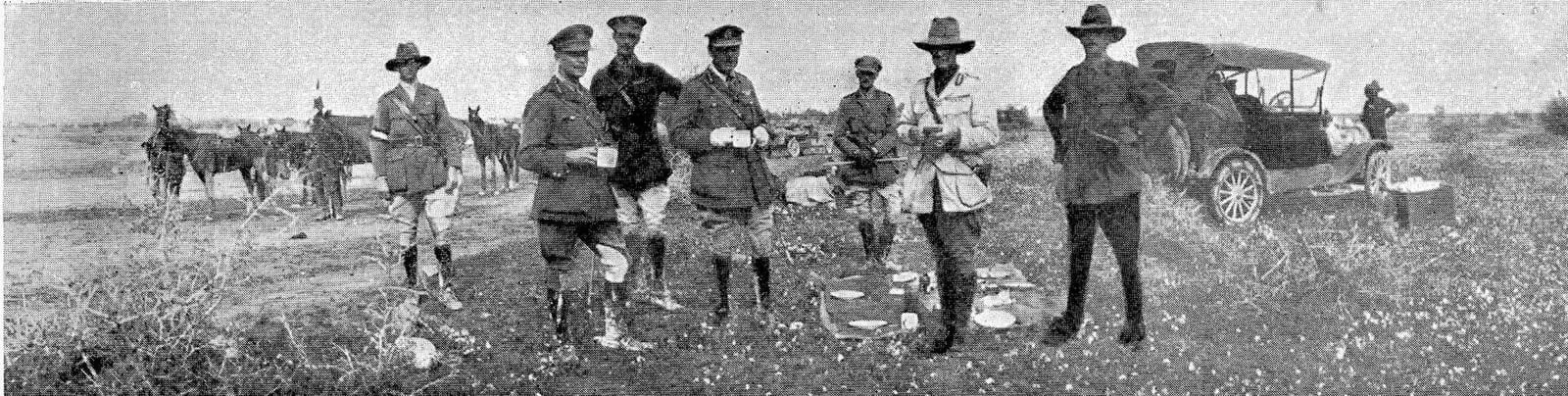
The capture of Jericho was a small, three-day operation which General Edmund Allenby carried out two months after the taking of Jerusalem. Its object was not the little town itself but the security of the right flank of the British front. Major-General John Shea’s 60th (London) Division crossed the wild, ravine-cut hills of the Judaean Desert as far as the edge of the escarpment falling towards the Jordan, and two brigades of Major-General Edward Chaytor’s Anzac Mounted Division came down on its right flank to the Dead Sea. The Turks, threatened with encirclement, gave up one hill after another and on 21 February 1918 withdrew across the Jordan. On the morning of that day Australian horsemen rode into Jericho. For the first time the British stood in the Jordan Valley, from which a month later they set out on the first raid to the east bank of the river.
Name and dates
The British Battles Nomenclature Committee named this operation “the Capture of Jericho” (The Capture of Jericho) and fixed its dates as 19 to 21 February 1918. The British official chronology of the war dates it the same way, recording the occupation of Jericho under 21 February with the note “19–21”. The British official history (Cyril Falls, Military Operations: Egypt and Palestine, vol. II), on which the account below is based, also mentions preliminary operations on 14 February, when the 60th Division took the village of Mukhmas (the biblical Michmash) and its neighbour, the 53rd (Welsh) Division, the village of Deir Dibwan. On 22 February the infantry drew its main line back to the hills halfway from Jerusalem, and the horsemen set off back to Bethlehem. Some details, for example the time at which Jebel Ekteif was taken, differ between the Australian and New Zealand accounts. Such discrepancies are noted below.
Background
After the defence of Jerusalem in the last days of December 1917 the front in Palestine came to a halt. The winter rains had washed out the roads, and the only railway line from Egypt advanced slowly. Allenby sent most of his cavalry to rest south of Gaza, because he could not feed it at the front. He did, however, intend to remove the threat to his right flank. His left flank rested on the Mediterranean, while his right hung in the air above the desert hills east of Jerusalem. On 25 January he wrote to the Chief of the Imperial General Staff, General William Robertson, that he wished to extend his right flank so as to take in Jericho and the northern end of the Dead Sea. Driving the Turks across the Jordan and seizing the crossings would also prevent Turkish raids on the western shore of the lake and provide a starting point for a blow at the Hejaz Railway on the other side of the river.
In London more was being considered. The military representatives at the Supreme War Council recommended in January that in 1918 the Allies should stand on the defensive in France, Italy and the Balkans and deal a decisive blow against Turkey. At the beginning of February the government sent General Jan Smuts, a member of the War Cabinet, to Egypt to discuss with Allenby and the Mesopotamian command how this was to be done. On 15 February Smuts telegraphed to London his recommendation that the Mesopotamian front should go over to the defensive and hand some of its troops to Palestine. The expedition to Jericho was a first, cautious step in that direction.
By the beginning of February the roads behind Lieutenant-General Sir Philip Chetwode’s XX Corps were good enough for an advance to be considered. On 9 February Chetwode sent the plan of the operation to General Headquarters. The 60th Division was to attack in three brigade columns, each with a heavy battery, a field artillery brigade and a field company of engineers: the right column against Jebel Ekteif (Jebel Ekteif) south of the main road to Jericho, the centre column against the hill of Talat ed Dumm on that road, and the left column along the “old road” east of Mukhmas. Finally the columns were to reach the edge of the escarpment above the Jordan Valley, but the infantry was not to descend into the valley itself. Chaytor’s mounted troops, that is, the 1st Light Horse Brigade (Australian) and the New Zealand Mounted Rifles Brigade, were to cover the infantry’s right flank, cut off the Turkish retreat from Jericho, drive the rest across the Jordan and seize the boats and stores at Rujm el Bahr, a small port on the northern shore of the Dead Sea. Both brigades came from near Jaffa and on 17–18 February reached Bethlehem.
The terrain was among the most difficult of the whole campaign. Between Jerusalem and the edge of the escarpment above the Jordan the ground falls by more than 600 metres in under 20 kilometres, and then the escarpment drops steeply into the valley, whose floor at the mouth of the Jordan in the Dead Sea lies nearly 400 metres below sea level. Ravines such as the famous Wadi el Kelt run from west to east and make movement from north to south practically impossible. Falls wrote that one hardly met people here, only flocks of sheep and goats with solitary shepherd boys, and that before the war tourists travelling to Jericho had often been attacked by robbers. Tradition placed the inn of the parable of the Good Samaritan at the khan below the hill of Talat ed Dumm.
The Turkish positions belonged to Colonel Ali Fuad Bey’s XX Corps of Fevzi Pasha’s Seventh Army, part of General Erich von Falkenhayn’s “Yıldırım” Army Group. According to the American historian Edward Erickson they were held by about 3,000–5,000 soldiers of the 26th and 53rd Infantry Divisions. Allenby at first estimated the enemy’s strength at 5,000 rifles, but prisoners and a monk who came over to the British spoke of about 3,000. The Turks held a chain of hills from near the Dead Sea through Talat ed Dumm to the Wadi Fara ravine, with the strongest position astride the road to Jericho.
Course of the operation
19 February
The infantry moved off before dawn. On the right went the 179th Brigade with the attached New Zealand Wellington Mounted Rifles regiment, in the centre the 180th Brigade, on the left the 181st Brigade. The first line of hills was held only by Turkish rearguards and most objectives were taken easily. The only heavy fighting took place on the left, on “Splash Hill” north of Ras et Tawil, which was defended by about 300 Turks. The 2/23rd Battalion of the London Regiment lost about 50 men before it took the hill with 25 prisoners and two machine guns. Soon afterwards the Turks gave up Ras et Tawil. The division also pushed its centre forward to shorten the next day’s march. The 2/20th Battalion had to attack along a narrow ridge above the Wadi Fara and lost 66 men. On the left the 53rd Division, after heavy fighting, took the village of Rammun and the hills south of it, covering its neighbours from the north.
The New Zealanders of the Wellington regiment led their horses in single file through the gorge by the Greek monastery of Mar Saba and came out on the El Buqei’a plateau, where they ran into Turkish trenches barring the road to Jericho south of Nebi Musa, a place regarded by Muslims as the tomb of Moses. The rest of Chaytor’s division was meanwhile coming down from Bethlehem to below the hill of El Muntar. Generals Chetwode and Harry Chauvel, commander of the Desert Mounted Corps, watched the start of the attack from the Mount of Olives.
20 February
On the second day all three infantry columns faced a long and difficult march. The 2/13th Battalion of the right column came up against a sheer drop of more than six metres in a ravine. Its commander tried to lower the men on ropes made of puttees, but this was hopelessly slow, so he sent the companies over the ridges into the neighbouring ravines. Even so the battalion was late for the attack on Jebel Ekteif and was replaced by two companies of the 2/16th. The Turkish forward trench fell at 8.15 a.m., and the summit, according to Falls, at 11.25 a.m. The New Zealand historian C. Guy Powles wrote that the British reached the mountain at about 10 a.m., but a Turkish counter-attack drove them off and they finally took it only at about 12.30 p.m., with the help of the heavy artillery. In the centre the 180th Brigade had the Jerusalem–Jericho road at its disposal and, after an hour’s bombardment, including from heavy guns, took Talat ed Dumm. On the left the 181st Brigade advanced slowly, because skilfully manoeuvring Turkish rearguards defended every ridge. By evening it had covered only about four kilometres and stopped halfway to Jebel Kuruntul, which tradition regards as the Mount of Temptation of the Gospels.
Chaytor’s mounted troops set out from near El Muntar at 3.30 a.m. The column had to descend in single file along a narrow path and stretched out over more than ten kilometres, while the Turks watched its descent from the heights. The New Zealanders attacked on foot the Turkish positions on the hills along the road from Mar Saba to Jericho. Resistance was strong at first, but when the infantry took Jebel Ekteif the Turks began to fall back, and after 2 p.m. both hills were in New Zealand hands. The Turks, however, held Nebi Musa firmly, with artillery, and Chaytor postponed the attack until morning. Meanwhile a patrol reported to him that the path down the ravine near Qumran to the Dead Sea was unguarded. At dusk the 1st Light Horse Brigade began to descend a goat track which fell about 400 metres over three kilometres, in order to strike Nebi Musa from the rear. Before midnight it was at the bottom. The photographer Frank Hurley, who rode with the brigade, wrote that he would not have dared to ride down that path by day, yet the whole brigade went down it by night without an accident.
21 February
In the morning it turned out that the Turks had withdrawn along the whole front, probably in part because the Australian brigade threatened their rear. The New Zealand Canterbury regiment occupied the abandoned Nebi Musa at dawn. The infantry reached the edge of the escarpment above the Jordan Valley, from Nebi Musa to Jebel Kuruntul. The 1st Light Horse Brigade rode straight for Jericho but failed to cut off the retreating Turks. At about 8 a.m. a troop of the Australian 3rd Light Horse Regiment rode into the town. The garrison had already left and had left no stores behind. A squadron of the Wellington regiment reached Rujm el Bahr on the Dead Sea, but the Turks had managed to remove the grain from there and had sunk the boats or taken them up the Jordan.
On the west bank of the Jordan, between the Dead Sea and the Wadi el Auja stream, the Turks held only a strong bridgehead at Ghoraniye, by the bridge on the road from Jerusalem through Jericho to Es Salt, and a smaller detachment at the Makhadet Hajla ford, the traditional site of the baptism of Christ. Their camps could be seen on the east bank. A Turkish gun from across the river shelled the area around Jericho from a range of more than nine kilometres, beyond the reach of the British guns. One of its shells hit the front of Chaytor’s car, and he escaped unhurt by a miracle.
Losses
According to the official history Chetwode’s force lost 510 men during the operation: 27 officers (5 killed and 22 wounded) and 483 other ranks, most of them wounded and four missing. The British took 144 prisoners and eight machine guns. British sources do not give Turkish losses in killed and wounded. The participants agreed that it was the most difficult terrain they had yet attacked across. What helped was command of the air. Airmen of the Royal Flying Corps and of the Australian No. 1 Squadron chased off Turkish aircraft, bombed the enemy’s positions and reported every withdrawal as it happened. Because relatively few troops took part in the attack, supply from the depot at Bethany (today al-Eizariya) by camel convoys caused less trouble than in earlier operations. There was enough water at Nebi Musa and in the valley.
Significance
On 22 February the 60th Division drew its main line back to the hills of Ekteif, Talat ed Dumm and Ras et Tawil, leaving outposts on the escarpment above the valley. The mounted troops returned to the coast, and only the New Zealand Auckland Mounted Rifles regiment, with machine guns and a battery of artillery, remained in the valley under General Shea’s orders. On 25 February its patrols found that the Turks had removed men, guns and the pontoon bridge from the west bank. On the east bank the Seventh Army quickly dug in at Shunet Nimrin, at the foot of the mountains of Moab. At the beginning of March the airmen made a further attempt to capture Turkish boats seen on the shore of the Dead Sea: they brought a seaplane by lorry, and when it was damaged they made two boats out of its floats. The current, however, carried them several kilometres from their objective and the expedition achieved nothing.
The operation achieved its aim. Allenby’s right flank was secure, and the Jordan became the front line. The strip that had been won was, however, too narrow for larger operations across the river to be mounted from it. That is why in March the British extended their gains to the north, and on 21 March, the day the great German offensive began in France, they set out on the first raid across the Jordan, against Amman and the Hejaz Railway, which ended in a withdrawal. Some historians consider that the capture of Jericho shielded Jerusalem from the east, but did not give Allenby a good base for blows against the east bank. On 1 March there was a change in the Turkish command: Falkenhayn, whom Enver Pasha had ceased to trust, was replaced by General Otto Liman von Sanders. The Jordan Valley, green and pleasant in February, turned with the coming of summer into a stifling hell in which the British troops had to spend the following months.
Spotted a mistake?Report an error