1917: Baghdad and Gaza
Second Battle of Gaza
- Dates:
- 17–19 April 1917
- Front:
- Middle East
- Location:
- Gaza and its approaches, from the dunes on the Mediterranean through the Es Sire, Mansura and Sheikh Abbas ridges to the defences along the Beersheba road (Khirbet Sihan, Atawineh, Hareira), in southern Ottoman Palestine (today the Gaza Strip and southern Israel)On the battle map →
- Sides:
- United Kingdom, Australia and New ZealandArchibald Murray, Charles Dobell, Philip ChetwodeOttoman Empire, Germany and Austria-HungaryDjemal Pasha, Friedrich Kress von Kressenstein
- Result:
- Ottoman victory. The British took only the approaches and Samson Ridge, losing 6,444 men. The Turks lost about 2,000. The front stood still for half a year.
- Author:
- Łukasz Skowroń
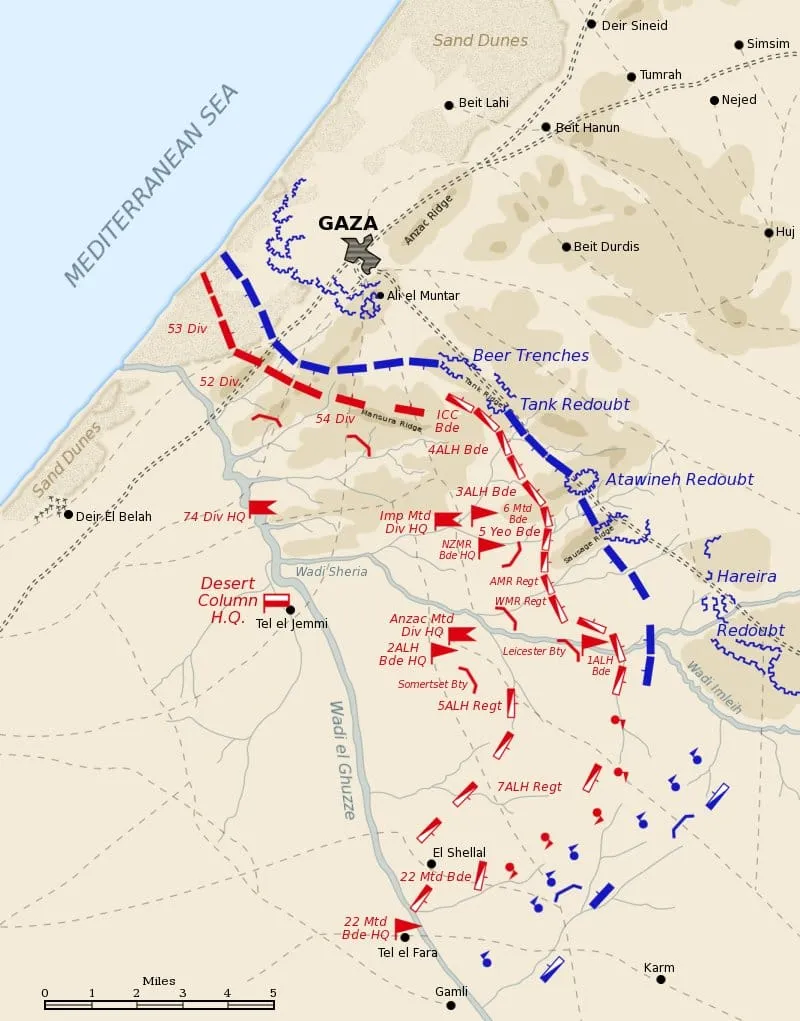
The Second Battle of Gaza was the largest battle fought on the Palestine front up to that time and one of the heaviest British defeats of the campaign. Three weeks after the failed attack in March, the Eastern Force of Lieutenant-General Sir Charles Dobell attacked Gaza a second time. This time it was not a swift mounted raid but a carefully prepared frontal assault by three infantry divisions, supported by naval gunfire, eight tanks and gas shells, which had never before been used on this front. On 17 April the British occupied the approaches to the town without much resistance. On 19 April they launched the main attack and spent the whole day assaulting Turkish redoubts on bare, open slopes. By evening they held none of the key positions and had lost more than 6,000 men. The Turks, who in three weeks had turned Gaza into a fortress, lost about 2,000.
Name and dates
The British official history (George MacMunn and Cyril Falls, Military Operations: Egypt and Palestine, vol. I) calls the action the Second Battle of Gaza. The Australian official historian Henry Gullett writes of the Second Gaza Engagement. The battle had two phases. On 17 April the infantry occupied a start line from Sheikh Abbas through Mansura to the Es Sire Ridge, 18 April was spent in bombardment and preparation, and on 19 April the main attack went in. In the night of 19–20 April Dobell cancelled the renewal of the attack announced for the morning, and on 20 April his troops were only digging in. We take 19 April, the last day of the attack, as the end of the battle. The official history gives the losses of both sides for the period 17–20 April.
Background
Murray reported the first battle to London in such a way that it looked like a success. The War Cabinet therefore demanded that he defeat the Turks south of Jerusalem and take the city. The situation at Gaza, however, was now quite different. In March Gaza had been an advanced post with a strong garrison. Now it had become the strongest point of a fortified line that ran from the sea through the town and on along the road to Beersheba as far as Hareira, a length of about 20 kilometres. Under the direction of German officers the Turks did not build a continuous front but a chain of redoubts and trenches, sited so that every approach was under the fire of at least one of them. British airmen reported new trenches and camps almost daily. The Bavarian colonel Friedrich Kress von Kressenstein, who commanded this sector on behalf of Djemal Pasha, commander of the Ottoman Fourth Army, received reinforcements: two regiments of the 53rd Division, which had not fought in March, four batteries and cavalry. The 3rd Division stood in the town itself, the 53rd Division and part of the 16th Division east of it, at Khirbet Sihan and Khirbet el Bir, and the rest of the 16th Division at Hareira and Tel el Sheria. According to the Turkish General Staff the front was held by 18,185 rifles, 86 machine guns and 101 guns, of which 68 fired in the battle. On the flank stood the 3rd Cavalry Division, on whose staff served the Venezuelan volunteer Rafael de Nogales.
Murray and Dobell knew that it would be better to outflank the Turkish line from the east, through Beersheba, which was defended by only two battalions. But there was no water in that country for a large army, so a frontal attack on Gaza itself was all that remained. On 5 April the railway reached Deir el Belah, where Eastern Force set up its headquarters, and water was pumped from there by pipeline to reservoirs on the Wadi Ghuzzee. The British had a clear numerical advantage: Gullett puts it at at least two to one. The 52nd, 53rd and 54th Divisions were joined by the 74th Division, made up of dismounted yeomanry regiments, and both mounted divisions of Lieutenant-General Sir Philip Chetwode’s Desert Column had their missing brigades restored. Artillery, on the other hand, was short. Eastern Force had twelve 60-pounders and one siege battery with two 8-inch and two 6-inch howitzers, and only a few hundred rounds of ammunition per gun.
Murray and Dobell therefore placed their hopes in two new weapons. The first was eight tanks of the early Mark I type, which had previously been used for training in England and had arrived in Egypt in January. It turned out that they ran well on sand as long as their tracks were not greased. Apart from France and Belgium, this was the only theatre of the war in which the British used tanks. The second was gas shells for the 4.5-inch howitzers: 4,000 according to the official history, 2,000 according to Gullett. It was the first chemical weapon used in the Palestine campaign. Gullett writes that Murray and Dobell hesitated for a long time over whether to use it and decided only in mid-April. The attack was also to be supported by warships: the French coastal defence battleship Requin, which in 1915 had defended the Suez Canal, and two British monitors, M21 and M31.
Plan
Dobell presented his plan on 3 April, and Murray left him a free hand in the details. The attack was to go in two stages. First the infantry, without fighting for the town itself, was to occupy a line from Sheikh Abbas through Mansura to Kurd Hill on the Es Sire Ridge, a few kilometres beyond the Wadi Ghuzzee, and dig in there, while the artillery moved up closer. After at least one day’s pause the second stage would follow: a two-hour bombardment from land and sea, then the assault. Major-General W. E. B. Smith’s 52nd Division was to take the Ali Muntar group of defences, Major-General S. W. Hare’s 54th Division was to attack the redoubts between Khirbet el Bir and Khirbet Sihan and then wheel to the north-east of the town, and the 53rd Division, led after the sick General Dallas stood down by Brigadier-General S. F. Mott, was to take the dunes between Gaza and the sea. The two eastern divisions formed “Eastern Attack” under Smith’s command. The mounted troops were to pin the Turks at Atawineh and Hareira so that they could not support Gaza, and, if the infantry broke through, to pass through the gap. The 74th Division stayed in reserve.
Some commanders did not believe in the plan. According to Gullett neither Chetwode nor Major-General Harry Chauvel, commanding the Anzac Mounted Division, liked it, and one British commander, having explained it to his brigadiers, added: “That is the plan, gentlemen, and I will tell you frankly that I do not think much of it.” Some commanders proposed a deep thrust along the coast, but Dobell rejected the idea because it gave no scope for the mounted troops.
Course of the battle
17 April. On the evening of 16 April the infantry moved down to the crossings over the Wadi Ghuzzee, and at dawn it advanced. The 52nd and 54th Divisions occupied the line Sheikh Abbas – Mansura – Kurd Hill by seven in the morning. It was held only by Turkish outposts. One of the two tanks advancing with the 54th Division along the Sheikh Abbas ridge was hit three times and put out of action. The two tanks allotted to the 52nd Division were not needed. The infantry at once began to dig in under fire from Turkish artillery around Ali Muntar. The official history estimates the day’s losses at about 300 men; Gullett gives fewer. The 53rd Division crossed the wadi near the coast and pushed the outposts back into the dunes. The Desert Column’s mounted troops reconnoitred towards Hareira: a patrol of the Worcestershire Yeomanry cut the telegraph line by the Beersheba road, but the Turks did not leave their trenches. In the evening the mounted troops returned behind the wadi.
18 April. The land artillery and the warships shelled the Turkish positions, while ammunition and water were carried across the wadi: 8,000 full tin containers, about 450,000 litres, were stacked behind the line at Mansura. Dobell was still considering whether to mask Gaza itself with one division and strike to the north-east, but Turkish passivity on the flank persuaded him to return to the original plan. Chetwode believed that his dismounted brigades could not break the Turkish flank on their own, and asked for part of the 74th Division for the attack on Atawineh. Dobell refused and kept it in reserve. He did, however, attach the Imperial Camel Corps Brigade to the 54th Division to widen its front. There was no surprise: after the approaches had been taken, the Turks knew that the main attack was still to come and had two days to prepare for it.
19 April, morning. The bombardment began at 5.30 a.m. Requin fired at Ali Muntar, the monitors at other defences, the heavy artillery at batteries and redoubts, while for the first 40 minutes the field howitzers fired gas shells at the Turkish artillery positions and the wooded ground west of Ali Muntar. There were too few guns, however, to cover the whole front, and their fire silenced neither the Turkish batteries nor the machine guns. The mounted troops moved off as early as 6.30 a.m. At 7.15 a.m. the 53rd Division went into the attack, and at 7.30 a.m. the 52nd and 54th Divisions and the Camel Brigade.
The 52nd Division and Outpost Hill. The Scottish 155th Brigade advanced along the narrow Es Sire Ridge, the only way between deep ravines. One of the tanks fell nose first into a ravine and was stuck there all day; the other took its place, and at 8.15 a.m. the infantry took Lee’s Hill. Further on, on Outpost Hill, the Scots were halted by fire from the front and from the left flank. At about ten the tank drove onto the Turkish redoubt on the summit, and the 5th Battalion, King’s Own Scottish Borderers, broke in behind it. The tank, hit by three shells, burnt out, and an hour later the Turks retook the hill. At noon Major W. T. Forrest led two companies of the 4th Battalion of the same regiment and retook the redoubt in hand-to-hand fighting. He himself was mortally wounded on the parapet. The Scots held Outpost Hill all afternoon, without communication with the rear, and left it only at 6.20 p.m., when 70 men of the force remained and all the senior officers had been killed or wounded. The neighbouring 156th Brigade lay for five hours in the open under fire from Green Hill. The official history believes that had Middlesex Hill, Green Hill and Ali Muntar been shelled really heavily, the 52nd Division might have taken them. But the ammunition ran out.
The 54th Division and Tank Redoubt. The hardest fighting fell to the 54th (East Anglian) Division, which advanced over completely open ground, through barley and poppies. Its 163rd Brigade, led by a tank, attacked a redoubt about one and a half kilometres north-west of Khirbet Sihan, later named Tank Redoubt. At about nine the tank drove into the redoubt, followed by men of the 5th Battalion, Norfolk Regiment, and Australian soldiers of the 1st Battalion, Imperial Camel Corps Brigade. According to Gullett there were about 600 Turks in the redoubt, who fled in panic to the main line. The Turkish artillery, however, concentrated its fire on the redoubt, the tank went up in flames, and after two hours the handful of defenders had been killed, wounded or taken prisoner. The 4th Battalion, Norfolk Regiment, was stopped 500 metres from its objective, losing two-thirds of its men. The three battalions of the 163rd Brigade lost 1,500 men, including two commanding officers and all twelve company commanders. In the 162nd Brigade the furthest advance was made by the 10th Battalion, London Regiment, which crossed the Beersheba road at 8.30 a.m. There Sapper Sore climbed a pole to cut the telegraph line. He cut one wire and fell, shot, but climbed the pole again, cut the second and was reaching for the third when he was blown apart by a mountain-gun shell. The isolated battalion eventually had to fall back before a counter-attack by two Turkish battalions. On the right flank the 3rd Battalion of the Camel Brigade crossed the road and took two hillocks, named Jack and Jill. This was the furthest point the British reached that day, but they had to withdraw from there too.
The 53rd Division by the sea. The Welsh division advanced slowly under machine-gun fire from the wooded ground. Only after 1 p.m. did it take with the bayonet the great dune called Samson Ridge, capturing 39 prisoners, while its left brigade took Sheikh Ajlin on the seashore. The division went no further, because the 52nd Division had not taken the hills from which the Turks were firing on its flank. The official history notes that the Welsh were still feeling the losses and fatigue of the March battle.
The mounted troops at Atawineh. Major-General Henry Hodgson’s Imperial Mounted Division attacked the defences at Atawineh and Sausage Ridge on foot, while the Anzac Mounted Division covered it from Hareira. The regiments of the Australian Light Horse advanced over long, even slopes without any cover. The 4th Brigade had only about 500 men on a front of a kilometre. Its staff officer recalled that everything was going well “when suddenly the whole thing melted away, simply dissolved under casualties”. The line stopped half a mile short of the Atawineh redoubt. At two in the afternoon the Turks counter-attacked along the whole divisional front and drove back the 3rd and 4th Light Horse Brigades. The gap was closed by the 6th Mounted Brigade, which arrived at the gallop at the last moment. On the extreme right flank, south of the Wadi Imleih, Nogales led Turkish cavalry and Bedouin against the Australian 2nd Light Horse Brigade, which fell back but finally stopped them with machine-gun fire.
Afternoon and evening. At 1 p.m. the commander of the 54th Division committed his reserve 161st Brigade, but at 3 p.m. he ordered the whole line to halt, fearing for his right flank. Smith still wanted to bring the reserve 157th Brigade into action, but it could not move until four o’clock and he judged it pointless. At 4.40 p.m. Eastern Force ordered the attack to be broken off and the troops to dig in on the positions taken. Murray, who followed the battle from a railway carriage at Khan Yunis, had ordered at 4 p.m. that the ground gained be held at all costs, so that the attack on Ali Muntar could be renewed at dawn on 20 April. In the evening, however, Dobell heard his divisional commanders, learnt that the losses had reached 6,000 and that ammunition was short, and in the night asked Murray to cancel the attack. Chetwode and all the divisional commanders shared his view. Murray reluctantly agreed. The 54th Division withdrew to Sheikh Abbas, while the 53rd Division held Samson Ridge, almost the only gain of the day.
Losses
According to the official history the British lost 6,444 men from 17 to 20 April: 509 killed, 4,359 wounded and 1,576 missing. Most of the missing died in front of the Turkish trenches, and the Turks reported taking 272 prisoners, two-thirds of them wounded. The 54th Division lost 2,870 men, of whom the 163rd Brigade alone lost 1,828, the 52nd Division 1,874, the 53rd Division 584 and the Imperial Mounted Division 547. Dobell gave 5,900 men in his report, Murray “about 7,000” in his dispatch. More than 2,000 horses and camels were killed or wounded. The British took about 200 prisoners. According to the Turkish historical staff the Ottoman side lost 2,013 men: 402 killed, 1,364 wounded and 247 missing. Other tallies give slightly fewer or slightly more, from about 1,900 to 2,200.
Significance
The official history calls the Second Battle of Gaza a persistent attack on imperfectly reconnoitred trenches, under the fire of concealed artillery and without adequate support from its own guns. The battle showed how well Turkish infantry defended prepared positions, and the superiority of a defence based on redoubts with reserves for counter-attacks over a continuous line of trenches. The new weapons failed. The tanks were scattered singly along the front, so they drew on themselves, and on the infantry following them, the fire of every battery in the vicinity. Several burnt out or got stuck. The gas bombardment did not silence the Turkish artillery, although the Turkish General Staff admitted that it had some effect.
Dobell did not keep his post. On 21 April Murray, citing his state of health after sunstroke, sent him back to England and gave Eastern Force to Chetwode. The Desert Column was taken over by Chauvel, the first Australian to hold the rank of lieutenant-general, and the Anzac Mounted Division by the New Zealand general Edward Chaytor. The War Cabinet cancelled the order to march on Jerusalem, but did not give up on Palestine. In Whitehall it was reportedly said that Gaza was beginning to look like “a second Gallipoli”. Instead of abandoning the campaign, London decided to give it a new commander and far more troops. In June Murray was replaced by General Edmund Allenby.
The Turks came out of the battle strengthened. No one spoke any more of a withdrawal to the Jaffa – Jerusalem line. Within a few weeks Kress received two new divisions, the 7th and 54th, and extended the defences as far as Beersheba. Both sides dug in from the sea to Sheikh Abbas, and the front stood still for half a year, in the heat and dust of the desert summer. It was decided only by the outflanking move that Murray and Dobell had been unable to carry out for lack of water: at the turn of October and November 1917 Allenby took Beersheba, and a few days later the Turks abandoned Gaza.
Spotted a mistake?Report an error