1917: Baghdad and Gaza
Third Battle of Gaza
- Dates:
- 27 October – 7 November 1917
- Front:
- Middle East
- Location:
- The Ottoman defensive line from the Mediterranean coast at Gaza through Atawineh, Abu Hureira and Tel esh Sheria to Beersheba, together with the hills north of Beersheba (Tel el Khuweilfe), in southern Ottoman Palestine (today the Gaza Strip and southern Israel)On the battle map →
- Sides:
- United Kingdom, Australia, New Zealand and British IndiaEdmund Allenby, Philip Chetwode, Edward Bulfin, Harry ChauvelOttoman Empire, Germany and Austria-HungaryErich von Falkenhayn, Friedrich Kress von Kressenstein, Fevzi Pasha, Refet Bey, İsmet Bey
- Result:
- British victory. Allenby took Beersheba and broke the left wing of the Turkish line, and on the night of 6/7 November the Turks abandoned Gaza and fell back northwards.
- Author:
- Łukasz Skowroń
The Third Battle of Gaza decided the fate of southern Palestine. After two failed assaults in the spring of 1917, the front had stood for six months on the Gaza–Beersheba line. General Sir Edmund Allenby, commander of the Egyptian Expeditionary Force since June, did not strike this time at the strongest point of the Turkish defences. For several days he shelled Gaza from land and sea to confirm the enemy’s belief that the town was his objective, while moving most of his army to the other, desert flank. On 31 October he took Beersheba together with its wells, on 1 and 2 November he attacked the western defences of Gaza, and on 6 November he broke the Turkish line at Tel esh Sheria. On the night of 6/7 November the Turks abandoned Gaza, and the next morning the British entered the empty, ruined town. The road to Jerusalem lay open.
Name and dates
The British Battles Nomenclature Committee defined the Third Battle of Gaza as lasting from 27 October to 7 November 1917 and including the capture of Beersheba (31 October) and the capture of the Sheria position (6 November). The British official history (Cyril Falls, Military Operations: Egypt and Palestine, vol. II) describes it in the same way. On 27 October the British artillery began shelling Gaza, and on 7 November the British occupied the abandoned town and set off in pursuit. Some works, especially in English, apply the name Third Battle of Gaza only to the attack on the western defences of the town on the night of 1/2 November, and call the whole operation from Beersheba to the pursuit the Southern Palestine Offensive. Following the official history, we adopt the broader definition.
Background
After the Second Battle of Gaza London decided not to abandon the campaign but to give it a new commander and more troops. Allenby based his plan on an appreciation of the situation prepared before his arrival by the commander of Eastern Force, Lieutenant-General Sir Philip Chetwode, and his chief of staff, Brigadier-General Guy Dawnay. It concluded that Gaza could not be taken by storm without enormous losses and that the Turkish line had a weak left flank. Beersheba was in effect an isolated stronghold, a dozen or more kilometres from the main line and linked to it only by a few small works. Whoever took it together with its wells could strike the Turkish line from the flank. The problem was water: there was almost none in the desert between the Wadi Ghuzzee and Beersheba, and tens of thousands of men and horses could not fight for more than a day or two without drinking. All summer, therefore, railways, pipelines and reservoirs were built, and engineers dug out the wells at Khalasa and Asluj, far to the south of the front, which the Turks had filled in.
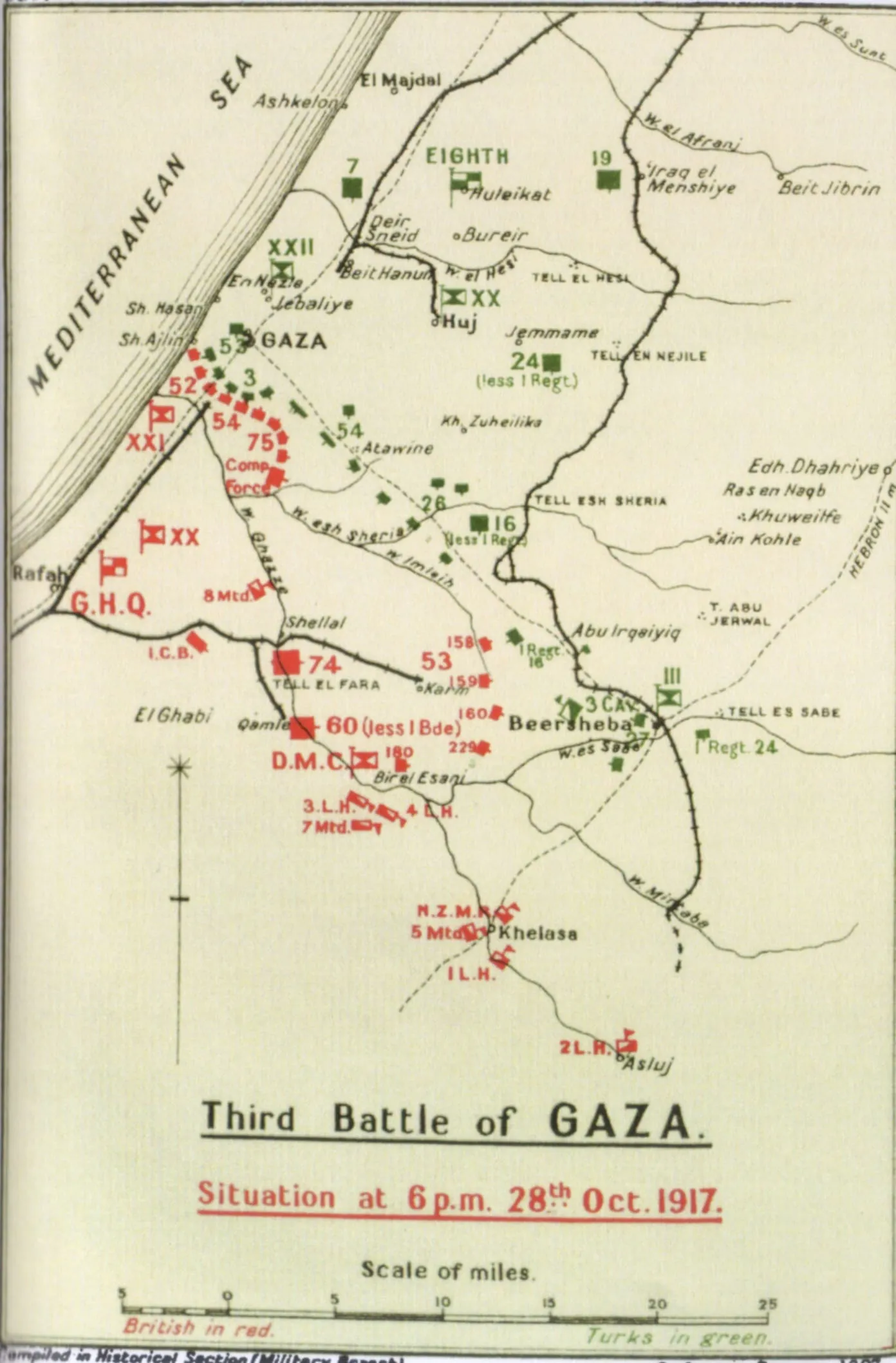
On 12 August Allenby divided his forces into three corps. Chetwode’s XX Corps (10th, 53rd, 60th and 74th Divisions) and the Desert Mounted Corps of Lieutenant-General Sir Harry Chauvel (the Anzac Mounted Division, the Australian Mounted Division, the Yeomanry Mounted Division and the Imperial Camel Corps Brigade) were to strike at Beersheba. The XXI Corps of Lieutenant-General Edward Bulfin (52nd, 54th and 75th Divisions) faced Gaza. According to the official history, the Egyptian Expeditionary Force had 80,000 infantry rifles and 15,000 sabres on paper, and in reality about 60,000 and 12,000 in the ranks. The British had roughly a twofold superiority in infantry, an eightfold one in cavalry and a one-and-a-half-fold one in artillery.
Much had changed on the other side as well. In the summer the Turks and Germans intended to retake Baghdad with the forces of a new army group, “Yıldırım”, under General Erich von Falkenhayn, but in the autumn they abandoned the plan and its forces were sent to Palestine. The front from the sea to Beersheba was held by the Eighth Army of the Bavarian General Friedrich Kress von Kressenstein, with its headquarters at Huleikat, north of Huj. Gaza was defended by Refet Bey’s XXII Corps (3rd and 53rd Divisions), the centre by Ali Fuad Bey’s XX Corps (54th, 26th and 16th Divisions), and Beersheba by the III Corps of İsmet Bey, later president of Turkey as İsmet İnönü, with the largely Arab 27th Division and the 3rd Cavalry Division. The 7th and 24th Divisions stood in reserve, and the 19th Division was the reserve of the whole “Yıldırım” group. According to the official history, based on Turkish figures, the Turks had about 33,000 rifles, 1,400 sabres and 260 guns. The headquarters of the new Seventh Army under Fevzi Pasha had just arrived in Hebron and was to take over the Beersheba sector at midnight on 31 October, while Falkenhayn himself was still in Aleppo. In practice, for the first days of the battle Kress commanded the whole front.
Plan and ruse
Allenby issued his orders for the attack on 22 October. Four days before the attack on Beersheba, XXI Corps was to begin a methodical bombardment of Gaza, with strong support from warships. XX Corps and the Desert Mounted Corps were to take Beersheba in a single day: the infantry from the west and south-west, the cavalry from the east and north-east, so that the Turks would not have time to destroy the wells. Both corps were then to wheel north-west and roll up the left wing of the Turkish line at Tel esh Sheria and Abu Hureira, while the cavalry got round to the Turkish rear. The attack of XXI Corps on Gaza was to come between the capture of Beersheba and the blow at Tel esh Sheria, in order to pin down the Turkish reserves.
The Turks had to be convinced that the main blow would fall on Gaza. The British first tried to feign a landing in northern Syria: on Cyprus camps were marked out and false telegrams sent. The official history considers that this ruse failed. A second, much simpler one had, in its view, an effect hard to equal in the history of modern war. On 10 October an officer of Allenby’s staff rode out into no man’s land near El Girheir, as if on reconnaissance. Fired on by a Turkish cavalry patrol, he pretended to be wounded and in his flight dropped his field glasses and a haversack of documents stained with fresh blood from his horse. Among them were a false agenda for a staff conference, from which it followed that the main attack would go in against Gaza, with a landing on the coast north of the town, and that only cavalry would move on Beersheba as a diversion; notes on a cipher; private letters; and £20 in banknotes. The official history does not give the officer’s name, because he asked to remain anonymous. He is usually thought to have been Major Richard Meinertzhagen of intelligence. Some historians, however, doubt whether the idea was his and accuse him of claiming more credit after the war than he deserved. After the capture of Gaza an order by Ali Fuad Bey was found, rewarding the commander of the patrol and forbidding his own officers to carry papers on reconnaissance. According to the official history, Kress studied the documents carefully and, although he did not rule out a forgery, inclined to believe they were genuine. The Turks began to extend the trenches on their right wing and neglected the left. In the second half of October Kress sent a regiment of the 3rd Division from Beersheba to the Gaza wing and replaced it with a regiment of the 16th Division from Tel esh Sheria, strengthening the right wing at the expense of the centre.
Course of the battle
27–30 October. The concentration had begun as early as 21 October. At night columns of infantry, cavalry and camels marched south-east, and by day they hid in the beds of the wadis. In the camps by the sea tents were left standing and fires lit. On 27 October the bombardment of Gaza began, and from 29 October British and French warships joined in. On the morning of 27 October a Turkish force sent on Falkenhayn’s orders made a reconnaissance in force against British outposts on the Wadi Hanafish, east of Gaza. Two posts of the Middlesex Yeomanry held out all day, and one of them, at El Buqqar, fell after seven hours. Its commander, Major Alexander Lafone, was killed and was awarded a posthumous Victoria Cross. The Turks saw that the British were moving east. According to the official history, by 29 October they knew their dispositions fairly accurately, but still believed that the movements towards Beersheba were only a feint. On 30 October 12,000 horsemen with their horses stood at Asluj and Khalasa, and in the evening they set off on their last night march.
31 October: Beersheba. In the morning XX Corps (60th and 74th Divisions) attacked the defences west and south-west of the town. The 60th Division took its objectives before one in the afternoon, and the 74th Division not long afterwards. The corps lost 1,151 men and took 419 prisoners and 6 guns. Chauvel’s cavalry, which had swung round Beersheba from the east, was held up for a long time before the fortified hill of Tel el Saba, taken by the New Zealanders only at three in the afternoon. At dusk the 4th and 12th Regiments of the Australian 4th Light Horse Brigade charged across the Turkish trenches and burst into the town. The wells, which the Turks were to have blown up, were for the most part saved. That day the Desert Mounted Corps took about 1,500 prisoners, more than a thousand of them taken by the 4th Brigade.
1–2 November: Gaza. The wells of Beersheba yielded less water than expected, and the attack at Tel esh Sheria had to be postponed. Allenby did not, however, call off the attack on Gaza. The bombardment was the heaviest carried out in this war outside Europe. XXI Corps had 68 heavy guns and howitzers, and from the sea fire came from, among others, the cruiser Grafton, the French coast defence ship Requin, the monitor Raglan with 14-inch guns and smaller monitors. On 1 November a flotilla staged a mock embarkation of troops at Deir el Belah, so that the Turks would expect a landing. On the night of 1/2 November the 54th Division of Major-General S. W. Hare, with a brigade of the 52nd Division, attacked the defences between the Rafah road and the sea. At 11 p.m. the Scots took the dune of Umbrella Hill, and at three in the morning the main attack went in, supported by tanks, mostly worn-out Mark I machines. Some battalions lost their direction in the darkness and smoke, but by morning the British had taken El Arish Redoubt and the belt of dunes as far as Sheikh Hasan by the sea. Counter-attacks by the Turkish 7th Division were broken up by heavy artillery and naval fire. By 4 November the British had lost 2,696 men and taken 446 prisoners, and more than a thousand Turkish soldiers were buried in the captured trenches. They did not take the main defences of the town, but Kress had to throw his entire reserve in at Gaza.
1–6 November: the hills north of Beersheba. After the fall of Beersheba the Turks grew anxious about the road to Hebron and Jerusalem. On that road appeared a small detachment under Lieutenant-Colonel Stewart Newcombe, 70 British soldiers on camels and a few Arabs, which for forty hours cut communications between Hebron and Ed Dhahiriye before it had to surrender on 2 November. The Turks took this as the herald of a great attack and moved considerable forces east into the hills, among them the 19th Division. From 3 November the British 53rd Division, the Imperial Camel Corps Brigade and cavalry fought hard there for the hill of Tel el Khuweilfe and its wells, in heat and the dry khamsin wind, when the soldiers sometimes received a quarter of a pint of water a head. They did not take the hill, but they tied down in the hills almost half of the Turkish forces, which were then missing at Tel esh Sheria.
6–7 November: Tel esh Sheria and the fall of Gaza. On the morning of 6 November XX Corps struck the left wing of the Turkish line between the railway and the Wadi esh Sheria. The 74th Division, followed by the 60th and 10th Divisions, took the Kauwukah system of defences and by evening reached Tel esh Sheria, losing about 1,300 men and taking more than 600 prisoners and 12 guns. Meanwhile Kress, whose last reserve had been consumed by the bombardment and the continual attacks at Gaza, obtained Falkenhayn’s consent to abandon the town. He counted on holding the line of the Wadi el Hesi. According to Kress, the retreat began on the night of 5/6 November and ended the following night. Refet Bey conducted it so skilfully that Kress later praised him more than any other Turkish commander. At dawn on 7 November British patrols found the trenches empty. At seven in the morning they were on Ali Muntar, lost in March, and the 54th Division entered a town in which there was not a living soul. Almost every house had been hit by a shell, and the Turks had torn out the woodwork and every scrap of cloth for sandbags. The same morning the Londoners of the 60th Division took Tel esh Sheria with the bayonet, and the 10th Division took the Hareira Redoubt. Allenby sent his cavalry through the broken front towards Jemmameh and Huj to cut off the Gaza garrison. The pursuit started late and, for lack of water, failed to encircle the retreating Turks.
Casualties
The official history gives no single casualty figure for the whole battle. The British lost about 1,350 men at Beersheba (1,151 in XX Corps and just under 200 in the Desert Mounted Corps), 2,696 in the attack on Gaza and about 1,300 at Tel esh Sheria. The fighting for Tel el Khuweilfe cost several hundred more. In the main engagements the British took more than 3,000 prisoners. For the whole period from Beersheba to the capture of Jerusalem, from the week ending 3 November to 15 December, the British reported 18,928 killed, wounded and missing to London. According to the Turkish general staff, the Ottoman side lost 28,443 men from 31 October to 31 December, including almost 15,000 missing, most of them taken prisoner.
Significance
The Third Battle of Gaza was the first great British victory in Palestine and one of the few battles of this war in which an outflanking manoeuvre succeeded. The official history considers that it was decided by the haversack ruse: the Turks believed to the very end that the main blow would fall on Gaza and kept their best forces there, while Beersheba fell in a single day. The Turkish colonel Hüseyin Hüsnü summed up Kress’s conduct with the remark that he had “trusted the notebook” planted by the British. After the battle the legend of the charge at Beersheba grew up in Britain and Australia.
The victory was not complete, however. The cavalry, exhausted by marching and lack of water, failed to surround the retreating Eighth Army, which escaped destruction. Some British officers, known as the “Gaza school”, later argued that it would have been better to break the front by the sea, where there was no shortage of water. Allenby, however, pressed on northwards. On 13 November his troops beat the Turks at El Mughar, the next day they took the railway junction linking Jerusalem with the coastal railway, and on 16 November Jaffa. On 9 December 1917 Jerusalem surrendered. Two days later Allenby entered it on foot through the Jaffa Gate. Prime Minister Lloyd George got the “Jerusalem before Christmas” he had asked for.
Spotted a mistake?Report an error