1917: Baghdad and Gaza
Battle of Mughar Ridge
- Dates:
- 13–14 November 1917
- Front:
- Middle East
- Location:
- The ridge and villages of Al-Maghar (El Mughar) and Katrah (Qatra) and the junction station of Wadi al-Sarar (Junction Station) on the coastal Philistine Plain, about 15–20 km south of Ramleh (Ottoman Palestine, today central Israel, near Gedera and Mazkeret Batya)On the battle map →
- Sides:
- United Kingdom, Australia, New Zealand and British IndiaEdmund Allenby, Edward Bulfin, Harry Chauvel, George BarrowOttoman Empire and German EmpireErich von Falkenhayn, Friedrich Kress von Kressenstein, Refet Bey
- Result:
- British victory. The Ottoman XXII Corps was routed, the British took more than 1,000 prisoners and on 14 November captured Junction Station. The Ottoman Eighth Army fell back north towards Jaffa, the Seventh Army into the hills towards Jerusalem.
- Author:
- Łukasz Skowroń
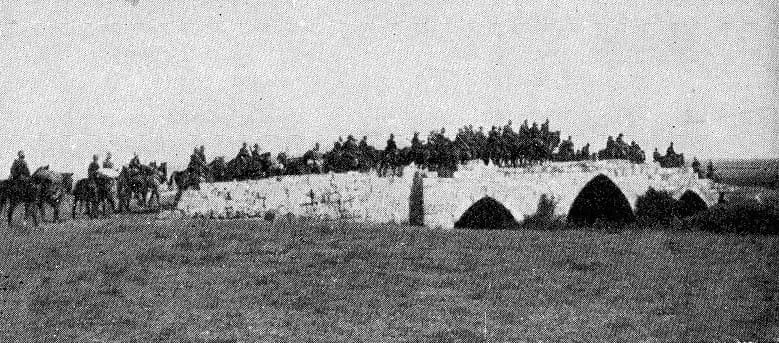
The Battle of Mughar Ridge ended the pursuit that the troops of General Sir Edmund Allenby had been conducting since the Third Battle of Gaza. After a week of marching along the coast the British stood before the last line that the Turks had managed to cobble together on the Philistine Plain. It covered Junction Station, where the line to Jerusalem branched off the railway running from north to south. On 13 November 1917 two infantry divisions of XXI Corps and the yeomanry attacked this line. The most famous episode of the day was the charge of the British 6th Mounted Brigade on the ridge by the village of El Mughar (Al-Maghar), often called the last great charge of the British cavalry. By the evening the Turkish defence had been broken, and on the morning of 14 November Indian infantry and armoured cars took the station. The Ottoman armies were split: one fell back along the coast towards Jaffa, the other into the hills, towards Jerusalem.
Name and dates
The British Battles Nomenclature Committee ruled that the Third Battle of Gaza had ended on 7 November and divided the subsequent fighting into separate engagements: the “action of El Mughar” on 13 November and the “capture of Junction Station” on 14 November. The British official history (Cyril Falls, Military Operations: Egypt and Palestine, vol. II) describes both days in a single chapter, “The Capture of Junction Station”, and notes that in the army the name “action of El Mughar” was applied above all to the attack on the Katrah–El Mughar line. English-language accounts also use the names “Battle of Mughar Ridge” and “Battle of Junction Station”, and some of them include in it the fighting from 10 November. The British spelled the name of the village El Mughar or El Maghar. We adopt the dates 13–14 November 1917, from the attack on the Katrah–El Mughar line to the capture of the station.
Background
When the British entered abandoned Gaza on 7 November, Allenby hoped that his cavalry would cut off the retreating Ottoman Eighth Army. It did not succeed. Horses were collapsing from thirst, and the pursuit, as Allenby wrote in his report, became “a question of supply rather than of manoeuvre”. The wells in the villages were deep and often damaged, and soldiers lowered canvas buckets into them on telephone wire. Supplies were landed from ships at the mouth of the Wadi el Hesi. On 8 November the Warwickshire and Worcestershire Yeomanry captured an Austrian battery by a charge at Huj. By 10 November the Australians and New Zealanders had reached Esdud and the Nahr Sukereir river, while the 52nd Division, advancing along the coast, fought several night actions with Turkish rearguards on the way.
The Turks too tried to regain the initiative. Many soldiers of the Eighth Army fled in panic as far as Jerusalem or Damascus, but at Ramleh about 10,000 stragglers were gathered and reorganised. The commander of the “Yıldırım” Army Group, General Erich von Falkenhayn, against the advice of his own staff, decided to strike at the British right wing. On 12 November forces of the Ottoman Seventh Army attacked the Australian Mounted Division at Balin and Berkusie and pushed it back a few kilometres, but failed to break it. The same day the Scottish 156th Brigade of the 52nd Division took the village of Burqa and the nearby hill after heavy fighting, but the Turks regained the hill by counter-attack, and it was finally recaptured from them only by the Gurkhas of the neighbouring 75th Division. It cost almost 500 killed and wounded. Falkenhayn had to withdraw part of his forces from the counter-attack to reinforce the Eighth Army.
Forces and plan
By the evening of 12 November it was already clear that the Turks were building a defensive line from the village of El Kubeibeh, a few kilometres from the sea, to Beit Jibrin at the foot of the hills. According to the official history they had no more than 15,000 rifles and sabres along the whole front. On the flat plain the only strong position was a narrow, steep ridge on which stood the villages of Katrah and El Mughar, about 10 km west of Junction Station. It was held by Refet Bey’s XXII Corps, that is, the remnants of the 3rd and 7th Divisions, bled white in the fighting for Gaza: according to Falls, at most 3,000 rifles. Both villages were surrounded by gardens and prickly-pear hedges, which were an obstacle in themselves, and on the west they were separated from the British by a flat, open valley in which the only cover was given by the wadi beds. South of Katrah lay the Jewish settlement of Gedera.
At noon on 12 November Allenby met the commanders of XXI Corps, Lieutenant-General Edward Bulfin, and of the Desert Mounted Corps, Lieutenant-General Harry Chauvel. The attack was to start on 13 November at eight in the morning, after an hour’s bombardment. Major-General Palin’s 75th Division, made up of British and Indian battalions, was to advance along the road to Junction Station through the villages of El Kastine and El Mesmiye, and Major-General Hill’s 52nd (Lowland) Division was to take Katrah and El Mughar. The left wing was covered by Major-General George Barrow’s Yeomanry Mounted Division, whose objective was the village of Yebna (today Yavne) and Aqir, and the right by the Australian Mounted Division. Allenby was already thinking of Jerusalem. On 11 November London warned him not to commit himself to occupying positions that would be hard to hold, but soon afterwards the Chief of the Imperial General Staff assured him that the War Cabinet had no intention of interfering with his plans.
Course of the battle
13 November: the 75th Division. The night of 11/12 November brought a thunderstorm with a downpour and a warning that after further rain the black, heavy soil of the plain would turn into a bog, but 13 November dawned fine. The battalions of the 75th Division took the first villages without a fight and at noon reached El Mesmiye el Gharbiye under fire. The Turkish rearguard defended itself in the cactus hedges and counter-attacked. A Somerset battalion repelled it with the support of South African artillery, and at four in the afternoon a Wiltshire battalion took the ridge north of the village. On the right wing a company of the Indian 58th Rifles made a frontal attack on an entrenched position by the railway to forestall a Turkish counter-attack that was being prepared. It lost 72 men, including both its British officers, but with the help of the Australian 11th Light Horse Regiment it drove the Turks out.
13 November: Katrah and El Mughar. Brigadier-General Pollok-M’Call’s Scottish 155th Brigade took the village of Beshshit without difficulty, and before noon its battalions came to within about 600 metres of Katrah and El Mughar. They could go no further, pinned down by machine-gun fire from the gardens. Hill ordered a short, heavy bombardment of both villages for 3.30 p.m. and rode off to ask Barrow for help. It turned out that the yeomanry was already preparing to give it. Yebna had been cleared of Turks before noon, and Brigadier-General Godwin’s 6th Mounted Brigade, made up of the Buckinghamshire, Dorset and Berkshire Yeomanry, assembled in the bed of the Wadi Jamus, to the left of the Scots. The Berkshire battery of horse artillery shelled El Mughar from a range of about 3 km, and Lieutenant Perkins of the Bucks Hussars galloped under fire along the neighbouring wadi and found in it a covered position for the machine-gun squadron.
At three in the afternoon the Buckinghamshire and Dorset regiments climbed the steep bank of the Wadi Jamus and set off towards the ridge, about 4,000 yards away, close to 4 km. They advanced in column of squadrons, with five paces between the riders. First at a trot, under artillery fire, then, when the machine guns reached them, at a gallop. The official history records that a fox jumped up in front of the line of the Bucks Hussars and was greeted with cheers as if on a hunt in their home county. The horses of the left squadron of the Dorsets, which had the furthest to go, were so tired that the riders dismounted and went up the ridge on foot. When the charge reached the crest, the Turks fled. Some of them, seeing how few riders were left, opened fire from the flanks, but the matter was decided by the supporting squadrons coming up and the Hotchkiss machine-gun sections that rode in the charge. The yeomanry took several hundred prisoners, two field guns and twelve machine guns.
Seeing the riders on the plain, Pollok-M’Call judged that they were drawing the defenders’ fire on themselves. He seized a rifle, ran out into the open and signalled to the Scots of the King’s Own Scottish Borderers to follow him. They ran several hundred metres to the gardens, hacked their way through the hedges and broke into El Mughar, where on the northern edge of the village they met the dismounted Berkshire Yeomanry. Another 400 prisoners were taken. Who took the village first remained disputed: according to the yeomanry its own men captured it, according to the infantry the Scots did, and the yeomanry merely rounded up prisoners. At 3.45 p.m., after the planned bombardment, the Royal Scots Fusiliers advanced on Katrah. The Turkish infantry began to fall back, but the machine-gun crews for the most part fought to the end. By four the village had been taken, with four hundred prisoners.
Just before sunset the East Riding Yeomanry of the 22nd Mounted Brigade rode onto the ridge and saw hundreds of fleeing Turks. Major Robinson with a handful of fifteen men galloped through the Arab village of Aqir, and another squadron headed for the Jewish settlement of Ekron, today Mazkeret Batya. There it was stopped by the fire of a detachment, roughly a company, that the commander of XXII Corps, Refet Bey, had himself gathered from the men of his staff. A Turkish account later claimed that this episode saved the corps. The official history holds that had the 22nd Brigade pressed on in full strength, the Turks would have lost their lines of retreat to Ramleh and suffered a far greater defeat. Aqir was taken only on the morning of 14 November.
14 November: Junction Station. After the capture of Katrah, Palin ordered the 234th Brigade to march on the station by night. At about 1.30 a.m. its advanced guard, the Indian 123rd Outram’s Rifles, reached the crossroads in front of the station, whose lights could be clearly seen. First a Turkish transport column ran into it, and an hour later a detachment of three or four hundred Turks attacked with shouts of “Allah!”. The attack was repelled, but the brigade commander judged that there would be no surprise any more and decided to wait for dawn. Between six and seven in the morning at least one train left the station. According to prisoners, Kress von Kressenstein, the commander of the Eighth Army, escaped on it. At 8.25 a.m. two British armoured cars drove onto the road and fired on the last Turks leaving the station, and moments later men of the 123rd Rifles entered it.
The booty was valuable. Most important was the undamaged steam pumping station: for the first time since the start of the offensive the British had as much water as they needed. At the station stood two locomotives and 60 wagons, and there were stocks of grain, flour and fodder, workshops, stores of timber and fuel, and a working military hospital, where the doctors had stayed with the wounded. Turkish sources state that the demolition of the buildings and track had been prepared, but the station commandant and the engineer officer abandoned their posts. That day the New Zealand Mounted Rifles Brigade fought a hard action with the Turkish 3rd Division near the Jewish settlement of Rishon LeZion (Ayun Kara). It repelled several counter-attacks and, according to the official history, lost 175 killed and wounded.
Losses
According to the official history the British lost 616 men in the attack on Katrah and El Mughar, of whom 486 were in the 155th Brigade, and 130 men and 265 horses in the 6th Mounted Brigade. The 75th Division lost 506 men on 13 and 14 November. Among the mortally wounded at El Mughar was Major Evelyn de Rothschild of the Bucks Hussars, of the banking family that had founded most of the Jewish settlements on this plain. He died a few days later. At Katrah and El Mughar the Turks lost more than a thousand prisoners, and more than 400 of their dead were found on the battlefield, although the gardens were never searched thoroughly. The 75th Division took 297 prisoners.
Significance
The capture of Junction Station cut the railway that supplied Jerusalem and split the Ottoman armies. On the evening of 13 November Falkenhayn ordered a retreat: Kress’s Eighth Army fell back along the coast behind the Yarkon river north of Jaffa, and the Seventh Army into the hills in front of Jerusalem. From then on the latter could receive supplies only by roads from Nablus or from the Hejaz Railway via Jericho. That same evening the Deputy Commander-in-Chief İsmail Enver came to Falkenhayn in Jerusalem. They agreed that the city should not be defended at the cost of a siege. On 15 November the yeomanry took the Abu Shusheh ridge in another charge, in which Neil Primrose, son of the former Prime Minister Lord Rosebery, was killed, and the Australians entered Ramleh and Lydda. On 16 November the New Zealanders took Jaffa.
Falls considered the action at El Mughar a model example of the co-operation of all arms on a small scale: reconnaissance under fire, machine guns and horse artillery supporting the charge, and infantry that seized the moment when the riders drew the defenders’ fire on themselves. The charge became a legend in Britain. It is often called the last great charge of the British cavalry, although in Palestine and Syria horsemen still charged in 1918, mainly Australian and Indian ones.
Spotted a mistake?Report an error