1917: Baghdad and Gaza
Battle of Nebi Samwil
- Dates:
- 17–24 November 1917
- Front:
- Middle East
- Location:
- The Judaean Hills north-west of Jerusalem, from Latrun and Ramleh through Qaryet el Enab (Abu Ghosh), Beit Liqya and Beit Ur et Tahta to Nebi Samwil hill (An-Nabi Samwil), El Jib and Beitunia near Ramallah (Ottoman Palestine, today the border area of Israel and the West Bank)On the battle map →
- Sides:
- United Kingdom and British IndiaEdmund Allenby, Edward Bulfin, Philip Palin, John Hill, George BarrowOttoman Empire and GermanyErich von Falkenhayn, Fevzi Pasha, Ali Fuad Bey, İsmet Bey
- Result:
- Inconclusive. The British entered the hills and took and held Nebi Samwil, but did not reach the Jerusalem–Nablus road. On 24 November Allenby halted the advance until fresh divisions arrived.
- Author:
- Natalia
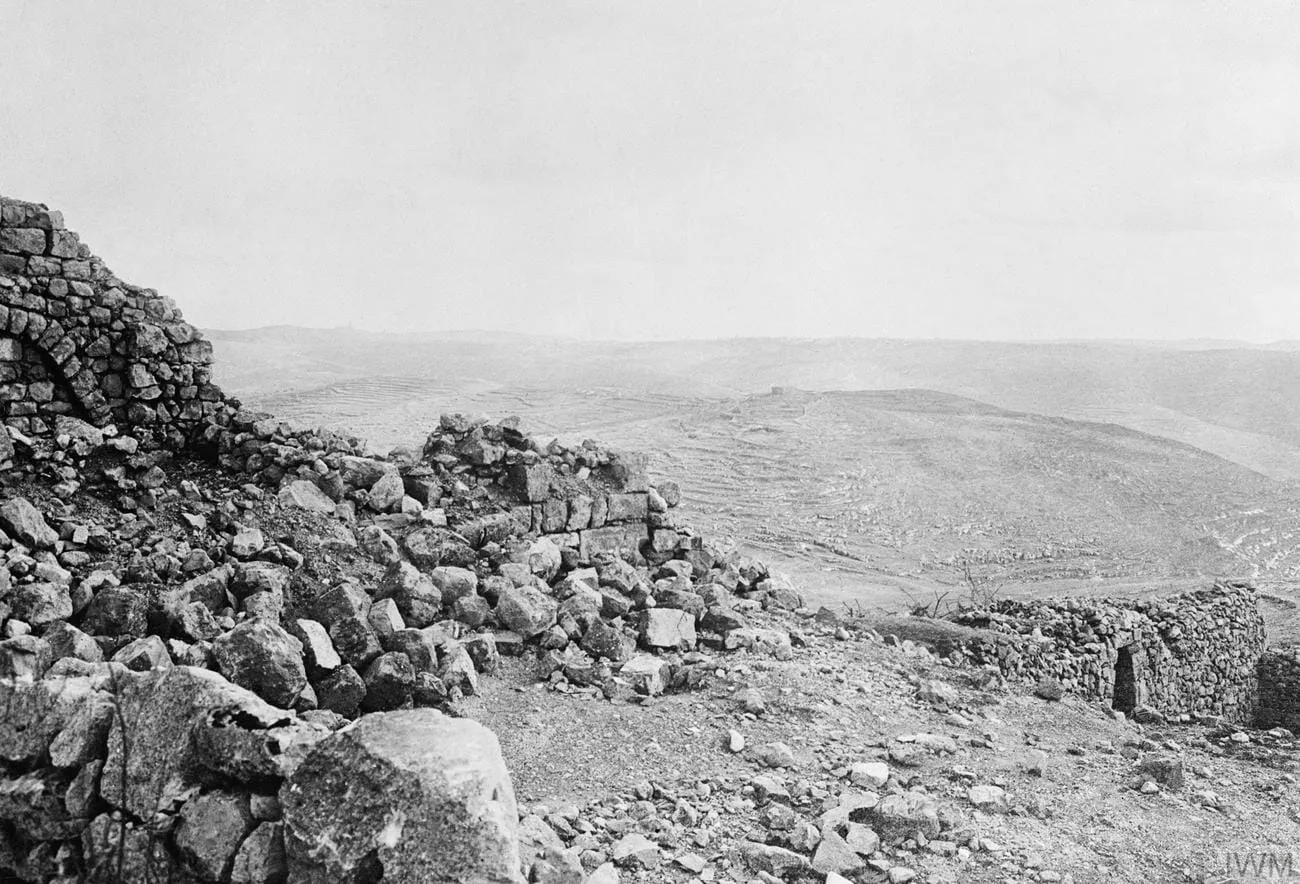
The Battle of Nebi Samwil was the first attempt by the troops of General Sir Edmund Allenby to take Jerusalem. After their victory on the coastal plain the British turned east, into the Judaean Hills. They did not want to fight for the Holy City itself. They intended to bypass it from the north and cut the only good road by which the Turks could supply it and withdraw from it, the road to Nablus. For several days the three divisions of Lieutenant-General Edward Bulfin’s XXI Corps pushed their way across trackless country, in cold rain and in summer uniforms. On the evening of 21 November the infantry took the hill of Nebi Samwil, with its mosque over the traditional tomb of the prophet Samuel, a few kilometres north-west of the city, and held it against fierce counter-attacks. It got no further. After two failed assaults on the village of El Jib, Allenby halted the advance on 24 November.
Name and dates
The British Battles Nomenclature Committee fixed the dates of the Battle of Nebi Samwil as 17 to 24 November 1917. The British official history (Cyril Falls, Military Operations: Egypt and Palestine, vol. II) and the British chronology of the war compiled at the time date it in the same way. The Committee gave this name to the whole entry into the hills, not just to the fighting for the hill itself. The actual advance began on 18 November with cavalry operations near Latrun, and the infantry moved off on 19 November. The hill was taken on the evening of 21 November (the Australian official historian Henry Gullett speaks of midnight), and the last attack was made on 24 November. According to the Committee the next engagement was the capture of Jerusalem (7–9 December). The official history describes the Turkish counter-attacks of late November and early December separately, as the fighting in the defence of Jerusalem. In British documents the hill was called Nebi Samwil or Nabi Samweil, and its Arabic name in Polish transcription is An-Nabi Samu’il.
Background
On 13 and 14 November the British defeated the Turks at El Mughar and took the junction station (Junction Station), from which the railway to Jerusalem branched off. On 15 November the cavalry entered Ramleh and Lydda, and on 16 November Jaffa. The Ottoman forces split into two parts. On the plain the Eighth Army fell back behind the Nahr el Auja river (the Yarkon), while the Seventh Army of Fevzi Pasha was driven into the hills. Allenby wanted to keep the Eighth Army in check on the plain and to pursue the Seventh Army in the hills before it could recover, and to take Jerusalem. In London Jerusalem was above all a political objective. Lloyd George’s government hoped to capture it for the impression it would make on the world, and on 11 November it reminded Allenby that he might soon have to give up some of his divisions to France and should not commit himself too deeply. Allenby replied that he understood, and pressed on.
He decided to cut the Nablus road near Ramallah and El Bireh, about 13 kilometres north of Jerusalem, so that the city would fall without fighting within it and without the risk of damage to the holy places of three religions. Originally almost all the cavalry, supported by one infantry division, was to enter the hills, and orders to that effect were issued on 16 November. The army’s quartermaster, Major-General Walter Campbell, warned, however, that until the captured Turkish railway was running he could not feed more than one additional infantry division in the hills. Allenby therefore changed his plan. The 54th Division and the Anzac Mounted Division were to remain on the plain, while the 52nd and 75th Infantry Divisions, the Yeomanry Mounted Division and the Australian Mounted Division entered the hills, all under Bulfin’s command.
Terrain and defenders
The Judaean Hills rise above the coastal plain in narrow, stony ridges running from east to west, cut by steep ravines. Many slopes were covered with stone terraces. The only good road from the plain to Jerusalem was the highway from Jaffa through Ramleh, which entered the hills at Latrun and Amwas, the biblical Emmaus, and just beyond passed through the easily defended defile of Bab el Wad. The road from Lydda through Beit Liqya was little better than a mule track in the hills, and the other tracks turned out to be even worse than the maps showed. There was little water in the hills, mostly in cisterns cut into the rock. The British railway had advanced little beyond where it had been at the start of the Third Battle of Gaza, the captured Turkish one was not yet working, and everything had to be carried by lorries and camels along sodden roads.
Erich von Falkenhayn, who commanded the “Yıldırım” Army Group, decided to defend Jerusalem. British airmen saw columns moving north and concluded that the Turks were leaving the city, but this was a mistake. Falkenhayn was only moving İsmet Bey’s III Corps north of Jerusalem to cover the Nablus road, and he entrusted the defence of the city itself to Ali Fuad Bey’s XX Corps. On 19 November he moved his headquarters from Jerusalem to Nablus. According to the official history, by 20 November XX Corps (26th and 53rd Divisions) stood from the Jerusalem railway to the area of the Jaffa road, and III Corps (3rd Cavalry Division and 24th Division) in the area of El Bireh. In front of these positions the Turks left only small rearguards, which were to delay the British in the defiles while the main forces of the Seventh Army rested and dug trenches.
Course
17–18 November. After the capture of Jaffa Allenby’s troops had a short rest. On 17 November the landing place for supplies from the sea was moved nearly 30 kilometres north, to the mouth of the Nahr Sukereir, and the next day the main base of XXI Corps was moved forward to Jibna. The cavalry watched the roads into the hills. On 18 November the Australian 9th Light Horse Regiment outflanked the position at Latrun from the north and got as far as the village of Jalu. The same day a conference at XXI Corps headquarters decided that the infantry of the 75th Division would advance along the highway, and the Australians’ attack was cancelled. Meanwhile Major-General George Barrow’s Yeomanry Mounted Division set off north-east towards Beit Ur et Tahta, the biblical Lower Beth-horon.
19–20 November. On the morning of 19 November Major-General Philip Palin’s 75th Division found Latrun and Amwas abandoned, probably because of the Australian outflanking move. Indian riflemen of the 58th Vaughan’s Rifles, practised in mountain fighting, cleared the hills above the Bab el Wad defile, working round one Turkish post after another. In the evening the rain came down in torrents and the division halted after advancing about 16 kilometres. The soldiers spent the night in the cold in summer drill uniforms and shorts. Major-General John Hill’s 52nd (Lowland) Division advanced north of it along the road from Lydda to Beit Liqya. No one opposed it, but in the darkness and the downpour the road simply vanished, camels broke their legs on the rocks, and soldiers with torn boots wrapped their feet in puttees. On 20 November the 75th Division took Saris, and towards evening, in a sudden mist, Gurkhas and a Somerset battalion took with the bayonet the hill above Qaryet el Enab (today Abu Ghosh). The 52nd Division took Beit Dukka, and the yeomanry was held up below the Zeitun ridge, in front of Beitunia. It became clear that the Turks were not leaving Jerusalem at all.
21 November: the capture of Nebi Samwil. Bulfin ordered the 75th Division to leave the highway and march straight on El Bireh by the track through Biddu and El Jib. Allenby did not want fighting near Jerusalem, but one brigade was to feint an advance along the highway as a diversion, and it drove the Turks out of El Kastal, six kilometres from the city’s suburbs. The column occupied Biddu, but then came under fire from Nebi Samwil. The hill, nearly 900 metres high, towered 120–150 metres above the plateau to the north and could not be bypassed. On its summit stood a mosque over the tomb that tradition holds to be that of the prophet Samuel, venerated by Muslims, Jews and Christians. The crusaders called the place Montjoie, because according to tradition it was from here that pilgrims first saw Jerusalem. Dusk was falling. The commander of the 123rd Outram’s Rifles, Lieutenant-Colonel G. R. Cassels, did not wait for reinforcements, and at 5.15 p.m. he set off with his battalion and a battalion of the Duke of Cornwall’s Light Infantry, neither of which still had 250 rifles. Under machine-gun fire they covered more than one and a half kilometres and took the mosque. They captured 42 prisoners and 2 machine guns at a cost of 36 men. The official history stresses that had Cassels waited, he would have found on the hill a Turkish column that was just then arriving, which his men broke up in the darkness with fire at close range. The same day the yeomanry, by then only about 1,200 men strong in the firing line, tried to take Beitunia and reach Ramallah, but ran into the 3rd Cavalry Division and part of the 24th Division and had to fall back during the night, losing 196 men and 108 horses.
22 November: the defence of the mosque. From the morning the Turks shelled Nebi Samwil from three sides, and then assaulted the hill several times. Twice they broke onto the ridge and twice they were driven off by counter-attacks of the Indian riflemen. The fiercest fighting was for the mosque itself, visible from afar and accurately ranged by the Turkish artillery. One shell brought down part of the roof and another smashed the prophet’s tomb. The wounded lay in the crypt. When the Turks had almost surrounded the building, the commander of the 3/3rd Gurkha battalion, Lieutenant-Colonel G. K. Channer, while closing the gate of the courtyard, came face to face with a German officer coming in and killed him with the bayonet. He then led his men out through a rear exit in a counter-attack and drove the Turks down onto the terraces below the mosque. Towards evening two Scottish battalions of the 52nd Division arrived and after dark took over the hill. The four battalions of the 75th Division that had defended it had lost 567 men, half their strength. Of the 3/3rd Gurkhas one officer and sixteen riflemen remained unwounded. The attack on El Jib did not take place that day, because there was no artillery.
23–24 November: El Jib. The village of El Jib, the biblical Gibeon, lies on a steep, terraced hill north of Nebi Samwil. On 23 November three battalions of the 75th Division, supported by only three worn-out mountain guns, crossed two kilometres of open plain under machine-gun crossfire and reached the foot of the hill. A few soldiers of the Somerset battalion broke into the village, but all of them were killed or captured. The division lost 480 men that day. On 24 November the 52nd Division repeated the attack, this time with a dozen or so field guns, which the gunners had dragged up into the hills with great difficulty. One brigade was to take El Jib and another to clear the ridge behind the mosque, from which the attackers had been fired on in the flank the day before. Both were held up in a maze of stone walls and gardens defended by numerous machine guns. The division lost 630 men. In the evening Hill reported that the Turks held a continuous line from Beit Iksa to Beitunia, had more artillery and showed no inclination to flee, and that one division could achieve nothing here. At 7.50 p.m. Allenby’s headquarters ordered the advance to be broken off until fresh troops arrived. The same day New Zealand cavalry crossed the Nahr el Auja on the plain as a diversion, but the next day the Turks drove them back.
Losses
The official history gives no single casualty figure for the whole battle. The fighting from 21 to 24 November alone cost the British more than 2,000 killed, wounded and missing: about 230 on 21 November (including 196 in the Yeomanry Mounted Division), more than 750 on 22 November, 480 on 23 November and 630 on 24 November. Cold, rain and disease also claimed many victims. The official history gives no Turkish losses. It only judges that the defenders, who attacked Nebi Samwil again and again under machine-gun fire, lost very many men.
Significance
The battle did not give the British what they wanted. The Nablus road remained in Turkish hands, and Allenby had to replace the exhausted divisions of XXI Corps with fresh divisions of Lieutenant-General Philip Chetwode’s XX Corps, arriving from the Gaza area. Even so, the official history regards the whole operation as a considerable success. Three divisions, hungry, soaked and almost without artillery, had within a few days entered hills that the Turks could have defended with small forces, and gained a foothold in them. Nebi Samwil, from which the buildings of Jerusalem could be seen, became the key point of the new line. The official history calls the defence of the mosque a fine feat of arms. The Australian historian Gullett notes that many soldiers who had read the Bible and guidebooks to the Holy Land during the campaign remembered that, according to tradition, it was from here in 1192 that Richard the Lionheart looked upon Jerusalem, which he never took.
Falkenhayn made use of the pause the British needed to relieve their troops, and from 27 November to early December his troops repeatedly, though without success, tried to retake Nebi Samwil and drive the British out of the hills. These attacks cost him many men who were later missing in the defence of the city. Meanwhile the British built roads and hauled heavy artillery up into the hills. The next advance, no longer from the north but from the west and south, began on 8 December, and on 9 December 1917 Jerusalem surrendered.
Spotted a mistake?Report an error