1917: Baghdad and Gaza
Capture of Jerusalem
- Dates:
- 7–9 December 1917
- Front:
- Middle East
- Location:
- The Judaean Hills around Jerusalem, from Ein Karem, Lifta and Beit Iksa in the west through Bethlehem and Beit Jala in the south to Shuafat and Tell el-Ful on the Nablus road in the north (Ottoman Palestine, today Israel and the West Bank)On the battle map →
- Sides:
- United Kingdom and AustraliaEdmund Allenby, Philip Chetwode, John Shea, Stuart Mott, Eric GirdwoodOttoman Empire and GermanyErich von Falkenhayn, Fevzi Pasha, Ali Fuad Bey
- Result:
- British victory. On 8 December the British took the Turkish defences west of Jerusalem, that night the Turks abandoned the city, and on 9 December the mayor surrendered it without a fight.
- Author:
- Łukasz Skowroń
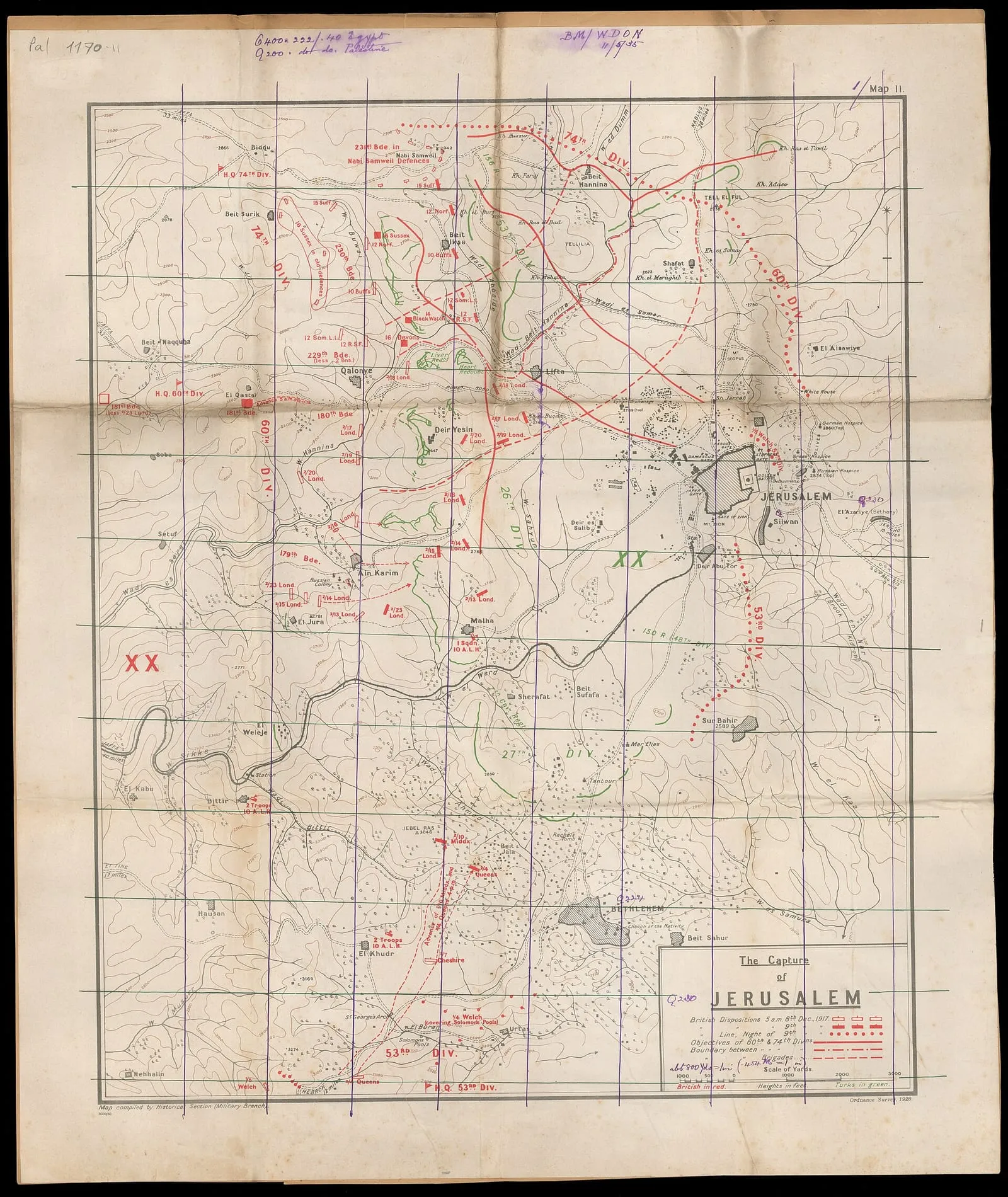
The capture of Jerusalem ended General Sir Edmund Allenby’s autumn campaign in Palestine. After a failed attempt to outflank the city from the north, the British shifted their effort closer to it. On 8 December 1917, in pouring rain, two divisions of Lieutenant-General Sir Philip Chetwode’s XX Corps surprised the Turks in their trenches west of the city, while a third came up from the south along the road from Hebron. The attack halted short of the suburbs, but during the night the defenders panicked and abandoned the city. On the morning of 9 December the mayor of Jerusalem came out with a white flag to meet the British and spent a long time looking for someone who would accept his surrender. The Holy City of three religions passed into British hands without fighting in its streets and without damage to a single place of worship.
Name and dates
The British Battles Nomenclature Committee called this fighting the Capture of Jerusalem (The Capture of Jerusalem) and fixed its dates as 7 to 9 December 1917. On 7 December the column advancing from Hebron fought its first skirmish at Solomon’s Pools, south of Bethlehem, on 8 December the main attack was delivered, and on 9 December the city surrendered and the British took the hills to the north of it. Fighting east of the city went on into 10 December, when the Turks were cleared from the Mount of Olives. Allenby’s formal entry into Jerusalem on 11 December was no longer part of the battle. Many works, especially in English, use the name “Battle of Jerusalem” for the whole of the fighting in the Judaean Hills from 17 November to 30 December 1917, including the Battle of Nebi Samwil and the later defence of the city against the Turkish counter-attack. The account of the fighting is based mainly on the British official history (Cyril Falls, Military Operations: Egypt and Palestine, vol. II).
Background
After the capture of Nebi Samwil, Allenby halted the advance in the hills on 24 November. The exhausted divisions of XXI Corps were relieved by XX Corps, which had come up from Gaza: the 60th (London) Division, the 74th (Yeomanry) Division and the 10th (Irish) Division. From 27 November to 3 December Erich von Falkenhayn, commander of the Yıldırım Army Group, threw his troops into counter-attacks to push the British out of the hills and gain time until reinforcements arrived, among them the German Asia Corps. The British held their positions, however, and the Turks lost many men.
Chetwode concluded that Jerusalem could not be cut off from the north and decided to move his right wing south, beyond the Jaffa road, even at the price of fighting closer to the city. The road had gained importance because on 5 December supply trains began running on the rebuilt Turkish railway to Ramleh. The plan that Chetwode laid before his divisional commanders on 3 December provided for Major-General John Shea’s 60th Division and Major-General Eric Girdwood’s 74th Division to attack from the line Ein Karem – Biddu, pass round the western suburbs of Jerusalem and, pivoting on Nebi Samwil as on a hinge, reach the road to Nablus north of the city. From the south, along the Hebron road, the so-called Mott’s Detachment was to come up: Major-General Stuart Mott’s 53rd (Welsh) Division with the corps cavalry, a heavy battery and armoured cars. By the morning of 8 December it was to stand on the line Sur Bahir – Sharafat, three miles south of Jerusalem. The troops were given detailed orders to respect the Dome of the Rock, the Church of the Holy Sepulchre, the Garden of Gethsemane and the Tomb of David, and Mott’s Detachment also the Church of the Nativity in Bethlehem and Rachel’s Tomb. In London the prime minister, David Lloyd George, had wanted Jerusalem for months as a Christmas present for the nation.
That Hebron was clear had been known for some time. On 1 December two Fords of the 7th Light Car Patrol, in which an officer of the Australian Mounted Division was pursuing a Turkish agent, drove on their own initiative through El Khadr near Bethlehem, scattered a Turkish mounted patrol and reached Hebron, where they found only a hospital. The official history notes that, contrary to the legend that grew up around this raid, it was not what persuaded the command to send Mott’s Detachment. It did show, however, that no resistance was to be expected as far as Bethlehem. The defence of Jerusalem was in the hands of Colonel Ali Fuad Bey’s XX Corps (26th and 53rd Divisions), who according to the official history did not want the task and accepted it only after promotion to general. Near Bethlehem stood the weakened 27th Division, probably only a few hundred men strong, and north of the city, by the Nablus road, III Corps. On 6 December XX Corps had a ration strength of 12,300. Falkenhayn had moved his headquarters to Nablus as early as 19 November, and the Seventh Army was commanded by Fevzi Pasha.
Course
7 December. From 4 December Mott’s Detachment had been marching north through Hebron, meeting almost no resistance but with great difficulty. Its only link with corps headquarters was a telegraph line running the long way round through Beersheba and Gaza, so orders were sent to it by aeroplane. On the morning of 7 December its advanced guard took the hill of Ras esh Sherifa, from which Jerusalem could be seen. Soon, however, fog shrouded the hills, rain fell and visibility dropped to two or three hundred metres. In the afternoon the advanced guard fought a sharp action for the ridge above Solomon’s Pools, but there it ran into the Turkish positions covering Bethlehem. Mott, who until then had been ahead of the timetable, stopped four miles short of the objective he was to have reached at dawn. Chetwode replied that the attack must go on whatever the weather. The night was terrible. Whole teams of artillery horses fell on the slippery road, camels collapsed with their legs splayed, and several Egyptian drivers died of cold. Meanwhile the divisions of XX Corps were moving up by night to their starting positions west of the city.
8 December. The attack on the western defences began before dawn, in darkness and rain, without an artillery preparation, so as to surprise the defenders. On the right wing the 179th Brigade of the 60th Division took the village of Ein Karem, the Russian colony and the hills to the south of it, and then the trenches east of the village. Corporal C. W. Train crawled up to two machine guns and put them out of action with rifle grenades, for which he received the Victoria Cross. The 180th Brigade attacked the redoubts near the village of Deir Yassin and the strongest defences on the whole front, known to the British as the Heart Redoubt and the Liver Redoubt, which covered the Jaffa road. The defenders were caught in their trenches, and by seven in the morning the first objective had been almost entirely taken. One of the London battalions broke up with its fire a column of about two hundred Turks falling back from Beit Iksa. Further on the brigade was stopped by fire from the hill of Khirbet el-Buqei’a above the village of Lifta. At 3.15 p.m., in full view of Chetwode and Shea, four battalions took it with the bayonet. In the 74th Division the 229th Brigade surprised the sleeping defenders and took 104 prisoners, but the 230th Brigade was delayed on a steep, rocky slope, came under machine-gun crossfire, including from the northern slopes of Nebi Samwil, and took the village of Beit Iksa only in the afternoon.
In the south things went worse. In the morning Turkish guns near Bethlehem accurately shelled the crossroads through which Mott’s Detachment had to pass. Mott did not want to return fire towards Bethlehem without the corps’ consent, and the wireless kept failing: his report of 8.40 a.m. reached Chetwode three hours later, and garbled. Only before nightfall did two battalions occupy the hills near Beit Jala without a fight, and the Turks, it was reported, were leaving Bethlehem in the afternoon. Because the right flank of the 60th Division remained exposed, the artillery was struggling forward and the men were exhausted by night marches in cold and rain, Chetwode, in agreement with Shea, postponed the further advance to the next day. The infantry spent the night on the rocks without greatcoats, in groundsheets only, with the last of the water in their bottles and on iron rations, because the food convoys were stuck on the roads.
Night of 8/9 December. The loss of the western defences caused something like panic in several Turkish units. According to the official history Ali Fuad, doubting whether he could rally them for further defence, ordered the city to be abandoned. From the north, Turkish columns streamed through the suburbs, northwards along the Nablus road and eastwards along the road to Jericho. The haste saved many Christian and Jewish notables, who had been ordered to walk to Nablus with their families. Before dawn the Ottoman governor, Izzet Bey, also left the city, leaving the mayor a letter surrendering it.
9 December: the surrender. It was a Sunday, and that evening the Jewish festival of Hanukkah began. The mayor, Hussein Salim al-Husseini, came out with a group of inhabitants and a white flag, for which, according to later accounts, a sheet from the American Colony hospital was used. The first to meet him were two cooks from the 2/20th London Battalion who had lost their way in the night looking for water. Next came two sergeants of the 2/19th Battalion on outpost duty, James Sedgewick and Frederick Hurcomb. Their photograph with the mayor was taken by the Swedish photographer of the American Colony, Lewis Larsson. Neither the cooks nor the sergeants felt authorised to accept the surrender. Nor did two artillery majors, who promised only to pass the message on. At last the group was found by Lieutenant-Colonel H. Bayley, commander of a field artillery brigade, who had ridden out to reconnoitre. The mayor told him in English: “I am the mayor of Jerusalem and I wish to surrender the city to the British general.” Bayley telephoned Shea, and soon the commander of the 180th Brigade, Brigadier-General C. F. Watson, arrived on the spot. Amid the cheers of the crowd the two rode to the Jaffa Gate and entered the Old City through the breach beside it, made in the wall in 1898 for the Kaiser Wilhelm II. Finally Shea, whom Chetwode had appointed to take over the city, arrived by car and formally accepted the surrender in Allenby’s name.
Meanwhile fighting continued around the city. The advanced guard of the 53rd Division passed through Bethlehem in the morning without opposition, at 8.45 a.m. stood beneath the walls of Jerusalem, and then marched past the Jaffa Gate and through the suburbs past the Damascus Gate, among enthusiastic inhabitants, to the north-eastern corner of the walls. From 10.30 a.m. the 60th and 74th Divisions were advancing again. The Turks still held the ridge of Mount Scopus north of the city, and only after hard fighting gave up the area around the tomb of Sheikh Jarrah, leaving more than 70 dead on the position. At 1.30 p.m. the British took Shuafat on the Nablus road, and half an hour later the hill of Tell el-Ful, which dominates the whole area. A Turkish counter-attack was beaten off by 4 p.m. Airmen dropped a hundred bombs on the columns retreating along the roads to Nablus and Jericho. To the east the Turks still held the Mount of Olives, which the 53rd Division found abandoned on 10 December. By the morning of 11 December its men were already in al-Eizariya, the biblical Bethany, and in Abu Dis.
Losses
The official history gives no total losses for these three days. It lists only the losses of some brigades: the 179th Brigade lost 277 men on 8 December, having taken about 240 prisoners, three guns and 12 machine guns, the 230th Brigade 181 men, and the 181st Brigade 43 men in the fighting at Mount Scopus on 9 December. The British field marshal Archibald Wavell, who took part in the campaign as a liaison officer, states in his history of the campaign that from 25 November to 10 December, that is including the defence against the Turkish counter-attacks and the capture of the city, the British lost 1,667 men and took about 1,800 prisoners. For the whole campaign from Beersheba to Jerusalem the British reported to London 18,928 killed, wounded and missing, and the Turkish General Staff later gave 28,443 killed, wounded and missing from 31 October to 31 December.
Significance
The British official history calls the surrender of Jerusalem one of the most dramatic events of the war. It attributes the collapse of the defence to the error or weakness of the commander of the Turkish XX Corps, to the decline in morale after continual defeats, and to the threat that British-held Nebi Samwil posed to the Turkish supply routes. The city passed into British hands without damage to a single holy building, which, at a time when the shelling of Reims Cathedral and the destruction of the university at Louvain were still remembered, was of great propaganda value. For the first time since the 13th century Jerusalem was under the rule of a Christian state, and four hundred years of Ottoman rule came to an end. For the Ottoman Empire, which in 1916 had lost Mecca to Sharif Hussein and in March 1917 Baghdad, it was another heavy blow to its prestige.
The news came at the darkest moment for the Entente, after the Italian defeat at Caporetto, the disintegration of the Russian army, the elimination of Romania from the fighting and the German counter-attack at Cambrai. On 10 December Allenby’s report of the city’s surrender was read out in the House of Commons. Lloyd George had his Christmas present. On 11 December Allenby entered Jerusalem on foot through the Jaffa Gate and proclaimed martial law there. The campaign, however, went on. At the end of December Falkenhayn made a last attempt to retake the city, but the British beat it off and pushed the front further north.
Spotted a mistake?Report an error