Key event
Battle of Épehy
- Category:
- Military operations
- Front:
- Western Front
- Date:
- 18 September 1918
- Author:
- Łukasz Skowroń
- Battle:
- Battle of Épehy
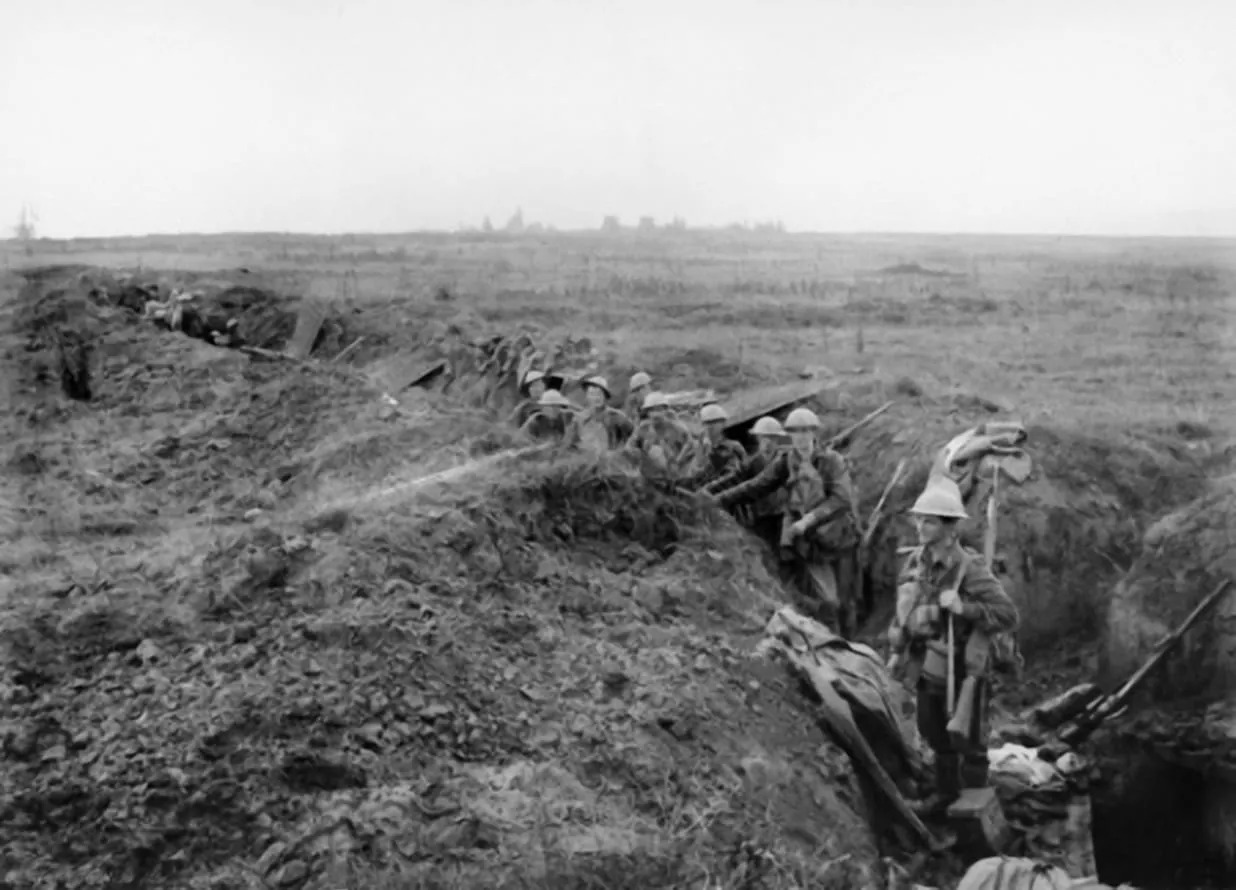
On 18 September 1918 at 5.20 a.m., in pouring rain and thick fog, General Henry Rawlinson’s British Fourth Army and the right wing of the Third Army advanced against the outer positions of the Hindenburg Line between Saint-Quentin and Gouzeaucourt. Six days earlier the Third Army had taken Havrincourt on the northern sector of the same line. Now it was the turn of the belt of old British trenches, lost on 21 March, with the fortified villages of Le Verguier, Ronssoy and Épehy. By evening the Australians in the centre had taken all their objectives, and the British on the flanks, after a whole day of fighting, had driven the Germans out of most of the fortified villages. More than 9,000 Germans were taken prisoner.
The night before the battle
Orders for the attack were issued on 13 and 14 September. For several days the British and Australians gained better jumping-off positions with small attacks, and from 15 September, when the weather cleared, aircraft photographed the whole outpost zone. Rawlinson relied on surprise, as at Amiens on 8 August. There was no preliminary bombardment, and the 1,488 guns were to open fire only at zero hour. There were only twenty tanks, because the rest were being saved for the assault on the main line, so dummies of canvas on wooden frames were set up near the jumping-off positions and dragged a little way forward before dawn.
During the night of 17–18 September a storm with torrential rain and gales swept across the front, and after a short break, at about one o’clock, while the infantry were assembling in position, it began to pour again. The Germans shelled the assembly area with gas. Holnon Wood on the right flank was so saturated with gas that the brigades of the 6th Division had to go round it in the dark. The men of the 74th and 58th Divisions had already suffered considerable losses from mustard gas on 17 September.
Morning
At 5.20 a.m. the artillery opened fire and the infantry advanced behind the barrage. Fog lay in the valleys and the rain went on falling. It cleared only around 9.30 a.m., but the day was grey, and the airmen could do no more than direct the fire of the guns. Tanks bogged down in the sodden ground. Reports, carried mainly by runners and the wounded, reached divisional headquarters many hours late.
In the centre two Australian divisions, the 4th and 1st, advanced through positions held by more Germans than they themselves had men. By 7.35 a.m. they had taken the whole first objective. In fortified Le Verguier they took 450 prisoners from two German divisions and 60 machine guns. Sergeant Maurice Buckley of the 13th Battalion knocked out seven German posts there with a Lewis gun, and Private James Woods of the 48th Battalion captured and held a strongpoint manned by 25 men with six machine guns. Both received the Victoria Cross. At 8.30 a.m. the Australians went on. In the ruins of Villeret and in the maze of trenches around Cologne Farm the tanks helped, and before 10 a.m. the second objective, the old British outpost line, had been taken.
To their left the 74th (Yeomanry) Division began with a surprise. One of its battalions, from Suffolk, moved earlier into the Australian sector, attacked Templeux-le-Guérard and the quarries by the village from the flank and took many prisoners, and a Sussex battalion took between four and five hundred prisoners on the first objective. The division’s left brigade, however, was held up beyond the first objective by machine-gun fire. Lance-Sergeant William Waring of the 25th Battalion, Royal Welsh Fusiliers, was killed attacking German machine-gun nests and was awarded a posthumous Victoria Cross. His battalion lost so many officers and NCOs that the remainder, about 120 men, were formed into two companies commanded by second lieutenants.
Ronssoy and Épehy
The heaviest fighting took place on the left wing of the Fourth Army, in General Richard Butler’s III Corps. The British themselves had turned the villages of Ronssoy, Basse-Boulogne, Lempire, Épehy and Peizière into fortresses with wire entanglements and deep dugouts in the winter of 1917–1918. Now they were held by the 2nd Guard Division, sent to Ronssoy on the night of 11–12 September after ten days’ rest, and by the Alpine Corps, one of the best formations in the German Army. For the Germans this was a key sector, because it covered the place where the St Quentin Canal runs through a tunnel at Bellicourt and tanks could cross over it on solid ground.
General Richard Lee’s 18th Division took Ronssoy with the help of three tanks, but clearing the village of Germans hidden in cellars dragged on for hours. Lee had warned beforehand that the plan did not allow enough time to take the village before moving on to the second objective, but his objections were overruled. The division also took Basse-Boulogne and La Pauerelle and reached the ridge near Quid Copse. Lance-Corporal Allan Lewis of the 6th Battalion, Northamptonshire Regiment, attacked German machine-gun nests single-handed. He received the Victoria Cross for that day and for the fighting on 21 September, in which he was killed. In the afternoon divisional headquarters ordered the 55th Brigade to attack the second objective at 5 p.m., but meanwhile the fresh German 121st Division, sent in to counter-attack, arrived. The right of the attack advanced, the left was held up by flanking fire, and the units pushed out beyond the first objective were in danger of being surrounded. At 9 p.m. the British fell back to the first objective.
Épehy was attacked by the 35th Brigade of the 12th Division, with two battalions (from Norfolk and Essex) in the assault and a third, from Cambridgeshire, to mop up the village. Both its tanks soon dropped out, one through a breakdown, the other hit by a shell. At about 7 a.m. a tank from the neighbouring 58th Division, which had entered Épehy from the north, lost its bearings in the fog and began firing on men of the 35th Brigade. The British cleared the southern part of the village, but the Germans kept fighting in the ruins and cellars, and both sides lost many men. At about 5.30 p.m. a party of some 150 Germans was seen withdrawing to the north-east, and just before 8 p.m. it was reported that the village, or rather its ruins, was clear. The British official history stresses that the Alpine Corps, with twelve rifle battalions, had been driven by five British battalions out of a fortress it had been ordered to hold to the last. The Germans later explained the loss of Épehy by an attack of “at least three British divisions with tanks and ground-attack aircraft”. The Leib Regiment of the Alpine Corps wrote that the bombardment was extraordinarily effective: it levelled stretches of trench within a minute and buried dugout entrances, machine guns and mortars. The 173rd Brigade of the 58th Division had taken neighbouring Peizière by 7.30 a.m., but could not take the first objective beyond the village either that day or during the night.
On both flanks
On the right flank IX Corps came to a halt far short of its objective. The French 34th Division, which was to cover its flank, did not attack, so the British 6th Division came under fire from two hills in the French sector. A Durham Light Infantry battalion fought its way through the village of Holnon but had to fall back, losing more men than it had numbered at the start of the attack. The tanks allotted to the 6th Division bogged down or were destroyed, and five German aircraft bombed and machine-gunned the British line near Fresnoy-le-Petit. The neighbouring 1st Division reached the second objective only with its left wing.
To the left of the Fourth Army, the Third Army’s V Corps attacked with the 21st, 17th and 38th Divisions. The 21st Division retook Vaucelette Farm, which it had itself defended in March. The 17th Division took Chapel Hill and Gauche Wood. In the wood the Germans had made a machine-gun nest out of four abandoned British tanks left over from the fighting of 1917, and heavy mortars had to be brought up to destroy it. The division took 1,069 prisoners and held all its gains despite a counter-attack in the afternoon. The Welsh 38th Division on the corps’ left wing had partly to return to its jumping-off positions.
Evening and night
At about 5 p.m. the Germans threw three almost fresh divisions into a counter-attack: the 121st at Ronssoy, and the 6th and 20th further north, at Havrincourt, which they wanted to recover. At Havrincourt it was preceded by heavy shelling with gas and by air attacks, and the Germans broke into the British trenches in places, but by 11 p.m. they had been driven out everywhere. The history of one of the 20th Division’s regiments admitted that the attack advanced barely a hundred metres. The 121st Division’s counter-attack on Malakoff Farm, at the junction of the Australians and III Corps, was stopped by artillery and machine-gun fire. At 11 p.m. two battalions of the Australian 4th Division, in a night attack, took the whole Hindenburg Line outpost position on their sector, capturing more than 300 prisoners. From their positions the Australians now looked down on the St Quentin Canal and the southern entrance of the Bellicourt tunnel.
The day’s balance
According to the British official history, the Fourth Army took more than 7,000 prisoners, of whom the Australian Corps took 4,243, III Corps about 2,300 and IX Corps 559. The Third Army’s V Corps took 1,848 prisoners and 24 guns. The Australians also captured 76 guns and more than 300 machine guns, losing 1,260 men. Their success was all the greater because their battalions averaged only about 360–420 men, as reinforcements from Australia had almost dried up. The official history gives no total for British losses on the flanks, where the fighting was heaviest.
The 1st Guard Grenadier Regiment, which had defended Ronssoy and Lempire, blamed its defeat on the fog, which prevented the attack from being detected early and neutralised the defenders’ weapons. The British official historian remarked that this was worth remembering when assessing the German success of 21 March, when it was the fog that had favoured the Germans. The Fourth Army’s flanks did not reach all their objectives on 18 September and for another week had to fight hard for the last defences before the canal. Even so, the day showed that the German Army could no longer hold even strong positions it had been ordered to defend. A few days later Haig assured Marshal Foch that he was ready to attack the main Hindenburg Line.
Remember the articles you have read? Only in this browser; nothing is sent anywhere.How it works
Read ·
Spotted a mistake?Report an error
Meanwhile
(04)Elsewhere in the same days.
- 18 September 1918 · Balkan FrontBattle of Doiran beginsOn 18 September 1918 the British and Greeks attacked the Bulgarian defences by Lake Doiran. The Greeks took the forward line, but the main attack broke down.
- 19 September 1918 · Middle EastBattle of Megiddo beginsAt dawn on 19 September 1918 Allenby's infantry broke the Turkish front by the sea within hours, and three cavalry divisions raced north through the gap.
- 20 September 1918 · Middle EastCapture of Nazareth and BeisanOn 20 September 1918 British cavalry reached the Jezreel Valley, took Afula and Beisan and burst into Nazareth. Liman von Sanders barely escaped capture.
- 20 September 1918 · Middle EastExecution of the Baku commissarsOn 20 September 1918, in the desert beyond Krasnovodsk, Transcaspian SRs shot 26 leaders of the Baku Commune, among them Stepan Shaumian.
Related events
(04)The same battle, people or subject.
- 3 October 1918 · Western FrontStart of the battle of the Beaurevoir LineOn 3 October 1918 the British and Australians broke the Beaurevoir Line, the Hindenburg Line's last position. Montbrehain fell, but the Germans retook it.
- 22 August 1918 · Western FrontBritish retake AlbertOn 22 August 1918 the British 18th Division crossed the Ancre and retook the ruins of Albert; III Corps wiped out the German salient between Somme and Ancre.
- 29 September 1918 · Western FrontBattle of the St Quentin Canal beginsOn 29 September 1918 the British 46th Division crossed the St Quentin Canal in fog, while Americans and Australians stormed the Hindenburg Line at Bellicourt.
- 2 October 1918 · Western FrontEnd of the Battle of the St Quentin CanalOn 1–2 October 1918 the British Fourth Army took Joncourt and the rest of the Hindenburg Line at Bony and broke into the Beaurevoir Line, but lost Sequehart.