Key event
Operation Michael begins
- Category:
- Military operations
- Front:
- Western Front
- Date:
- 21 March 1918
- Author:
- Łukasz Skowroń
- Battle:
- Operation Michael
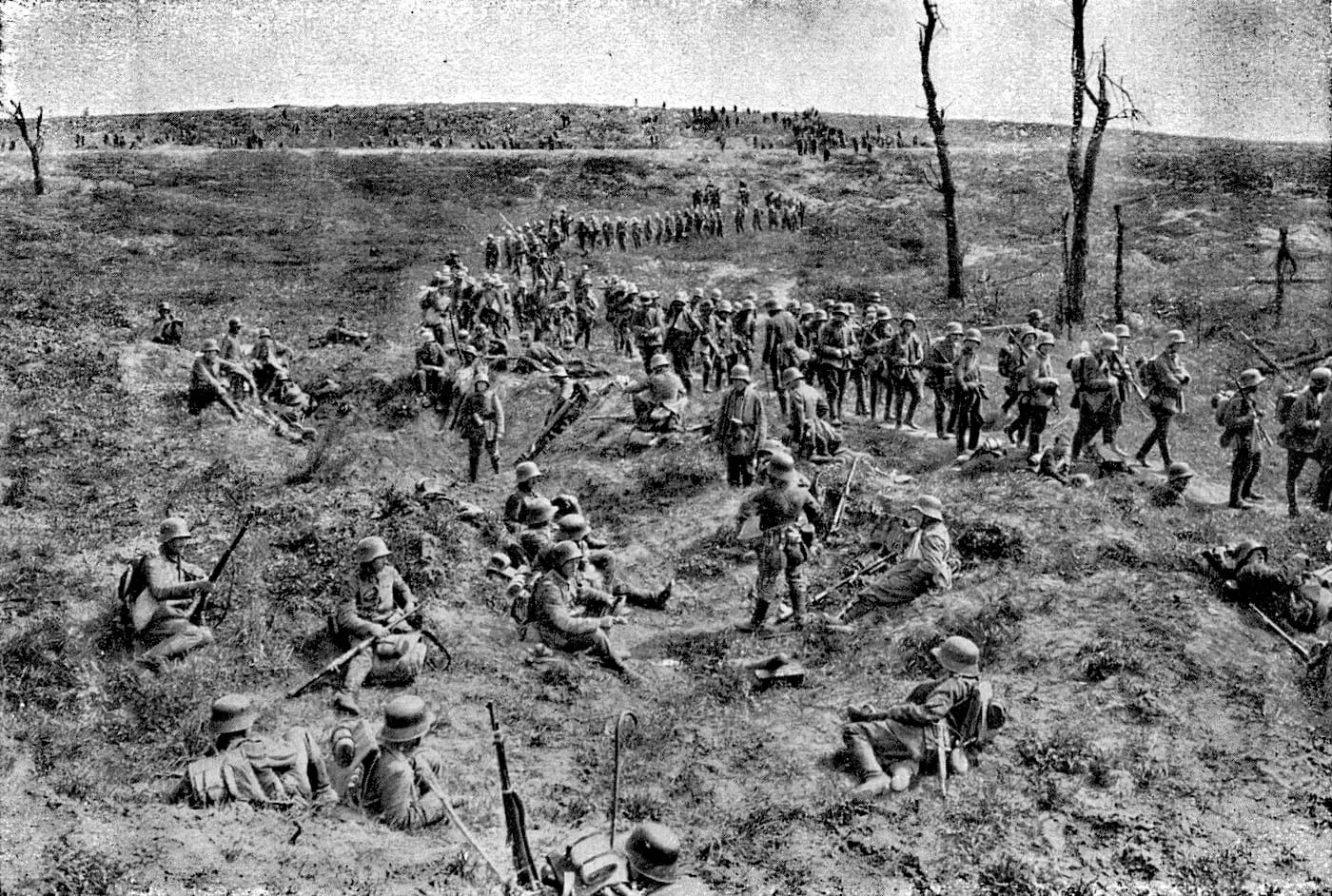
On Thursday 21 March 1918, at 4.40 a.m., more than six thousand German guns and several thousand trench mortars opened fire on a front some 70–80 kilometres long, from Croisilles south-east of Arras to the river Oise near La Fère. So began Operation Michael, the first of the great offensives with which Erich Ludendorff meant to win the war before masses of American soldiers reached France. After five hours of bombardment the German infantry advanced in thick fog against the British Fifth Army of General Hubert Gough and the right wing of the Third Army of General Julian Byng. By evening it had passed through almost the whole of Gough’s forward zone and broken into the battle zone. It was the second-worst day in the history of the British Army, after 1 July 1916: the British lost about 38,500 men, including about 21,000 prisoners. Times are given according to the British official history.
Before dawn
The British knew the blow was coming. For weeks they had watched from the air new roads, ammunition dumps and airfields behind the front between Arras and Saint-Quentin, and on the evening of 20 March a raid on the German trenches took prisoners who stated that the attack would come the next day and that the bombardment would begin at 4.40. The news was passed by telephone to Fifth Army headquarters, and from there to General Headquarters and the neighbouring armies. The Germans meanwhile were completing preparations such as the Western Front had never yet seen. After the peace with Russia and the winter transfer of divisions from the east, they had assembled 63 divisions for the attack. Facing the Fifth Army, which held 68 kilometres of front with twelve infantry and three cavalry divisions, stood some forty-three of them. The assault divisions took up their jumping-off positions on the night of 19/20 March, and had the night of 20/21 March to prepare for the attack.
On the evening of 20 March fog began to gather over the valleys of the Somme and the Oise. By morning it had grown so thick that in the Oise valley and over the St Quentin Canal columns of soldiers vanished from sight at ten or twelve metres. The British official history later called it “the Germans’ luck”. It was thickest and most lasting on the right wing of the Fifth Army, where it held until about 1 p.m. In the north, in front of the Third Army, it cleared more quickly, and by about 10 a.m. visibility there was quite good.
The bombardment
The bombardment began suddenly, with all batteries firing at once. It had been planned by the method tried out at Riga by Lieutenant-Colonel Georg Bruchmüller, artillery adviser to the Eighteenth Army. The artillery hardly registered at all; it fired from maps and calculations, and its fire passed through successive phases. For the first two hours it struck the British batteries, command posts, telephone exchanges, billets and camps with a mixture of gas and high-explosive shells. Then for several dozen minutes it shifted its fire onto the infantry lines, checking ranges, and from about 7.10 a.m. for more than an hour it pounded the trenches, supported by mortars. The British reported that the air seemed to tremble with the explosions. According to various estimates, between over a million and 3.5 million shells were fired in five hours.
The Germans had reconnoitred their targets well. The deeply buried telephone cables leading to the forward zone were almost all cut, because their routes had been photographed from the air and the junction points shelled. The battery positions were flooded with gas, which combined with the fog into a heavy, nauseating mixture. The men had to wear masks until about 11 a.m. At the signal “Bustle” the units in the rear set off for their assigned positions in the battle zone. In masks, in darkness and fog, they went holding on to one another “like blind men”, but almost everywhere they arrived in time. Mustard gas fell on the Flesquières salient, which had projected towards Cambrai since the Battle of Cambrai. The British chief gas officer noted that this was a sign the Germans did not intend to attack it, but to cut it off. By evening the gas had poisoned almost three thousand men of the 47th and 63rd Divisions there. The bombardment also fell on the First Army’s sector on the La Bassée Canal and on the French front in Champagne, but in both places it was only a feint.
The assault
At about 9.40 a.m. the German infantry advanced behind a creeping barrage. The first waves, the storm troops, with rifles slung on their backs but with bags of grenades, bypassed redoubts and machine-gun nests and pushed as deep as possible, followed by units with machine guns, flamethrowers, mortars and field guns. The British forward zone consisted of scattered posts and redoubts meant to support one another with fire. In the fog they could see neither each other nor the enemy. Rockets calling for the barrage were lost in the fog, runners went astray, pigeons died from the gas, and on the Fifth Army front the airmen could see nothing until noon. Commanders in the battle zone did not know for many hours what was happening in front of them, and the General Headquarters of Field Marshal Douglas Haig learnt that the German infantry had advanced only after 11 a.m. It received the news almost with relief: the blow had fallen on the front of the Fifth and Third Armies, where it had been expected, and not in the north, in front of the Channel ports.
Many garrisons fought to the end. On Manchester Hill near Saint-Quentin the 16th Battalion of the Manchester Regiment held out until about 4.30 p.m. Its commander, Lieutenant-Colonel Wilfrith Elstob, was killed, and the last message received from him was “Goodbye”. He was awarded a posthumous Victoria Cross. The neighbouring redoubts, held by a battalion of the Worcestershire Regiment and a detachment of the Oxfordshire and Buckinghamshire Light Infantry, fell between 4.30 and 5.15 p.m. Their defenders tried to break through to the battle zone, but all were killed or captured. The British official history stresses that German frontal attacks failed everywhere, and that the Germans won by finding a way round to the flanks and rear. The forward zone, however, held too many young, inexperienced soldiers and officers, and defence in small posts cut off from one another did not suit, as one old NCO put it, the British habit of fighting in line.
Afternoon and evening
Things were worst on the right wing of the Fifth Army, between the Oise and the Somme, where the fog lasted longest. There the Germans crossed the Oise near La Fère, and around noon they broke the defence on the Essigny plateau south-west of Saint-Quentin and began to penetrate the battle zone. At about 3 p.m. Gough drove round the headquarters of all four corps. At III Corps he heard that the 14th Division had been badly beaten and thrown far back, and he decided to withdraw the whole corps behind the Crozat Canal. At XVIII Corps General Ivor Maxse assured him that the battle zone was intact, although eight battalions of the forward zone had been almost destroyed. XIX Corps had lost its forward zone and its flanks were threatened. VII Corps had lost Ronssoy but otherwise was holding well. Gough instructed the commanders to fight a delaying action and to hold out as long as possible, without, however, letting their troops be destroyed in the defence of any one position.
Against the Third Army, the Seventeenth Army of General Otto von Below had taken the front trenches from Boursies to Bullecourt by 10 a.m., and by 1 p.m. had reached the forward part of the battle zone. The British 51st, 6th, 59th and 34th Divisions suffered most, and three of the Third Army’s five reserve divisions had to be thrown into the fight. In the afternoon, however, the German attack lost momentum. German reports spoke of “unexpectedly strong resistance” and the “desperate” activity of the British airmen, who in better visibility attacked columns marching along the roads. The Flesquières salient remained in British hands, because the two wings of the German attack failed to join up behind it.
By nightfall the Fifth Army had lost almost all of its forward zone, and on its right wing part of the battle zone as well, from Tergnier on the Oise to Seraucourt-le-Grand on the Somme. On the Third Army front the Germans stood before the battle zone or in its forward part. By the historian Martin Middlebrook’s calculations, the British lost about 38,500 men that day, of whom about 7,500 were killed and about 21,000 taken prisoner, many of them wounded or gassed. The Commonwealth War Graves Commission today commemorates more than 8,000 soldiers who died in France on that single day. German losses were roughly the same: according to Middlebrook, they amounted to about 40,000 men in the 31 divisions that attacked that day.
On the German side
The German command received the results of the first day without enthusiasm. The communiqué stated briefly that British positions had been attacked from south-east of Arras to La Fère and that “everywhere the enemy’s first lines have been taken”. Crown Prince Rupprecht of Bavaria, whose army group conducted the attack of the Seventeenth and Second Armies, noted that the British artillery positions had not been taken as expected, and that the number of guns and prisoners captured was small. Real success was achieved only by the Eighteenth Army of General Oskar von Hutier on the left wing, which had struck a weak spot. That same day Ludendorff sent six fresh divisions to it and kept with the attacking armies the heavy artillery that, in the event of success, he had intended to move north, to Arras. The Emperor Wilhelm II, who watched the battle from an observation post of the Eighteenth Army and the day before had formally assumed supreme command in this battle, took the news from the front differently. In a letter to one of the state diets he proclaimed a complete victory, and the next day he decorated Field Marshal Hindenburg with the Iron Cross with golden rays, whose only previous recipient had been Field Marshal Blücher (in 1815).
Despite the commanders’ reservations, 21 March was a great achievement for the Germans. For the first time since 1914 on the Western Front, a defence prepared in depth had been broken in a single day. The next day, again in fog, the Germans struck Gough’s weakened divisions, which had already lost half their infantry, and the Fifth Army began to retreat behind the Somme.
Remember the articles you have read? Only in this browser; nothing is sent anywhere.How it works
Read ·
A voice from the front
“As you will have learned, the much advertised offensive crashed upon us last Thursday, since when we have been fighting a rearguard action, almost continuously. A retreat was the one possibility that had never occurred to us, and, unfortunately, it involves a kind of manœuvring in which we are unversed, in spite of all our experience.”
Spotted a mistake?Report an error
Meanwhile
(04)Elsewhere in the same days.
- 21 March 1918 · War at seaDestroyer action off DunkirkBefore dawn on 21 March 1918 Allied destroyers intercepted a German raid off Dunkirk. They sank two torpedo boats, but a French torpedo hit HMS Botha.
- 21 March 1918 · DiplomacyRequisition of Dutch shipsOn 20–21 March 1918 the United States and Britain, invoking the right of angary, seized Dutch ships in their ports. The Netherlands protested.
- 18 March 1918 · PoliticsMarghiloman becomes prime minister of RomaniaOn 18 March 1918 King Ferdinand entrusted the government to the Germanophile Alexandru Marghiloman. Constantin Arion became foreign minister.
- 18 March 1918 · DiplomacyAllies reject the Treaty of Brest-LitovskOn 18 March 1918 the Entente premiers and foreign ministers declared that they did not recognise the Brest peace, warning of a fourth partition of Poland.
Related events
(04)The same battle, people or subject.
- 28 March 1918 · Western FrontGerman attack at ArrasOn 28 March 1918 the Germans attacked at Arras in Operation Mars. The British defence held; in the evening Ludendorff called it off and turned to Amiens.
- 25 March 1918 · Western FrontGermans capture NoyonOn 25 March 1918 Hutier's army broke the French reinforcements on the Oise and entered Noyon in the evening. The gap between the French and British widened.
- 24 March 1918 · Western FrontGermans take Bapaume and PéronneOn 24 March 1918 the Germans crossed the old Somme battlefield. Péronne was theirs, the British gave up Bapaume at night, and at Dury Pétain alarmed Haig.
- 15 April 1918 · Western FrontGermans take BailleulOn 15 April 1918 the Germans took the Ravelsberg ridge east of Bailleul. That night the British left the town, which in later months was reduced to ruins.