1918: The German Spring Offensive
Operation Michael
- Dates:
- 21 March – 5 April 1918
- Front:
- Western Front
- Location:
- The front from Croisilles south-east of Arras to the Oise at La Fère, and then the whole area of the old Somme battlefield as far as Albert, Villers-Bretonneux, Moreuil and Montdidier, Pas-de-Calais, Nord, Aisne, Somme and Oise departments (France)On the battle map →
- Sides:
- United Kingdom (with Australia, New Zealand, Canada and South Africa) and FranceDouglas Haig, Philippe Pétain, Ferdinand Foch, Hubert Gough, Julian Byng, Émile Fayolle
- Result:
- German tactical victory, strategic failure. The Germans occupied more than 3,000 km² and took about 75,000 British prisoners, but did not separate the Allied armies or take Amiens. Each side lost about 240,000–250,000 men.
- Author:
- Łukasz Skowroń
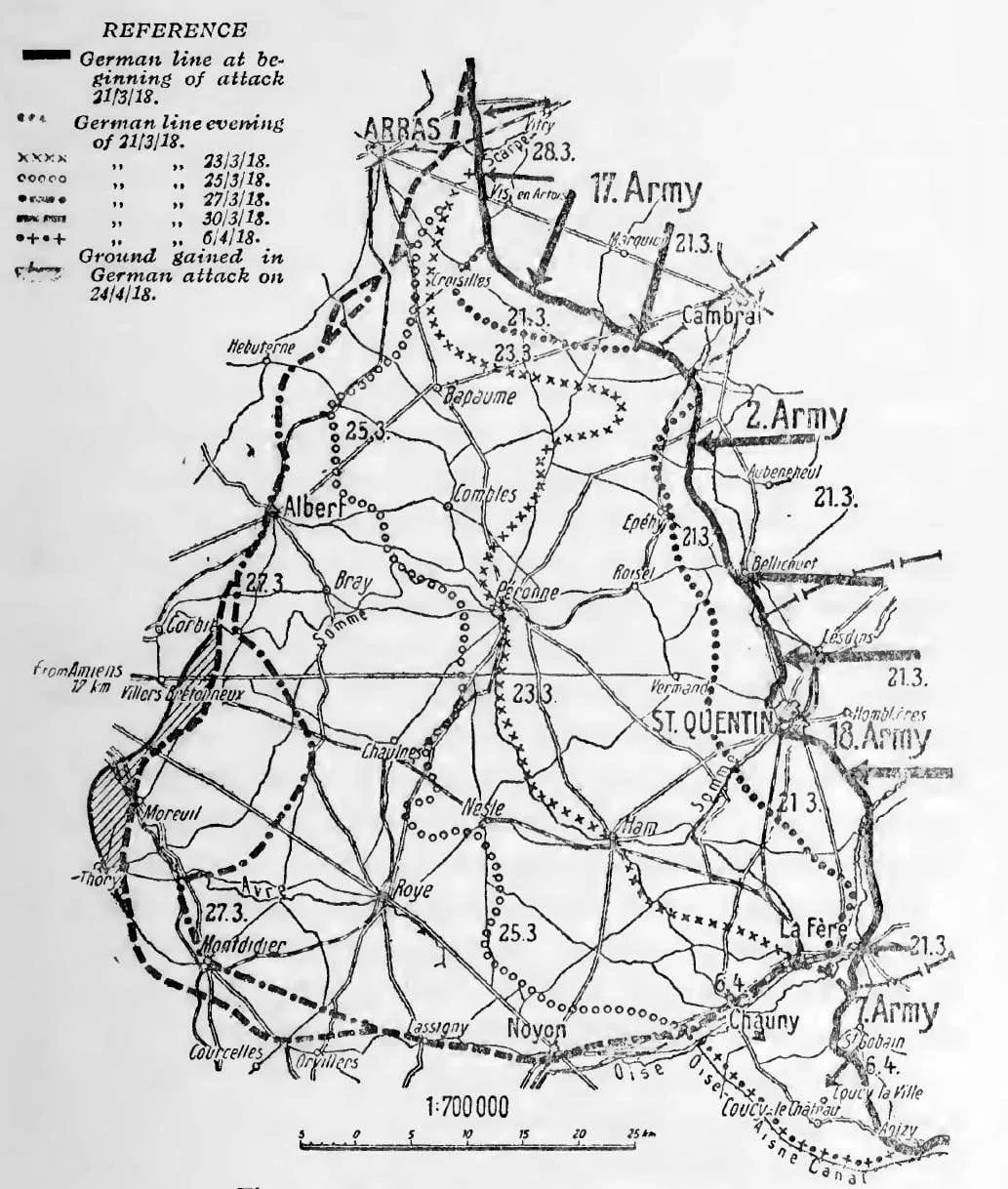
Operation Michael was the first and largest of the German offensives of the spring of 1918, with which Erich Ludendorff hoped to decide the war before the mass of American troops reached France. On the morning of 21 March 1918, after a five-hour hurricane bombardment, three German armies attacked on a front about 70–80 kilometres long between Croisilles near Arras and the river Oise. They threw more than sixty divisions against the British Fifth Army of General Hubert Gough and the right wing of the Third Army of General Julian Byng. In thick fog the storm troops passed through the British lines, and within two weeks the Germans had crossed the Somme, regained the whole area fought over in 1916, taken Bapaume, Péronne, Noyon, Albert and Montdidier and captured about 75,000 British soldiers. It was the greatest shift of the front in the west since 1914. They did not, however, achieve their strategic aim: the British and French armies were not separated, the advance stalled before Amiens, and the German losses, in large part among the best units, were as great as those of the Allies. The crisis did, however, lead the Allies for the first time to entrust one general, Ferdinand Foch, with the coordination of their armies.
Name and dates
“Michael” (after St Michael the Archangel, the patron saint of Germany) was the code name of the German plan. German propaganda called the whole spring offensive the “Kaiser’s battle” (Kaiserschlacht); in Germany it is also called the “Great Battle in France” (Große Schlacht in Frankreich), and the French call the fighting the Second Battle of Picardy. The British Battles Nomenclature Committee named it the First Battles of the Somme, 1918 and divided it into the Battle of St Quentin (21–23 March), the First Battle of Bapaume (24–25 March), the Battle of Rosières (26–27 March), the Battle of the Avre (4 April) and the Battle of the Ancre (5 April). It counted separately the Battle of Noyon (25 March), fought mainly by the French, and the First Battle of Arras 1918 (28 March), that is the repulse of the German Operation Mars. We date the offensive, as the British official history does, to 21 March – 5 April 1918. Ludendorff himself later wrote that the battle ended on 4 April, and many accounts close it with the attack on Villers-Bretonneux on 4–5 April. We give times according to the British official history (James Edmonds, Military Operations France and Belgium 1918, volumes I and II, 1935–1937).
Background
In the autumn of 1917 Germany found itself in a position it had not been in since the beginning of the war. Russia, after the October Revolution, was leaving the war, and Italy, after the defeat at Caporetto, had ceased to be a threat. On the other hand, since April 1917 the United States had been in the war, and the naval blockade was strangling the German economy ever more tightly. On 11 November 1917, at a conference at Mons, Ludendorff, First Quartermaster-General and the real head of the German command alongside Field Marshal Paul von Hindenburg, stated that Germany could gather in the west forces for one great offensive. It had to be carried out as early as possible, at the end of February or the beginning of March, “before the Americans can throw strong forces into the scale”. He added: “We must beat the British.”
Through the winter the Germans transferred divisions to the west from Russia and Italy. According to the British official history, the number of German divisions in France and Belgium rose from 150 in November 1917 to 192 on 21 March. The chief of staff of Rupprecht’s army group, General Hermann von Kuhl, proposed a blow in Flanders, under the code name “George”, against the rear of the British near the coast. Ludendorff judged, however, that in the marshy valley of the Lys the attack depended on the weather and could not start until April or May, and that an attack at Arras (“Mars”) was too difficult as long as the British held Vimy Ridge. On 21 January 1918 he chose a blow on both sides of St Quentin. The final order was issued on 10 March, and the attack was fixed for 21 March. Political considerations also played a part: the Eighteenth Army was transferred to the army group of Crown Prince Wilhelm, which, according to the British official history, made it possible to call the decisive battle the “Kaiser’s battle” and to give the Kaiser’s son a share in the victory.
The sector was carefully chosen. The British Expeditionary Force was then weaker than ever. After the bloody battles of 1917, especially at Ypres and at Cambrai, Lloyd George’s government had been sparing with reinforcements, and in February 1918 the missing soldiers were replaced by a reorganisation: in each division the number of infantry battalions was cut from twelve to nine. At the same time, at the request of Philippe Pétain, the British took over from the French a long stretch of front south of St Quentin, as far as Barisis beyond the Oise. As a result the weakest army, Gough’s Fifth Army, had to defend 42 miles (about 68 km) of front with twelve infantry divisions and three cavalry divisions. On the new sector the defences were unfinished, and in London and at headquarters there were disputes over how the front should be defended. The dispute over a common Allied reserve, created on paper in February, cost the Chief of the Imperial General Staff, William Robertson, his post. The reserve itself never came into being, because on 2 March Field Marshal Douglas Haig refused to give it divisions and relied instead on an agreement with Pétain on mutual help.
Plan and forces
The “Michael” plan provided for the Seventeenth Army of General Otto von Below (“Michael 1”) to strike towards Bapaume, the Second Army of General Georg von der Marwitz (“Michael 2”) towards Péronne, and the Eighteenth Army of General Oskar von Hutier (“Michael 3”) towards Ham, covering the left flank of the attack on the Somme and the Crozat Canal. After reaching the Somme–Péronne line the main forces were to wheel north-west, roll up the British front and push the British back towards the sea. The decision was to be brought by the Seventeenth and Second Armies. The Eighteenth Army was at first to halt on the Somme and the canal, but at the beginning of March Ludendorff agreed that, if successful, it should go further. In the final plan the subsidiary Operation “Mars” against Arras was to start a few days after “Michael”, and preparations for “George” in Flanders continued. Ludendorff is said to have replied to Rupprecht, who asked about the operational objective: “We will punch a hole. The rest will follow.”
The forces assembled were enormous. According to the British official history, 63 divisions were assigned to the attack, which with the divisions already in the line made 74. About 43 of them faced the 14 divisions of the Fifth Army, and 19 faced the centre of the Third Army. The three armies had 6,473 guns, of which 2,435 were heavy, as well as about 3,500 trench mortars and several dozen air squadrons. The bombardment was planned, according to the method tried out at Riga, by Lieutenant-Colonel Georg Bruchmüller, Hutier’s artillery adviser: without prior registration, with a mixture of gas and high-explosive shells, first on the batteries, command posts and communications, then on the trenches, and finally as a creeping barrage ahead of the infantry. The infantry was to fight by the method developed in the east and at Caporetto. The first waves, the Stoßtruppen, bypassed centres of resistance and went as deep as possible, while the following waves dealt with the encircled strongpoints. Fifty-six divisions underwent special training in the winter. Younger soldiers were picked for the assault, and those older than 35 were sent east. The assault divisions moved up to their jumping-off positions on the nights of 19–20 and 20–21 March.
The British knew that the attack was coming. They expected it on the front of the Fifth and Third Armies, and on 20 March prisoners taken in a night raid even gave the hour at which the bombardment would begin. The defence was organised on the German model, in depth: a Forward Zone with scattered redoubts, behind it a Battle Zone, and a Rear Zone, which in many places existed only on the map. Haig deliberately kept his strongest forces in the north, where only a few kilometres separated him from the sea, and accepted that in the south the Fifth Army would give ground if necessary.
The fighting: the breakthrough (21–23 March)
On 21 March at 4.40 a.m. a bombardment such as the British had never yet experienced fell on the whole front of the Fifth Army and most of the front of the Third Army. Gas shells blanketed the artillery positions, cut the buried telephone cables and destroyed the command posts. Mustard gas fell on the Flesquières salient, a remnant of the Battle of Cambrai, poisoning almost three thousand soldiers of the 47th and 63rd Divisions. Thick fog lay over the valleys of the Somme and the Oise. At about 9.40 a.m. the German infantry went over to the assault. The garrisons of the Forward Zone redoubts did not see the enemy until he was in their rear, and the signals calling for the defensive barrage were lost in the fog. Many posts fought to the end, like the 16th Battalion of the Manchester Regiment on Manchester Hill near St Quentin, whose commander, Lieutenant-Colonel Wilfrith Elstob, was killed and posthumously awarded the Victoria Cross. By evening the Germans had taken almost the whole Forward Zone of the Fifth Army and broken into the Battle Zone, most deeply on its right wing between the Oise and the Somme. In the north, against the Third Army, the attack of the Seventeenth Army stopped in front of the Battle Zone, and the Flesquières salient held. The first day was the second worst in British military history, after 1 July 1916: according to Martin Middlebrook the British lost about 38,500 men, including about 21,000 prisoners. German losses were little smaller or even greater, about 40,000.
On 22 March, again in fog, the Germans completed the breakthrough of the Battle Zone. Gough, whose army had already lost half its infantry, ordered a withdrawal behind the Crozat Canal and the Somme, and the Third Army abandoned the Flesquières salient. On the night of 22–23 March and the following day the Eighteenth Army forced the canal and the river at Tergnier, Jussy and Ham. That day Ludendorff, encouraged by Hutier’s success, changed the plan: the Seventeenth Army was to go north-west towards Arras and Saint-Pol, the Second Army west towards Amiens, and the Eighteenth Army south-west towards Noyon. From then on all three armies were diverging in different directions. The aim was to separate the British and the French, but the German effort lost its concentration as a result. On 23 March the first shells from the long-range gun in the forest near Crépy also fell on Paris.
The fighting: retreat across the old battlefield (24–27 March)
On 24 March the Germans took Péronne and Bapaume, while the Third Army fell back across the wasteland of the old Somme battlefield, from which the Germans had withdrawn a year earlier. Gaps were opening between the Third and Fifth Armies. In the south, where French divisions of General Georges Humbert’s Third Army, and then of General Marie-Eugène Debeney’s First Army, were arriving to help under the overall command of General Émile Fayolle, the Allies fought together, but the French came piecemeal, often without artillery. On the night of 24–25 March Pétain told Haig at Dury near Amiens that in the event of a further advance Fayolle was to fall back south-west to cover Paris. Haig judged that this threatened to tear the Allied front apart and asked London to intervene. On 25 March the Eighteenth Army took Noyon. On 26 March Albert, Chaulnes and Roye fell, and on 27 March Montdidier. South of the Somme the remnants of the Fifth Army held a line near Rosières, and the gap in front of Amiens was plugged by a scratch force of sappers, men from training schools and American engineers, known as Carey’s Force.
On 26 March, in the town hall at Doullens, President Raymond Poincaré, Prime Minister Georges Clemenceau, Lord Alfred Milner, Haig, Pétain and Foch met. They decided that Foch would coordinate the operations of the British and French armies in front of Amiens. Haig himself argued that Foch’s authority should cover the whole Western Front. On 3 April at Beauvais his powers were extended to the strategic direction of operations, and on 14 April Foch became Commander-in-Chief of the Allied Armies in France. On 28 March Gough, blamed by the government for the defeat, was replaced at the head of the Fifth Army by General Henry Rawlinson. Later historians largely exonerated him, pointing out that his army had defended too long a front with too few forces.
The fighting: Arras and Amiens (28 March – 5 April)
On 28 March the Seventeenth Army carried out the hastily prepared Operation “Mars” on its right wing, on both banks of the Scarpe near Arras. There the British Third Army stood in strong, well-developed positions and without fog; the attack collapsed within a single day with heavy losses. Ludendorff abandoned “Mars” and concentrated his remaining forces on Amiens, an important railway junction through which communications between the British and French armies ran. On 30 March the Germans renewed the attack on both banks of the river Avre. That day a Canadian cavalry brigade, in a daring charge, retook part of the wood near Moreuil. On 4 April, in the last great blow, the Germans took several villages on the Avre and came up to Villers-Bretonneux, some fifteen kilometres from Amiens, but the Australians and British held the little town, and the French south of it, though they lost several villages, prevented a breakthrough. On 5 April the attack on the Ancre also failed. That day Ludendorff broke off the offensive. As he himself wrote, “the enemy’s resistance was beyond our powers”, and the command had to take “the exceedingly difficult decision to abandon the attack on Amiens for good”. On 9 April the attack in Flanders began, prepared as “George” and now under the reduced code name “Georgette”.
Losses
The losses were enormous and disputed in detail. The British official history, totalling the figures from divisional war diaries, gives for 21 March – 5 April 177,739 killed, wounded and missing, of whom 90,882 were in the Fifth Army and 78,860 in the Third Army. After deducting the missing who later rejoined their units, it estimates the net losses at about 160,000, including about 22,000 killed and about 75,000 prisoners. The Germans in their communiqué of 4 April spoke of more than 90,000 prisoners, but this figure also included French soldiers. The Allies lost about 1,100–1,300 guns and about 200 tanks. French losses are estimated at about 77,000–80,000 men. The German medical report gives for 21 March – 10 April, including the subsidiary attack of the Seventh Army, 239,558 men, of whom 35,163 were killed. The historian David Zabecki gives 239,800, and other accounts about 250,000. The Germans lost most heavily in their best assault divisions, which they had nothing to replace with.
Significance
In tactical terms Operation Michael was the greatest success on the Western Front since 1914. In sixteen days the Germans advanced more than 60 kilometres and occupied more than 3,000 km². According to the British War Graves Commission, this was almost ten times more than the British had gained in 1916 in the 141 days of the Battle of the Somme. They almost completely shattered the British Fifth Army, and Kaiser Wilhelm II was proclaiming victory after the very first day. Strategically the offensive failed. The Germans did not separate the Allied armies, did not take Amiens or Arras, and did not force the British to retreat towards the ports. Instead they gained an exposed salient, difficult to defend, on devastated ground, with a front lengthened by several dozen kilometres and shattered supply routes. The changes in the direction of the attack after 23 March dispersed their forces, and in many places hungry soldiers stopped to plunder British depots.
The most lasting result of the offensive was the unification of the Allied command. The dispute over a common reserve, which could not be settled in the winter, was settled by the threat to Amiens: within three weeks Foch went from coordinator to commander-in-chief. Britain raised the upper age limit for conscription and began sending to France its youngest soldiers and units hitherto kept at home, and the United States agreed to speed up the shipment of infantry. Ludendorff tried several more times, in Flanders, on the Aisne and on the Marne, but none of the subsequent offensives matched “Michael”, and each exhausted the German army. In August 1918 the Allies went over to the counter-offensive and within a few weeks took back the ground won in March.
Spotted a mistake?Report an error
Battles and phases
(07)- 21–23 March 1918Battle of St QuentinOn 21–23 March 1918 three German armies broke through the British Fifth Army in fog at Saint-Quentin and drove it back behind the Crozat Canal and the Somme.
- 24–25 March 1918First Battle of BapaumeOn 24–25 March 1918 the British Third Army fell back across the old Somme battlefield. It lost Bapaume and on the night of 25 March withdrew behind the Ancre.
- 25–26 March 1918Battle of NoyonOn 25–26 March 1918 Hutier's German 18th Army took Noyon on the Oise and drove back French reinforcements, but stopped at Mont Renaud on the road to Paris.
- 26–27 March 1918Battle of RosièresOn 26–27 March 1918 British XIX Corps held the Santerre on the road to Amiens. The Germans took Albert, Chaulnes, Roye and Montdidier but did not break through.
- 28 March 1918First Battle of Arras (1918)On 28 March 1918 the German Seventeenth Army attacked at Arras in Operation Mars. The British repulsed the assault, and Ludendorff called it off that evening.
- 4 April 1918Battle of the AvreOn 4 April 1918 the Germans struck at Amiens for the last time. The French lost villages on the Avre, but Australians and British held Villers-Bretonneux.
- 5 April 1918Battle of the Ancre, 1918On 5 April 1918 the Germans attacked on the Ancre at Dernancourt, Aveluy and Bucquoy. They took only scraps of ground; that evening Ludendorff ended Michael.