1918: The German Spring Offensive
First Battle of Arras (1918)
- Dates:
- 28 March 1918
- Front:
- Western Front
- Location:
- The area around Arras on both sides of the river Scarpe, from Oppy and Gavrelle through Fampoux and Neuville-Vitasse to Ayette, Bucquoy, Hébuterne and the Ancre valley in the south, Pas-de-Calais and Somme departments (France)On the battle map →
- Sides:
- United Kingdom, Canada, Australia and New ZealandDouglas Haig, Julian Byng, Henry HorneGerman EmpireErich Ludendorff, Rupprecht, Crown Prince of Bavaria, Otto von Below
- Result:
- British victory. The Seventeenth Army's attack at Arras took only the forward zone of the British defences and collapsed with heavy losses. Ludendorff abandoned Operations Mars and Walküre and turned his effort towards Amiens and the Lys.
- Author:
- Natalia
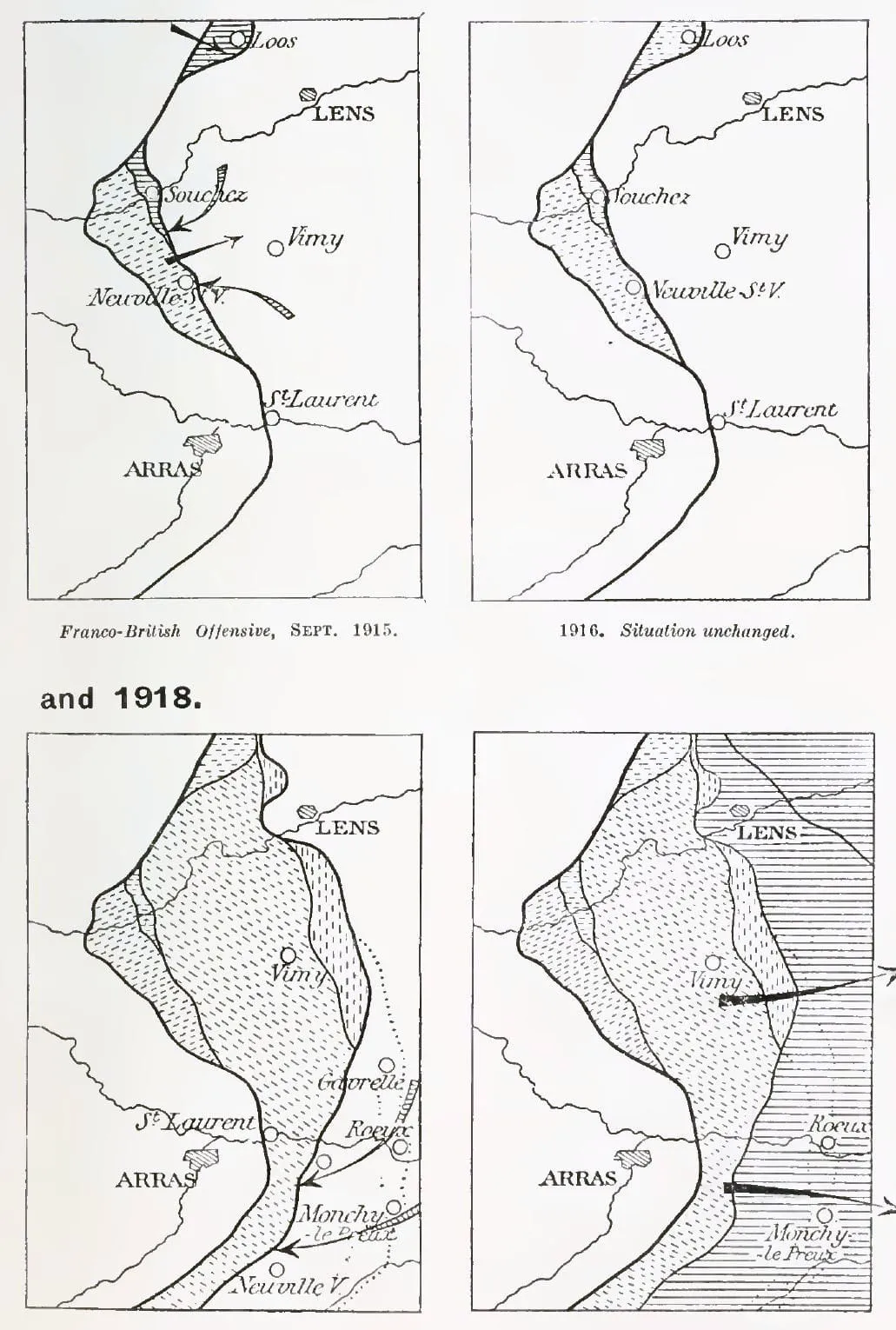
The First Battle of Arras was an attempt to extend the great German spring offensive northwards, onto the strongest sector of the British front. On the morning of 28 March 1918, Maundy Thursday, the seventh day of Operation Michael, General Otto von Below’s German Seventeenth Army struck on both sides of the river Scarpe at General Julian Byng’s British Third Army and the right wing of General Henry Horne’s First Army. The Germans called this attack Operation Mars. It was meant to smash the bastion of Arras, open the way to the north-west and give fresh impetus to an offensive that was clearly flagging on this wing. After a bombardment of several hours, similar to that of 21 March, nine German divisions fell upon four British ones. This time, however, there was no fog, and the defence had been carefully prepared. The Germans took the forward zone of the position and in places came up to the main line of resistance, but along the whole front from the Somme to Oppy they were thrown back with enormous losses. In the evening Erich Ludendorff forbade any renewal of the attack. It was the first clear defeat of the spring offensive.
Name and dates
The name “First Battle of Arras, 1918” and the date of 28 March 1918 were fixed after the war by the British Battles Nomenclature Committee. The word “First” distinguishes it from the Second Battle of Arras of August 1918, not from the great British offensive of April 1917, which is counted separately. The committee included in the battle all the fighting of the Third Army and the First Army’s XIII Corps on that day, from the Ancre valley near Albert to Oppy, and thus also the repulsed attacks on Hébuterne, Bucquoy and Ayette. Operation Mars proper, however, covered only a sector of roughly 16 km on both sides of the Scarpe. The Germans divided it into two parts: “Mars Süd” south of the river and “Mars Nord” north of it. This division is used below. In the German view the battle was part of the “Great Battle in France”, that is Operation Michael, within the whole spring offensive.
Background
Before the offensive both the Supreme Army Command (OHL) and the staff of Crown Prince Rupprecht of Bavaria’s army group had judged an attack on Arras too difficult. Below had wanted from the start to extend the front of his attack as far as the Scarpe, but there were not enough troops. It was therefore agreed that Operation Mars would follow only a few days after the start of Operation Michael, once the artillery it needed had been freed, and only in the part south of the river. The British official history notes that the whole plan depended on the success of the Seventeenth Army, and that too little attention had been paid to its difficulties.
And so it turned out. When on 21 March Hutier’s Eighteenth Army and Marwitz’s Second Army broke deep into the lines of the British Fifth Army, the Seventeenth Army met stiff resistance from the Third Army at Arras and on the edge of the Flesquières salient and advanced slowly. On the night of 22–23 March the British XVII Corps abandoned without a fight the hill and village of Monchy-le-Preux, taken with such difficulty in April 1917. The Seventeenth Army then reported that it had taken them by storm, which misled both OHL and Rupprecht. When the Third Army fell back onto the Somme battlefield, its left wing at Arras stayed almost in place, like a pivot. On 23 March Ludendorff gave the Seventeenth Army the direction of attack towards Arras and Saint-Pol-sur-Ternoise. On the morning of 25 March he instructed Rupprecht’s chief of staff, General Hermann von Kuhl, that the British front on both sides of the Scarpe as far as the Lens coalfield was to be “shaken and broken” by the attacks Mars Nord and Mars Süd, and a day later by the attack Walküre of the Sixth Army’s left wing between Lens and the La Bassée canal. Beyond that the attack was to proceed on both sides of Arras, with the main weight on the Lorette heights, and OHL set Boulogne-sur-Mer as the Sixth Army’s objective. Since the attack required careful preparation, the date was set for 28 March.
On 27 March the Seventeenth Army was still standing still. Rupprecht asked OHL for three divisions for its right wing. When he learned in the afternoon that they had been refused, he exclaimed, according to the British official history: “then we have lost the war”. The attacks of the Seventeenth Army’s left wing were halted until Operation Mars could improve the situation. Meanwhile the so-called siege train, the mass of heavy artillery and mortars that had supported the first blow on 21 March, was brought up to Arras.
Forces and defences
The main blow fell on four British divisions: the 3rd and 15th (Scottish) Divisions south of the Scarpe, and north of it the 4th Division of General Charles Fergusson’s XVII Corps and the 56th (London) Division of the First Army’s XIII Corps. Two of them were Regular divisions, one belonged to the Territorials and one to Kitchener’s New Armies. Behind them there was nothing in reserve. Against them the Germans threw nine divisions, eight of them fresh, and two in the second line. Along the whole front from the Somme to Arleux-en-Gohelle, about 53 km long, 29 German divisions attacked that day, with 16 more in support. The British official history points out that this fight resembled, on a larger scale and on almost the same ground, the first day of the Battle of the Somme on 1 July 1916, only with the roles reversed.
The defences at Arras were far stronger than those the Fifth Army had taken over from the French. North of the Scarpe the British held the whole system of fortifications intact: the Forward Zone, the Battle Zone and the rear Green Line. Vimy Ridge, taken by the Canadians in April 1917, gave them excellent observation over the Douai plain. South of the river the 3rd and 15th Divisions, after the retreat, were defending the former Battle Zone, which had now become the front line. First Army intelligence had predicted that the attack would reach no further north than the wood near Oppy, and on 23 March a prisoner stated that it would begin on 25 March. From that day the British artillery shelled the German rear areas every night. On 27 March Horne, knowing the fate of the Fifth Army’s forward zone, ordered XIII Corps to leave only outposts in it. In the end the corps commanders agreed that the forward zone would not be abandoned, but that the front line itself would be lightly held. The divisions sited their machine guns in depth, in concealed nests surrounded by wire invisible from the air, and the 56th Division’s artillery was moved on the night before the attack to alternative positions.
Course
The bombardment. At three in the morning on 28 March the German artillery opened fire along the whole front of VI, XVII and XIII Corps. It began with mustard gas shells on the battery positions, while long-range guns struck command posts, telephone exchanges and approach roads. According to Rupprecht’s orders the batteries were to be gassed from 3.00 to 4.30 a.m., the objectives of the attack shelled from 4.30 to 7.30 a.m., and at 7.30 a.m. the infantry was to go in. At the end came a hurricane of trench-mortar fire. Almost all the buried cables between observation posts and batteries were destroyed, and the SOS signals could not be seen. The weather, until then fine, though cold and with morning mist, clouded over during the night. There was, however, no fog.
Mars Süd. South of the Scarpe some of the German infantry set off earlier than the plan foresaw. The first attacks on the 3rd Division began at 5.50 a.m., and on the other brigades of both divisions between 6.00 and 7.30 a.m. Despite losses from the bombardment, most of the machine guns and mortars hidden underground survived, so the waves of infantry advancing through the smoke ran into fire from all sides. After 7.00 a.m. the Germans, advancing along the Arras–Cambrai road and under cover of the undulating ground south-west of Monchy, got through a small gap into the rear of two Scottish brigades. By 8.30 a.m. the 3rd and 15th Divisions had lost the front line of the Battle Zone but were holding its rear line. From 8.40 a.m. the Germans launched successive assaults, each preceded by a bombardment they called down with green flares. One eyewitness later called them a model of perfect infiltration. At about 1 p.m., partly as a result of a misunderstanding over which line was now the main one, both divisions began to fall back to the Green Line. The 9th Brigade held a stretch of the rear line until 3.30 p.m., and the 8th Battalion, King’s Own Royal Lancaster, defended the village of Neuville-Vitasse until 4.30 p.m. Fergusson sent the corps cyclist battalion and every man from the transport lines to the 15th Division. At about 5 p.m. the German attack on this sector ceased. In the evening the two Scottish brigades, together with the 4th Division’s 10th Brigade, counter-attacked and pushed the front a few hundred metres forward of the Green Line.
Mars Nord. The Germans directed their main effort north of the river, where seven divisions, including two from the second line, struck the 4th and 56th Divisions. The bombardment swept away most of the front-line outposts, but many of them had been abandoned. The last message from one of the outposts read: “The Germans are on the wire. We will do what we can.” Two fully manned posts, Towy Post south of Gavrelle and Wood Post near Oppy, held out until they were surrounded, and the 4 officers and 40 men who survived fought their way back to their own lines. At about 7.30 a.m. the German infantry set off across a no man’s land less than a hundred metres wide. Held up in a tangle of old trenches and wire, it lost the cover of the creeping barrage, and British machine guns and batteries on Vimy Ridge tore into the dense columns advancing, as the official history puts it, shoulder to shoulder through Gavrelle. The Germans nevertheless broke in along a shallow, marshy valley at the junction of the two divisions and turned their flanks. The 2nd Battalion, Essex Regiment, was surrounded and overwhelmed at about 10.30 a.m., losing 13 officers and 418 men. A company of the 2nd Battalion, Lancashire Fusiliers, cut off in a switch trench on the 4th Division’s left wing, was almost entirely destroyed. Second Lieutenant Bernard Cassidy was awarded a posthumous Victoria Cross for its defence. At about midday a German aircraft carrying three officers was shot down near Oppy. The pilot had on him a map with the plan of attack: eight divisions in the first line and one to take Arras, with the day’s objective on a line from Blairville through Arras to Arleux, followed by the attack Walküre on the coalfield near Béthune. Prisoners stated that they were to reach the sea in four days and had been issued rations for six.
The commanders of the 4th and 56th Divisions withdrew their brigades to the front line of the Battle Zone. The 56th Division was on it before 1 p.m. and the 4th Division by 1.45 p.m., and from that moment the front north of the Scarpe was continuous again. The Germans tried to bring field guns right up to the former British front line, but the divisional artillery destroyed them before they could open fire. Attacks at 4.15 and 5 p.m. broke down in a barrage of artillery, machine-gun and rifle fire. During the night the 4th Division’s 11th and 12th Brigades, pivoting on their left, swung back their right flank to a trench line running north from the weir at Fampoux, to close the gap by the river. In the afternoon it had begun to rain.
The rest of the Third Army’s front. To the south, VI Corps at Ayette, IV Corps with the New Zealanders, the 62nd and 42nd Divisions and an Australian brigade around Hébuterne, Rossignol Wood, Bucquoy and Ablainzevelle, and V Corps on the Ancre near Aveluy repulsed every attack. At Ayette German columns in march formation appeared on the horizon and kept coming until the artillery broke them up. The 3rd Australian Division even advanced a little between the Somme and the Ancre. According to the German historian Wolfgang Foerster, the fighting died down in the afternoon “partly on the orders of the commanders, partly owing to the attitude of the troops themselves”.
Losses
The British official history states that the Germans suffered very heavy losses, the total of which was never disclosed. Nor does it give a separate figure for British losses on that day, which it included in the overall toll of Operation Michael. Some front-line battalions suffered severely, such as the 2nd Essex or the 1/5th Battalion, London Regiment, which after reorganisation was left with 4 officers and 64 men out of 23 officers and 564 men. In the twenty-four hours from the morning of 28 March the British field artillery fired about 750 rounds per 18-pounder gun and 650 per field howitzer, one of the highest rates of ammunition expenditure of the whole war. Participants agreed, however, that the main part in stopping the Germans was played by skilfully sited machine guns. The Royal Flying Corps lost that day, over the whole front of the Third and Fifth Armies, 17 aircraft missing and more than 40 wrecked or abandoned, almost entirely to ground fire.
Significance
The British official history gives five reasons why the Germans achieved far less at Arras than on 21 March: the fortifications here were stronger because the British had held them longer; divisional frontages were somewhat shorter; the front line was more lightly held, although the forward zone as a whole was more strongly held; the bombardment was less accurate because of the shorter preparation; and above all there was no fog. German accounts added that the attack had been prepared too hastily, that some artillery commanders did not know the new bombardment methods, and that the infantry got stuck in uncut wire and a labyrinth of trenches. The German author Gustaf Goes wrote: “as the sun set behind the rain clouds, the hopes OHL had placed in the attack died too. Mars, to whom so much blood had been sacrificed, had failed to break the British salient at Arras.”
On the evening of 28 March Ludendorff, against the advice of Rupprecht’s army group to renew the attack with fresh forces after a few days, ordered that Operation Mars was not to be renewed, that the attack Walküre was to be cancelled, and that the Seventeenth Army was from then on to make only local attacks. The only direction that still held out hope was the sector where the front was fluid: the southern wing of the Second Army and the Eighteenth Army, attacking towards Amiens and the junction of the British and French forces. At the same time Ludendorff ordered the attack Georgette on the Lys towards Hazebrouck to be prepared as quickly as possible. Because he had not prepared such a “second act” in advance, moving the heavy artillery and ammunition was to take eight to ten days. The offensive against the Third Army had stalled for good, and the last attacks of Operation Michael on the Avre and the Ancre at the beginning of April failed to take Amiens. On 9 April the Battle of the Lys began.
The Battle of Arras showed that German stormtroop tactics and a short hurricane bombardment did not guarantee a breakthrough if the defender had strong positions in depth, good observation and was not blinded by fog. The bastion of Arras and Vimy Ridge remained in British hands until the end of the war, and the offensive that was meant to destroy the British Expeditionary Force drifted further and further to the south-west, where ground was easier to take but the strategic objective harder to achieve.
Spotted a mistake?Report an error