1917: Arras and the Nivelle Offensive
Battle of Arras (1917)
- Dates:
- 9 April – 16 May 1917
- Front:
- Western Front
- Location:
- Artois, Pas-de-Calais department, France. A stretch of front from Vimy Ridge and Givenchy-en-Gohelle in the north, through Arras and the Scarpe valley (Monchy-le-Preux, Rœux, Gavrelle), to Croisilles and Bullecourt on the Hindenburg Line in the southOn the battle map →
- Sides:
- United Kingdom, Canada, Australia, New Zealand, Newfoundland and the Union of South AfricaDouglas Haig, Edmund Allenby, Henry Horne, Hubert Gough, Julian ByngGerman EmpireErich Ludendorff, Rupprecht, Crown Prince of Bavaria, Ludwig von Falkenhausen, Otto von Below, Fritz von Loßberg
- Result:
- Inconclusive. On the first day the British advanced further than at any time since the start of trench warfare and the Canadians took Vimy Ridge, but the front was not broken. In five weeks a few kilometres were gained at a cost of about 150,000 men.
- Author:
- Łukasz Skowroń
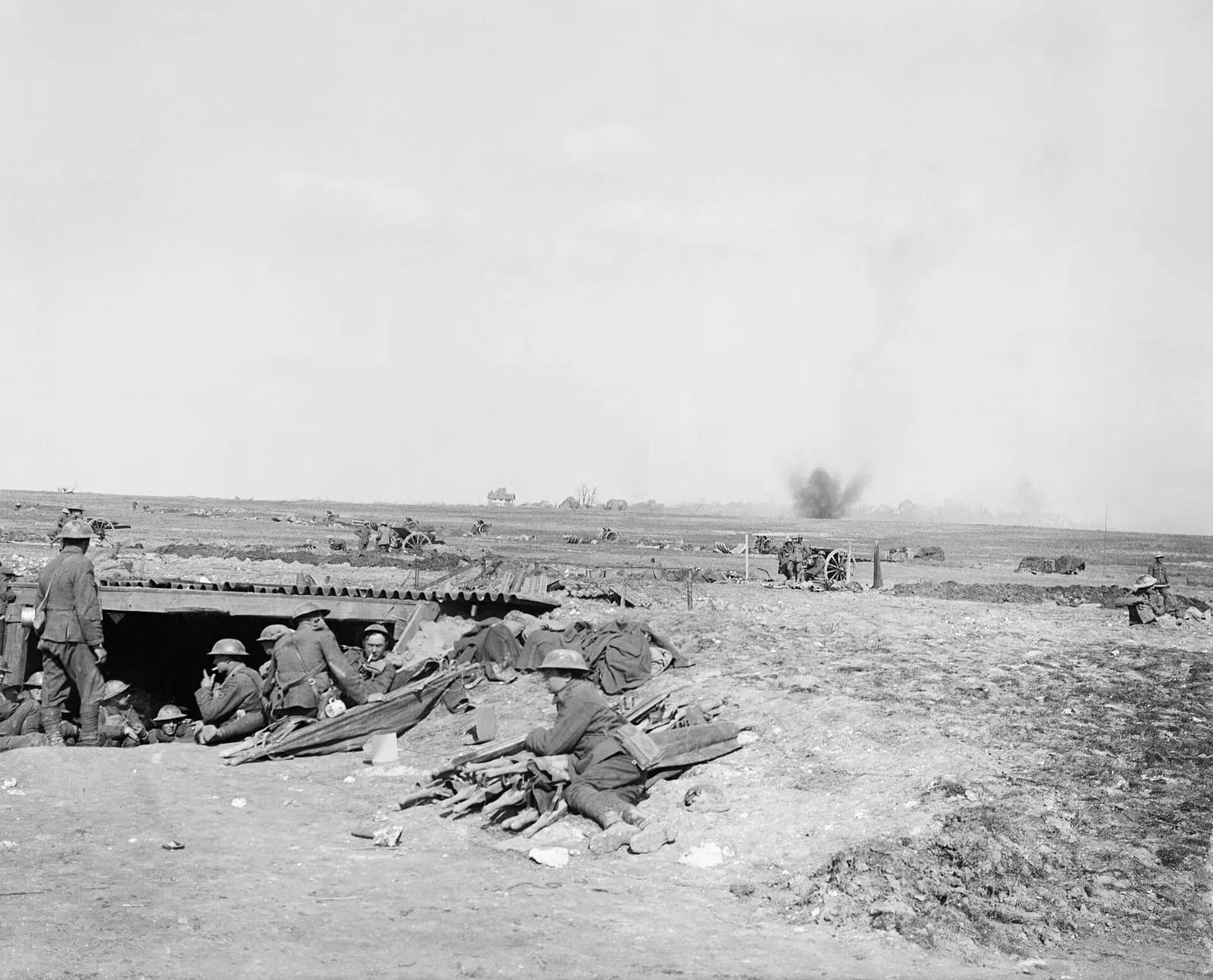
The Battle of Arras was the great British offensive of the spring of 1917. On Easter Monday, 9 April, three armies of the British Expeditionary Force struck the German positions around Arras in Artois: the Third Army on both banks of the Scarpe, the First Army’s Canadian Corps on Vimy Ridge, and a few days later the Fifth Army at Bullecourt. The attack was above all meant to draw in the German reserves ahead of the main French offensive on the Aisne. The first day was one of the British Army’s greatest successes of the whole war: the Canadians took almost all of Vimy Ridge, for which the French had fought in vain in 1915, and at Fampoux British troops advanced more than five kilometres, the furthest since the start of trench warfare on the Western Front. After only three days, however, the Germans had sealed the breach with fresh divisions, and the battle turned into a series of ever more costly attacks on the villages and hills above the Scarpe. Because the French offensive failed, the British had to go on attacking until mid-May. It cost them about 150,000 men, and the average daily loss was higher than on the Somme.
Name and dates
The British speak of the Battles of Arras 1917; the French and the Poles usually of the Battle of Arras, and, to distinguish it from the fighting of 1914, also of the Second Battle of Arras. The Germans called the first days of fighting the Easter Battle (Osterschlacht). We adopt the dates 9 April – 16 May 1917, as most studies do. The British Battles Nomenclature Committee divided the offensive into several battles: the First Battle of the Scarpe (9–14 April) and the Battle of Vimy Ridge (9–12 April; the committee counts it up to 14 April, but the fighting for the ridge itself ended on 12 April with the capture of the Pimple, and on 13–14 April the Germans withdrew to the Oppy – Méricourt line), the Second Battle of the Scarpe (23–24 April), the Battle of Arleux (28–29 April) and the Third Battle of the Scarpe (3–4 May). It separately included in it the operations on the flank: the first attack on Bullecourt (11 April), the German attack at Lagnicourt (15 April) and the Battle of Bullecourt (3–17 May). The British official history (Cyril Falls, Military Operations France and Belgium 1917, volume I), the main source of this page, also describes minor attacks up to 24 May, and the official nomenclature includes among the Battles of Arras even the later fighting at Lens. These, however, were local in character.
Background
The plan for 1917 was born in the autumn of 1916, still in the days of General Joffre. The British were then to attack between Bapaume and Vimy, and the French between the Somme and the Oise, on both sides of the old battlefield of the Somme. When in December General Robert Nivelle took command of the French armies, he changed this scheme. The main blow was now to be struck by the French on the Aisne and the Chemin des Dames, with the promise of breaking the front within two days, and all operations north of the Oise became subsidiary. The British were to attack about a week earlier at Arras and draw the German reserves onto themselves. Field Marshal Douglas Haig accepted this role reluctantly, and the disputes over who was to give orders to whom ended at the Calais conference and in London in a compromise: for the duration of the offensive Haig was to follow Nivelle’s general directions, but kept command of his armies. The British government also backed him when Nivelle wanted to strike the capture of Vimy Ridge from the plan.
The plans were upset by the German withdrawal to the Hindenburg Line. On the sector of the British Fifth and Fourth Armies the objective of the attack vanished, and the Fifth Army, which had to cross a devastated belt of land, could support the main blow only with a local attack at Bullecourt. The Hindenburg Line now met the Third Army’s front at Telegraph Hill between Neuville-Vitasse and Tilloy. North of it, however, ran the old and very strong German positions, and at Arras the front had not moved at all. According to the British official history, much more now depended on the Third Army’s attack than in the original plan. It was given 18 divisions instead of the ten previously envisaged.
Plan and preparations
The plan was drawn up by the commander of the Third Army, General Edmund Allenby. His three corps, VII, VI and XVII, were to break the front between Croisilles and Vimy Ridge, taking in turn four lines marked on the maps in colours: black (the first position), blue (the second), brown (the Wancourt – Feuchy position south of the Scarpe and the Point du Jour line north of it) and green, with the village of Monchy-le-Preux, which dominated the surrounding country. The novelty was that after three divisions of each corps had taken the brown line, a fourth, fresh division was to pass through their ranks and take the green line. Behind the infantry waited the Cavalry Corps, which was to break out into open country and move towards Cambrai. At the same time the Canadian Corps of General Julian Byng, part of General Henry Horne’s First Army, was to take Vimy Ridge, covering the Third Army’s left flank and opening a view over the Douai plain. Allenby wanted to surprise the Germans with a short, 48-hour bombardment. Haig and his artillery adviser judged that the wire could not be destroyed in that time, and the bombardment was extended to four days.
The weight of fire was unprecedented in the British Army. According to the official history the Third Army, the Canadian Corps and part of I Corps together had 2,817 guns and howitzers against 1,014 German guns on the whole battle front. The Third Army alone had one gun for every 12 yards (about 11 metres) of front. Some studies state that more than 2.6 million shells were fired, over a million more than before the Battle of the Somme. The wire was destroyed by shells with the new No. 106 percussion fuze, which burst on contact with the ground, and by trench mortars. Counter-battery fire was directed on the basis of aerial bearings, sound ranging and flash spotting, and in the last hours before the attack the artillery drenched the German battery positions, headquarters and dugouts with gas shells. The infantry was to follow a creeping barrage moving forward 100 yards every four minutes. The Third Army received 40 Mark I and Mark II tanks, and more supported the Canadians and the Fifth Army. The preliminary bombardment at Arras began on 4 April, and on Vimy Ridge as early as the second half of March.
The most remarkable part of the preparations was the underground of Arras. The town centre lay only about two kilometres from the front line, and all traffic to the front had to pass through its shelled streets. Beneath the Grand’Place and the Petite Place, however, there were huge cellars, and beneath the suburbs of Ronville and Saint-Sauveur old chalk quarries, from which building stone had been extracted to rebuild the town in the 17th century. The British discovered them by chance in October 1916. Mainly the New Zealand Tunnelling Company linked them by tunnels with the Crinchon sewer and drove galleries right under no man’s land. The underground, lit by electricity, with piped water, gas-proof doors and a hospital, could hold 24,500 soldiers according to the official history. On the First Army’s front, under Vimy Ridge, the sappers dug twelve similar subways. Part of the quarries can be visited today as a museum.
On the German side the front from Lens to Quéant was held by the Sixth Army of Colonel-General Ludwig von Falkenhausen, part of the army group of Crown Prince Rupprecht of Bavaria. The German Supreme Army Command was already recommending a new, deep defence: a more lightly held forward zone and strong counter-attack divisions (Eingreifdivisionen) close behind the front. Falkenhausen and his chief of staff, Colonel von Nagel, however, did not expect the attack until about mid-April and kept five reserve divisions behind Douai, 15–20 miles (about 25–30 km) from the battlefield, so as not to expose them to shellfire. The front lines, by contrast, were densely held and were to be defended at all costs.
Course: the first day
At the request of the French the attack was postponed by one day and, instead of Easter Sunday, 8 April, it went in on Easter Monday, 9 April, at 5.30 a.m. In the morning there was sleet, and a strong westerly wind drove the snowstorm into the Germans’ faces. Behind the creeping barrage the infantry quickly took the shattered front lines. Many Germans came out of their deep dugouts straight into captivity. North of the Scarpe the 9th (Scottish) Division, with the South African Brigade, took the Point du Jour line, and the 4th Division passed through its ranks and took Fampoux. The official history writes that this was the furthest advance in a single day made by any of the belligerent armies on the Western Front since the start of trench warfare: about 3.5 miles, or more than five kilometres. South of the river the 15th (Scottish) Division took the Wancourt – Feuchy position, but the other divisions of VI Corps were stopped by machine-gun fire from Feuchy Chapel, and on the right flank VII Corps was held up in front of the intact wire of the Hindenburg Line. At the same time the Canadians took almost all of Vimy Ridge. In the evening the Third Army reported the capture of 5,600 prisoners and 36 guns. The cavalry did not go into action. Some infantry commanders, among them Brigadier-General Adrian Carton de Wiart, believed that individual squadrons could have got through that day, and warned that “tomorrow it will be too late”.
Course: the First Battle of the Scarpe and Vimy
The following days showed how hard it was to exploit success. Snowstorms, mud and ruined roads delayed the moving forward of the artillery, and German reserves were arriving. On 10 April the Canadians took Hill 145, the highest point of Vimy Ridge, and the British rounded off their gains on the Scarpe. On 11 April the 37th Division, with the help of tanks and units of the 15th Division, took Monchy-le-Preux, and the cavalry that entered behind it held the village under a storm of fire, losing a great many horses. The same day the Fifth Army of General Hubert Gough attacked the Hindenburg Line at Bullecourt. The 4th Australian Division went in without artillery cover, behind tanks that failed. The Australians broke into the German trenches but were cut off and lost more than three thousand men, over a thousand of whom were taken prisoner. On 12 April the Canadians took the hill known as the Pimple at the northern end of the ridge, and the British entered Wancourt and Héninel, abandoned by the Germans. The attacks on Rœux and Guémappe failed, and on 14 April a German counter-attack destroyed two battalions (from Newfoundland and from Essex) that had attacked the hill east of Monchy. On 15 April Haig halted the attack in order to prepare a new, better coordinated blow. The same day the Germans attacked the overstretched positions of the 1st and 2nd Australian Divisions at Lagnicourt, briefly took several batteries, but were driven back, losing more than twice as many men as the defenders.
By 11 April the Third Army had lost about 8,200 men, and together with the First Army about 13,000, and had taken more than 7,000 prisoners. The British official history compares this with the first day on the Somme, when with the same number of divisions in the front line losses amounted to 57,000. The defeat of the defence shook the German command. Ludendorff, who celebrated his birthday on 9 April, later wrote that he had awaited the attack with confidence, and after the first reports was deeply depressed. Colonel Fritz von Loßberg, the best German specialist in defence, became chief of staff of the Sixth Army. He withdrew most of the batteries out of range of counter-battery fire, thinned out the forward zone, and placed the counter-attack divisions close to the front. At the end of April Falkenhausen was removed and appointed governor-general of occupied Belgium. The Sixth Army was taken over by General Otto von Below.
Course: the fighting for villages and hills, April – May
On 16 April the French offensive on the Aisne began. When it quickly became clear that it would not bring the promised breakthrough, Haig had to go on tying down the Germans at Arras, although there was no longer an operational objective. On 23 April, St George’s Day, the Third and First Armies attacked again on the front from Croisilles to Gavrelle. In the Second Battle of the Scarpe they took Guémappe and Gavrelle, but at Rœux, by the chemical works there, and on the hills east of Monchy German counter-attacks took back what had been won in the morning. On 28 April, in the Battle of Arleux, the Canadians took Arleux-en-Gohelle, but British attacks on Oppy and Gavrelle failed. On 3 May three armies attacked simultaneously on a front more than 14 miles (over 22 km) long. The Third Battle of the Scarpe, begun in the dark at 3.45 a.m., was according to the official history “nothing less than a disaster”. The only lasting gain was the Canadians’ capture of Fresnoy, which the Germans in any case retook on 8 May. The same day the Australians and British attacked Bullecourt again and for two weeks fought an exceptionally bitter battle there in the trenches of the Hindenburg Line. The ruins of the village were finally taken by the Londoners of the 58th Division on 17 May. A few days earlier, on 11–14 May, the chemical works and Rœux had at last been taken. Haig then moved the artillery and reserves to Flanders, where in June he struck at Messines.
Bloody April
The Battle of Arras was also one of the hardest trials of British air power. The Royal Flying Corps carried out reconnaissance, photographed positions and directed artillery fire, and from 5 April also an air offensive meant to drive German aircraft away from the battlefield. The German fighter squadrons, flying the new Albatros D.III fighters, nevertheless had technical superiority and better-trained pilots. The most dangerous was Jasta 11 of Manfred von Richthofen, based near Douai. According to various studies, in April 1917 the British lost 245–275 aircraft and more than two hundred airmen killed or missing, and the Germans about 66 aircraft. British airmen called the month “Bloody April”. Despite the losses the air arm carried out its tasks and supplied the artillery with photographs and reports.
Losses
According to the return of the British Adjutant-General, in April and May 1917 the three armies taking part in the offensive lost 158,660 men: the Third Army 87,226, the First Army 46,826 and the Fifth Army 24,608. The British official history notes that this figure also includes losses from the fighting for outposts before 9 April and from sectors outside the battlefield, and estimates the actual losses of the offensive at a little under 150,000. This figure included more than 10,000 Canadians from Vimy and more than 10,000 Australians from Bullecourt and Lagnicourt. Because the battle was short, frequently quoted calculations give an average of more than 4,000 killed, wounded and missing a day, more than in any other major British offensive of the war, including the Somme and Passchendaele.
German losses are less certain. According to the German official history the Sixth Army lost 79,418 men in April and May, including 22,792 missing, and according to Rupprecht about 85,000. These figures do not include losses on the sector opposite the Fifth Army, and German returns did not count the lightly wounded, so they must be increased for comparison with the British figures. The British took more than 20,000 prisoners in April and May. The official history considers that, apart from the first days, the losses of both sides were similar, and that in unsuccessful attacks, as at Bullecourt or on 3 May, the attacker paid considerably more.
Significance
The first days at Arras showed what the British Army had learned on the Somme. Thanks to its huge superiority in artillery, better ammunition, the creeping barrage, counter-battery fire and careful preparation, the infantry got through defences in front of which it had died in thousands a year earlier. The capture of Vimy Ridge became a national symbol in Canada. The British official history notes, however, that the success was due in large part to the mistakes of the German defence, and once the Germans had corrected them the battle quickly took on a “painfully familiar” appearance: the attacker gained ground in the first blow, and then every further kilometre cost more and more. The British also failed to exploit the break-in. The cavalry did not break out into open country, and the command was unable to move the artillery and fresh divisions quickly across the devastated ground.
Strategically the battle fulfilled its role only in part. It drew a considerable part of the German reserves to Arras, but it did not save the Nivelle offensive, which ended in failure, and mutinies broke out in the French Army. From then on it was the British Army that had to bear the main burden of the fighting on the Western Front. Allenby, whose subordinates criticised him for persistent small attacks, left in June for Egypt, where he took command of the forces fighting the Turks. His place at the head of the Third Army was taken by Byng, and the Canadian Corps for the first time received a Canadian commander, General Arthur Currie.
Spotted a mistake?Report an error
Battles and phases
(06)- 9–12 April 1917Battle of Vimy RidgeOn 9–12 April 1917 the four divisions of the Canadian Corps took Vimy Ridge near Arras, which the French had failed to retake in 1915 despite huge losses.
- 9–14 April 1917First Battle of the Scarpe (1917)From 9 to 14 April 1917 the British Third Army broke through German positions east of Arras and took Monchy-le-Preux, but could not reach open country.
- 23–24 April 1917Second Battle of the Scarpe (1917)On 23–24 April 1917 the British renewed their attack at Arras. They took Guémappe and Gavrelle, but German counter-attacks stopped them at Rœux and Monchy.
- 28–29 April 1917Battle of ArleuxOn 28–29 April 1917 the Canadians took Arleux-en-Gohelle, the only lasting gain of the attack, as the British attacks at Rœux, Gavrelle and Oppy failed.
- 3–4 May 1917Third Battle of the Scarpe (1917)On 3 May 1917 three British armies attacked at Arras in the dark. The assault failed almost everywhere. The only gain was Fresnoy, taken by the Canadians.
- 3–17 May 1917Battle of BullecourtFrom 3 to 17 May 1917 Australians and British fought for a breach in the Hindenburg Line and the ruins of Bullecourt, taking them at a cost of over 14,000 men.