1917: Arras and the Nivelle Offensive
Battle of Bullecourt
- Dates:
- 3–17 May 1917
- Front:
- Western Front
- Location:
- The village of Bullecourt and the stretch of the Hindenburg Line between Bullecourt and Quéant, south of Riencourt-lès-Cagnicourt, some 15 km south-east of Arras, Pas-de-Calais department (France)On the battle map →
- Sides:
- United Kingdom and AustraliaDouglas Haig, Hubert Gough, William Birdwood, Edward FanshaweGerman EmpireRupprecht, Crown Prince of Bavaria, Otto von Below, Otto von Moser
- Result:
- A costly British tactical success. The Australians held and widened their breach in the Hindenburg Line and the British took the ruins of Bullecourt. There was no breakthrough, and losses exceeded 14,000 men.
- Author:
- Natalia
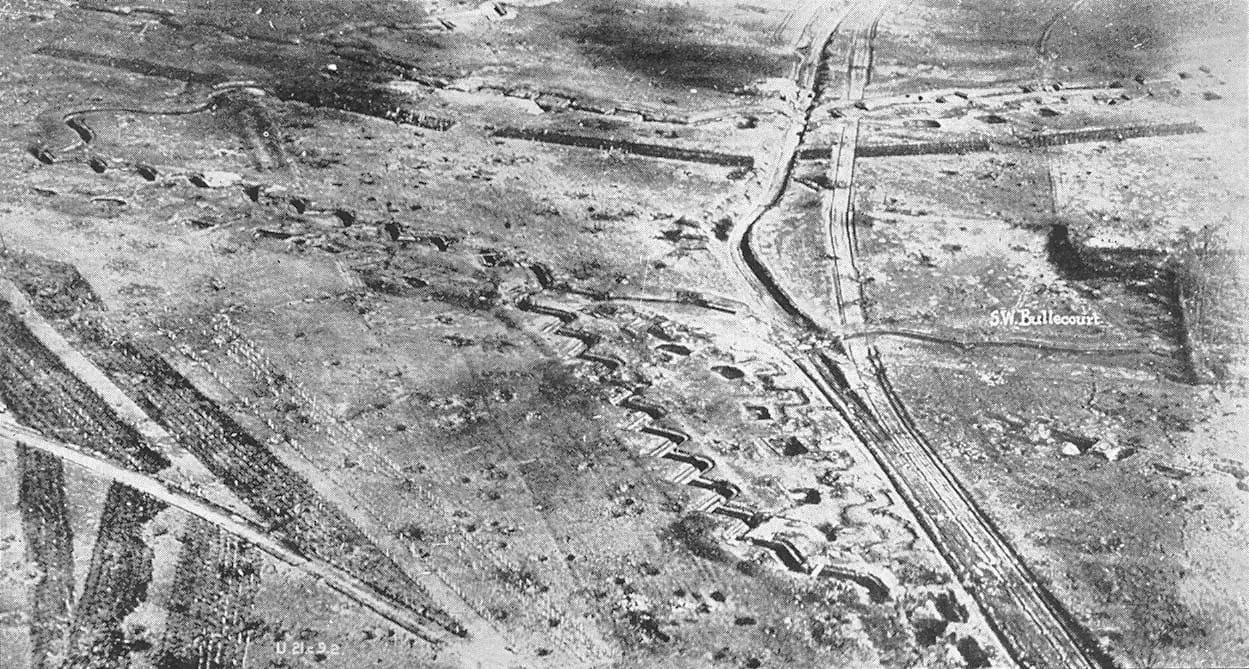
The Battle of Bullecourt was the longest and bloodiest episode of the final phase of the Battle of Arras. Early on 3 May 1917, at the same time as the Third Battle of the Scarpe, General Hubert Gough’s Fifth Army attacked the Hindenburg Line for the second time at the village of Bullecourt, where on 11 April the 4th Australian Division had suffered a heavy defeat. This time the 2nd Australian Division broke into the German trenches east of the village and held a small lodgement there, but the British 62nd Division failed to take Bullecourt itself. An attack meant to last one day turned into a two-week struggle for a few hundred metres of trench and a few hectares of rubble. Successive Australian and British divisions widened the breach with bombs, while the Germans counter-attacked again and again, including with flamethrowers. On 17 May Londoners of the 58th Division took the last scrap of the ruins. Both sides suffered enormous losses, and in Australian memory the battle remained one of the hardest of the whole war.
Name and dates
The British Battles Nomenclature Committee named the fighting of 3–17 May 1917 the Battle of Bullecourt and counted it among the Battles of Arras. It counts the attack of 11 April separately as the first attack on Bullecourt. In Australia people usually speak of the First and Second Battles of Bullecourt (First and Second Bullecourt), and this page is devoted to the second of them. The chronology on which our calendar is based gives 2 May as the start of the battle. All sources, however, including the British official history (Cyril Falls, Military Operations France and Belgium 1917, volume I) and the Australian War Memorial, date the assault to the early morning of 3 May, and we adopt that date. The capture of the western part of the ruins on 17 May is taken as the end of the battle, although minor clashes continued for a few more days, and later the British attacked the Hindenburg Line in the area several times. Times are given according to the official history, that is, in British time.
Background
After the spring German retreat to the Hindenburg Line the Fifth Army front faced new fortifications which formed a concave arc at Bullecourt and Quéant. The line consisted of two parallel trenches (front and support), covered by broad belts of wire, with deep dugouts. The village of Bullecourt itself, turned into a fortress, formed a salient in this line. On 11 April Gough had attacked here in haste, hoping that the Third Army at Arras would break through. The 4th Australian Division went in without artillery cover, behind tanks that failed, and lost over 3,000 men, more than 1,000 of whom were taken prisoner. Four days later the Germans struck the overextended Australian positions at Lagnicourt and were repulsed.
Gough at once began preparing a second attack. The order was issued on 12 April for 15 April, but the date was postponed many times. After their experience of 11 April the Australians did not trust tanks and wanted to attack without them, which required very thorough artillery preparation. Gough also wanted to wait until the Third Army reached the little river Sensée. In the end, according to the Australian official historian Charles Bean, the date of 3 May was confirmed on 30 April. By then the aim of the attack had changed. In April Bullecourt was to have been a gateway into the German rear after the expected breakthrough at Arras. In May it was only a matter of supporting the right wing of the Third Army. Field Marshal Douglas Haig was by then essentially resolved to end the Arras offensive and shift the main effort to Flanders. The May attacks were above all meant to pin the Germans in place, help the French after the collapse of the Nivelle offensive and encourage them to keep attacking.
Plan and preparations
General William Birdwood’s I ANZAC Corps was to attack on the same sector as on 11 April, on both sides of the road from Noreuil to Hendecourt, known as Central Road. On its left General Edward Fanshawe’s V Corps was simultaneously to take Bullecourt itself and the Hindenburg Line on a stretch of about 1.4 km north-west of the village. Each corps put one division into the assault: General Nevill Smyth’s 2nd Australian Division, with the 5th and 6th Brigades in front, and General Walter Braithwaite’s British 62nd (2nd West Riding) Division, made up of Territorial units from Yorkshire, which had never yet taken part in a major battle. Only the British were supported by ten tanks. The first objective was the support trench of the Hindenburg Line on a front of about 3.7 km, the second the road from Quéant to Fontaine, and the third the villages of Riencourt and Hendecourt. The official history notes that an attack fanning out in this way was hard to direct, and that the salient won could only be held if the Third Army joined up with it from the north.
This time there was no shortage of artillery. From 12 April heavy batteries shelled the wire, the trenches and the German batteries, and the remains of the houses in Bullecourt were levelled. The great cellars in which the defenders sheltered survived, however. There was one heavy gun to about every 20 yards (18 metres) of front and one field gun to about every 11 yards. Light railways and rebuilt roads across the belt of land devastated by the Germans made it possible to bring up ammunition. The infantry rehearsed the attack on ground laid out to resemble the German trenches. On the other side of the sector stood Group Quéant, a corps commanded, according to the British official history, by General Otto von Moser, with the Württemberg 27th Division in Bullecourt and the 2nd Guard Reserve Division to its east. From 28 April the Sixth Army was commanded by General Otto von Below, with Colonel Fritz von Loßberg as his chief of staff.
Course of the battle: 3 May
The attack began at 3.45 a.m., still in darkness, behind a creeping barrage. On the Australian right the 5th Brigade bunched up in the dark in front of the wire, ran into machine-gun crossfire and, after someone shouted to retire, fell back to the sunken road from Bullecourt to Quéant. Only small parties of it reached the German trench. On the left General John Gellibrand’s 6th Brigade found the wire well cut and by 4.18 a.m. had taken both trenches of the Hindenburg Line. Gellibrand, who could see the battlefield from his post on the railway embankment, practically directed the whole attack throughout the day and soberly assessed over-optimistic reports. Some of his men reached the second objective, but with no neighbours on their flanks they had to fall back to the captured trenches. In the afternoon a battalion of the 7th Brigade tried three times to bomb its way along the trenches east of Central Road and was driven back three times. In the evening, when men of the 5th Brigade withdrawing from shell holes were mistaken for Germans, an order to retire was issued. The 6th Brigade ignored it and held its lodgement.
The 62nd Division’s attack ended in failure. Battalions of the right brigade managed to enter Bullecourt and even pass through the village, but support did not arrive. The centre and left brigades were held up in front of imperfectly cut wire, became mixed up in the dark and smoke, and largely fell back to the railway embankment. Three tanks drove into the village and others crossed the Hindenburg Line north-west of it, but the infantry did not follow them. By noon the Germans had killed or captured almost all the parties that had broken into their positions. The division lost nearly 3,000 men that day. An evening and night attack by the 7th Division on Bullecourt also failed, although ten men of the Honourable Artillery Company held out in the ruins for three days and nights.
Course of the battle: 4–6 May
Birdwood gave Smyth brigades of the 1st Australian Division. On the night of 3/4 May fresh battalions moved up to the lodgement along a communication trench dug under fire, known as Pioneer Avenue, and the exhausted remnants of the 6th Brigade could at last leave the line. On the afternoon of 4 May the Australians widened the breach by bombing in both directions until it took in just over a kilometre of the Hindenburg Line. The Germans answered with ever heavier shelling and counter-attacks. The most dangerous came on 6 May. An attack from the north was broken up by the Australian barrage, but along the front trench the Germans advanced rapidly with flamethrowers and pushed the defenders back to Central Road. The situation was saved by Corporal George Howell, who leapt out of the trench and, running along its edge, bombed the Germans. The Australians counter-attacked and recovered the lost trench. Howell was wounded and received the Victoria Cross. According to the official history the Germans had made half a dozen major counter-attacks by 6 May, and in the meantime the 27th Division had been replaced by the 3rd Guard Division.
Course of the battle: 7–17 May
On 7 May at 3.45 a.m. a battalion of the Gordon Highlanders of the 7th Division took the south-eastern corner of Bullecourt, and Australian bombers of the 1st Brigade fought their way through to it along the Hindenburg Line. The British official history regards this Australian attack as a model of bombing in trenches. From then on the battle was a series of attempts to clear the whole village, especially the western scrap of ruins overlooking it, marked on maps as the Red Patch, and of German counter-attacks. The 5th Australian Division entered the fight, which General Talbot Hobbs, despite protests against so short a rest, had to send to Bullecourt. On 12 May the British 91st Brigade occupied most of the village, and the Australian 58th Battalion took the defences by the road from Riencourt to Bullecourt, capturing 186 prisoners. Lieutenant Rupert Moon, who led the attack and was wounded three times, also received the Victoria Cross. The Red Patch was still in German hands, and further attacks on 13 and 14 May brought no lasting result. On the night of 12/13 May the sector of the 15th Australian Brigade was taken over by the fresh 173rd Brigade of the 58th Division.
Before dawn on 15 May the Germans attacked along the whole length of the breach. After a night-long bombardment in which, according to General Moser, 31 batteries fired about 60,000 high-explosive and gas shells, storm troops and the specially trained Lehr Regiment of the 3rd Guard Division went in. The attack had been in preparation since 9 May, and Loßberg had put it off several times to accumulate more ammunition. Australians of the 14th Brigade and Londoners of General Bernard Freyberg’s brigade beat it off with heavy German losses. Only in Bullecourt itself did the Germans regain part of the ruins west of the road to Longatte. The 7th Division, exhausted after twelve days of fighting, was relieved by the 58th Division. On 17 May at 2 a.m., after a bombardment of only two minutes, a battalion of the London Rifle Brigade took the Red Patch and a company of the Post Office Rifles cleared the rest of the village, taking several dozen prisoners. A German communiqué stated that Bullecourt had been evacuated according to orders. Prisoners testified, however, that the Londoners had surprised them while they were preparing to evacuate.
Losses
According to the official history, based on Bean’s calculations, I ANZAC Corps lost 292 officers and 7,190 other ranks, 7,482 men in all, and the Australian War Memorial gives the same figure. The 2nd Australian Division lost the most, over 3,800. V Corps lost about 6,800 men, including over 3,400 in the 62nd Division and almost 2,700 in the 7th Division. In total British and Australian losses exceeded 14,000, an average of 1,000 men a day. German losses are not known in full. Two divisions, the 27th and the 3rd Guard, were fully committed, as well as regiments of four others. According to German regimental histories the 27th Division alone lost over 2,500 men and the 3rd Guard Division over 2,000, not counting the lightly wounded.
Significance
Bullecourt was of little importance for the offensive as a whole. Haig kept up the fighting because he did not want the Germans to realise, from a sudden halt in the attacks, that the Battle of Arras was over, but above all because the Australians in the trenches of the Hindenburg Line could not be left there without taking the village that covered them. The official history writes that the Second Battle of Bullecourt gained a reputation as a slaughterhouse, typical of trench warfare in its most murderous form. By the end of the fighting the dead of both sides lay in heaps all over the battlefield and in the trenches. The same history, however, also stresses high tactical skill: Australian attacks with hand grenades and Lewis guns supported by flanking barrages, the courage of the young British divisions and the tenacity of the German counter-attacks.
For the Australians the two battles of Bullecourt, like the earlier fighting at Pozières, were a source of bitterness towards the British command, especially towards Gough, and of a distrust of tanks fixed in Bean’s works. After the battle I ANZAC Corps was withdrawn to rest, and by the autumn it was fighting in Flanders, where Haig had shifted the main weight of operations, beginning in June with the Battle of Messines. Bullecourt today has an Australian memorial park with a statue of a soldier, and Australian ceremonies are held there on Anzac Day.
Spotted a mistake?Report an error