Key event
Battle of Bullecourt begins
- Category:
- Military operations
- Front:
- Western Front
- Date:
- 3 May 1917
- Author:
- Natalia
- Battle:
- Battle of Bullecourt
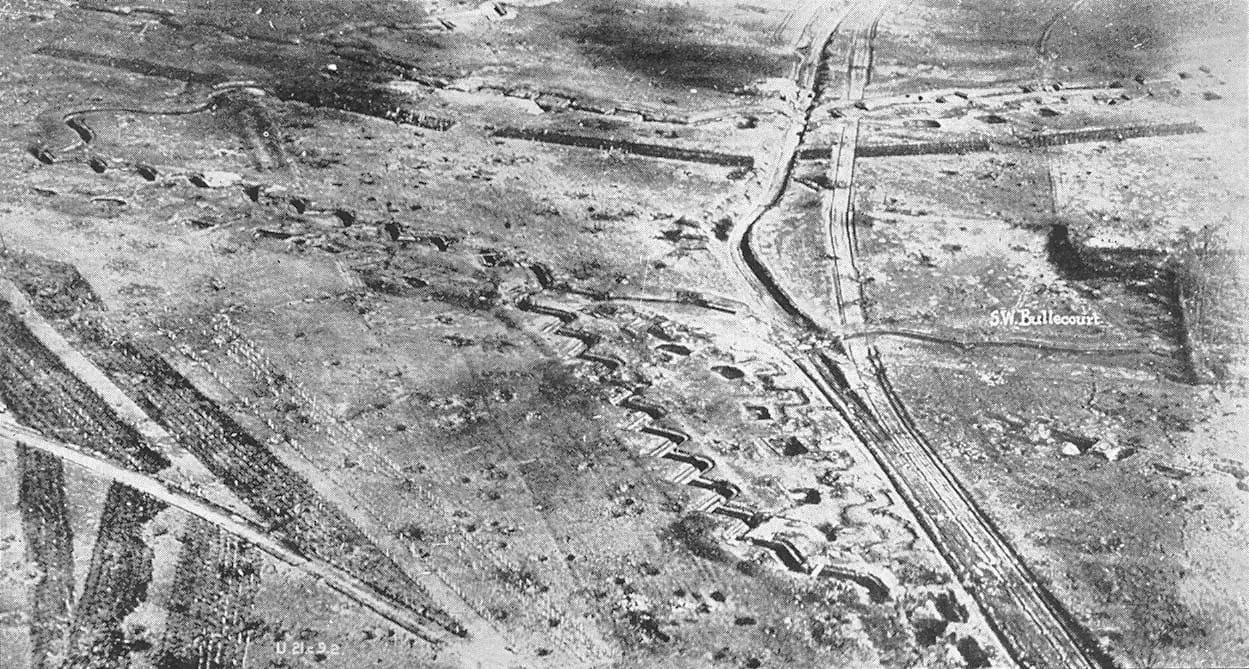
Early on the morning of 3 May 1917 General Hubert Gough’s Fifth Army attacked the Hindenburg Line at Bullecourt for the second time, a dozen or so kilometres south-east of Arras. The attack began at 3.45 a.m., at the same moment as the Third Battle of the Scarpe to the north of it, and was part of the last great British effort in the Battle of Arras. The chronology on which our calendar is based gives 2 May as the start of the battle, but the British official history and the Australian War Memorial agree in dating the assault to 3 May. The day brought the British only one lasting gain: a small foothold which the Australian 6th Brigade won and held in the trenches of the Hindenburg Line east of the village. From it grew a two-week, exceptionally bloody battle.
The second attempt
Three weeks earlier, on 11 April, the 4th Australian Division had attacked the same re-entrant of German fortifications between Bullecourt and Quéant behind tanks that failed, and lost more than three thousand men. This time the preparations took almost three weeks, and the date was postponed many times. The Australians refused to work with tanks, so their attack was based on the artillery. From 12 April heavy guns destroyed the wire and levelled the remains of the houses in Bullecourt, and at night they shelled the approach roads. The infantry rehearsed the attack on ground laid out in the shape of the German trenches. Two divisions were to strike: General Nevill Smyth’s 2nd Australian Division of I ANZAC Corps to the right of the village, on both sides of the road from Noreuil to Hendecourt known as Central Road, and the British 62nd (2nd West Riding) Division of V Corps against Bullecourt itself and the Hindenburg Line west of it. The objectives were, in turn, both trenches of the Hindenburg Line, the road from Quéant to Fontaine, and the villages of Riencourt and Hendecourt.
The plan had weak points. To keep the attackers clear of the wire of the village and of Quéant on either side of the re-entrant, the front of the Australian attack was narrowed. The sectors on the flanks would then have to be taken by bombing along the trenches. On the left flank, between the Australians and the 62nd Division, about 300 yards (270 metres) of both trenches were neither attacked frontally nor even shelled. The night was so bright with moonlight that the tapes marking the jumping-off line were laid several dozen metres further back than planned.
Australians in the Hindenburg Line
On the right flank the 5th Australian Brigade met with disaster. In the darkness the men bunched into clusters in front of the almost destroyed wire and came under crossfire from machine guns. Some went on, others hesitated, and when someone shouted an order to retire, they all fell back to the sunken road from Bullecourt to Quéant. Only small groups from its left flank got into the German trench. Brigade headquarters reported for a long time that its objective had been taken.
To its left, General John Gellibrand’s 6th Brigade found the wire well cut, jumped into the first trench and at 4.18 a.m. took the second. Only the left flank of the 22nd Battalion, fired on from the flank from Bullecourt, had to fall back. Gellibrand had his command post on the railway embankment and was the only one who from the start understood well what was happening. At 4.57 a.m. he reported to division that three battalions of the 5th Brigade were withdrawing, and according to the British official history he practically directed the attack along the whole front throughout the day. He sent Captain W. R. Gilchrist, an engineer attached to his staff, to rally the men in the sunken road. After 5.45 a.m. a company of the 26th Battalion and about two hundred men of the 5th Brigade went forward again, but under fire they broke just short of the German trench. Gilchrist jumped into the trench with a handful of men, fought for a long time with grenades to break through to the east, and was killed.
Part of the 6th Brigade reached the second objective, the road from Quéant to Fontaine. Captain P. G. R. Parkes of the 23rd Battalion, seeing that nobody was advancing on his right and that the Germans were firing from the trenches across Central Road, turned his men back on his own initiative and lined them up along the road, covering the flank. General William Birdwood, the corps commander, at first ordered the advance to continue according to plan, but cancelled the order when he learned of the real situation and of the failure of the 62nd Division. The men on the second objective beat off a counter-attack from the direction of Riencourt, but when shells from their own artillery began falling on them, they returned to the trenches of the Hindenburg Line. Smyth further ordered the 25th Battalion to attack Bullecourt from the south-east across open ground. Gellibrand considered this impracticable and advised sending two platoons first. These were pinned down by fire, and the further attack was cancelled.
In the afternoon the 28th Battalion of the 7th Brigade entered the trenches of the Hindenburg Line and from the second one began clearing them with grenades east of Central Road. Three times it got close to the road from Noreuil to Riencourt, about 450 metres further on, and three times it was driven back, the last time at 8.40 p.m. Immediately afterwards, in the half-light, men were seen moving across the field towards Central Road. They were soldiers of the 5th Brigade who had lain all day in shell holes and were now withdrawing, but they were taken for Germans trying to cut off the foothold. The exhausted 28th Battalion was ordered to retire, and the remnants of other units withdrew with it. The 6th Brigade, however, ignored the order passed to it. Small groups blocked the communication trench from Riencourt and manned Central Road. The foothold, a few hundred metres wide, remained in Australian hands.
Failure at Bullecourt
General Walter Braithwaite’s 62nd Division, made up of Territorial units from the West Riding of Yorkshire, had been at the front for little more than two months and had never yet taken part in a major battle. It attacked with all three brigades, with the help of ten tanks, two of which were held in reserve. On the right flank the 185th Brigade was to take the village itself. A north-easterly wind blew smoke into the attackers’ eyes, and machine-gun fire inflicted heavy losses on them. Even so, the 2/5th West Yorkshire battalion went through the ruins as far as the northern edge of the village, and part of another battalion established a post near the church. Support did not arrive: a company sent to help was held up in front of the wire and, seeing its neighbours falling back, returned to the railway embankment.
To its left, the 186th and 187th Brigades were held up in the darkness and confusion in front of wire that had not been fully cut. Some men passed the first trench without recognising it, most fell back to the railway embankment, and a renewed attack at 9.30 a.m. broke down under machine-gun fire. A group from two battalions got through as far as the factory north of Bullecourt, where an airman spotted it in the afternoon. Three tanks drove into the village. One cruised about in it for at least an hour and a half and then burned. The crew of another, with four wounded, exchanged them for fit men from a broken-down tank and went back into the fight. The commander of the third got out to persuade the infantry to follow him, but without result, and when he returned so many of his men had been wounded by armour-piercing bullets that the tank could not fight on. By noon the Germans had killed or captured almost all the parties that had broken into their positions. The division lost nearly three thousand men and was incapable of further attack.
Without Bullecourt the Australians could not hold for long their foothold, which was fired on from the village on its flank. The commander of V Corps, General Edward Fanshawe, therefore threw the 7th Division into the fight. Its 22nd Brigade attacked the village at 10.30 p.m. from the direction of the railway embankment. The Honourable Artillery Company battalion reached the centre of the village and the Royal Welch Fusiliers took a trench on its southern edge, but counter-attacks, one of them along the uncaptured stretch of the Hindenburg Line between the two divisions, threw both battalions out. Ten men of the Honourable Artillery Company survived in the ruins. A renewed attack at 4 a.m. on 4 May was broken up by heavy German shelling that fell exactly on the jumping-off line.
The day’s balance
After twenty-four hours of fighting the British had achieved nothing beyond the 6th Brigade’s foothold, and even that seemed very precarious. The Third Battle of the Scarpe north of Bullecourt had also failed, and VII Corps, whose attack was to link up with the Australians from the north, had been unable to hold Chérisy. The official history nevertheless judged the 6th Brigade’s feat the most impressive of the whole battle and wrote of its soldiers that they had written one of the most glorious pages in the history of Australian arms. On the night of 3 to 4 May they were relieved by battalions of the 1st Australian Division through a communication trench dug under fire. Since the foothold could neither easily be abandoned nor held without taking the village, Haig decided to fight on. A battle of attrition began in which, over the next two weeks, the Australians and the British threw brigade after brigade into the fight over a few hectares of ground.
Remember the articles you have read? Only in this browser; nothing is sent anywhere.How it works
Read ·
Spotted a mistake?Report an error
Meanwhile
(04)Elsewhere in the same days.
- 3 May 1917 · PoliticsApril CrisisOn 3 May 1917 the papers published Milyukov's note on war to victory. Soldiers marched on the seat of government and Petrograd saw two days of demonstrations.
- 2 May 1917 · Balkan FrontZaimis prime minister of Greece once moreIn early May 1917 King Constantine dismissed the Lambros cabinet and for the third time in the war turned to Alexandros Zaimis, a friend of the Entente.
- 4 May 1917 · War at seaAmerican destroyers at QueenstownOn 4 May 1917 six destroyers under Commander Taussig reached Queenstown in Ireland, the first US Navy ships sent to fight the U-boats off Europe.
- 5 May 1917 · Balkan FrontBattle of the Vardar beginsOn 5 May 1917 French and Italian artillery began shelling positions in the Crna bend. On the Vardar the French and Greeks moved the front forward.
Related events
(04)The same battle, people or subject.
- 17 May 1917 · Western FrontEnd of the Battle of BullecourtOn 17 May 1917 Londoners of the 58th Division took the last of the ruins of Bullecourt. The two-week fight cost the Australians and British over 14,000 men.
- 14 April 1917 · Western FrontFirst Battle of the Scarpe endsOn 14 April 1917 at Arras a German counter-attack shattered two battalions east of Monchy. The British halted, ending the first stage of the battle.
- 5 April 1917 · Western FrontEnd of the retreat to the Hindenburg LineOn 5 April 1917 the British took Ronssoy and Lempire, the last villages before the Hindenburg Line. The British official history ends the German retreat there.
- 14 June 1917 · Western FrontBattle of Messines (1917) endsOn 14 June 1917 the British 2nd Army closed up to the German Warneton Line, ending the Battle of Messines. Gough took over the main offensive from Ypres.