United Kingdom · The Entente
Hubert Gough
Commander of the Reserve Army, then the British Fifth Army in France and Flanders (1916–1918), general
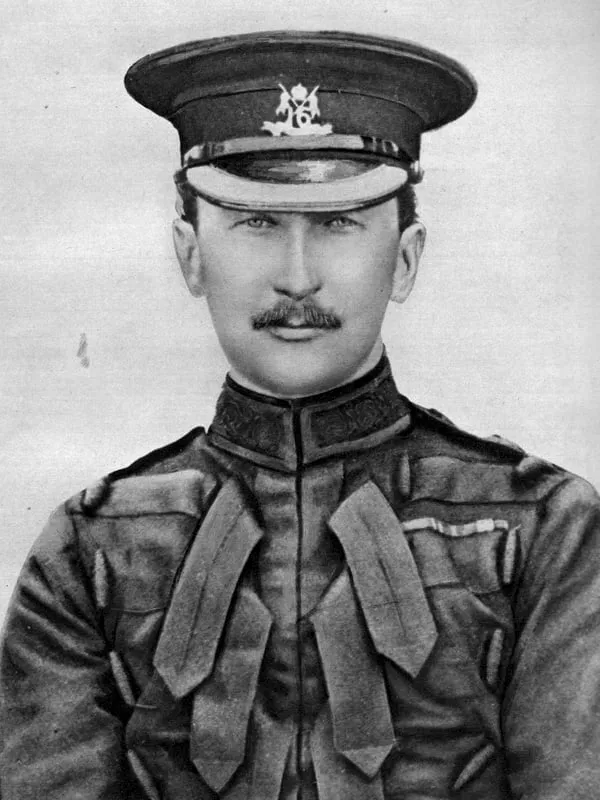
- Born:
- 12 August 1870, London
- Died:
- 18 March 1963, London
- Author:
- Łukasz Skowroń
- Photo:
- Official British military photographer, domena publiczna, Wikimedia Commons

Sir Hubert Gough rose faster during the war than anyone else in the British Army. In August 1914 he was a colonel with the temporary rank of brigadier-general commanding a cavalry brigade, and less than two years later, aged 45, he became a full general and an army commander, the youngest on the Western Front. His army, first called the Reserve Army and then the Fifth Army, fought on the Somme, at Bullecourt and in the Third Battle of Ypres, and in March 1918 took the main blow of the German Spring Offensive. After that defeat the government stripped him of his command. Gough spent the rest of his long life fighting for his good name and largely regained it. Historians still argue, however, whether in 1918 he was the victim of other men’s mistakes or paid belatedly for his own of 1916–1917.
Before the war
He was born on 12 August 1870 in London into an Anglo-Irish military family. His father, General Charles Gough, and his uncle Hugh were holders of the Victoria Cross, as was later Hubert’s younger brother, John. He spent his childhood at schools in England, far from his parents serving in India. After Eton College and Sandhurst he joined the 16th Lancers in 1889. He was a superb horseman and polo player, was promoted early and fought on the North-West Frontier of India.
In the Boer War he commanded a hastily formed regiment of colonial mounted volunteers and on 28 February 1900, against his superior’s orders, was the first to ride with his unit into besieged Ladysmith. A year and a half later, after poor reconnaissance, he fell into a Boer ambush at Blood River Poort and was taken prisoner, but escaped. In 1904–1906 he taught at the Staff College at Camberley, whose commandant was Henry Rawlinson; in 1907, as the youngest lieutenant-colonel in the army, he took command of the 16th Lancers, and in 1911 of the 3rd Cavalry Brigade at the Curragh camp in Ireland.
There, in March 1914, he found himself at the centre of the Curragh incident. As the government of Herbert Asquith prepared to introduce Irish home rule, and the command in Ireland considered using troops against the armed Ulster volunteers, Gough and most of his officers declared that they would rather resign than take part in such an operation. In London he demanded a written guarantee that the army would not be used to impose home rule on Ulster, and he got it. Asquith repudiated the pledge, and the Secretary of State for War, John Seely, and the Chief of the Imperial General Staff, John French, left the government and the staff. Gough returned to his brigade as a hero of the Unionists, but for the Liberals and some of the generals he remained the officer who had dictated terms to the government.
1914–1915: from brigade to corps
In August 1914 he led his brigade to France as part of the cavalry division of General Edmund Allenby. He fought at Mons and at Le Cateau, and during the retreat broke away from Allenby on his own initiative and attached himself to the corps of Douglas Haig, which soured relations between the two men for a long time. During the Battle of the Marne he already commanded a group of two brigades, which in mid-September was formed into the 2nd Cavalry Division. In the autumn his cavalrymen, often dismounted and few in number, held part of the front in Flanders at Messines and Wytschaete. In October he was promoted to major-general.
In February 1915 his brother John, Haig’s chief of staff, died of wounds, and Hubert to some extent took his place as the confidant of the First Army’s commander. In April he took over the 7th Division, which in May at Festubert was the only one of the attacking divisions to break into the German trenches on its sector. In July he became a temporary lieutenant-general and commander of I Corps. At Loos on 25 September his corps was to take the Hohenzollern Redoubt and the pits on the northern sector. Despite the uncertain wind, chlorine was released, and in places it blew back onto the British trenches; in the following days Gough repeatedly ordered renewed attacks without adequate artillery support. Later he was among the generals who, in conversations with Haldane and King George V, blamed French for the failure and helped Haig take over the command.
The Somme
In April 1916 Gough took over the Reserve Corps, renamed the Reserve Army in May. It was to exploit the breakthrough Haig was counting on: to lead cavalry and infantry into the gap and roll up the German front. On 1 July there was no breakthrough. That same evening Gough took over two shattered northern corps, and on 7 July he became a temporary full general. Over the following months his army attacked on the left wing of the Battle of the Somme.
At Pozières in July and August three Australian divisions, constantly pressed by Gough into further, often narrow and hastily prepared attacks, lost about 23,000 men. The Australians never forgave him. Gough also commanded in a way unusual for the British Army: instead of leaving decisions to his corps commanders, he interfered in the details of plans, took control of the artillery himself and sharply rebuked his subordinates.
In the autumn the Reserve Army took Thiepval and in rain and mud won the heights above the Ancre. At the end of October it was renamed the Fifth Army. On 13 November, despite doubts at Haig’s headquarters, Gough struck on the Ancre and took Beaumont-Hamel, an objective of the first day of the battle. This success, won on the eve of the Allied conference at Chantilly, strengthened his standing with Haig. In the winter and spring of 1917 the Fifth Army pressed the Germans on the Ancre and then followed them during the retreat to the Hindenburg Line. On 11 April Gough hastily threw the 4th Australian Division against the Hindenburg Line at Bullecourt, to advance behind tanks instead of behind an artillery barrage. The tanks failed, and the Australians lost more than 3,000 men. The second Battle of Bullecourt in May brought a small break-in at an enormous price and deepened the Australians’ distrust of Gough still further.
Third Battle of Ypres
At the end of April 1917 Haig entrusted Gough with the main offensive in Flanders. He chose him instead of Herbert Plumer, who had known the Ypres salient for two years, because he wanted a vigorous commander bent on a breakthrough and an advance to the Belgian coast. On 10 June, after Plumer’s victory at Messines, the Fifth Army took over the front north of the ridge. Gough enlarged the plan of Haig’s staff and ordered the infantry to go much deeper in the first attack than the artillery cover reached.
On 31 July nine divisions of the Fifth Army advanced on Pilckem Ridge. On the left wing they succeeded, but on the key Gheluvelt plateau they stalled, and the units that had gone furthest were shattered by German counter-attacks. The rains began that same day. Gough renewed his attacks in the mud, and on 16 August at Langemarck his army lost, according to Robin Prior and Trevor Wilson, about 15,000 men while gaining little. Confidence in him collapsed, and at the end of August Haig handed the main role to Plumer. In the subsequent attacks, from the Menin Road to Passchendaele, the Fifth Army merely covered the left flank of the Second Army. By the end of 1917 units were reluctant to join Gough’s army, and for many soldiers his name had become a byword for disregard of losses.
March 1918 and dismissal
In the winter the Fifth Army was moved south to the Somme, where it took over from the French the front as far as the Oise. In March 1918 twelve infantry divisions and three cavalry divisions held about 68 kilometres, many of them in weakly fortified positions. Gough asked for reinforcements and for labourers to build defences, but Haig, who was more worried about the Channel ports, kept his reserves in the north. As early as 5 March the Secretary of State for War, Lord Derby, wrote to Haig that Gough did not have the confidence of his troops, but Haig did not remove him.
On 21 March Operation Michael fell on the Fifth Army and the neighbouring Third Army of General Julian Byng. In thick fog the Germans went through the forward zone, and at St Quentin they broke Gough’s right wing. Gough decided to fight a retreating battle, and for a week his army, torn apart in several places, withdrew across the Somme towards Amiens, but it did not disintegrate. From the night of 24 March its units south of the Somme were under the French general Émile Fayolle, and on 26 March at Doullens coordination on the front was entrusted to Ferdinand Foch.
Meanwhile, stories of an army in panic were circulating in London. The Chief of the Imperial General Staff, Henry Wilson, with the consent of the government of David Lloyd George, held Gough to blame. On the evening of 27 March Gough learned that Rawlinson would replace him the next day, and on 28 March he handed over command to him. Haig wanted to keep him to build rear lines of defence, but the government ordered him home. On 9 April Lloyd George did not rule out a court martial in the House of Commons. The promised inquiry was never held.
After the war
From May 1919 Gough headed the Allied military mission to Finland and the Baltic states. He maintained good relations with the White general Nikolai Yudenich and with the leaders of Latvia and Estonia. In 1922 he retired as a general, and he stood unsuccessfully for Parliament as a Liberal in a by-election. He changed his mind on Ireland, supported home rule and turned down an offer to stand as a Unionist.
He fought for his reputation with his pen. In 1931 he published the book “The Fifth Army”, and in 1954 his memoirs “Soldiering On”. In the 1930s Lloyd George admitted to him in a letter that “no general could have won that battle”. In 1937 Gough received the Grand Cross of the Order of the Bath, which was seen as his rehabilitation. In 1940, at nearly 70, he raised a Home Guard unit from scratch in Chelsea, London. He died in London on 18 March 1963, aged 92.
Assessment
Opinions about Gough were extreme even in his lifetime. He was brave, quick-witted, charming in company and the only one of the senior commanders who regularly visited the front line. The British official historian James Edmonds compared him to George Patton and believed that in a war of manoeuvre he could have been a great commander, while his biographer Anthony Farrar-Hockley pointed out that on the Somme Gough’s army captured more difficult ground and took more prisoners than Rawlinson’s Fourth Army while losing fewer men.
Most modern historians, however, judge him severely. Robin Prior and Trevor Wilson write that after the Somme he should have disappeared into well-deserved obscurity, and they call his August attacks at Ypres disastrous. Gary Sheffield believes that Haig promoted and kept him beyond his abilities, and that Gough’s impetuosity and his urge to control everything may have stemmed from a need to prove that he deserved such rapid promotion. Many historians, Sheffield among them, also grant that in March 1918 he commanded sensibly and that he was dismissed for the only great battle in which his army did better than circumstances demanded. His long life and his fight for rehabilitation meant that in the second half of the 20th century he was treated more leniently than Haig, and criticism of his command in 1916–1917 returned only in the work of historians of recent decades.
Sources
Spotted a mistake?Report an error
Commanded in battles
(25)- 12 October – 2 November 1914Battle of Messines (1914)Western Front
- 25 September – 8 October 1915Battle of LoosWestern Front
- 1 July – 18 November 1916Battle of the SommeWestern Front
- 1–13 July 1916Battle of Albert (1916)Western Front
- 23 July – 3 September 1916Battle of Pozières RidgeWestern Front
- 15–22 September 1916Battle of Flers–CourceletteWestern Front
- 26–28 September 1916Battle of Thiepval RidgeWestern Front
- 1 October – 11 November 1916Battle of the Ancre HeightsWestern Front
- 13–18 November 1916Battle of the AncreWestern Front
- 22 February – 5 April 1917German retreat to the Hindenburg LineWestern Front
- 9 April – 16 May 1917Battle of Arras (1917)Western Front
- 3–17 May 1917Battle of BullecourtWestern Front
- 31 July – 2 August 1917Battle of Pilckem RidgeWestern Front
- 31 July – 10 November 1917Third Battle of YpresWestern Front
- 16–18 August 1917Battle of Langemarck (1917)Western Front
- 20–25 September 1917Battle of the Menin Road RidgeWestern Front
- 26 September – 3 October 1917Battle of Polygon WoodWestern Front
- 4 October 1917Battle of BroodseindeWestern Front
- 9 October 1917Battle of PoelcappelleWestern Front
- 12 October 1917First Battle of PasschendaeleWestern Front
- 26 October – 10 November 1917Second Battle of PasschendaeleWestern Front
- 21–23 March 1918Battle of St QuentinWestern Front
- 21 March – 5 April 1918Operation MichaelWestern Front
- 24–25 March 1918First Battle of BapaumeWestern Front
- 26–27 March 1918Battle of RosièresWestern Front
Mentioned in battles
(04)Often appears with
People who appear in the same events.
On the timeline
(33)1915
1916
July
September
October
November
- 18
- Key eventEnd of the Battle of the SommeOn 18 November 1916, in the first snowstorm of winter, the British attacked on the Ancre for the last time. After four and a half months the Somme was over.
- End of the Battle of the AncreOn 18 November 1916, in the first snowstorm, Canadians and British attacked Desire Trench and Grandcourt on the Ancre. At Serre the attack failed again.
1917
January
February
April
May
- 03
- Key eventThird Battle of the Scarpe beginsAt 3.45 a.m. on 3 May 1917, still in darkness, three British armies struck again at Arras. They failed almost everywhere. Only the Canadians succeeded.
- Key eventBattle of Bullecourt beginsOn 3 May 1917 the Australians broke into the Hindenburg Line east of Bullecourt. The 6th Brigade held the breach, but the British 62nd Division's attack failed.