Key event
Start of the Battle of the Menin Road Ridge
- Category:
- Military operations
- Front:
- Western Front
- Date:
- 20 September 1917
- Author:
- Natalia
- Battle:
- Battle of the Menin Road Ridge
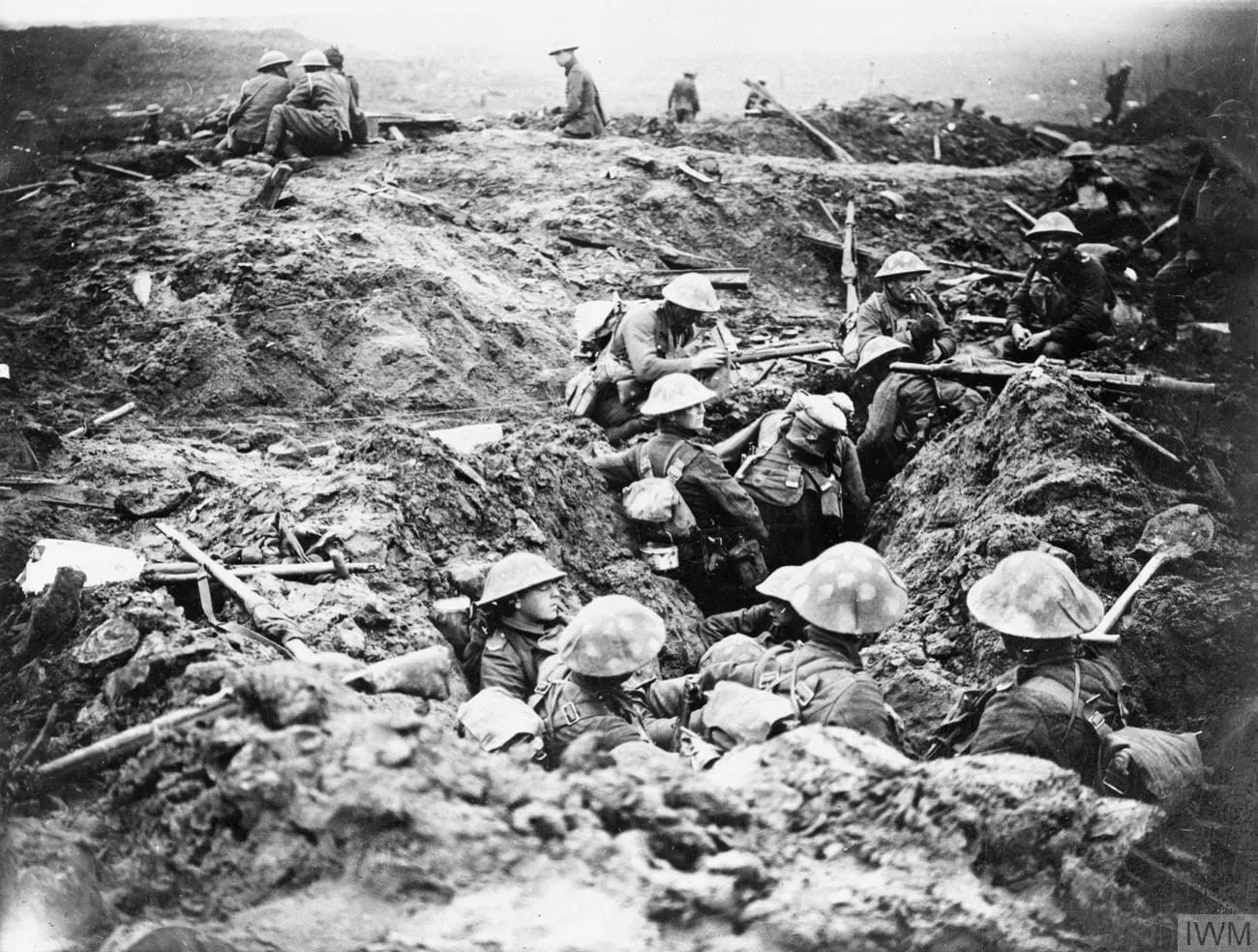
At 5.40 a.m. on 20 September 1917, as the eastern sky was only just turning pink, the artillery of the British Second and Fifth Armies opened fire on a front about 13 kilometres long, from the Ypres–Comines canal to the railway to Staden. Eleven divisions, two of them Australian, advanced east of Ypres in the third great attack of the Third Battle of Ypres. For the first time it was directed by General Herbert Plumer, who had spent three weeks massing guns and ammunition and had set the infantry modest, shallow objectives. By evening it was clear that the method had worked. On the Gheluvelt plateau, by the road from Ypres to Menin, the Australians took Glencorse Wood and Nonne Bosschen and dug in on the edge of Polygon Wood, and the German reserves that tried to push them out were drowned in artillery fire.
The night before the attack
On the evening of 19 September rain began to fall, threatening to turn the dried-out battlefield back into a swamp. The commander of the Fifth Army, General Hubert Gough, wanted to call off the attack, but Plumer, after consulting his corps and divisional commanders and being assured by the meteorologists that the rain would soon stop, kept to the date. Zero hour was given to the units only during the night. The rain did indeed stop at about midnight, though the sky remained overcast.
The battalions of the Australian I ANZAC Corps marched all night along the Menin road, on tracks marked with tape, through shattered woods and the ruins of the village of Hooge, of which only a cluster of craters remained. The Germans shelled the road with gas, and some of the columns lost their way, but the mistakes were quickly put right. The jumping-off tapes were laid in places only 150 metres from the German outposts, and the men formed up on them in complete silence, in the light of German flares. At about three o’clock the Germans brought to a brigade headquarters an officer of an Australian machine-gun company who had lost his way in no man’s land and run into a German patrol. The remains of the attack order were found on the prisoner. The Germans alerted their artillery and reserve divisions, but did not know at what hour the blow would fall.
At about 4.30 a.m. the German shelling thickened over Glencorse Wood and fell on the battalions of the 3rd Brigade, which were still coming up through Château Wood. The 9th Battalion from Queensland lost all its company commanders and half its junior officers, and the machine-gun company half its men. Twenty-five minutes before the attack the Germans struck with a flamethrower at an advanced post by Cryer Farm. The defenders beat off the attack, and a lieutenant of the 6th Battalion bombed a machine gun that the Germans had set up right next to it. At 5.36 a.m. German alarm flares went up over the centre of the front and the German field guns began to pound the 5th Australian Brigade. A captain of the 20th Battalion then jumped out of the ditch, blew his whistle and led the line forward, away from the explosions, three minutes early.
The first hours
At 5.40 a.m. the British artillery and machine guns struck all at once, like a great orchestra. The belt of fire, several hundred metres deep, stood for three minutes in front of the tapes and then moved forward 90 metres every four minutes, and further on every six. The men, as the Australian historian Charles Bean recorded, stood up and almost every one of them lit a long-awaited cigarette. They advanced in small columns, each of an NCO and seven or eight men, behind a line of skirmishers keeping close to the bursts. The mist after the night’s rain and the dust from the shells hid them from the German riflemen.
The Germans of the Prussian 121st Division and the Bavarian Ersatz Division had expected a bombardment lasting several hours and were taken by surprise when the infantry appeared right behind the first shells. In many concrete shelters the Australians found stunned defenders, who came out with their hands up, waving bandages. Where anyone resisted, the shelter was worked round from the rear. In Glencorse Wood Lieutenant Frederick Birks of the 6th Battalion rushed a machine gun together with a corporal, and when the corporal fell wounded, he reached the back of the shelter alone and forced the crew to surrender. By a sunken road on the northern edge of the wood the Germans set up a machine gun on the roof of a shelter and stopped the 11th Battalion from Western Australia. The lieutenant leading a platoon that tried to outflank the nest was killed, and his men, as the commander of a neighbouring battalion wrote, “went mad”. A fierce fight with bombs and revolvers broke out at the shelter, from which only a few dozen prisoners emerged. Bean made no secret that in these fights for the shelters men who were surrendering were sometimes killed.
The swamp in the Nonne Bosschen wood, where in November 1914 the British had stopped the Prussian Guard, proved passable: the men walked along the rims of flooded shell holes. To the north the 2nd Australian Division crossed a hundred-metre bog on the Hanebeek stream, and the first groups of Germans in the shell holes surrendered without a shot. Between 5.57 and 6.09 a.m. the whole line of attack stood on the first objective, as the timetable had foreseen. FitzClarence Farm, Glencorse Wood and Nonne Bosschen, scenes of terrible fighting in August, were taken in less than half an hour.
To Polygon Wood
At 7.08 a.m. fresh battalions passed through the line and set off for the second objective. This bound went even more easily. The 12th Battalion reached the edge of Polygon Wood, of which only chest-high stumps of young trees were left, and took nine machine guns from which the Germans had not managed to fire a single shot. On the Anzac spur the 18th Battalion captured a two-storey concrete artillery observation post, called “Anzac” by the British, and planted a small Australian flag on it. Between 7.30 and 7.45 a.m. the Australians occupied the main German line of defence along their whole front.
Then came a two-hour pause. It was not quiet everywhere. At Black Watch Corner on the edge of the wood, when the garrison of a strong shelter signalled its surrender, one of them shot a captain of the 5th Battalion who was running up, and the enraged Victorians killed several Germans before their officers stopped them. Elsewhere the men ate sandwiches and smoked captured German cigars, and the commander of the 10th Battalion, the eccentric Englishman Maurice Wilder-Neligan, had specially obtained copies of the Daily Mail and the Daily Mirror handed out. A messenger dog ran up to the “Anzac” post with an order from a German regimental commander in a metal tube: “Retake the crater zone”. A similar counter-attack by two companies of a neighbouring regiment had earlier broken against the Scots to the north.
At 9.53 a.m. the barrage moved off for the last few hundred metres, and by 10.15 the Australians were already digging trenches on the green line. Some shells of their own artillery were falling short, so in the centre the barrage had to be lifted 200 metres before the infantry could complete the bound. At 11.25 a.m. a contact pilot dropped at 1st Division headquarters a map marked with the flares that the units had lit along the whole objective line. One intelligence officer reported to his brigadier that everything was très bon and that there were enough men on the new line to stop all the German divisions on the front.
Along the whole front
On the Australians’ right the British 23rd Division forced its way through Inverness Copse, though German soldiers who emerged from hiding after the first wave had passed inflicted heavy losses on it, and took the bunkers by the Menin road at Veldhoek. On the southern flank the 19th and 39th Divisions reached their objectives. The 41st Division fared worst: it got stuck in the valley of the Bassevillebeek stream and did not take the Tower Hamlets spur. In the Fifth Army the 9th (Scottish) Division and a brigade from the Union of South Africa took Hanebeek Wood, Borry Farm and the Bremen Redoubt in the valley below Zonnebeke. The Londoners of the 58th Division outflanked the fortified farms on the Gravenstafel spur and took almost 300 prisoners and 50 machine guns. The weakened 55th Division and the 20th Division on the northern flank were held up short of some of their objectives.
Counter-attacks
The German defence in Flanders relied on counter-attack divisions, which were to strike the attackers once they had advanced far and become dispersed. That day they had been standing ready since morning: the 16th Bavarian at Gheluwe, the 236th at Moorslede and the 234th at Oostnieuwkerke. The mist, however, lifted at about eight o’clock, and at noon the British and Australians had the sun behind them and could see the whole plateau. The airmen of the Royal Flying Corps sent 394 wireless reports that day, and roughly one in three immediately brought down artillery fire. The German columns had to deploy for the attack far from their objective and spent many hours struggling from shell hole to shell hole under constant fire.
After 3 p.m. observers saw a column of infantry with batteries coming down from Zonnebeke and Broodseinde, and troops assembling in the valley of the Reutelbeek stream. The artillery smothered them with fire before they came within rifle range. At about 6 p.m., and again after 7 p.m., when German movement was spotted once more, bombardments lasting forty minutes and an hour came down at the signal of three coloured flares. One officer of the 8th Battalion recalled that his men sat and laughed, knowing that the Germans would not get through such fire. According to German accounts, the soldiers of the 236th Division could not even find their way across the field of shell holes, and German commanders took the British shelling for the herald of another attack. Only in the north did a counter-attack from the Poelkapelle spur push back the flank of the 51st Division a little, and a regiment of the 236th Division that attacked from Gravenstafel towards Hill 37 was stopped by flanking fire. By nightfall all the counter-attacks had been repulsed.
The day’s results
The night was unusually quiet. Australian patrols ventured deep into Polygon Wood, and stray soldiers of the 16th Bavarian Division stumbling into the Australian trenches were the first news for the staffs that the German counter-attack division had entered the fight at all. Over the whole day the Australians advanced about one and a half kilometres, and the whole line of attack on average over a kilometre. The British took over 3,000 prisoners. The two Australian divisions lost over 5,000 men in the whole battle, largely from shelling before the attack and in the following days. The photographer Hubert Wilkins, who photographed the barrage from behind a wireless tank in the former no man’s land near Glencorse Wood, lost some of his negatives when a German shell hit the machine and killed several of its crew.
After the August defeats at Ypres the news that the British line once again ran across the ridge and through Polygon Wood brought enormous relief to the army. The Germans, who as late as mid-September had believed that the fighting in Flanders was over, lost within a few hours ground they had been defending since 31 July. Plumer at once began preparing the next step. According to his plan, the next attack was to follow after about six days, as soon as the artillery could move forward.
Remember the articles you have read? Only in this browser; nothing is sent anywhere.How it works
Read ·
Spotted a mistake?Report an error
Meanwhile
(03)Elsewhere in the same days.
- 21 September 1917 · DiplomacyThe Bernstorff affairOn 21 September 1917 Lansing released a cable in which Ambassador Bernstorff asked Berlin for $50,000 to influence Congress. Washington was in uproar.
- 21 September 1917 · DiplomacyCosta Rica breaks off relations with GermanyOn 21 September 1917 Federico Tinoco's government, not recognised by Washington, broke off relations with Germany, hoping to win over Wilson.
- 22 September 1917 · Eastern FrontGermans capture JakobstadtOn 21–22 September 1917 the Germans stormed the Russian bridgehead at Jakobstadt (Jēkabpils) on the Dvina. Some 4,000–5,000 Russians were taken prisoner.
Related events
(04)The same battle, people or subject.
- 25 September 1917 · Western FrontEnd of the Battle of the Menin Road RidgeOn 25 September 1917 the Germans attacked at Ypres south of Polygon Wood and pushed back the 33rd Division. Plumer still kept the attack set for the morning.
- 9 October 1917 · Western FrontBattle of PoelcappelleOn 9 October 1917, after a night march through mud, the British attacked at Ypres towards Passchendaele and were repulsed. Guards and French reached Houthulst.
- 4 October 1917 · Western FrontBattle of BroodseindeOn 4 October 1917 the Anzacs took the Broodseinde ridge near Ypres, colliding in no man's land with attacking Germans. They took thousands of prisoners.
- 14 June 1917 · Western FrontBattle of Messines (1917) endsOn 14 June 1917 the British 2nd Army closed up to the German Warneton Line, ending the Battle of Messines. Gough took over the main offensive from Ypres.